Europe Asphalt Additives Market Size
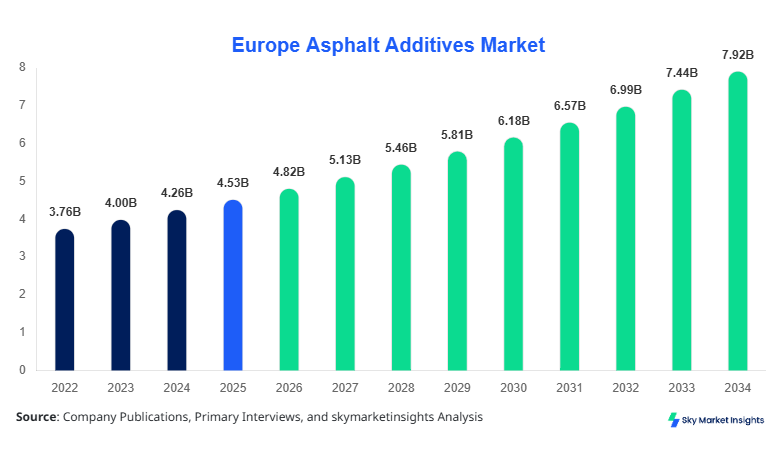
Europe Asphalt Additives market size is projected at USD 4.82 billion in 2026 and is expected to hit USD 7.94 billion by 2034 with a CAGR of 6.4%. The market recorded an estimated valuation of USD 4.51 billion in 2025, while total consumption volume exceeded 3.8 million metric tons across Europe. Increasing highway rehabilitation activities, rising investments in durable pavement materials, and growing use of polymer-modified asphalt are supporting expansion across the region. The report evaluates detailed segmentation, technological developments, production capacity, and competitive positioning among regional manufacturers and suppliers.
The market assessment further analyzes pricing trends, production output, import-export patterns, and application penetration across road construction, roofing systems, and airport infrastructure. Demand acceleration from sustainable transportation infrastructure and long-life pavement engineering continues to reshape the competitive landscape in the Europe Asphalt Additives Market.
The asphalt additives industry comprises specialty chemical compounds incorporated into asphalt mixtures to enhance adhesion, viscosity, elasticity, temperature resistance, and pavement longevity. Europe produced more than 289 million tons of asphalt mixtures in 2025, with the United Kingdom, Germany, and France collectively accounting for over 58% of total regional production. Polymeric modifiers contributed approximately 41% of additive utilization due to superior rutting resistance and fatigue performance, while anti-strip additives represented nearly 26% of market consumption. Asphalt pavement recycling penetration reached 34% in Western Europe during 2025, significantly increasing the requirement for rejuvenators and warm mix additives.
Adoption and penetration rates continue to increase across infrastructure modernization programs. More than 72% of newly developed highway projects in Europe integrated advanced asphalt additives during 2025 compared with 61% in 2022. Smart paving technologies with viscosity-controlled additives improved pavement life by 18% to 24%, while low-temperature asphalt solutions reduced carbon emissions by nearly 27%. Consumer demand analytics indicate that government agencies and infrastructure contractors prioritize lifecycle cost reduction, with nearly 63% of procurement contracts favoring modified asphalt formulations over traditional mixtures. Road construction applications accounted for approximately 68% of total additive usage, followed by roofing applications at 21% and airport infrastructure at 11%. The Europe Asphalt Additives Market continues to experience strong industrial integration supported by sustainability mandates and transportation investment expansion.
Explore more data points, trends and opportunities Download Free Sample Report
Asphalt Additives Market Trends
The integration of sustainable paving technologies represents one of the most influential developments in the asphalt additives industry. Europe recycled approximately 98 million tons of reclaimed asphalt pavement in 2025, with nearly 46% processed using rejuvenating additives and warm mix technologies. Demand for bio-based asphalt additives increased by 29% year-over-year as governments implemented carbon reduction targets for road infrastructure. Germany and France collectively deployed more than 21 million tons of warm mix asphalt in 2025, reducing fuel consumption during production by approximately 20% to 25%. High-performance polymer additives improved fatigue resistance by nearly 35%, extending road lifecycle performance beyond 18 years in heavy traffic zones. These developments continue influencing procurement strategies and operational efficiency within the Asphalt Additives Market.
Technological shifts toward nano-modified asphalt additives are reshaping material performance standards across Europe. Nanomaterial-enhanced asphalt formulations achieved approximately 28% higher resistance to cracking and thermal deformation compared with conventional mixtures. More than 42% of European infrastructure authorities introduced specification requirements for advanced polymer-modified binders in 2025. Digitalized batching systems integrated with additive dispensing technologies improved mixing precision by 19%, reducing operational waste and enhancing pavement consistency. Roofing applications increasingly adopted UV-resistant asphalt additives, with penetration rates surpassing 33% in Southern Europe due to extreme climatic conditions. Rising adoption of smart infrastructure materials continues supporting long-term expansion in the Asphalt Additives Market.
The airport infrastructure sector is witnessing increasing demand for high-durability asphalt additives capable of supporting elevated aircraft loads and thermal stress. Europe upgraded over 74 airport runways between 2023 and 2025 using elastomeric modifiers and anti-rutting additives. Polymer-based formulations improved skid resistance by approximately 26% and reduced maintenance frequency by nearly 18%. Russia and Spain together invested more than USD 2.8 billion in airport modernization projects utilizing advanced asphalt compounds. Additive manufacturers are also developing low-emission formulations capable of reducing production temperatures by 30°C to 40°C. Such technological advancements continue strengthening the Asphalt Additives Market across transportation infrastructure applications.
Europe Asphalt Additives Drivers
Expansion of Highway Rehabilitation and Sustainable Infrastructure Programs
European governments allocated more than USD 148 billion toward transportation infrastructure modernization between 2024 and 2026, significantly driving asphalt additive consumption. More than 67% of road rehabilitation projects implemented polymer-modified asphalt to enhance pavement durability and reduce lifecycle maintenance costs. The European Union’s green mobility initiatives encouraged the adoption of warm mix additives capable of lowering greenhouse gas emissions by approximately 22%. Germany alone resurfaced over 5,600 kilometers of highways in 2025, consuming nearly 420,000 metric tons of specialty asphalt additives. In France, road maintenance expenditure increased by 18% year-over-year, while Italy expanded municipal road rehabilitation budgets by approximately USD 1.6 billion. Contractors increasingly prefer advanced additives due to performance enhancements such as 30% higher rut resistance and 24% longer pavement life. Rising investments in durable transportation corridors and smart infrastructure systems continue accelerating Europe Asphalt Additives Market Growth.
Europe Asphalt Additives Restraints
Volatility in Crude Oil-derived Raw Material Pricing
The asphalt additives sector remains heavily exposed to fluctuations in petroleum-based feedstock pricing, creating substantial operational challenges for manufacturers and contractors. Bitumen prices across Europe increased by nearly 19% during periods of crude oil instability in 2025, directly affecting additive production costs. Polymeric modifiers derived from styrene-butadiene-styrene and ethylene-vinyl acetate witnessed raw material cost increases ranging between 14% and 23%. Smaller manufacturers operating with limited procurement capabilities experienced margin pressures exceeding 11%. In Eastern Europe, logistics and transportation expenses associated with specialty additives rose by approximately 17% because of fuel price inflation and supply chain disruptions. Infrastructure contractors frequently delay procurement decisions when additive prices fluctuate beyond 8% within quarterly contracts. Furthermore, dependence on imported specialty chemicals from Asia contributes to extended lead times and inventory management concerns. These economic pressures continue restricting adoption rates in price-sensitive public infrastructure projects and create limitations for Europe Asphalt Additives Market Growth.
Europe Asphalt Additives Opportunities
Increasing Penetration of Recycled Asphalt and Bio-based Additives
The rapid expansion of recycled asphalt pavement technologies presents significant opportunities for additive manufacturers throughout Europe. Approximately 34% of asphalt pavement materials used in 2025 incorporated recycled aggregates, while government sustainability mandates target penetration beyond 50% by 2030. Bio-based rejuvenators and organic warm mix additives demonstrated emission reductions of nearly 28% while improving asphalt workability by 21%. The United Kingdom and Germany collectively invested more than USD 3.2 billion into circular infrastructure initiatives emphasizing recycled pavement technologies. Contractors increasingly utilize additives capable of restoring aged asphalt binder elasticity and viscosity, extending recycled pavement service life by 15% to 20%. Research institutions across Europe also accelerated development of lignin-based and vegetable-oil-derived asphalt modifiers with improved environmental compatibility. The growing preference for eco-efficient pavement engineering solutions continues generating substantial expansion potential for the Europe Asphalt Additives Market.
Europe Asphalt Additives Challenge
Regulatory Compliance and Technical Standardization Across Countries
One of the primary challenges impacting the industry involves varying regulatory standards and technical requirements across European countries. More than 14 distinct national pavement performance frameworks govern additive utilization across Europe, complicating product certification and cross-border commercialization. Manufacturers frequently spend 8% to 12% of annual operating budgets on compliance testing, environmental validation, and quality certifications. In France and Germany, low-emission additive formulations must comply with strict VOC reduction thresholds below 50 mg/m³, while Russia maintains separate thermal stability standards for extreme climatic conditions. Technical inconsistencies delay infrastructure project approvals and increase product development timelines by nearly 16%. Additionally, performance verification for recycled asphalt additives requires extensive field testing spanning 12 to 24 months. These operational complexities continue creating commercialization barriers and cost pressures within the Europe Asphalt Additives Market.
Report Scope
| Report Metric | Details |
|---|---|
| Market Size in 2025 | USD 4.53 Billion |
| Market Size in 2026 | USD 4.82 Billion |
| Market Size in 2034 | USD 7.94 Billion |
| CAGR | 6.4% (2026-2034) |
| Base Year for Estimation | 2025 |
| Historical Data | 2022-2024 |
| Forecast Period | 2026-2034 |
| Report Coverage | Revenue Forecast, Competitive Landscape, Supply Chain Disruption, Growth Factors, Environment & Regulatory Landscape and Trends |
Explore more data points, trends and opportunities Download Free Sample Report
Asphalt Additives Market Segmentation
The market is segmented by type and application, with polymeric modifiers dominating approximately 41% of total demand due to superior elasticity and durability characteristics. Road construction remains the leading application segment with nearly 68% consumption share, supported by government-funded transportation infrastructure programs and increasing pavement rehabilitation requirements.
BY TYPE
Polymeric modifiers represent the largest segment within the industry, accounting for nearly 41% of total additive consumption in 2025. Production volumes exceeded 1.56 million metric tons across Europe, supported by strong demand for enhanced pavement flexibility and rutting resistance. Styrene-butadiene-styrene and crumb rubber modifiers significantly improved fatigue resistance by approximately 33% while extending pavement lifecycle beyond 15 years in high-traffic environments. Germany and the United Kingdom collectively contributed over 48% of polymer-modified asphalt production. These additives demonstrated thermal stability across temperature ranges from -25°C to 70°C, making them highly suitable for variable climatic conditions. Highway modernization programs increasingly require polymer-enhanced binders capable of reducing cracking frequency by nearly 26%. The segment continues to strengthen operational efficiency and infrastructure durability within the Asphalt Additives Market.
Anti-strip additives accounted for approximately 26% of regional demand during 2025, with consumption surpassing 980,000 metric tons. These additives improve adhesion between bitumen and aggregates, reducing moisture damage and stripping failures by nearly 31%. France and Spain recorded the highest utilization rates because of humid environmental conditions and coastal infrastructure development. Amine-based anti-strip compounds improved pavement lifespan by 18% while reducing maintenance expenditure by approximately 14%. Technical specifications indicate optimal additive concentrations ranging from 0.3% to 0.7% of binder weight. Road agencies increasingly mandate anti-strip technologies for bridge decks and high-rainfall transportation corridors. Growing emphasis on pavement longevity and structural integrity continues expanding utilization within the Asphalt Additives Market.
Emulsifiers represented nearly 18% of total additive demand, supported by increasing use of cold mix and emulsion-based asphalt technologies. Production volumes reached approximately 670,000 metric tons across Europe in 2025. These additives enable efficient dispersion of bitumen in water systems, reducing energy consumption during pavement applications by nearly 24%. Municipal road maintenance programs across Italy and Russia extensively utilized cationic emulsifiers due to their rapid curing characteristics and superior aggregate coating efficiency. Emulsion-based asphalt systems lowered construction emissions by approximately 19% and reduced production temperatures by 30°C to 45°C. Increasing sustainability requirements and low-temperature paving initiatives continue stimulating growth across the Asphalt Additives Market.
BY APPLICATION
Road construction remained the dominant application segment, accounting for nearly 68% of total additive consumption in Europe during 2025. More than 195 million tons of asphalt mixtures used for highways and urban roads incorporated advanced additives for enhanced durability and weather resistance. Polymeric modifiers improved load-bearing capacity by nearly 29%, while anti-strip additives reduced moisture damage by approximately 31%. Germany, the United Kingdom, and France collectively represented over 61% of road construction additive demand because of large-scale infrastructure rehabilitation programs. Warm mix asphalt penetration exceeded 36% in road construction projects, reducing production energy consumption by approximately 20%. Advanced additive systems also improved skid resistance and reduced maintenance cycles from every 8 years to nearly 12 years. Continuous transportation modernization initiatives are supporting expansion within the Asphalt Additives Market.
Roofing applications accounted for approximately 21% of market demand in 2025, supported by increasing commercial and residential construction activities across Europe. Roofing membranes incorporating UV-resistant asphalt additives improved thermal stability by nearly 27% and extended material lifespan beyond 20 years. Southern European countries such as Spain and Italy demonstrated high adoption rates because of extreme summer temperatures exceeding 40°C. Production of modified roofing asphalt exceeded 54 million square meters annually across Europe. Oxidation-resistant additives reduced roof deterioration rates by approximately 18%, while waterproofing performance improved by nearly 23%. Sustainable building standards encouraged manufacturers to incorporate low-emission additives and recycled asphalt compounds into roofing products. Growing demand for energy-efficient building materials continues contributing to the Asphalt Additives Market.
Airport infrastructure represented nearly 11% of total additive utilization, with Europe investing more than USD 6.4 billion into runway modernization and airport expansion projects between 2024 and 2026. Heavy-duty polymer additives improved runway deformation resistance by approximately 34% and increased fatigue life under high aircraft loads. Russia and the United Kingdom upgraded more than 38 major airport runways using elastomeric asphalt technologies during 2025. Specialty additives enhanced skid resistance by nearly 26% and reduced runway maintenance downtime by approximately 17%. Technical standards for airport pavements require temperature resistance exceeding 75°C and superior fuel spill durability, supporting adoption of advanced additive formulations. Increasing aviation traffic and airport infrastructure development continue generating strong opportunities within the Asphalt Additives Market.
Europe Asphalt Additives Market Segmentations
Type
- Polymeric Modifiers
- Anti-strip Additives
- Emulsifiers
Application
- Road Construction
- Roofing
- Airport Infrastructure
Europe Asphalt Additives Regional Outlook
United Kingdom
The United Kingdom represented approximately 24% of regional market revenue in 2025, supported by extensive transportation infrastructure investments and advanced pavement engineering practices. The country produced more than 52 million tons of asphalt mixtures annually, with nearly 64% integrating polymer-modified additives. Government expenditure on highway modernization exceeded USD 12 billion, while municipal road resurfacing programs covered more than 8,400 kilometers during 2025. Warm mix asphalt penetration reached approximately 37%, significantly reducing production emissions and fuel consumption. Roofing applications accounted for nearly 18% of national additive demand, driven by commercial construction expansion and energy-efficient building standards.
The presence of major additive manufacturers and research institutes accelerated technology innovation across the United Kingdom. Digital pavement monitoring systems integrated with advanced asphalt formulations improved maintenance efficiency by nearly 21%. Airport infrastructure modernization projects across Heathrow, Manchester, and Birmingham consumed over 74,000 metric tons of specialty asphalt additives during 2025. Sustainability mandates encouraging recycled asphalt utilization also contributed to strong demand expansion throughout the country.
Germany
Germany accounted for nearly 21% of total regional consumption and maintained one of the largest asphalt production capacities in Europe. The country produced more than 58 million tons of asphalt mixtures during 2025, supported by federal road rehabilitation programs valued above USD 14 billion. Polymer-modified asphalt adoption exceeded 66% across autobahn resurfacing projects due to requirements for enhanced fatigue resistance and long-term durability. Recycled asphalt pavement utilization surpassed 38%, creating substantial demand for rejuvenating additives and warm mix technologies.
Germany’s industrial base includes more than 95 specialty asphalt additive manufacturers and chemical suppliers. Infrastructure agencies increasingly implemented nano-modified asphalt formulations capable of improving crack resistance by approximately 28%. Roofing applications contributed nearly 19% of domestic additive demand, while airport modernization programs in Frankfurt and Munich expanded elastomeric additive utilization. Continuous investments in sustainable transportation systems continue strengthening regional market development.
France
France contributed approximately 17% of Europe’s asphalt additive consumption during 2025, supported by road modernization initiatives and environmental sustainability policies. The country consumed nearly 640,000 metric tons of asphalt additives, with road construction accounting for approximately 69% of utilization. Warm mix asphalt technologies penetrated nearly 41% of public infrastructure contracts, reducing carbon emissions by approximately 24%. France resurfaced over 4,200 kilometers of highways during 2025, driving significant demand for polymeric and anti-strip additives.
The roofing sector demonstrated strong additive utilization because of increasing urban redevelopment projects and energy-efficient construction requirements. UV-resistant asphalt membranes improved durability by approximately 22% in high-temperature regions across Southern France. Government regulations emphasizing low-VOC formulations encouraged adoption of bio-based asphalt additives, which expanded by nearly 18% year-over-year. Infrastructure sustainability strategies continue supporting expansion across the French market.
Spain
Spain represented approximately 12% of regional market demand, supported by transportation infrastructure investments and tourism-related urban development. Asphalt additive consumption exceeded 430,000 metric tons in 2025, with road rehabilitation projects accounting for approximately 65% of utilization. High-temperature climatic conditions increased adoption of polymer-modified asphalt capable of resisting thermal cracking and rutting. Airport infrastructure modernization projects in Madrid and Barcelona significantly increased demand for high-performance runway additives.
Roofing applications accounted for nearly 24% of additive demand because of extensive commercial and residential construction activities. Oxidation-resistant asphalt additives improved roofing lifespan by approximately 19% while reducing maintenance requirements. Sustainable paving initiatives also accelerated warm mix asphalt deployment, reducing fuel usage during production by nearly 20%. Continuous urban expansion and infrastructure investments are supporting long-term market development in Spain.
Italy
Italy accounted for nearly 11% of regional asphalt additive demand during 2025, driven by municipal road maintenance programs and building renovation activities. National asphalt production exceeded 36 million tons, while additive consumption reached approximately 390,000 metric tons. Road construction represented nearly 67% of total utilization, supported by infrastructure funding exceeding USD 5.6 billion. Emulsion-based asphalt technologies gained traction because of their lower production temperatures and reduced environmental impact.
Italy’s roofing industry also contributed significantly to additive consumption, particularly for waterproofing systems and energy-efficient construction materials. Polymer-enhanced roofing membranes improved UV resistance by approximately 25% and extended lifecycle performance beyond 18 years. The country increasingly adopted recycled asphalt pavement technologies, with penetration rates approaching 31% in municipal projects. Government sustainability initiatives continue driving demand for advanced additive formulations.
Russia
Russia represented approximately 9% of Europe’s regional market consumption in 2025, supported by extensive highway expansion and airport infrastructure development. The country consumed more than 320,000 metric tons of asphalt additives, with polymer modifiers accounting for nearly 44% of utilization. Extreme climatic conditions increased demand for thermal-resistant additives capable of operating efficiently between -35°C and 65°C. Federal road development projects covered over 3,800 kilometers during 2025, significantly supporting additive demand.
Airport modernization investments exceeded USD 1.4 billion across Moscow and Saint Petersburg, increasing demand for high-load runway asphalt systems. Emulsifier adoption also increased because of cost-efficient road maintenance applications in remote regions. Russia’s infrastructure modernization strategies and industrial production expansion continue contributing to regional Asphalt Additives Market development.
Top players in Europe Asphalt Additives
- Arkema Group
- BASF SE
- Evonik Industries AG
- Honeywell International Inc.
- Ingevity Corporation
- Kraton Corporation
- Sika AG
- Dow Inc.
- ArrMaz
- Kao Corporation
- Akzo Nobel N.V.
- Nouryon
- Iterchimica S.p.A.
- Sasol Limited
- Colas Group
Arkema Group
-
Arkema Group accounted for approximately 11% of the Europe regional market revenue in 2025 through its advanced polymer-modified asphalt technologies and sustainable additive portfolio.
-
The company operates multiple production facilities across France, Germany, and the United Kingdom with combined specialty additive capacity exceeding 420,000 metric tons annually.
-
Arkema invested nearly USD 240 million into low-emission asphalt additive technologies between 2023 and 2025, improving production efficiency by approximately 18%.
-
Its product portfolio focuses on warm mix asphalt solutions, UV-resistant roofing additives, and high-performance elastomeric modifiers supporting transportation infrastructure projects across Europe.
BASF SE
-
BASF SE held approximately 9% regional market share during 2025 and maintained strong positioning in polymeric modifiers and anti-strip additive technologies.
-
The company’s asphalt additive production exceeded 360,000 metric tons annually across European facilities, supporting highway, airport, and industrial roofing applications.
-
BASF developed nano-enhanced asphalt formulations capable of improving pavement crack resistance by nearly 28% and reducing lifecycle maintenance costs by approximately 16%.
-
Strategic collaborations with infrastructure contractors and government agencies strengthened BASF’s penetration across sustainable road construction initiatives throughout Europe.
Investment Analysis
Investments in asphalt additive technologies increased significantly across Europe as governments expanded infrastructure modernization budgets and sustainability programs. Approximately 58% of total investments during 2025 targeted road construction applications, while roofing and airport infrastructure represented 24% and 18%, respectively. Germany, the United Kingdom, and France collectively accounted for nearly 63% of total regional capital allocation toward advanced pavement technologies. Public-private partnerships exceeded USD 19 billion across transportation rehabilitation projects utilizing polymer-modified asphalt systems and warm mix technologies.
Private sector investments in sustainable additives and recycled asphalt technologies also accelerated. More than 31% of research funding allocated by additive manufacturers focused on bio-based formulations and low-temperature paving systems. Merger and acquisition activity increased across the specialty chemicals sector, with over 14 strategic agreements completed between 2023 and 2025. Collaboration between infrastructure contractors and additive suppliers improved deployment of smart pavement systems capable of reducing maintenance expenditure by approximately 18%. These investments continue expanding manufacturing capacity and technological innovation throughout Europe.
Infrastructure-focused venture investments additionally supported digital batching systems, nanotechnology-based asphalt compounds, and AI-driven pavement monitoring solutions. The United Kingdom and Germany together represented approximately 46% of innovation funding allocated to advanced additive research programs. Long-term infrastructure sustainability mandates and emission reduction targets continue creating substantial investment opportunities across the European asphalt additives ecosystem.
New Product Developments
Manufacturers across Europe introduced multiple high-performance asphalt additive solutions during 2025 aimed at improving durability, sustainability, and operational efficiency. Approximately 36% of newly launched products focused on warm mix technologies capable of reducing production temperatures by 30°C to 40°C. Nano-modified additives improved crack resistance by nearly 28% and increased pavement lifecycle by approximately 22%. Bio-based rejuvenators derived from vegetable oils and lignin compounds reduced carbon emissions by nearly 25% while improving recycled asphalt performance.
Product innovation in roofing applications also accelerated significantly. UV-resistant asphalt membranes enhanced weather resistance by approximately 24% and extended service life beyond 20 years. Airport-grade polymer additives improved heavy-load resistance by nearly 31%, reducing runway maintenance frequency. Advanced emulsifier technologies additionally improved asphalt mixing consistency by approximately 19%, supporting efficient low-temperature pavement applications throughout Europe.
Recent Developments in Europe Asphalt Additives
- 2025: Arkema expanded its polymer-modified asphalt additive production capacity in France by approximately 18%, adding nearly 75,000 metric tons annually to support highway rehabilitation projects and sustainable infrastructure initiatives across Western Europe. The expansion also reduced manufacturing emissions by approximately 14%.
- 2025: BASF introduced a nano-enhanced asphalt additive formulation capable of improving pavement fatigue resistance by approximately 29% while lowering maintenance cycles by nearly 17%. The product achieved strong adoption across German autobahn modernization programs and airport runway projects.
Research Methodology
The research methodology for the Europe Asphalt Additives Market involved a combination of primary and secondary research processes designed to ensure accurate market estimation and strategic analysis.
Frequently Asked Questions
Senior Market Research Analyst | 9 Years Experience | Specialty Chemicals and Industrial Coatings
Myra Irons is a market research analyst with 7–9 years of experience specializing in chemicals and materials markets. Contributed to 70+ research reports for global clients. Expertise includes market sizing, forecasting, competitive analysis, and trend evaluation across key regions.