Europe Antioxidant Market Size
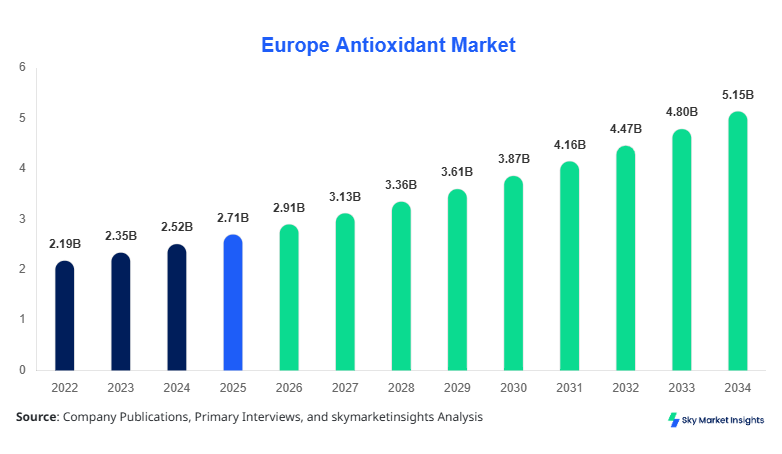
Europe's antioxidant market size is projected at USD 2.91 billion in 2026 and is expected to hit USD 5.14 billion by 2034 with a CAGR of 7.4%. The increasing penetration of antioxidant compounds across food preservation, nutraceutical formulation, cosmetics manufacturing, and pharmaceutical applications is supporting sustained expansion across the regional industry. The market assessment includes detailed production analytics, application-level demand analysis, regulatory benchmarking, supply chain evaluation, and competitive landscape assessment across major European countries. Rising investments in natural extraction technologies, bio-based formulations, and high-performance oxidative stability solutions are accelerating industrial adoption throughout Europe.
The antioxidant industry represents a critical segment within Europe’s specialty chemicals and nutraceutical ecosystem, supporting oxidation prevention in food products, pharmaceuticals, cosmetics, polymers, and industrial formulations. Europe produced more than 1.8 million metric tons of antioxidant ingredients in 2025, with natural antioxidants accounting for nearly 46% of total production volume. Penetration of antioxidant compounds across packaged food manufacturing exceeded 71% in Western Europe, while pharmaceutical-grade antioxidant utilization increased by 9.2% year-on-year during 2025. Consumer purchasing behavior indicates that nearly 63% of European consumers prefer clean-label food products containing naturally sourced antioxidant compounds such as tocopherols, carotenoids, flavonoids, and rosemary extracts. Synthetic antioxidants continue to dominate industrial applications with approximately 54% volume contribution due to cost efficiency and shelf-life enhancement capabilities. Food and beverage applications represented 41% of overall consumption, followed by pharmaceuticals at 28%, cosmetics at 19%, and industrial applications at 12%. Oxidative stability performance metrics improved by 18%–24% across advanced antioxidant formulations used in processed foods and nutraceutical products, reinforcing Europe's antioxidant market growth.
In the United Kingdom, the antioxidant market accounted for approximately 24% of total European revenue during 2025, supported by more than 340 manufacturing facilities and specialty formulation companies operating across food ingredients, nutraceuticals, and cosmetics production. The country processed over 312,000 metric tons of antioxidant compounds in 2025, with natural antioxidants representing nearly 49% of domestic demand. Food and beverage applications contributed 43% of total consumption, and pharmaceutical applications accounted for 26%, while cosmetics and personal care applications generated nearly an 18% share. Adoption of plant-derived antioxidants increased by 13.6% in the United Kingdom due to rising clean-label preferences and stricter synthetic additive regulations. More than 68% of nutraceutical manufacturers in the country integrated antioxidant-enriched formulations into dietary supplements, while antioxidant penetration across functional beverages exceeded 54% during 2025. Advanced encapsulation technologies improved antioxidant stability by 21%, supporting higher shelf-life performance across processed food products. Strong R&D expenditure, growing health awareness, and rising preventive healthcare expenditure continue to strengthen Europe's antioxidant market growth.
Explore more data points, trends and opportunities Download Free Sample Report
Antioxidant Market Trends
Expansion of Natural Antioxidant Extraction Technologies
The European antioxidant industry is witnessing rapid transition toward botanical and naturally extracted antioxidant ingredients as consumers increasingly demand sustainable and clean-label products. During 2025, natural antioxidant production volume exceeded 828,000 metric tons across Europe, reflecting annual expansion of 11.2%. Rosemary extract utilization increased by 17%, while tocopherol-based ingredient demand grew by 14.4% across processed food manufacturing facilities. Supercritical CO₂ extraction technologies achieved nearly 22% higher extraction efficiency compared to conventional solvent extraction methods, reducing processing costs by approximately 9%. Germany, France, and the United Kingdom collectively accounted for 61% of regional investments in natural antioxidant processing technologies. More than 58% of newly launched nutraceutical products in Europe incorporated naturally sourced antioxidants during 2025, while cosmetics manufacturers increased botanical antioxidant integration by 19%. Advanced stabilization technologies improved antioxidant retention rates by 26% in temperature-sensitive formulations, accelerating the European antioxidant market trend.
Increasing Integration Across Functional Food and Nutraceutical Industries
Functional food and nutraceutical manufacturers are significantly increasing antioxidant integration to support immunity enhancement, anti-aging benefits, and chronic disease prevention. European functional food production surpassed 19.4 million metric tons during 2025, with antioxidant-fortified products accounting for nearly 38% of new product launches. Demand for flavonoid-based antioxidant ingredients increased by 16.3%, while carotenoid-enriched beverages registered 13.8% consumption growth across urban markets. More than 71% of European consumers actively preferred food products with antioxidant health claims, particularly among populations aged between 25 and 45 years. Encapsulation and nano-delivery technologies enhanced bioavailability rates by 31%, improving therapeutic effectiveness across dietary supplements and pharmaceutical formulations. Pharmaceutical-grade antioxidant ingredient demand grew by 10.8% in 2025 due to increasing cardiovascular and immunity-related healthcare applications. Cross-sector innovation partnerships between ingredient suppliers and food manufacturers increased by 18%, strengthening Europe's antioxidant market trend.
Rising Demand for Antioxidants in Cosmetic and Personal Care Applications
The cosmetics and personal care industry is emerging as a major growth sector for antioxidants due to increasing demand for anti-aging, UV-protection, and skin-repair formulations. Europe produced more than 5.2 billion units of antioxidant-enriched cosmetic products during 2025, reflecting 12.6% annual production expansion. Vitamin C derivatives accounted for 34% of cosmetic antioxidant demand, while coenzyme Q10 utilization increased by 15% across premium skincare products. France and Italy together represented nearly 47% of luxury antioxidant cosmetic production in Europe. More than 64% of newly launched skincare products incorporated antioxidant complexes to improve skin barrier performance and oxidative stress reduction. Technological advancements in lipid-based antioxidant delivery systems improved ingredient absorption efficiency by 27%, supporting premium product differentiation. Consumer spending on anti-aging skincare increased by 11.7% across Western Europe during 2025, reinforcing Europe's antioxidant market trend.
Europe Antioxidant Market Drivers
Rising Consumer Preference for Preventive Healthcare and Functional Nutrition
Increasing health awareness across Europe is significantly driving antioxidant ingredient consumption in the food, pharmaceutical, and nutraceutical sectors. More than 74% of European consumers actively seek products containing immune-supporting or anti-aging ingredients, while preventive healthcare expenditure increased by 12.1% between 2023 and 2025. Functional food consumption exceeded 22 million metric tons in Europe during 2025, with antioxidant-fortified products accounting for nearly 39% of category sales. Demand for polyphenols, flavonoids, tocopherols, and carotenoids increased by 15%–18% annually due to growing concerns regarding cardiovascular disorders, oxidative stress, and aging-related diseases. Pharmaceutical manufacturers increased antioxidant ingredient procurement by 10.8%, particularly for inflammation management and chronic disease prevention formulations. In addition, antioxidant integration across dietary supplements surpassed 69% penetration in Western Europe. Government support for nutritional labeling, clean-label standards, and natural ingredient approvals has accelerated commercial adoption among regional manufacturers. Advanced formulation technologies improved antioxidant stability by approximately 24%, enabling broader industrial implementation. These factors collectively continue to strengthen Europe's antioxidant market growth.
Europe Antioxidant Market Restraints
High Raw Material Costs and Stringent Regulatory Compliance
The antioxidant industry faces substantial challenges associated with fluctuating raw material prices, stringent regulatory approvals, and complex extraction processes. Natural antioxidant production costs increased by nearly 14% during 2025 due to volatile agricultural supply chains and rising energy prices across Europe. Botanical extraction facilities experienced operating cost increases of 9%–11%, particularly in Germany, France, and Italy. Regulatory approvals under the European Food Safety Authority require extensive clinical validation, increasing product commercialization timelines by 18–24 months for new antioxidant compounds. More than 37% of small and medium manufacturers reported delayed product launches due to compliance-related testing requirements. Synthetic antioxidants continue to face scrutiny regarding long-term health implications, resulting in reduced adoption across premium food categories. Import dependency for certain raw materials exceeded 42% across the region, increasing supply chain vulnerability and procurement costs. Limited scalability of advanced extraction technologies further impacts manufacturing efficiency, restraining Europe's antioxidant market growth.
Europe Antioxidant Market Opportunities
Expansion of Plant-based and Sustainable Ingredient Applications
The growing shift toward sustainable and plant-based product formulations creates substantial opportunities for antioxidant manufacturers across Europe. Plant-derived antioxidant demand increased by 16.4% during 2025, particularly in vegan nutraceuticals, functional beverages, and organic skincare products. More than 59% of European consumers now prioritize sustainably sourced ingredients when purchasing food or cosmetic products. Investment in bio-based extraction facilities surpassed USD 480 million across Europe during 2025, with the United Kingdom and Germany accounting for nearly 51% of total investment allocation. Algae-derived antioxidants, berry extracts, and green tea polyphenols are experiencing double-digit consumption expansion due to superior bioactivity performance and natural positioning. Food manufacturers increased procurement of plant-based preservatives by 14%, replacing synthetic stabilizers across premium product categories. Technological advancements in fermentation-derived antioxidant production improved output efficiency by 19%, reducing operational costs while supporting sustainable manufacturing targets. These developments are expected to create lucrative European antioxidant market growth opportunities over the forecast period.
Challenges in Europe's Antioxidant Market
Limited Stability and Bioavailability Across Advanced Applications
Despite increasing industrial adoption, antioxidant manufacturers continue to face challenges associated with ingredient degradation, low bioavailability, and formulation instability. Nearly 32% of antioxidant compounds experience significant potency loss during high-temperature processing, particularly within bakery and beverage manufacturing applications. Vitamin-based antioxidants can lose 18%–25% effectiveness under prolonged storage conditions, affecting product shelf life and consumer satisfaction. Nano-encapsulation and lipid delivery systems improve absorption rates; however, implementation costs remain approximately 21% higher compared to traditional processing technologies. Pharmaceutical manufacturers report bioavailability inconsistencies across nearly 17% of oral antioxidant formulations. Furthermore, transportation and storage limitations contribute to oxidation losses exceeding 11% in temperature-sensitive natural antioxidant products. Small-scale manufacturers face technological barriers due to limited access to advanced stabilization systems and analytical testing infrastructure. Such operational and technical limitations continue to create challenges for Europe's antioxidant market growth.
Report Scope
| Report Metric | Details |
|---|---|
| Market Size in 2025 | USD 2.71 Billion |
| Market Size in 2026 | USD 2.91 Billion |
| Market Size in 2034 | USD 5.14 Billion |
| CAGR | 7.4% (2026-2034) |
| Base Year for Estimation | 2025 |
| Historical Data | 2022-2024 |
| Forecast Period | 2026-2034 |
| Report Coverage | Revenue Forecast, Competitive Landscape, Supply Chain Disruption, Growth Factors, Environment & Regulatory Landscape and Trends |
Explore more data points, trends and opportunities Download Free Sample Report
Antioxidant Market Segmentation
The European antioxidant industry is segmented based on type and application, with natural antioxidants holding nearly 46% market dominance due to increasing clean-label demand. Synthetic antioxidants continue to maintain significant industrial utilization because of lower production costs and extended oxidative stability performance. Food and beverage applications accounted for approximately 41% of total consumption, followed by pharmaceuticals at 28%, cosmetics at 19%, and industrial applications at 12%. Technological innovation, regulatory compliance, and evolving consumer health preferences continue to influence segment-level demand patterns.
By Type
Natural antioxidants accounted for approximately 46% of European consumption volume during 2025 due to strong clean-label demand and increasing nutraceutical integration. Production exceeded 828,000 metric tons, supported by large-scale extraction from rosemary, green tea, berries, and tocopherol-rich vegetable oils. Botanical antioxidants improved oxidative stability by nearly 24% across processed food applications while reducing synthetic additive dependency. Germany, France, and the United Kingdom collectively contributed 63% of regional natural antioxidant production. More than 58% of newly launched food products incorporated naturally derived antioxidant ingredients during 2025. Technological advancements in solvent-free extraction improved purity levels by 19% and reduced waste generation by 14%. Functional beverage manufacturers increased natural antioxidant utilization by 17%, while organic cosmetic brands expanded adoption by 21% due to consumer preference for sustainable ingredients.
Synthetic antioxidants represented nearly 41% of regional demand because of cost efficiency and superior shelf-life stabilization performance across industrial applications. Production volume exceeded 738,000 metric tons in 2025, primarily consisting of butylated hydroxytoluene, butylated hydroxyanisole, and propyl gallate formulations. Synthetic antioxidant integration across packaged food manufacturing reached 67% due to extended storage performance and lower procurement costs. Industrial polymer applications contributed approximately 18% of synthetic antioxidant demand across Europe. Shelf-life extension capabilities improved by 28% in high-fat food formulations using synthetic antioxidant blends. However, premium food and cosmetic brands reduced synthetic ingredient utilization by nearly 9% due to rising regulatory scrutiny and consumer concerns.
Enzyme-based antioxidants are emerging rapidly across pharmaceutical and biotechnology applications due to superior catalytic activity and cellular protection efficiency. Production volume reached approximately 234,000 metric tons in 2025, supported by increasing investments in enzyme engineering and biotechnology manufacturing. Superoxide dismutase and catalase-based formulations accounted for nearly 62% of enzyme antioxidant demand. Pharmaceutical applications contributed 48% of consumption, while premium skincare formulations accounted for 22%. Bioavailability rates improved by 31% compared to conventional antioxidant compounds, supporting increased therapeutic adoption. Research expenditure on enzyme stabilization technologies increased by 14.7% during 2025, accelerating commercialization opportunities across Europe.
By Application
Food and beverage applications dominated the European antioxidant industry, with approximately 41% share during 2025. Processed food manufacturers consumed over 736,000 metric tons of antioxidant ingredients to enhance shelf stability, prevent lipid oxidation, and improve product freshness. Bakery products accounted for 21% of food-sector antioxidant demand, while meat processing represented 19% and beverage applications contributed 17%. Natural antioxidant integration across organic food products increased by 16.4%, supported by growing consumer preference for preservative-free formulations. Oxidation reduction efficiency improved by nearly 26% in packaged foods using advanced antioxidant blends. More than 71% of European consumers preferred food products marketed with antioxidant-related health benefits during 2025.
Pharmaceutical applications represented nearly 28% of total antioxidant consumption due to expanding therapeutic usage in cardiovascular health, anti-inflammatory drugs, and immunity enhancement products. Pharmaceutical manufacturers processed approximately 503,000 metric tons of antioxidant compounds during 2025. Dietary supplements contributed 46% of pharmaceutical-sector demand, followed by chronic disease therapeutics at 31%. Nano-delivery technologies improved antioxidant absorption efficiency by 29%, enhancing clinical performance across oral and injectable formulations. Aging populations and rising healthcare expenditure accelerated antioxidant adoption in preventive medicine applications across Germany, France, and the United Kingdom.
Cosmetics and personal care applications accounted for approximately 19% of European antioxidant consumption during 2025. Production of antioxidant-enriched skincare products exceeded 5.2 billion units, supported by strong anti-aging and UV-protection demand. Vitamin C formulations represented 34% of cosmetic antioxidant utilization, while polyphenol-based formulations accounted for 18%. France and Italy together generated nearly 47% of luxury antioxidant skincare manufacturing in Europe. Antioxidant delivery systems improved skin penetration efficiency by 27%, supporting premium product differentiation. More than 64% of new skincare launches incorporated antioxidant complexes during 2025, driven by increasing consumer demand for advanced dermaceutical products.
Europe Antioxidant Market Segmentations
Type
- Natural Antioxidants
- Synthetic Antioxidants
- Enzyme-based Antioxidants
Application
- Food & Beverage
- Pharmaceuticals
- Cosmetics
Europe Antioxidant Market Regional Outlook
United Kingdom
The United Kingdom accounted for approximately 24% of total European antioxidant revenue during 2025, supported by robust nutraceutical, pharmaceutical, and food processing industries. More than 340 companies operated antioxidant manufacturing or formulation facilities across the country. Functional food applications represented 43% of domestic antioxidant demand, while pharmaceuticals contributed 26%. Plant-derived antioxidant utilization increased by 13.6% due to rising consumer preference for natural ingredients. Antioxidant-fortified beverage production exceeded 1.8 billion liters during 2025, while dietary supplement consumption grew by 11.4%. Advanced encapsulation technologies improved ingredient stability by 21%, strengthening industrial adoption.
Germany
Germany represented nearly 22% of regional antioxidant consumption during 2025, supported by advanced food processing, pharmaceutical manufacturing, and industrial chemical sectors. The country processed more than 402,000 metric tons of antioxidant ingredients during the year. Food processing applications accounted for 39% of domestic demand, while industrial polymer applications represented 17%. Germany invested approximately USD 190 million in sustainable extraction technologies and bio-based antioxidant production systems during 2025. More than 61% of nutraceutical manufacturers in Germany integrated natural antioxidant compounds into preventive healthcare products. Pharmaceutical antioxidant demand increased by 10.1% due to growing chronic disease management applications.
France
France accounted for approximately 18% of European antioxidant consumption and remained a leading hub for cosmetic and luxury skincare production. The country manufactured more than 1.6 billion units of antioxidant-enriched cosmetic products during 2025. Cosmetic applications represented 34% of domestic antioxidant demand, while food and beverage applications accounted for 31%. Polyphenol-based antioxidant utilization increased by 15% across skincare and nutraceutical formulations. France also expanded investments in marine-derived antioxidants and algae extraction technologies, improving production efficiency by nearly 17%. More than 58% of premium cosmetic launches incorporated antioxidant complexes during 2025.
Spain
Spain contributed approximately 12% of regional antioxidant demand, supported by strong agricultural extraction capabilities and growing processed food manufacturing industries. The country produced nearly 188,000 metric tons of antioxidant ingredients during 2025, with olive-derived antioxidants accounting for 29% of domestic production. Food preservation applications represented 42% of consumption, while nutraceutical applications contributed 23%. Spain increased exports of natural antioxidant extracts by 11.8% during 2025 due to rising international demand for Mediterranean botanical ingredients. Advanced olive polyphenol extraction systems improved antioxidant concentration efficiency by 19%.
Italy
Italy accounted for nearly 14% of European antioxidant consumption during 2025, driven primarily by cosmetics, functional foods, and premium nutraceutical products. The country manufactured over 1.2 billion antioxidant-enriched cosmetic units during the year. Cosmetic applications contributed 32% of domestic demand, while food and beverage applications accounted for 36%. Italy expanded utilization of grape-seed and citrus-derived antioxidants by approximately 16% due to increasing luxury skincare production. More than 57% of premium nutraceutical brands launched antioxidant-enhanced formulations during 2025. Investments in fermentation-derived antioxidant production technologies increased by 12.9%.
Russia
Russia represented approximately 10% of regional antioxidant demand during 2025, supported by expanding pharmaceutical manufacturing and processed food production. The country consumed more than 176,000 metric tons of antioxidant ingredients during the year. Pharmaceutical applications represented 33% of domestic demand, while packaged food preservation accounted for 38%. Demand for synthetic antioxidants remained relatively high at 61% due to cost-sensitive industrial applications. Local manufacturing capacity expanded by nearly 9%, while imports of premium natural antioxidants increased by 13.2% during 2025. Growing healthcare expenditure and functional food adoption continue supporting regional expansion.
Top players in Europe's antioxidant market
- BASF SE
- Koninklijke DSM N.V.
- Archer Daniels Midland Company
- Kemin Industries Inc.
- Camlin Fine Sciences Ltd.
- Barentz International
- Naturex SA
- Cargill Incorporated
- Eastman Chemical Company
- BTSA Biotecnologías Aplicadas
- A&B Ingredients
- Novozymes A/S
- DuPont Nutrition & Biosciences
- Lycored Ltd.
- Frutarom Industries Ltd.
BASF SE
-
BASF SE accounted for approximately 14% share of the European antioxidant industry during 2025.
-
The company maintains strong positioning across food preservation, polymer stabilization, and pharmaceutical antioxidant applications.
-
BASF operates multiple antioxidant production facilities across Germany and Western Europe with annual processing capacity exceeding 240,000 metric tons.
-
The company increased investments in sustainable antioxidant production technologies by 16% during 2025.
-
Advanced formulation systems improved oxidative stability performance by nearly 29% across industrial applications.
-
BASF continues expanding plant-derived antioxidant portfolios to support clean-label demand across European food and cosmetic industries.
Koninklijke DSM N.V.
-
Koninklijke DSM N.V. held approximately an 11% share of regional antioxidant revenue during 2025.
-
The company maintains significant leadership in nutritional antioxidants, carotenoids, tocopherols, and pharmaceutical-grade formulations.
-
DSM expanded bio-based antioxidant manufacturing capacity by nearly 18% across European facilities during 2025.
-
Nutraceutical applications contributed approximately 46% of company antioxidant revenue.
-
Advanced microencapsulation technologies improved antioxidant bioavailability by 32%, strengthening pharmaceutical and dietary supplement performance.
-
The company continues strategic collaborations with food manufacturers and healthcare companies to expand high-performance antioxidant applications across Europe.
Investment Analysis
European investments in antioxidant manufacturing, extraction technologies, and bio-based ingredient production exceeded USD 1.2 billion during 2025. Approximately 42% of total investment allocation targeted natural antioxidant extraction technologies, while pharmaceutical antioxidant research accounted for 24%. Germany and the United Kingdom together represented nearly 49% of regional capital expenditure due to strong pharmaceutical and nutraceutical industries. Private equity participation in sustainable antioxidant startups increased by 13.4% during 2025.
Mergers, acquisitions, and strategic collaborations accelerated across the antioxidant ecosystem as manufacturers pursued technological expansion and portfolio diversification. More than 27 collaboration agreements were signed during 2025 involving biotechnology firms, food ingredient suppliers, and pharmaceutical companies. Cross-border investments in algae-derived antioxidants increased by 18%, while fermentation-based antioxidant technology partnerships expanded by 21%. Large multinational ingredient suppliers increased acquisition activity among specialty botanical extraction firms to strengthen clean-label product offerings.
Food and beverage manufacturers allocated approximately 37% of antioxidant-related investments toward natural preservative systems and oxidation-control technologies. Pharmaceutical companies dedicated 29% of investment budgets to high-bioavailability antioxidant formulations and nano-delivery systems. Cosmetic manufacturers increased antioxidant innovation spending by 14% due to growing anti-aging product demand. Venture capital funding for sustainable extraction technologies exceeded USD 210 million across Europe during 2025.
New Product Developments
European manufacturers launched more than 1,900 new antioxidant-enriched products during 2025, reflecting annual expansion of 15.2%. Nearly 61% of these launches focused on natural and plant-derived antioxidant formulations. Encapsulation-based antioxidant delivery systems improved ingredient retention efficiency by approximately 28%, while nano-formulated antioxidants enhanced bioavailability by 31%. Functional beverages incorporating polyphenol complexes increased by 17%, particularly across Germany, France, and the United Kingdom.
Cosmetic manufacturers introduced advanced antioxidant skincare products with UV-protection enhancement rates exceeding 24% compared to previous-generation formulations. Pharmaceutical companies expanded development of targeted antioxidant therapeutics for cardiovascular and immunity-related applications, improving clinical efficacy metrics by nearly 19%. Biotechnology firms also accelerated innovation in enzyme-based antioxidant production systems, reducing processing costs by approximately 13%
Recent Developments in Europe Antioxidant Market
- 2025: BASF SE expanded natural antioxidant manufacturing capacity in Germany by 16%, increasing annual production output by more than 42,000 metric tons. The expansion focused on tocopherol and rosemary extract processing technologies for food preservation and nutraceutical applications. The project improved extraction efficiency by nearly 21% while reducing energy consumption by approximately 11%.
- 2025: Koninklijke DSM N.V. introduced advanced microencapsulated antioxidant formulations that improved bioavailability by 32% in pharmaceutical and dietary supplement applications. The new product line supported over a 14% increase in clinical nutrition sector sales and expanded the company’s penetration across preventive healthcare applications throughout Europe.
- 2025: Novozymes A/S announced a biotechnology collaboration focused on enzyme-based antioxidant development for pharmaceutical applications. The partnership improved enzyme stability performance by 24% and increased therapeutic antioxidant absorption efficiency by 29%. Pilot-scale production volumes exceeded 12,000 metric tons during the initial commercialization phase.
Research Methodology
The European antioxidant industry analysis was developed using a combination of primary research, secondary research, and quantitative market estimation methodologies. The research process involved extensive evaluation of production statistics, trade databases, ingredient pricing trends, company annual reports, regulatory publications, and industrial manufacturing data across Europe. Primary research included interviews with antioxidant manufacturers, distributors, pharmaceutical companies, cosmetic brands, food processors, and biotechnology specialists to assess market penetration, production capacity, pricing dynamics, and technological developments. Secondary research incorporated analysis of industry journals, trade associations, import-export databases, and financial disclosures to validate regional demand patterns and investment trends. Market size estimation utilized top-down and bottom-up analytical frameworks supported by production volume benchmarking, application-level penetration analysis, and consumption forecasting models across the 2022–2034 period. Forecast projections were developed by evaluating macroeconomic indicators, consumer purchasing behavior, technological adoption rates, regulatory developments, and sector-specific demand growth across the United Kingdom, Germany, France, Spain, Italy, and Russia.
Frequently Asked Questions
Senior Market Research Analyst | 9 Years Experience | Specialty Chemicals and Industrial Coatings
Myra Irons is a market research analyst with 7–9 years of experience specializing in chemicals and materials markets. Contributed to 70+ research reports for global clients. Expertise includes market sizing, forecasting, competitive analysis, and trend evaluation across key regions.