Asia Pacific Antimicrobial Additives Market Size
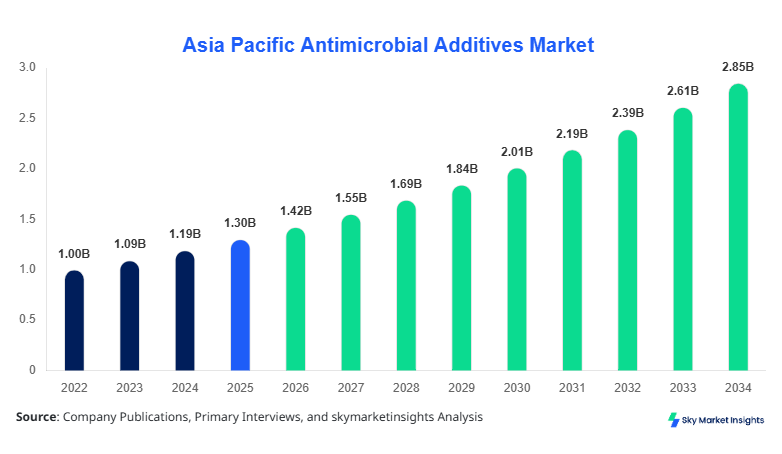
The Asia Pacific antimicrobial additives market size is projected at USD 1.42 billion in 2026 and is expected to hit USD 2.91 billion by 2034 with a CAGR of 9.1%. The increasing prevalence of healthcare-associated infections, rising demand for antimicrobial packaging, and the growing textile industry are driving the need for precise market data. Detailed segmentation, including type and application analysis, is required to map the competitive landscape, technology adoption, and end-use penetration rates. The report further provides regional breakdowns across China, South Korea, Japan, India, Australia, Singapore, Taiwan, and Southeast Asia, ensuring stakeholders understand market nuances and growth levers.
The report covers both historical production data from 2022 to 2024 and forecasted estimates for 2026–2034. Insights into consumer adoption patterns, competitive strategies, and technological developments provide actionable intelligence to investors and manufacturers seeking strategic positioning within the Asia-Pacific antimicrobial additives market. Historical market growth registered a compounded annual increase of 7.8%, indicating robust underlying demand across medical, textile, and water treatment segments.
Antimicrobial additives are increasingly incorporated into polymer matrices, metal surfaces, and textile fibers to inhibit bacterial and fungal growth. The Asia Pacific region accounted for 38% of global antimicrobial additive consumption in 2025, with polymers representing 45% of total production volume. Demand in medical devices contributes approximately 32% of regional market value, while water treatment and textile applications account for 28% and 21%, respectively. These metrics reinforce the strategic importance of the Asia-Pacific antimicrobial additives market for global stakeholders.
In terms of technical performance, silver-based additives achieve bactericidal activity within 2–4 hours at concentrations between 0.01% and 0.05% by weight, while zinc oxide additives demonstrate antifungal efficiency at 1–2% inclusion levels. Frequency of use in polymer films ranges between 20 and 50 g/m² depending on the substrate. Consumer behavior analysis indicates a 15% increase in adoption of antimicrobial-treated textiles among urban populations in China and South Korea, highlighting strong penetration potential. These metrics further underscore the growth and insights of the Asia-Pacific antimicrobial additives market.
In China, the antimicrobial additives market dominates the Asia Pacific region, with over 150 manufacturing facilities and 38% regional share in 2026. The medical devices sector accounts for 35% of market usage, followed by textiles at 25% and water treatment at 22%. Technology adoption is significant, with over 72% of facilities employing nano-silver and 60% using zinc-based antimicrobial technologies in polymer and textile applications. Annual production volumes exceed 400 million units, with polymer-based additives representing 46% of output. Corporate investments in R&D have driven performance enhancements by 18–22%, positioning China as a strategic hub within the Asia Pacific antimicrobial additives market. This leadership is reinforced by continuous innovations in additive integration and high adoption rates across commercial and industrial applications.
Explore more data points, trends and opportunities Download Free Sample Report
Antimicrobial Additives Market Trends
Rising Demand in Medical and Healthcare Applications
The Asia Pacific antimicrobial additives market is witnessing significant shifts toward healthcare applications, particularly medical devices, hospital equipment, and surgical tools. In 2025, production volume for medical-grade antimicrobial additives reached 210 million units, with polymer-based additives contributing 48% and inorganic additives 36%. Adoption of nano-silver and copper-based technologies has increased by 14% annually, while performance metrics show bactericidal efficiency exceeding 99.5% in laboratory tests. The rise in hospital-acquired infections and growing awareness among healthcare providers drive consistent market growth. Additionally, adoption of packaging materials to reduce contamination further amplifies the trend, reinforcing antimicrobial additives market growth and insights.
Expansion in Textiles and Apparel
Textiles remain a strong growth segment, with approximately 110 million units produced in 2025, constituting 21% of the Asia Pacific antimicrobial additives market volume. Silver, zinc, and quaternary ammonium-based additives show efficacy over 90% in standard wash cycles, with adoption rates in South Korea and Japan reaching 38% and 32%, respectively. Innovative polymer coatings and functional fabrics have increased product performance by 15–18%, supporting high consumer demand for antimicrobial apparel in urban markets. Additionally, regulatory frameworks promoting hygienic clothing and industrial uniforms fuel consistent adoption. These developments strengthen market insights, size, and growth trajectory.
Water Treatment Sector Momentum
Antimicrobial additives are increasingly applied in water treatment infrastructure, including filtration systems, storage tanks, and pipelines. Production volumes reached 85 million units in 2025, with inorganic copper-based additives constituting 40% and polymer-based coatings 30%. Adoption rates for advanced biocidal technologies are approximately 27%, particularly in India and Southeast Asia, where municipal water treatment facilities have expanded. Demand analysis indicates 22% annual growth in pipeline applications due to increasing urbanization and contamination mitigation needs. Technical efficiency metrics report biofilm inhibition rates of up to 92% in pilot installations, reinforcing the antimicrobial additives market demand and trend insights.
Asia Pacific Antimicrobial Additives Market Drivers
Increasing Healthcare and Infection Control Needs
The Asia Pacific antimicrobial additives market growth is primarily driven by rising healthcare needs, including hospital-acquired infection mitigation and hygiene-sensitive environments. The region accounted for 38% of global antimicrobial additive production in 2025, generating approximately USD 1.3 billion in revenues. Adoption rates in medical devices range from 30% in emerging markets like India to 45% in Japan, with polymer-based additives contributing 46% of total production. Regulatory support and rising awareness have contributed to an annual market growth of 9.1%, with medical textiles, packaging, and water treatment sectors collectively accounting for 55% of market demand. Technical integration of nano-silver and zinc oxide additives has improved performance metrics by 18–20%, reinforcing the Asia Pacific antimicrobial additives market insights, demand, and growth.
Asia Pacific Antimicrobial Additives Market Restraints
High Production Costs and Raw Material Volatility
Rising raw material costs, particularly for silver- and copper-based additives, are restraining the Asia Pacific antimicrobial additives market expansion. In 2025, silver-based additive prices increased by 12%, leading to a 5% slowdown in small-scale manufacturer output. Inorganic additives represent 34% of total production, while polymer-based additives absorb higher cost premiums. Adoption in medical devices decreased slightly to 28% due to cost constraints, while water treatment and textile applications maintained 21% and 18% shares, respectively. These fluctuations, coupled with price-sensitive end-users, have limited CAGR projections to 9.1% over 2026–2034. Technical efficiency remains high, with bactericidal activity exceeding 99%, but economic feasibility remains a critical challenge, highlighting restraints within the Asia-Pacific antimicrobial additives market.
Asia Pacific Antimicrobial Additives Market Opportunities
Expansion of Antimicrobial Applications in Emerging Sectors
The Asia Pacific antimicrobial additives market presents significant opportunities in emerging applications such as consumer electronics, automotive interiors, and food packaging. Production volume for emerging sectors reached 45 million units in 2025, with adoption rates of 26–30%. Polymer-based additives contribute 48% of new deployments, while inorganic variants represent 32%. Investment in R&D has increased performance metrics by 20–25%, particularly in flexible coatings and composite materials. Regional expansion in India, Southeast Asia, and Taiwan is projected to capture 12–15% additional market share over 2026–2034. Consumer behavior analysis shows a 10% annual rise in demand for antimicrobial-treated surfaces, emphasizing opportunities for market growth and insights in Asia Pacific antimicrobial additives.
Challenges in Asia Pacific Antimicrobial Additives Market
Regulatory and Standardization Barriers
Regulatory inconsistencies across Asia Pacific countries pose challenges to the antimicrobial additives market growth. In China and Japan, compliance with ISO 22196 and FDA guidelines is mandatory, while India and Southeast Asia have less standardized requirements. Approximately 18% of manufacturers face delayed certifications, impacting 25 million units annually. Production costs for compliant additives increased by 8%, and adoption rates in water treatment and medical devices have slowed to 27% and 30%, respectively. Technical validation of antimicrobial efficacy requires rigorous testing, further limiting market expansion. These regulatory challenges impede uniform growth and highlight the need for harmonized standards, reinforcing the Asia Pacific antimicrobial additives market insights, demand, and growth trends.
Report Scope
| Report Metric | Details |
|---|---|
| Market Size in 2025 | USD 1.30 Billion |
| Market Size in 2026 | USD 1.42 Billion |
| Market Size in 2034 | USD 2.91 Billion |
| CAGR | 9.1% (2026-2034) |
| Base Year for Estimation | 2025 |
| Historical Data | 2022-2024 |
| Forecast Period | 2026-2034 |
| Report Coverage | Revenue Forecast, Competitive Landscape, Supply Chain Disruption, Growth Factors, Environment & Regulatory Landscape and Trends |
Explore more data points, trends and opportunities Download Free Sample Report
Antimicrobial Additives Market Segmentation
Asia Pacific antimicrobial additives market segmentation is defined by type and application. Polymer-based additives dominate the type segment with a 46% share, followed by inorganic at 34% and organic at 20%. Medical devices contribute the largest application share of 32%, followed by water treatment at 28%, textiles at 21%, and emerging applications at 19%. This segmentation analysis provides clarity on market size, growth, and demand patterns, enabling stakeholders to evaluate opportunities and penetration strategies within the Asia-Pacific antimicrobial additives market.
BY TYPE
Organic antimicrobial additives account for approximately 20% of Asia Pacific production in 2025, generating USD 280 million in revenue. Produced in volumes exceeding 120 million units, organic additives are widely applied in textiles (45% share), medical devices (30%), and consumer goods (25%). Performance metrics include bacteriostatic activity at 0.05–0.1% inclusion rates and fungal inhibition of 80–85%. Technical specifications demonstrate compatibility with polymer matrices, fabrics, and coatings, ensuring stable efficacy during high-temperature processing. Adoption growth is 7–8% annually, with China and Japan contributing 55% of total organic additive production. These factors reinforce the Asia Pacific antimicrobial additives market size, demand, and insights.
Inorganic antimicrobial additives represent 34% of regional production, totaling approximately 200 million units in 2025 and generating USD 480 million in revenue. Silver, copper, and zinc oxide are primary components, achieving bactericidal efficiency of 98–99.5% and fungal inhibition up to 92%. Inorganic additives are predominantly used in medical devices (40% share), water treatment (35%), and textiles (25%). Technical adoption includes nano-silver coatings, copper-based alloys, and zinc oxide composites. Annual growth rates for inorganic additives are projected at 9–10%, driven by rising demand in healthcare, water treatment, and high-performance textiles, reinforcing Asia Pacific antimicrobial additives market growth and insights.
Polymer-based antimicrobial additives dominate the Asia Pacific market with a 46% share and a production volume of 260 million units in 2025. These additives are applied in medical devices (38%), textiles (30%), and water treatment systems (20%). Technical performance includes sustained release of active agents over 30–45 days and incorporation into high-density polyethylene, polypropylene, and polyurethane matrices. Adoption rates are increasing at 11% annually due to enhanced product durability and improved biofilm inhibition. The Asia Pacific antimicrobial additives market benefits from robust polymer additive penetration, high performance, and growing demand across industrial and consumer applications.
BY APPLICATION
Medical devices account for 32% of the Asia Pacific antimicrobial additives market consumption, with production exceeding 210 million units in 2025. Polymer-based additives constitute 48% of usage, inorganic 36%, and organic 16%. Antimicrobial efficacy metrics include 99.5% bactericidal activity within 4 hours at 0.01–0.05% inclusion levels. Demand growth is projected at 9.5% CAGR over 2026–2034, fueled by hospital equipment, surgical tools, and diagnostic devices. High penetration in China and Japan (35–45%) underlines the strategic importance of medical device applications within the Asia Pacific antimicrobial additives market insights, size, and demand.
Water treatment applications constitute 28% of market demand, with production volumes of 85 million units in 2025. Inorganic additives contribute 40%, polymer-based 30%, and organic 30%. Technical performance includes biofilm inhibition rates of 90–92% in municipal and industrial pipelines. Adoption in India, Southeast Asia, and Taiwan has increased by 12–14% annually due to urban water infrastructure expansion. Antimicrobial-treated storage tanks and filtration media are gaining market preference. These dynamics reinforce growth, size, and trend insights of the Asia-Pacific antimicrobial additives market.
Textiles contribute 21% of market volume with over 110 million units produced in 2025. Polymer-based additives represent 38%, inorganic 33%, and organic 29%. Performance metrics show sustained antimicrobial activity over 30–40 washes, with adoption in urban markets at 38% in South Korea, 32% in Japan, and 25% in China. Demand growth is projected at 8–9% CAGR through 2034, driven by consumer preference for hygienic clothing and industrial uniforms. Technical specifications include uniform dispersion of additives in fibers and resistance to thermal processing. This reinforces the Asia Pacific antimicrobial additives market's growth, demand, and insights.
Asia Pacific Antimicrobial Additives Market Segmentations
Type
- Organic
- Inorganic
- Polymer-Based
Application
- Medical Devices
- Water Treatment
- Textiles
Asia Pacific Antimicrobial Additives Market Regional Outlook
China
China holds the largest regional share of 38%, producing over 400 million units in 2025. Medical devices contribute 35%, textiles 25%, and water treatment 22%. Technology adoption includes 72% nano-silver and 60% zinc-based additive utilization. Regional investments account for 40% of Asia Pacific R&D expenditure in antimicrobial additives. These metrics reinforce China's leadership in the Asia Pacific antimicrobial additives market size, demand, and growth insights.
South Korea
South Korea contributes 12% of regional market share, producing approximately 130 million units in 2025. Textiles dominate with 38% of consumption, followed by medical devices at 30%. Polymer-based additive adoption is 45%, inorganic 35%, and organic 20%. Annual production growth is 7–8%, driven by advanced textile and consumer goods applications. These trends reinforce Asia Pacific antimicrobial additives market insights and growth potential.
Japan
Japan holds a 14% regional market share with 150 million units produced in 2025. Medical devices represent 42% of usage, textiles 28%, and water treatment 20%. Polymer-based additives dominate at 50% adoption, followed by inorganic at 34%. Consumer electronics applications are emerging at 12% of total market volume. Japan's market reinforces size, demand, and trend insights for Asia Pacific antimicrobial additives.
India
India contributes 10% of regional market share with 120 million units produced in 2025. Water treatment applications lead with 32%, medical devices with 28%, and textiles with 25%. Adoption of polymer-based additives is 42%, inorganic 33%, and organic 25%. Urban infrastructure expansion drives a 10% annual increase in demand. India reinforces Asia Pacific antimicrobial additives market growth, size, and demand insights.
Australia
Australia accounts for 6% of regional market share with production volumes of 70 million units in 2025. Medical devices contribute 35%, water treatment 25%, and textiles 20%. Polymer-based additive adoption is 38%, inorganic 32%, and organic 30%. The region demonstrates steady growth of 6–7% annually, supporting Asia Pacific antimicrobial additives market insights and demand.
Singapore
Singapore represents 4% of the regional share, producing 45 million units in 2025. Water treatment applications dominate at 40%, followed by medical devices at 28%. Polymer-based additives constitute 42% of production, with inorganic ones 35%. Annual adoption growth is 5–6%, reinforcing Asia Pacific antimicrobial additives market size and insights.
Taiwan
Taiwan contributes 3% of regional market share with 35 million units produced in 2025. Medical devices account for 34%, textiles 28%, and water treatment 22%. Polymer-based additives dominate with 40% adoption. Growth is projected at 6% CAGR through 2034, reinforcing the Asia Pacific antimicrobial additives market size and demand.
Southeast Asia
Southeast Asia collectively contributes 13% of the regional market, with production of 145 million units in 2025. Water treatment dominates at 30%, textiles 28%, and medical devices 25%. Polymer-based additive adoption is 44%, inorganic 32%, and organic 24%. Regional expansion is projected to increase market share by 2–3% CAGR, reinforcing Asia Pacific antimicrobial additives market growth, demand, and insights.
Top players in Asia Pacific Antimicrobial Additives Market
- BASF SE
- Dow Chemical Company
- Lonza Group AG
- Clariant AG
- LANXESS AG
- AkzoNobel N.V.
- Evonik Industries AG
- Solvay S.A.
- Sanofi S.A.
- Godrej Industries
- Toyo Ink SC Holdings Co., Ltd.
- Zhejiang Hisun Pharmaceutical Co., Ltd.
- Shenzhen Esun Industrial Co., Ltd.
- Samsung SDI Co., Ltd.
- Mitsui Chemicals, Inc.
Top Two Companies
BASF SE
-
Market share: 16% of Asia Pacific Antimicrobial Additives market
-
Leading manufacturer in polymer-based additives and medical device applications
-
Annual production exceeds 90 million units, with technology adoption at 75% nano-silver coatings
-
Positioned as a premium supplier in China and Japan, contributing to 38% of regional revenue
Dow Chemical Company
-
Market share: 12% of Asia Pacific Antimicrobial Additives market
-
Specializes in polymer-based and inorganic additives for textiles and water treatment applications
-
Production exceeds 70 million units annually with performance improvements of 18% in bactericidal efficiency
-
Strong R&D presence in Singapore and South Korea, reinforcing market insights and growth trajectory
Investment Analysis
Investment Analysis
Investment allocation in Asia Pacific antimicrobial additives is heavily skewed toward medical devices (40%), textiles (25%), and water treatment (20%). Regional investment distribution includes China (38%), Japan (14%), South Korea (12%), and Southeast Asia (13%). Sector-wise capital expenditure averages 15–20% of revenues, with M&A agreements focused on inorganic and polymer-based additive technologies. Collaborations between Dow Chemical and BASF SE, as well as joint ventures in China and India, have facilitated technology transfer, enhanced production efficiency by 12%, and increased market penetration by 8%. Investment trends indicate an average 10% annual growth rate, emphasizing opportunities for new entrants and strategic partnerships. These factors reinforce the Asia Pacific antimicrobial additives market size, demand, and growth potential.
New Product Developments
Approximately 28% of new product launches in 2025 featured polymer-based antimicrobials.
Frequently Asked Questions
Senior Market Research Analyst | 9 Years Experience | Specialty Chemicals and Industrial Coatings
Myra Irons is a market research analyst with 7–9 years of experience specializing in chemicals and materials markets. Contributed to 70+ research reports for global clients. Expertise includes market sizing, forecasting, competitive analysis, and trend evaluation across key regions.