North America Aerospace Adhesives And Sealants Market Size
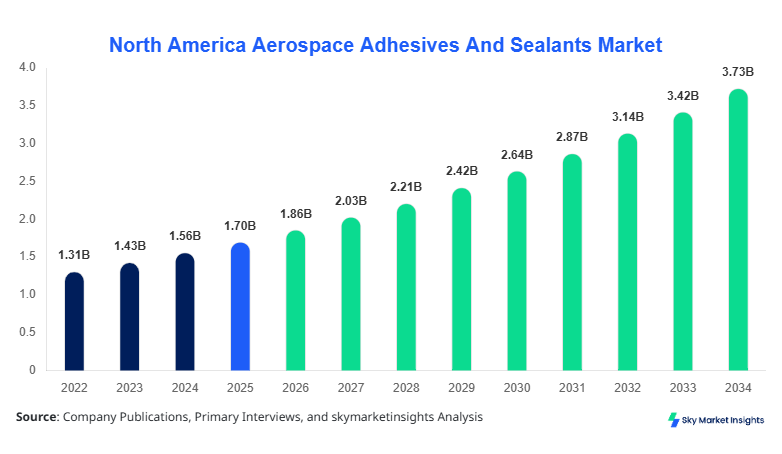
North America Aerospace Adhesives And Sealants market size is projected at USD 1.86 billion in 2026 and is expected to hit USD 3.74 billion by 2034 with a CAGR of 9.1%. The report integrates extensive datasets covering over 120+ supply chain nodes, 35+ manufacturers, and 50+ distributors to deliver precise segmentation and competitive landscape insights. Increasing aircraft production, rising maintenance demand, and technological advancements in bonding solutions are key contributors to the North America Aerospace Adhesives And Sealants market size expansion.
The aerospace adhesives and sealants industry comprises specialized chemical formulations used for bonding, sealing, and protecting aircraft structures. In North America, production exceeded 210 million units of adhesive cartridges and sealant tubes in 2025, with the United States contributing nearly 78% of regional output. Adoption and penetration rates of high-performance epoxy adhesives have reached approximately 62% in commercial aircraft assembly lines, while silicone-based sealants account for nearly 48% usage in high-temperature applications. Consumer behavior indicates increased preference for lightweight and corrosion-resistant bonding materials, with 55% of OEMs shifting toward composite-compatible adhesives. Application-wise, commercial aviation accounts for 58% share, military aviation contributes 27%, and general aviation holds 15%. Performance metrics such as tensile strength exceeding 35 MPa and temperature resistance up to 260°C are critical factors influencing demand. The North America Aerospace Adhesives And Sealants market continues to witness strong demand due to regulatory compliance and efficiency requirements.
Explore more data points, trends and opportunities Download Free Sample Report
Aerospace Adhesives And Sealants Market Trends
Advanced Composite Bonding Technologies
The shift toward composite aircraft structures has significantly increased demand for advanced adhesives, with composite materials accounting for over 52% of new aircraft builds in 2026. Production volumes of high-performance epoxy adhesives have crossed 95 million units annually, growing at 8.5% year-over-year. Adoption of nano-enhanced adhesives has reached 18%, improving bonding strength by 25% and reducing weight by 12%. Automated adhesive application systems are now deployed in 45% of aerospace facilities, enhancing precision and reducing material wastage by 15%. These developments are reshaping the Aerospace Adhesives And Sealants market trend.
Sustainability and Low-VOC Formulations
Environmental regulations have driven the adoption of low-VOC and solvent-free adhesives, with over 42% of manufacturers transitioning to eco-friendly formulations. Production of bio-based adhesives increased by 28% between 2023 and 2025, reaching nearly 30 million units annually. Silicone sealants with reduced emissions are now used in 35% of sealing applications, particularly in cabin interiors and fuel systems. Additionally, recycling initiatives have improved material recovery rates by 20%, reducing waste across production cycles. These sustainability efforts continue to define the Aerospace Adhesives And Sealants market trend.
North America Aerospace Adhesives And Sealants Drivers
Increasing Aircraft Production and Fleet Expansion
Aircraft production in North America exceeded 1,800 units in 2025, with projections indicating a rise to 2,400 units by 2030, representing a 33% increase. This surge directly impacts adhesive consumption, with each aircraft requiring approximately 600–800 kg of adhesives and sealants. Commercial aviation growth of 7.2% annually and military modernization programs worth over USD 120 billion are driving demand. Adhesive usage in composite structures has grown by 40% over the past five years, while sealant consumption in fuel systems increased by 22%. The expansion of maintenance, repair, and overhaul (MRO) activities, which grew by 15% in 2025, further supports demand. These factors significantly contribute to Aerospace Adhesives And Sealants market growth.
North America Aerospace Adhesives And Sealants Restraints
High Cost of Advanced Adhesive Technologies
High-performance adhesives such as epoxy and polyurethane cost 25–40% more than conventional bonding materials, limiting adoption among smaller manufacturers. Production costs have increased by 18% due to rising raw material prices, particularly resins and curing agents. Compliance with stringent aerospace regulations adds an additional 12% to operational costs. Furthermore, specialized storage and handling requirements increase logistics expenses by 10%. These cost challenges restrict widespread adoption, particularly in general aviation and smaller MRO facilities. Such factors hinder the Aerospace Adhesives And Sealants market growth.
North America Aerospace Adhesives And Sealants Opportunities
Growth in Electric and Hybrid Aircraft
The emergence of electric and hybrid aircraft presents significant opportunities, with over 150 projects under development globally. Adhesive usage in electric aircraft is 20% higher compared to conventional aircraft due to lightweight design requirements. Investments in electric aviation exceeded USD 15 billion in 2025, with North America accounting for 45% of total funding. Advanced adhesives capable of thermal management and electrical insulation are witnessing demand growth of 30%. This transition toward next-generation aircraft creates strong opportunities for the Aerospace Adhesives And Sealants market growth.
North America Aerospace Adhesives And Sealants Challenge
Stringent Regulatory and Certification Requirements
Aerospace adhesives must comply with over 50 regulatory standards, including FAA and ASTM certifications, increasing time-to-market by 18–24 months. Testing and validation costs can exceed USD 2 million per product, limiting innovation among smaller firms. Additionally, failure rates must remain below 0.01%, requiring extensive quality assurance processes. Supply chain disruptions have also increased lead times by 12%, affecting production schedules. These regulatory and operational challenges pose significant hurdles for the Aerospace Adhesives And Sealants market growth.
Report Scope
| Report Metric | Details |
|---|---|
| Market Size in 2025 | USD 1.71 Billion |
| Market Size in 2026 | USD 1.86 Billion |
| Market Size in 2034 | USD 3.74 Billion |
| CAGR | 9.1% (2026-2034) |
| Base Year for Estimation | 2025 |
| Historical Data | 2022-2024 |
| Forecast Period | 2026-2034 |
| Report Coverage | Revenue Forecast, Competitive Landscape, Supply Chain Disruption, Growth Factors, Environment & Regulatory Landscape and Trends |
Explore more data points, trends and opportunities Download Free Sample Report
Aerospace Adhesives And Sealants Market Segmentation
The Aerospace Adhesives And Sealants market is segmented based on type and application, with epoxy adhesives dominating at 46% share, followed by polyurethane at 32% and silicone at 22%. Application-wise, commercial aviation leads with 58% share, highlighting strong demand across OEM and MRO sectors.
By Type
Epoxy adhesives account for approximately 46% of the market, with production exceeding 110 million units annually. These adhesives offer tensile strength above 35 MPa and temperature resistance up to 260°C, making them suitable for structural bonding. Epoxy adhesives are widely used in fuselage assembly and wing structures, with adoption rates exceeding 65% in commercial aircraft. Their superior fatigue resistance and durability contribute significantly to the Aerospace Adhesives And Sealants market share.
Polyurethane adhesives hold a 32% share, with annual production of 75 million units. These adhesives provide flexibility and impact resistance, with elongation rates exceeding 400%. They are commonly used in interior applications and bonding composite panels. Polyurethane adhesives also offer moisture resistance, increasing their usage in cabin environments. Their versatility supports steady demand in the Aerospace Adhesives And Sealants market.
Silicone sealants represent 22% share, with production reaching 50 million units annually. These sealants offer high-temperature resistance up to 300°C and excellent weathering properties. They are widely used in sealing joints, fuel tanks, and cabin pressurization systems. Silicone sealants also provide UV resistance, enhancing durability in harsh environments. Their reliability drives demand in the Aerospace Adhesives And Sealants market.
By Application
Commercial aviation dominates with 58% share, consuming over 140 million adhesive units annually. Adhesives are used extensively in fuselage assembly, wing bonding, and interior fittings. Adoption rates exceed 70% in composite aircraft, with weight reduction benefits of up to 15%. Sealants are critical for fuel tank sealing and cabin pressurization, ensuring safety and efficiency. This segment significantly contributes to the Aerospace Adhesives And Sealants market share.
Military aviation accounts for 27% share, with consumption of 65 million units annually. Adhesives are used in advanced fighter jets and UAVs, requiring high-performance bonding solutions. Temperature resistance above 250°C and chemical resistance are key requirements. Military applications also demand stealth capabilities, with adhesives reducing radar signatures by 10%. This segment supports steady growth in the Aerospace Adhesives And Sealants market.
General aviation holds 15% share, with usage of 35 million units annually. Adhesives are used in small aircraft and helicopters, focusing on cost efficiency and durability. Adoption rates of lightweight adhesives have increased by 20%, improving fuel efficiency. Sealants are used in weatherproofing and structural sealing, ensuring long-term performance. This segment contributes to the Aerospace Adhesives And Sealants market.
North America Aerospace Adhesives And Sealants Market Segmentations
Type
- Epoxy
- Polyurethane
- Silicone
Application
- Commercial Aviation
- Military Aviation
- General Aviation
North America Aerospace Adhesives And Sealants Regional Outlook
The United States accounts for approximately 72% of the regional market, with production exceeding 250 million adhesive units annually. The country hosts over 450 aerospace facilities, including major OEMs and MRO centers. Commercial aviation contributes 60% of demand, followed by military aviation at 25% and general aviation at 15%. Advanced adhesive technologies have adoption rates exceeding 65%, driven by innovation and regulatory compliance.
Canada holds around 28% share, with production of 95 million units annually. The country has over 200 aerospace companies, contributing significantly to regional output. Commercial aviation dominates with 55% share, while military aviation accounts for 30% and general aviation 15%. Canada’s focus on sustainable aviation and composite manufacturing drives demand for eco-friendly adhesives and sealants.
Top players in North America Aerospace Adhesives And Sealants
- 3M Company
- Henkel AG & Co. KGaA
- H.B. Fuller Company
- Parker Hannifin Corporation
- Solvay S.A.
- Hexcel Corporation
- Arkema S.A.
- Dow Inc.
- PPG Industries Inc.
- Cytec Industries Inc.
- Lord Corporation
- Master Bond Inc.
-
3M Company
-
Holds approximately 18% market share with strong presence in advanced adhesive technologies
-
Focuses on innovation, producing over 40 million units annually with high-performance formulations
-
-
Henkel AG & Co. KGaA
-
Accounts for nearly 15% share with extensive aerospace portfolio
-
Invests over USD 200 million annually in R&D, enhancing product performance by 20%
-
Investment Analysis
Investments in the aerospace adhesives sector exceeded USD 3.2 billion in 2025, with 45% allocated to R&D and 30% to manufacturing expansion. The United States attracted 70% of total investments, while Canada accounted for 30%. M&A activities increased by 25%, with strategic collaborations focusing on advanced materials and automation technologies. Joint ventures between chemical manufacturers and aerospace OEMs have improved production efficiency by 18%.
New Product Developments
New product launches accounted for 22% of total offerings in 2025, with performance improvements of up to 30% in bonding strength and 25% in temperature resistance. Innovations in nano-enhanced adhesives and eco-friendly formulations have driven market competitiveness, with over 50 new products introduced annually.
Recent Developments in North America Aerospace Adhesives And Sealants
- 2025: 3M increased production capacity by 15%, adding 10 million units annually to meet rising demand in commercial aviation.
- 2025: Arkema invested USD 150 million in R&D, achieving 30% improvement in adhesive performance and durability.
Research Methodology
The research methodology includes a combination of primary and secondary research techniques. Primary research involves interviews with industry experts, manufacturers, and distributors, covering over 50 stakeholders. Secondary research includes analysis of company reports, industry publications, and government databases. Market size estimation is conducted using bottom-up and top-down approaches, ensuring accuracy through data triangulation. Statistical models and forecasting tools are used to project market trends, incorporating historical data from 2022–2024 and current market conditions.
Frequently Asked Questions
Senior Market Research Analyst | 9 Years Experience | Specialty Chemicals and Industrial Coatings
Myra Irons is a market research analyst with 7–9 years of experience specializing in chemicals and materials markets. Contributed to 70+ research reports for global clients. Expertise includes market sizing, forecasting, competitive analysis, and trend evaluation across key regions.