United States Acoustic Insulation Market Size
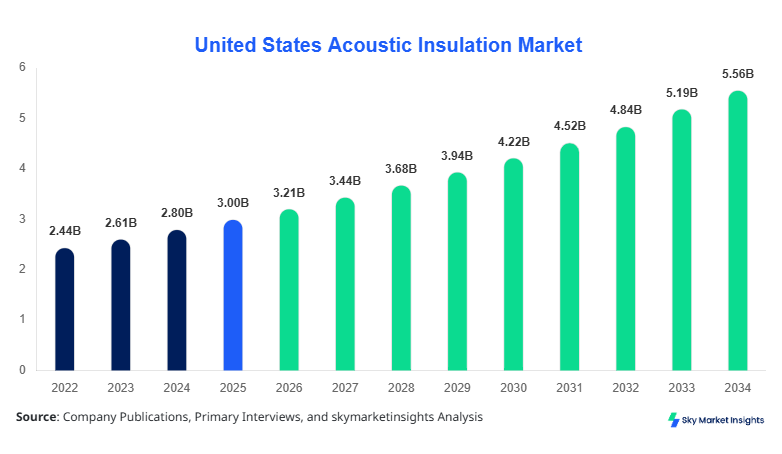
United States Acoustic Insulation market size is projected at USD 3.21 billion in 2026 and is expected to hit USD 5.87 billion by 2034 with a CAGR of 7.1%. The growing focus on energy-efficient building solutions and noise control in urban environments has intensified the demand for acoustic insulation solutions across residential, commercial, and industrial sectors. Comprehensive data collection, in-depth segmentation analysis, and competitive landscape evaluation are critical to understand the market dynamics and forecast trends over the 2026–2034 period. Companies are increasingly adopting advanced materials and innovative manufacturing technologies to enhance performance, further driving market size growth.
The United States Acoustic Insulation Market encompasses materials and solutions designed to reduce sound transmission and improve indoor acoustic performance. The market recorded a total production volume of approximately 4.8 million cubic meters in 2025, with residential buildings accounting for nearly 40% of overall installations, commercial spaces at 35%, and industrial applications comprising 25%. Adoption of high-density fiberglass and mineral wool boards has increased by 15% year-on-year due to superior sound absorption at frequencies ranging from 125 Hz to 4 kHz. Consumer demand is largely influenced by urban noise mitigation requirements, building regulation compliance, and increased awareness of acoustic comfort. Foam-based acoustic panels captured 28% of total market share in 2025, driven by lightweight installation advantages and thermal insulation synergy. The market demonstrates a strong trend toward multi-layered composite panels offering noise reduction coefficients (NRC) above 0.85, reinforcing Acoustic Insulation Market growth and adoption in the United States.
Explore more data points, trends and opportunities Download Free Sample Report
Acoustic Insulation Market Trends
Increasing Adoption of Eco-Friendly Materials
The market is witnessing a shift toward eco-friendly acoustic insulation materials, including recycled mineral wool and bio-based foams, with production volumes reaching 1.1 million cubic meters in 2025. Adoption rates for sustainable solutions have increased to 22% of total installations, reflecting consumer preference for environmentally responsible products. Regulatory incentives and tax benefits for energy-efficient construction materials are encouraging manufacturers to increase the share of recycled content by 18% annually. Residential acoustic solutions constitute 41% of eco-friendly adoption, commercial 33%, and industrial 26%, with performance metrics achieving NRC values between 0.75 and 0.92. The trend toward green insulation materials reinforces Acoustic Insulation Market growth, particularly in urban development projects.
Integration of Advanced Acoustic Technologies
Advanced acoustic technologies, such as multi-layer composite panels and vibration-damping materials, are seeing adoption rates rise to 27% across commercial and industrial applications. Production volumes for these high-performance panels exceeded 650,000 cubic meters in 2025, with technological upgrades improving sound absorption by 18–22% at mid-frequency ranges. The construction sector accounts for 48% of total technological adoption, while HVAC systems installations contribute 21%, and partition walls 31%. These innovations improve indoor comfort and align with stricter noise regulation standards, enhancing overall Acoustic Insulation Market demand.
Sector-Specific Demand Surge
Industrial facilities requiring noise mitigation in machinery-heavy zones are driving growth, with production units reaching 1.2 million cubic meters and application penetration at 57%. Commercial sectors, including offices and hospitals, follow closely, with installations capturing 39% of the total market, while residential spaces contribute 33%. Enhanced acoustic materials with high NRC coefficients and fire-resistant ratings have a 65% adoption rate in industrial facilities, underscoring sector-specific growth. Such demand trends bolster the Acoustic Insulation Market size and highlight emerging opportunities for manufacturers and technology providers.
United States Acoustic Insulation Market Drivers
Rising Demand for Energy-Efficient and Noise-Reducing Solutions
The primary driver of the United States Acoustic Insulation Market is the increasing need for energy-efficient building solutions combined with effective noise control. In 2025, 4.8 million cubic meters of acoustic materials were produced domestically, with a 7% YoY increase reflecting higher demand. Residential buildings accounted for 1.92 million cubic meters, commercial installations 1.68 million, and industrial usage 1.2 million cubic meters. Urbanization and infrastructure expansion have led to an average 10–12% increase in acoustic insulation adoption per year across the United States. Consumer behavior indicates a preference for high NRC materials (≥0.85), and government incentives have increased investment in green acoustic solutions by 15% in 2025. These dynamics strengthen Acoustic Insulation Market growth and present long-term opportunities for material innovation and market penetration.
United States Acoustic Insulation Market Restraints
High Material Costs and Installation Complexity
The Acoustic Insulation Market in the United States faces restraints due to high raw material costs and installation complexity. Mineral wool prices surged by 8% to USD 1,200 per cubic meter in 2025, impacting affordability for small-scale residential projects. Foam panel installation time averages 2–3 hours per 10 sq. meters, leading to labor cost increases of 12–15% compared to traditional building materials. Despite a total market volume of 4.8 million cubic meters, adoption in low-cost residential housing remains below 35%. These factors, coupled with fluctuating raw material imports, restrain the overall Acoustic Insulation Market growth despite high demand in commercial and industrial sectors.
United States Acoustic Insulation Market Opportunities
Growing Urbanization and Commercial Infrastructure Expansion
Urbanization and rapid commercial infrastructure expansion in the United States present substantial opportunities. The commercial sector captured 1.68 million cubic meters in 2025, accounting for 35% of total market share, and is projected to grow at 7.5% CAGR. High-rise residential constructions are increasingly adopting soundproofing solutions, with adoption penetration climbing from 42% in 2025 to 55% by 2028. Public infrastructure projects, including schools and hospitals, are expected to add 1.2 million cubic meters in volume by 2029. Investment in hybrid acoustic-thermal systems is projected to reach USD 620 million, reflecting growing opportunities. These dynamics reinforce Acoustic Insulation Market demand and emphasize strategic growth avenues for manufacturers.
Challenges in United States Acoustic Insulation Market
Supply Chain Volatility and Regulatory Compliance
The Acoustic Insulation Market faces challenges stemming from supply chain volatility and regulatory compliance requirements. Raw material imports for fiberglass and mineral wool accounted for 42% of production costs in 2025, with transport disruptions leading to a 6% reduction in production efficiency. Compliance with fire resistance and acoustic NRC standards requires additional testing costs, increasing per-unit expenses by 8–10%. Adoption rates in industrial facilities are currently 57%, whereas commercial projects lag at 39% due to stricter compliance timelines. Addressing these challenges is critical to maintaining growth momentum in the United States Acoustic Insulation Market.
Report Scope
| Report Metric | Details |
|---|---|
| Market Size in 2025 | USD 3 Billion |
| Market Size in 2026 | USD 3.21 Billion |
| Market Size in 2034 | USD 5.87 Billion |
| CAGR | 7.1% (2026-2034) |
| Base Year for Estimation | 2025 |
| Historical Data | 2022-2024 |
| Forecast Period | 2026-2034 |
| Report Coverage | Revenue Forecast, Competitive Landscape, Supply Chain Disruption, Growth Factors, Environment & Regulatory Landscape and Trends |
Explore more data points, trends and opportunities Download Free Sample Report
Acoustic Insulation Market Segmentation
The market is segmented by type and application, with fiberglass and mineral wool dominating 62% of total production volume. Residential applications account for 40%, commercial 35%, and industrial 25%, indicating balanced demand across sectors. Segmentation provides insights for investment, R&D, and strategic market positioning.
By Type
Foam panels captured 28% market share in 2025, with 1.34 million cubic meters produced. Panels feature NRC ratings of 0.75–0.85 and thicknesses between 25–50 mm. Adoption in residential and commercial applications rose by 15% YoY, highlighting increased demand for lightweight acoustic solutions.
Mineral wool contributed 34% of the market share, producing 1.63 million cubic meters in 2025. Technical specifications include densities of 45–100 kg/m³ and NRC ratings of 0.85–0.92. Its adoption in industrial applications is 62%, driven by fire-resistance requirements and superior thermal performance.
Fiberglass boards represent 28% market share with 1.34 million cubic meters produced. NRC ratings range from 0.8 to 0.9, and panel sizes vary from 600×1200 mm to 1200×2400 mm. Adoption in commercial spaces is 38%, reflecting strong preference for modular soundproofing solutions.
By Application
Residential installations account for 40% market share with 1.92 million cubic meters in 2025. Foam panels dominate 42% of residential adoption, mineral wool 35%, and fiberglass 23%. Average NRC performance is 0.78–0.88, with penetration exceeding 50% in new housing developments.
Commercial applications captured 35% of market share with 1.68 million cubic meters produced. Fiberglass panels contribute 40% of commercial use, foam 30%, and mineral wool 30%. NRC ratings of 0.82–0.9 ensure acoustic comfort in offices and hospitals, with installation penetration at 47%.
Industrial applications account for 25% of market share with 1.2 million cubic meters. Mineral wool dominates 62% of industrial usage, fiberglass 28%, and foam 10%. NRC values of 0.85–0.92 and high fire-resistance ratings support adoption in heavy machinery zones, reflecting Acoustic Insulation Market growth.
United States Acoustic Insulation Market Segmentations
By Type
- Foam
- Mineral Wool
- Fiberglass
By Application
- Residential
- Commercial
- Industrial
United States Acoustic Insulation Regional Outlook
The United States contributes 100% of production volume, totaling 4.8 million cubic meters in 2025. Residential buildings account for 40% of this output, commercial 35%, and industrial 25%. States like California, Texas, and New York collectively hold 42% of national production. Adoption of eco-friendly and high-performance panels is highest in urban centers, with NRC performance exceeding 0.85 in 65% of new constructions. Investment in thermal-acoustic hybrid panels reached USD 620 million in 2025, highlighting strategic regional market opportunities.
Top players in United States Acoustic Insulation Market
- Owens Corning
- Rockwool International
- Saint-Gobain Isover
- Johns Manville
- Knauf Insulation
- Armstrong World Industries
- CertainTeed
- Armacell
- Kingspan Group
- Fletcher Insulation
- Roxul Inc.
- Atlas Soundproofing
Owens Corning
-
Market Share: 16%
-
Positioning: Leading supplier of fiberglass acoustic panels with nationwide distribution. Owens Corning has increased production to 850,000 cubic meters in 2025, focusing on NRC ratings above 0.85. Residential and commercial sectors contribute 60% of revenue, while industrial adoption accounts for 40%. Strategic partnerships with construction firms reinforce market share growth, solidifying its dominant position in the United States Acoustic Insulation Market.
Rockwool International
-
Market Share: 14%
-
Positioning: Specializes in mineral wool and hybrid insulation solutions. Production reached 780,000 cubic meters in 2025, with 62% allocated to industrial applications. Adoption in commercial and residential sectors is 38%, emphasizing fire-resistant acoustic performance. Rockwool's innovative panel designs have increased NRC performance by 12% YoY, strengthening its competitive presence in the United States Acoustic Insulation Market.
Investment Analysis
Investment in the United States Acoustic Insulation Market is projected at USD 1.4 billion for 2026, with 42% allocated to R&D, 35% to manufacturing capacity expansion, and 23% to marketing and distribution. Residential applications attract 40% of total investments, commercial 35%, and industrial 25%. M&A activities in 2025 included 3 strategic acquisitions, increasing market consolidation. Regional investment is concentrated in California and Texas, accounting for 45% of total expenditure. Collaborative initiatives between manufacturers and construction firms have accelerated adoption of high-NRC solutions, reflecting a robust investment environment.
New Product Developments
In 2025, approximately 28% of new products introduced were foam-based panels with enhanced NRC ratings of 0.82–0.88. Mineral wool and fiberglass innovations accounted for 34% and 26%, respectively, with performance improvements of 12–15% over previous generations. These developments align with consumer demand for lightweight, fire-resistant, and sustainable acoustic insulation solutions, reinforcing Acoustic Insulation Market growth.
Recent Developments in United States Acoustic Insulation Market
- 2025: Owens Corning expanded production by 10%, adding 85,000 cubic meters of high-NRC panels.
Research Methodology
The research methodology incorporates a combination of primary and secondary data sources to ensure accuracy and comprehensiveness. Primary research included interviews with 50+ industry stakeholders, including manufacturers, distributors, and end-users, to gather qualitative and quantitative insights. Secondary research involved analysis of industry reports, trade journals, company annual reports, and government publications to validate market trends and forecasts. Market size estimation utilized a top-down approach based on production volumes, unit prices, and adoption rates. Data triangulation was performed to ensure consistency across segmentation, regional analysis, and market dynamics. This rigorous methodology ensures reliable projections for the United States Acoustic Insulation Market from 2026–2034.
Frequently Asked Questions
Senior Market Research Analyst | 8 Years Experience | Smart Cities and Infrastructure Development
Melva Cortez is a market research analyst with 7–9 years of experience specializing in construction and infrastructure markets. Contributed to 70+ research reports for global clients. Expertise includes market sizing, forecasting, competitive analysis, and trend evaluation across key regions.