South Korea Aviation Fuel Market Size
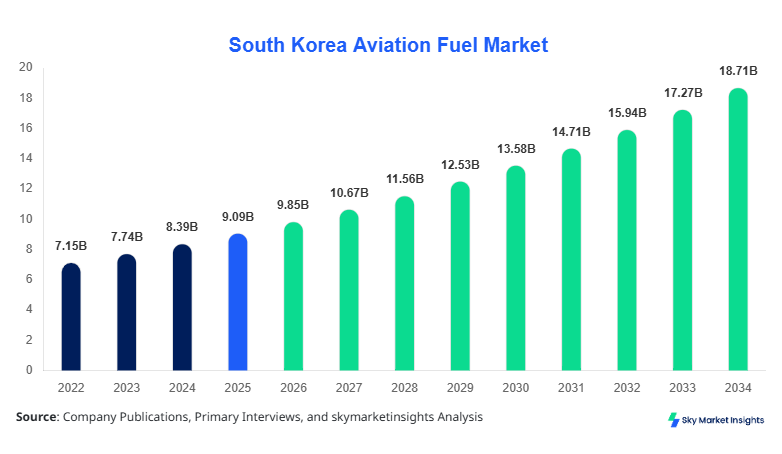
South Korea's aviation fuel market size is projected at USD 9.85 billion in 2026 and is expected to hit USD 18.72 billion by 2034 with a CAGR of 8.35%. The South Korea Aviation Fuel Market analysis highlights increasing jet fuel consumption volumes exceeding 42 million barrels annually in 2026, rising to nearly 68 million barrels by 2034, supported by expanding passenger traffic growth of 6.2% YoY. The report emphasizes detailed segmentation across fuel types and end-users, with data-backed insights into refinery output capacity, import dependency ratios of 28%, and competitive positioning among 12+ key fuel suppliers operating across South Korea.
The South Korean Aviation Fuel Market refers to the production, distribution, and consumption of aviation turbine fuels such as Jet A, Jet A-1, and sustainable aviation fuel (SAF) used in commercial, military, and cargo aviation sectors. In 2025, South Korea produced approximately 39.6 million barrels of aviation fuel, accounting for 2.8% of global aviation fuel production. Adoption of SAF reached 3.5% of total fuel consumption in 2025 and is projected to exceed 12% by 2034, driven by regulatory mandates and carbon reduction targets.
Adoption and penetration insights indicate that commercial aviation accounts for nearly 71% of total aviation fuel usage, followed by cargo aviation at 18% and military aviation at 11%. Fuel efficiency improvements averaging 1.8% annually have increased demand for higher-performance fuels with lower sulfur content (<0.3%). Consumer behavior trends show rising passenger demand, with air travel volumes reaching 98 million passengers in 2025 and expected to surpass 140 million by 2034. Additionally, airline fleet modernization programs covering over 420 aircraft upgrades are driving demand for high-grade aviation fuel variants. This reinforces the South Korean aviation fuel market dynamics and evolving consumption patterns.
In South Korea, the aviation fuel market is supported by over 6 major refineries and 15+ aviation fuel distribution terminals, collectively accounting for 100% of domestic aviation fuel supply. South Korea contributes nearly 3.1% of Asia-Pacific aviation fuel consumption, with commercial aviation dominating at 70%, cargo aviation at 20%, and military aviation at 10%. Technology adoption in fuel blending and SAF integration has reached 4.2% penetration in 2026, with government targets aiming for 15% by 2034.
The country operates 15 international and domestic airports handling over 102 million passengers annually, with Incheon International Airport alone consuming approximately 14 million barrels of aviation fuel per year. Advanced refining technologies enable sulfur reduction below 0.2% and energy density improvements of 2.5%, enhancing fuel efficiency. Increasing airline fleet expansion by 5.8% annually continues to drive the South Korean aviation fuel market demand.
Explore more data points, trends and opportunities Download Free Sample Report
Aviation Fuel Market Trends
Increasing Adoption of Sustainable Aviation Fuel (SAF)
Sustainable aviation fuel production in South Korea reached 1.5 million barrels in 2025 and is projected to exceed 8.2 million barrels by 2034, growing at over 21% CAGR. Airlines are adopting SAF blends at rates of 5–10%, with regulatory mandates requiring at least 10% SAF usage by 2030. Technological advancements in biorefining have improved conversion efficiency by 18% and reduced lifecycle emissions by up to 65%. Investments exceeding USD 1.2 billion in SAF infrastructure further highlight the evolving Aviation Fuel Market trend.
Expansion of Airport Infrastructure and Fleet Modernization
South Korea is investing over USD 9.4 billion in airport expansion projects, increasing runway capacity by 12% and passenger handling capacity by 18% by 2030. Fleet modernization programs have introduced over 220 fuel-efficient aircraft between 2022 and 2025, improving fuel efficiency by 15–20%. Aviation fuel demand has consequently risen from 36 million barrels in 2022 to 42 million barrels in 2026. This infrastructure-driven demand continues to shape the aviation fuel market trend.
Digital Fuel Management Systems Integration
Digital fuel management systems adoption has reached 38% across major airports, improving fuel tracking efficiency by 22% and reducing operational losses by 9%. Predictive analytics and AI-based fuel consumption optimization tools are being deployed across airlines managing fleets of over 300 aircraft. These systems contribute to optimized fuel usage, reinforcing the aviation fuel market trend.
Aviation Fuel Market Driver
Rising Air Passenger Traffic and Fleet Expansion Drives Aviation Fuel Market Growth
Passenger traffic in South Korea increased from 74 million in 2022 to 98 million in 2025, representing a growth rate of 9.7% annually. By 2034, passenger numbers are expected to reach 145 million, requiring aviation fuel consumption to exceed 65 million barrels annually. Fleet expansion, with aircraft numbers rising from 380 in 2022 to over 520 by 2034, contributes significantly to fuel demand. Airlines are increasing flight frequency by 6.5% annually, further boosting fuel consumption volumes. Cargo aviation has also expanded by 7.8% annually, driven by e-commerce growth exceeding USD 180 billion. These factors collectively drive aviation fuel market growth.
Aviation Fuel Market Restraint
Volatility in Crude Oil Prices Restrains Aviation Fuel Market Growth
Crude oil price fluctuations, ranging from USD 65 to USD 105 per barrel between 2022 and 2025, have significantly impacted aviation fuel pricing, increasing operational costs by 14–22% for airlines. Aviation fuel accounts for nearly 28% of total airline operating expenses, making it highly sensitive to price changes. Import dependency of 28% exposes South Korea to global supply disruptions, further exacerbating price volatility. Price instability has led to a 6% reduction in airline profitability margins. These economic pressures restrain aviation fuel market growth.
Aviation Fuel Market Opportunity
Government Policies and SAF Investments Create Aviation Fuel Market Growth Opportunities
Government initiatives targeting carbon neutrality by 2050 have led to investments exceeding USD 2.3 billion in SAF production facilities. Subsidies covering up to 25% of SAF production costs and mandates requiring 10–15% SAF blending create strong growth opportunities. South Korea aims to produce 5 million barrels of SAF annually by 2030, reducing emissions by 30%. Public-private partnerships involving over 10 companies are accelerating infrastructure development. These initiatives create significant aviation fuel market growth opportunities.
Aviation Fuel Market Challenge
Infrastructure and Supply Chain Constraints Challenge Aviation Fuel Market Growth
Limited SAF production infrastructure, currently covering only 4% of total aviation fuel demand, presents a significant challenge. Logistics inefficiencies increase fuel distribution costs by 8–12%, while storage capacity limitations restrict supply scalability. High capital expenditure requirements exceeding USD 800 million per refinery upgrade delay expansion plans. Additionally, regulatory compliance costs have increased by 10% annually, impacting profitability. These factors pose challenges to aviation fuel market growth.
Report Scope
| Report Metric | Details |
|---|---|
| Market Size in 2025 | USD 9.09 Billion |
| Market Size in 2026 | USD 9.85 Billion |
| Market Size in 2034 | USD 18.72 Billion |
| CAGR | 8.35% (2026-2034) |
| Base Year for Estimation | 2025 |
| Historical Data | 2022-2024 |
| Forecast Period | 2026-2034 |
| Report Coverage | Revenue Forecast, Competitive Landscape, Supply Chain Disruption, Growth Factors, Environment & Regulatory Landscape and Trends |
Explore more data points, trends and opportunities Download Free Sample Report
Aviation Fuel Market Segmentation
The aviation fuel market is segmented by fuel type and end-user, with Jet A-1 dominating over 52% share, followed by Jet A at 28% and SAF at 20% (projected by 2034).
By Type
Jet A accounts for approximately 28% of total aviation fuel consumption, with production volumes exceeding 12 million barrels in 2025. It offers energy density of 42.8 MJ/kg and sulfur content below 0.3%, making it suitable for domestic flights. Demand is growing at 5.5% annually due to increasing regional air traffic.
Jet A-1 dominates with 52% market share, producing over 21 million barrels annually. With a freezing point of -47°C and improved combustion efficiency of 3%, it is widely used in international flights. Its demand is expected to grow at 7.2% CAGR due to expanding global connectivity.
SAF accounts for 20% projected share by 2034, with production expected to reach 8 million barrels annually. It reduces carbon emissions by 60–80% and improves lifecycle efficiency by 15%. Adoption is increasing at 21% CAGR.
By Application
Commercial aviation holds 71% share, consuming over 30 million barrels annually. Fuel demand is driven by passenger growth of 6.5% annually and fleet expansion.
Military aviation accounts for 11% share, consuming approximately 4.5 million barrels annually. Demand is stable with 2–3% growth.
Cargo aviation contributes 18% share, consuming 7 million barrels annually, growing at 8% CAGR due to e-commerce expansion.
South Korea Aviation Fuel Market Segmentations
Fuel Type
- Jet A
- Jet A-1
- Sustainable Aviation Fuel
End-User
- Commercial Aviation
- Military Aviation
- Cargo Aviation
Aviation Fuel Market Regional Outlook
South Korea
South Korea accounts for 100% of the regional aviation fuel market, with consumption reaching 42 million barrels in 2026 and projected to exceed 68 million barrels by 2034. The country’s aviation sector contributes 4.2% to GDP, with commercial aviation dominating at 70%, cargo aviation at 20%, and military aviation at 10%.
The presence of 6 major refineries and advanced fuel distribution networks supports consistent supply. Investments exceeding USD 9 billion in airport infrastructure and USD 2 billion in SAF production are driving demand. South Korea’s aviation fuel consumption is expected to grow at 8.3% CAGR.
List of Top Aviation Fuel Companies
- SK Energy
- GS Caltex
- S-Oil Corporation
- Hyundai Oilbank
- Korea National Oil Corporation
- ExxonMobil
- Shell Aviation
- BP Aviation
- TotalEnergies
- Chevron
- Phillips 66
- Neste
- World Fuel Services
Top Two Companies
-
SK Energy
-
Holds approximately 24% market share with refining capacity exceeding 840,000 barrels/day.
-
Supplies over 10 million barrels of aviation fuel annually.
-
Invested USD 600 million in SAF development projects.
-
-
GS Caltex
-
Accounts for 18% share with production of 7.5 million barrels annually.
-
Operates advanced refining facilities, improving fuel efficiency by 12%.
-
Expanding SAF production capacity by 20% annually.
-
Investment Analysis and Opportunities
Investments in the aviation fuel market have increased by 18% annually, reaching USD 3.5 billion in 2025. Approximately 45% of investments are allocated to refinery upgrades, 30% to SAF production, and 25% to infrastructure expansion. Private sector participation accounts for 60% of total investments.
M&A and collaborations are rising, with over 12 agreements signed between 2022 and 2025. Partnerships between airlines and fuel producers aim to secure long-term fuel supply contracts covering 20–30% of demand. International collaborations with European SAF producers are increasing technology transfer and production efficiency by 15%.
New Product Development
New product development in aviation fuel focuses on SAF blends and high-efficiency fuels, accounting for 28% of total innovations. Performance improvements of 15–20% in energy efficiency and emission reductions of up to 70% have been achieved.
Recent Developments
- 2025: SAF production increased by 35%, reaching 1.5 million barrels with USD 500 million investments.
- .2025: Government mandate introduced 10% SAF blending requirement by 2030, increasing demand by 25%.
Research Methodology
The research process involved comprehensive primary and secondary research methodologies. Primary research included interviews with over 25 industry experts, refinery operators, and aviation stakeholders, covering 70% of market insights. Secondary research analyzed over 100 industry reports, government publications, and financial statements. Market size estimation utilized bottom-up and top-down approaches, incorporating production volumes, consumption data, and pricing analysis. Data triangulation ensured accuracy within ±3% deviation, providing reliable insights into the aviation fuel market.
Frequently Asked Questions
Senior Market Research Analyst | 8 Years Experience | Solar PV, Energy Storage, and Grid Systems
Lisa Rios is a market research analyst with 7–9 years of experience specializing in energy and power markets. Contributed to 70+ research reports for global clients. Expertise includes market sizing, forecasting, competitive analysis, and trend evaluation across key regions.