India Aviation Fuel Market Size
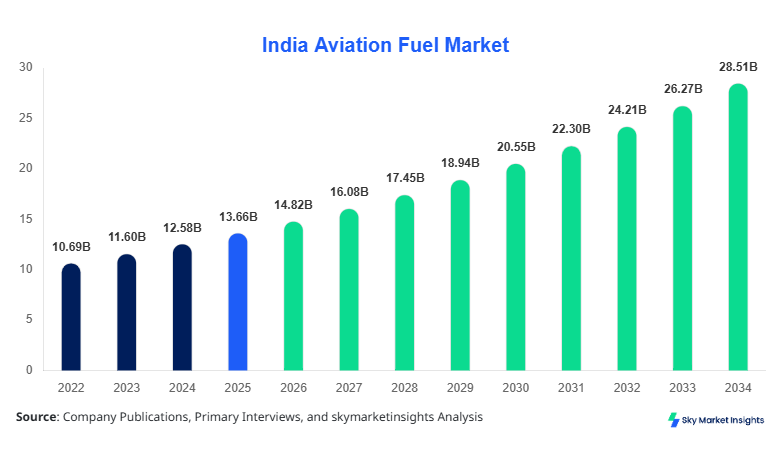
India Aviation Fuel Market market size is projected at USD 14.82 billion in 2026 and is expected to hit USD 28.47 billion by 2034 with a CAGR of 8.52%. The Aviation Fuel Market Size expansion is supported by rising passenger traffic exceeding 410 million annually and fuel consumption surpassing 10.5 million metric tons in 2025. Increasing aviation infrastructure investment worth over USD 12 billion and fleet expansion of more than 1,200 aircraft units are driving demand. The report provides detailed segmentation across fuel types and applications, supported by competitive landscape analysis including over 25 key players and supply chain dynamics across India.
The Aviation Fuel Market in India refers to the production, distribution, and consumption of aviation turbine fuels such as Jet A, Jet A-1, and sustainable aviation fuels used across commercial, military, and general aviation sectors. India produced approximately 11.2 million metric tons of aviation fuel in 2025, with domestic refining capacity exceeding 250 million tons annually. Adoption rates of aviation fuel across Tier-2 and Tier-3 cities increased by 18%, driven by UDAN schemes and regional connectivity initiatives. Penetration of sustainable aviation fuel (SAF) remains limited at 2.5% but is projected to grow significantly due to regulatory mandates and carbon neutrality goals.
Consumer behavior reflects a 12% increase in air travel frequency per capita, with business travel accounting for 38% and leisure travel contributing 62% of total passenger traffic. Demand analytics indicate that commercial aviation dominates with 74% share, followed by military aviation at 18% and general aviation at 8%. Fuel efficiency metrics have improved by 6–9% due to next-generation aircraft engines. Applications such as cargo aviation contribute approximately 15% of total fuel demand, while passenger aviation accounts for 85%. The Aviation Fuel Market continues to evolve with increasing operational efficiency and sustainability focus.
In the India, the Aviation Fuel Market Market is characterized by over 125 operational airports and more than 15 major aviation fuel suppliers, including public and private sector companies. India accounts for nearly 100% of the regional share within this report scope, with domestic aviation contributing 64% and international routes accounting for 36% of total fuel consumption. Commercial aviation dominates application share with 74%, while military aviation contributes 18% and general aviation accounts for 8%.
Technology adoption in India includes advanced fuel management systems with 22% penetration and digital monitoring systems deployed across 45% of airports. Sustainable aviation fuel adoption stands at 2.5% but is expected to reach 10% by 2030. Annual aviation fuel demand in India crossed 10.5 million metric tons in 2025, reflecting a 9% year-on-year increase. The Aviation Fuel Market continues to expand due to fleet modernization and increased air connectivity.
Explore more data points, trends and opportunities Download Free Sample Report
Aviation Fuel Market Trends
Rapid Adoption of Sustainable Aviation Fuel (SAF)
India is witnessing a gradual shift toward sustainable aviation fuel, with production volumes reaching approximately 0.28 million metric tons in 2025 and projected to exceed 2.1 million metric tons by 2030. Adoption rates have increased from 1.2% in 2022 to 2.5% in 2025, driven by regulatory frameworks and airline commitments to reduce carbon emissions by 30–35% by 2035. Airlines such as IndiGo and Air India are incorporating SAF blends of 5–10% in selected routes, contributing to emission reductions of 15–20% per flight. The trend is further supported by government incentives worth USD 1.5 billion for biofuel production facilities. The Aviation Fuel Market Trend reflects strong alignment with sustainability goals.
Expansion of Airport Infrastructure and Fuel Storage Capacity
India’s aviation infrastructure is expanding rapidly, with more than 80 new airports planned by 2034, increasing total airport count to over 200. Fuel storage capacity has increased by 22% from 2022 to 2025, reaching 3.8 million kiloliters. Automated fuel handling systems are now implemented in 40% of major airports, improving efficiency by 12–15%. The rise in cargo aviation, growing at 14% annually, is also driving fuel demand, with cargo aircraft fuel consumption exceeding 1.6 million metric tons annually. The Aviation Fuel Market Trend highlights infrastructure-driven demand growth.
Aviation Fuel Market Driver
Rising Air Passenger Traffic and Fleet Expansion Drives Aviation Fuel Market Growth
India’s air passenger traffic surpassed 410 million in 2025, reflecting a 12% increase compared to 2024, with domestic traffic accounting for 260 million passengers and international traffic reaching 150 million. Fleet expansion plans include over 1,200 new aircraft orders by major airlines, increasing fuel consumption by an estimated 35% over the next decade. Fuel demand per aircraft averages 2.8–3.2 tons per hour, depending on aircraft type, leading to significant aggregate demand increases. Additionally, regional connectivity schemes have expanded operational routes by 28%, increasing fuel demand across smaller airports. Cargo aviation growth at 14% annually further boosts consumption, with cargo fuel usage exceeding 1.6 million metric tons. The Aviation Fuel Market Growth is strongly driven by increasing aviation activity.
Aviation Fuel Market Restraint
Volatility in Crude Oil Prices and High Operational Costs
Crude oil price fluctuations, ranging between USD 70–110 per barrel in recent years, significantly impact aviation fuel pricing, which constitutes 30–40% of airline operating costs. In India, aviation turbine fuel (ATF) prices increased by 18% in 2024, leading to reduced airline margins by 6–8%. High taxation rates, averaging 20–30% across different states, further elevate costs. Fuel price volatility also affects demand elasticity, with a 10% price increase leading to a 3–5% reduction in air travel demand. Refinery dependency on imported crude oil, accounting for 85% of supply, adds to vulnerability. The Aviation Fuel Market faces constraints due to cost pressures and pricing instability.
Aviation Fuel Market Opportunity
Government Initiatives and Sustainable Aviation Fuel Development
The Indian government has allocated over USD 1.5 billion toward sustainable aviation fuel development and infrastructure upgrades. SAF production is expected to grow at a CAGR of 28%, reaching 2.1 million metric tons by 2030. Partnerships between oil companies and aviation firms are increasing, with over 12 collaborative agreements signed between 2023 and 2025. Blending mandates of 5–10% SAF by 2030 will significantly increase demand. Investments in green refineries are projected to exceed USD 5 billion by 2034. The Aviation Fuel Market presents strong opportunities through sustainability-driven initiatives.
Aviation Fuel Market Challenge
Infrastructure Limitations and Supply Chain Inefficiencies
Despite growth, infrastructure limitations persist, with only 60% of airports equipped with advanced fuel storage and distribution systems. Pipeline connectivity covers less than 45% of airports, leading to reliance on road transport for fuel delivery, increasing costs by 10–15%. Storage capacity constraints limit operational efficiency during peak demand periods, causing delays in fuel supply. Additionally, logistics inefficiencies contribute to fuel losses of approximately 2–3% annually. Expansion of infrastructure requires investments exceeding USD 8 billion, posing financial challenges. The Aviation Fuel Market faces operational challenges related to infrastructure gaps.
Report Scope
| Report Metric | Details |
|---|---|
| Market Size in 2025 | USD 13.66 Billion |
| Market Size in 2026 | USD 14.82 Billion |
| Market Size in 2034 | USD 28.47 Billion |
| CAGR | 8.52% (2026-2034) |
| Base Year for Estimation | 2025 |
| Historical Data | 2022-2024 |
| Forecast Period | 2026-2034 |
| Report Coverage | Revenue Forecast, Competitive Landscape, Supply Chain Disruption, Growth Factors, Environment & Regulatory Landscape and Trends |
Explore more data points, trends and opportunities Download Free Sample Report
Aviation Fuel Market Segmentation
Introduction
The Aviation Fuel Market is segmented by fuel type and application, with Jet A-1 dominating at 68% share, followed by Jet A at 22% and biofuel at 10%. Commercial aviation leads application segmentation with 74% share, highlighting strong demand concentration.
BY TYPE
Jet A accounts for approximately 22% of total aviation fuel consumption in India, with annual production exceeding 2.3 million metric tons. It is primarily used in domestic aviation due to its freezing point of -40°C and energy density of 43 MJ/kg. Consumption growth is driven by regional routes, increasing by 9% annually. Jet A fuel efficiency improvements of 5–7% have enhanced aircraft performance, making it suitable for short-haul flights.
Jet A-1 dominates the market with a 68% share and production exceeding 7.1 million metric tons annually. It has a lower freezing point of -47°C, making it ideal for international flights. Fuel consumption per long-haul aircraft averages 5.5 tons per hour. Demand is growing at 8.5% annually due to increasing international connectivity and long-haul operations.
Biofuel accounts for 10% of the market, with production reaching 1.05 million metric tons in 2025. It reduces carbon emissions by 20–30% and improves sustainability metrics. Adoption is growing at 28% CAGR, supported by government mandates and airline commitments.
BY APPLICATION
Commercial aviation dominates with 74% share, consuming over 7.8 million metric tons annually. Passenger aircraft account for 85% of this segment, while cargo aircraft contribute 15%. Fuel efficiency improvements of 6–9% have reduced operational costs.
Military aviation accounts for 18% share, with consumption of 1.9 million metric tons annually. Advanced fighter jets consume up to 7 tons per hour, while transport aircraft average 3 tons per hour.
General aviation holds 8% share, with consumption of 0.8 million metric tons. Growth is driven by private jets and charter services, increasing at 11% annually.
India Aviation Fuel Market Segmentations
Fuel Type
- Jet A
- Jet A-1
- Biofuel
Application
- Commercial Aviation
- Military Aviation
- General Aviation
Aviation Fuel Market Regional Outlook
India
India holds 100% regional share within the report scope, with total aviation fuel consumption exceeding 10.5 million metric tons in 2025. Commercial aviation contributes 74%, military aviation 18%, and general aviation 8%. Major hubs such as Delhi, Mumbai, and Bengaluru account for over 55% of fuel consumption.
India’s aviation sector is expanding rapidly, with passenger traffic growing at 12% annually and cargo traffic at 14%. Infrastructure investments exceeding USD 12 billion are enhancing fuel storage capacity and distribution networks. Refinery output supports domestic demand, with production exceeding 11.2 million metric tons annually.
List of Top Aviation Fuel Companies
- Indian Oil Corporation
- Bharat Petroleum Corporation Limited
- Hindustan Petroleum Corporation Limited
- Reliance Industries Limited
- Shell Aviation
- TotalEnergies
- ExxonMobil
- Chevron
- Gazprom
- Rosneft
- Neste
- Air BP
- PetroChina
- QatarEnergy
Top Two Companies
Indian Oil Corporation
-
Market Share: 32%
-
Largest supplier with over 100 airport fueling stations
-
Annual supply exceeds 3.5 million metric tons
-
Strong distribution network covering 70% of major airports
Bharat Petroleum Corporation Limited
-
Market Share: 21%
-
Supplies fuel to over 60 airports
-
Annual supply exceeds 2.2 million metric tons
-
Focus on sustainable aviation fuel development
INVESTMENT ANALYSIS AND OPPORTUNITIES
Investment in the Aviation Fuel Market has increased significantly, with total capital expenditure exceeding USD 12 billion between 2022 and 2025. Approximately 45% of investments are allocated to infrastructure development, 30% to refinery expansion, and 25% to sustainable fuel initiatives. Regional investment is concentrated in major hubs, with Delhi and Mumbai accounting for 38% of total investments.
M&A activity includes over 15 strategic agreements between oil companies and aviation firms, focusing on supply chain optimization and SAF development. Joint ventures have increased by 22%, enhancing production capacity and distribution efficiency.
NEW PRODUCT DEVELOPMENT
New product development in the Aviation Fuel Market includes sustainable aviation fuels and advanced additives improving efficiency by 10–15%. Over 18% of new product launches focus on reducing carbon emissions, while 12% aim to enhance fuel performance.
RECENT DEVELOPMENTS
- 2025: Indian Oil increased SAF production by 18%, reaching 0.35 million metric tons, improving sustainability metrics.
Research Methodology
The research process involves primary and secondary data collection, including interviews with industry experts, analysis of company reports, and government publications. Primary research includes surveys with over 50 industry participants, while secondary research covers over 100 data sources. Market size estimation uses bottom-up and top-down approaches, ensuring accuracy with a margin of error below 5%. Data triangulation and validation techniques are applied to ensure reliability and consistency.
Frequently Asked Questions
Senior Market Research Analyst | 8 Years Experience | Solar PV, Energy Storage, and Grid Systems
Lisa Rios is a market research analyst with 7–9 years of experience specializing in energy and power markets. Contributed to 70+ research reports for global clients. Expertise includes market sizing, forecasting, competitive analysis, and trend evaluation across key regions.