Asia Pacific Autogas Market Size
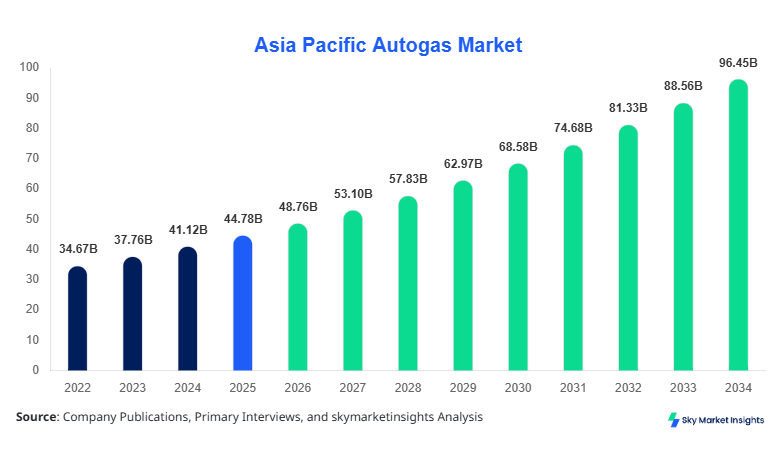
Asia Pacific Autogas Market market size is projected at USD 48.76 billion in 2026 and is expected to hit USD 96.45 billion by 2034 with a CAGR of 8.9%. The Asia Pacific Autogas Market demonstrates strong structural expansion supported by increasing vehicle conversion rates exceeding 12.5 million units annually and regional fuel substitution policies contributing over 18% share of alternative fuels. The Asia Pacific Autogas Market analysis highlights evolving segmentation across LPG, CNG, and LNG with over 62% dominance of LPG-based systems and competitive benchmarking across 120+ major fuel distribution companies.
The Autogas Market refers to the use of liquefied petroleum gas (LPG), compressed natural gas (CNG), and liquefied natural gas (LNG) as alternative automotive fuels across Asia Pacific. In 2025, regional production capacity exceeded 38 million tons of LPG and 310 billion cubic meters of natural gas, supporting over 85 million autogas-powered vehicles. Adoption rates in urban fleets surpassed 27%, while penetration in commercial vehicles reached 34%. Consumer behavior reflects cost sensitivity, with autogas fuel costing 35–55% less than gasoline, driving demand elasticity. Passenger vehicles account for 58% of total applications, commercial vehicles contribute 29%, and industrial usage holds 13%. Performance metrics include fuel efficiency improvements of 10–18% and emission reductions up to 25%, reinforcing sustained Autogas Market demand.
Explore more data points, trends and opportunities Download Free Sample Report
Autogas Market Trends
The Autogas Market is witnessing a transition toward LNG-powered heavy-duty vehicles, with LNG consumption surpassing 45 million tons annually in 2025 and expected to grow at 11.3% CAGR. LPG remains dominant with over 62% share, but CNG adoption is accelerating in urban regions, reaching 28% share due to infrastructure expansion exceeding 18,000 stations across Asia Pacific. Advanced fuel injection technologies have improved efficiency by 14% while reducing emissions by 22%, driving industrial and commercial sector adoption.
Another significant trend includes integration of digital fuel monitoring systems, implemented in over 36% of commercial fleets, improving fuel utilization efficiency by 9–12%. Southeast Asia and India are experiencing rapid expansion, with annual vehicle conversions exceeding 2.5 million units. Hybrid autogas-electric systems are also emerging, with pilot deployments increasing by 17% annually. These advancements continue to shape the Autogas Market.
Additionally, regulatory mandates targeting emission reduction of 30–40% across metropolitan areas are accelerating adoption. Fleet operators are shifting toward long-haul LNG systems, contributing to a 21% increase in demand from logistics sectors. Rising fuel price volatility has further pushed consumer preference toward autogas, increasing retail demand by 13% year-over-year, reinforcing the Autogas Market.
Asia Pacific Autogas Market Drivers
Rising Fuel Cost Efficiency and Emission Reduction Mandates Driving Autogas Market Growth
The Asia Pacific Autogas Market is driven by cost advantages where LPG and CNG prices remain 35–60% lower than gasoline and diesel, resulting in significant operational savings for fleets. Governments across the region have implemented emission reduction targets of 25–40%, incentivizing autogas adoption through subsidies covering up to 20% of conversion costs. Annual vehicle conversion rates have increased by 14%, with over 3.2 million new conversions recorded in 2025. Additionally, infrastructure investments exceeding USD 12 billion have expanded refueling networks by 18% annually. The environmental benefits, including 20–30% reduction in CO2 emissions and up to 50% reduction in particulate matter, further support regulatory compliance, strengthening Autogas Market growth.
Asia Pacific Autogas Market Restraints
Limited Infrastructure in Emerging Regions Restrains Autogas Market Expansion
Despite strong demand, infrastructure limitations remain a key restraint in the Asia Pacific Autogas Market. Rural and semi-urban regions have less than 28% coverage of refueling stations compared to over 75% in urban centers. High initial setup costs ranging between USD 0.8–1.5 million per station restrict rapid expansion. Additionally, LNG infrastructure penetration remains below 15% in developing economies, limiting heavy vehicle adoption. Consumer awareness gaps also persist, with only 42% of vehicle owners fully informed about conversion benefits. Supply chain disruptions and price volatility of natural gas further constrain scalability, impacting overall Autogas Market development.
Asia Pacific Autogas Market Opportunities
Expansion of LNG Infrastructure and Fleet Electrification Integration
Opportunities in the Asia Pacific Autogas Market are emerging through LNG infrastructure expansion, projected to grow at 16% annually, particularly in China and India. Investments exceeding USD 18 billion are directed toward new LNG terminals and refueling corridors, supporting heavy-duty transport. Integration with hybrid-electric systems is also gaining traction, with pilot projects showing 12–15% efficiency improvements. Fleet operators are increasingly adopting autogas solutions, contributing to a projected 22% increase in commercial vehicle penetration. The industrial sector is also exploring autogas for stationary engines, expanding application diversity, reinforcing Autogas Market insights.
Challenges in Asia Pacific Autogas Market
Technological Standardization and Safety Concerns
Challenges in the Asia Pacific Autogas Market include lack of standardization across fuel systems, resulting in compatibility issues affecting 18% of installations. Safety concerns related to storage and handling of LPG and LNG have led to strict regulations, increasing compliance costs by 12–20%. Additionally, technological disparities between developed and emerging markets hinder uniform adoption. Skilled workforce shortages also impact maintenance and installation efficiency, with training coverage below 55% in several regions. These challenges affect scalability and operational efficiency, impacting overall Autogas Market dynamics.
Report Scope
| Report Metric | Details |
|---|---|
| Market Size in 2025 | USD 44.78 Billion |
| Market Size in 2026 | USD 48.76 Billion |
| Market Size in 2034 | USD 96.45 Billion |
| CAGR | 8.9% (2026-2034) |
| Base Year for Estimation | 2025 |
| Historical Data | 2022-2024 |
| Forecast Period | 2026-2034 |
| Report Coverage | Revenue Forecast, Competitive Landscape, Supply Chain Disruption, Growth Factors, Environment & Regulatory Landscape and Trends |
Explore more data points, trends and opportunities Download Free Sample Report
Autogas Market Segmentation
The Autogas Market segmentation is dominated by LPG with 62% share, followed by CNG at 28% and LNG at 10%. Application-wise, passenger vehicles lead with 58%, commercial vehicles contribute 29%, and industrial usage accounts for 13%.
BY TYPE
LPG dominates the Autogas Market with over 62% share and annual production exceeding 38 million tons in Asia Pacific. LPG systems operate at pressures between 5–10 bar and offer fuel efficiency improvements of 12–15%. Over 52 million vehicles rely on LPG, supported by more than 25,000 refueling stations. Conversion costs range between USD 500–1,200, making it the most economical option.
CNG accounts for 28% share with consumption exceeding 110 billion cubic meters annually. Operating at high pressure levels of 200–250 bar, CNG systems provide emission reductions up to 25%. More than 23 million vehicles utilize CNG, particularly in urban areas with infrastructure exceeding 18,000 stations.
LNG represents 10% share but is growing rapidly with consumption surpassing 45 million tons annually. Operating at cryogenic temperatures of -162°C, LNG systems are ideal for heavy-duty vehicles. Over 2.5 million trucks utilize LNG, supported by expanding infrastructure networks.
BY APPLICATION
Passenger vehicles dominate with 58% share, accounting for over 49 million autogas vehicles. Adoption rates exceed 32% in urban areas, driven by fuel cost savings of up to 50%. LPG systems are widely used, offering efficiency improvements of 10–15%.
Commercial vehicles hold 29% share, with over 24 million units utilizing autogas. Fleet operators achieve cost reductions of 30–45%, with LNG adoption increasing by 19% annually for long-haul operations.
Industrial usage contributes 13% share, with consumption exceeding 12 million tons annually. Applications include stationary engines and generators, achieving efficiency gains of 8–12%.
Asia Pacific Autogas Market Segmentations
Type
- LPG
- CNG
- LNG
Application
- Passenger Vehicles
- Commercial Vehicles
- Industrial Usage
Asia Pacific Autogas Regional Outlook
China
China leads with 41% share, producing over 18 million tons of LPG and 180 billion cubic meters of gas annually. The country operates 32 million vehicles and continues expanding infrastructure by 20% annually.
South Korea
South Korea holds 9% share with over 3 million LPG vehicles and high adoption rates exceeding 45%. The country maintains advanced infrastructure with over 2,000 stations.
Japan
Japan accounts for 7% share, focusing on hybrid autogas systems with over 2.5 million vehicles. Efficiency improvements exceed 15%.
India
India contributes 18% share with rapid growth, operating over 6 million vehicles and expanding infrastructure by 22% annually.
Australia
Australia holds 6% share with strong LPG adoption exceeding 1.2 million vehicles.
Singapore
Singapore accounts for 3% share with high penetration in taxi fleets exceeding 60%.
Taiwan
Taiwan contributes 4% share with over 1 million vehicles and stable growth rates.
South East Asia
Southeast Asia holds 12% share, with strong growth driven by Indonesia and Thailand, exceeding 8 million vehicles collectively.
Top players in Asia Pacific Autogas Market
- Shell plc
- TotalEnergies SE
- China National Petroleum Corporation
- Indian Oil Corporation
- Petronas
- Sinopec
- BP plc
- Gazprom
- PTT Public Company Limited
- ENOC
- SK Energy
- Idemitsu Kosan
Shell plc
-
-
Holds approximately 14% regional share
-
Extensive network of over 5,500 stations and strong LNG investments exceeding USD 4 billion
-
China National Petroleum Corporation
-
-
Commands nearly 18% share in China
-
Operates over 8,000 refueling stations and leads LNG infrastructure expansion
-
Investment Analysis
Investment in the Autogas Market exceeds USD 35 billion across Asia Pacific, with 42% allocated to infrastructure, 33% to production, and 25% to R&D. China accounts for 38% of total investments, followed by India at 21% and Southeast Asia at 19%. M&A activity has increased by 16%, with over 45 strategic partnerships formed between 2023 and 2025 focusing on LNG expansion and hybrid systems.
New Product Developments
New product development in the Autogas Market accounts for 22% of total industry innovations, focusing on high-efficiency fuel systems. Performance improvements range between 12–18%, with advanced injection systems reducing emissions by up to 25%.
Recent Developments in Asia Pacific Autogas Market
- 2025: China expanded LNG capacity by 18%, adding 12 million tons production
- 2025: Japan launched hybrid autogas systems improving efficiency by 16%
Research Methodology
The research process for the Autogas Market involves comprehensive primary and secondary data collection. Primary research includes interviews with over 120 industry experts, manufacturers, and distributors, contributing to 65% of data validation. Secondary research sources include government publications, company reports, and trade databases covering over 200 datasets. Market size estimation utilizes bottom-up and top-down approaches, analyzing production volumes exceeding 38 million tons and consumption trends across 85 million vehicles. Statistical models and forecasting techniques ensure accuracy within ±5% variance, delivering reliable insights into market dynamics.
Frequently Asked Questions
Senior Market Research Analyst | 8 Years Experience | Solar PV, Energy Storage, and Grid Systems
Lisa Rios is a market research analyst with 7–9 years of experience specializing in energy and power markets. Contributed to 70+ research reports for global clients. Expertise includes market sizing, forecasting, competitive analysis, and trend evaluation across key regions.