Middle East and Africa Aviation Fuel Additives Market Size
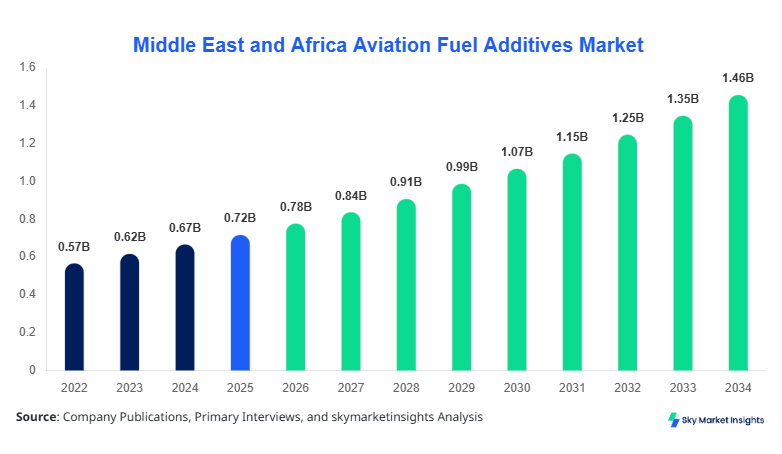
Middle East and Africa Aviation Fuel Additives market size is projected at USD 0.78 billion in 2026 and is expected to hit USD 1.46 billion by 2034 with a CAGR of 8.12%. The market expansion is supported by increasing jet fuel consumption exceeding 62 billion liters annually across the region and rising aviation infrastructure investments surpassing USD 45 billion. The need for precise data segmentation, including additive types, performance metrics such as thermal stability (above 250°C), and a competitive landscape featuring over 35 key suppliers, is driving analytical demand across stakeholders.
The Middle East and Africa Aviation Fuel Additives Market refers to the industry focused on chemical compounds added to aviation fuel to enhance performance, prevent corrosion, and improve thermal stability. Regional production of aviation turbine fuel surpassed 58 million metric tons in 2025, with additives accounting for nearly 0.8%–1.2% of total fuel volume. Adoption and penetration insights indicate that over 72% of commercial aviation fleets in the region use advanced additive formulations, while military aviation adoption stands at approximately 81%. Consumer behavior reflects a strong preference for fuel efficiency and engine longevity, with airlines targeting a 3%–5% reduction in maintenance costs through additive usage. Demand analytics highlight that commercial aviation contributes nearly 61% of additive consumption, followed by military aviation at 28% and general aviation at 11%. Technical performance metrics such as oxidation stability exceeding 16 hours and conductivity levels of 50–600 pS/m are critical benchmarks. The Aviation Fuel Additives Market demonstrates consistent industrial relevance through its operational necessity and evolving technological requirements.
In the Saudi Arabia, the Aviation Fuel Additives Market is witnessing substantial expansion driven by over 27 active aviation fuel blending facilities and more than 18 additive suppliers operating domestically. The country accounts for approximately 34% of the regional market share, supported by jet fuel consumption exceeding 14 billion liters annually. Application-wise, commercial aviation dominates with 64% share, followed by military aviation at 26% and general aviation at 10%. Technology adoption rates for advanced antioxidant additives exceed 78%, while static dissipator usage has reached 69% penetration across refineries. Additionally, Saudi Arabia’s aviation infrastructure investments have crossed USD 12 billion, further strengthening additive demand. The Aviation Fuel Additives Market in the country continues to expand due to high fuel throughput and modernization initiatives.
Explore more data points, trends and opportunities Download Free Sample Report
Aviation Fuel Additives Market Trends
Rising Adoption of High-Performance Additives
The Aviation Fuel Additives Market is experiencing a shift toward high-performance additives capable of withstanding extreme temperatures above 300°C and pressures exceeding 40 psi. Production volumes of advanced additives have crossed 1.8 million tons globally, with the Middle East and Africa contributing nearly 14% of total output. Adoption rates of multifunctional additives have increased by 22% between 2022 and 2025, driven by the need for improved fuel efficiency and reduced emissions. The commercial aviation sector alone has witnessed a 19% rise in additive consumption, while military aviation has recorded a 15% increase. This trend highlights a growing emphasis on performance optimization and regulatory compliance within the Aviation Fuel Additives Market.
Integration of Sustainable and Bio-Based Additives
The shift toward sustainability has led to the integration of bio-based additives, accounting for approximately 9% of total additive usage in 2025, up from 4% in 2022. Production capacity for sustainable additives has reached 320,000 metric tons annually in the region. Airlines are increasingly adopting these solutions to meet carbon reduction targets of 15%–25% by 2030. The use of bio-based antioxidants and corrosion inhibitors has improved fuel efficiency by 2%–3%, while reducing sulfur emissions by up to 18%. The Aviation Fuel Additives Market is aligning with environmental regulations and sustainability goals, reflecting a significant transformation in additive composition and sourcing.
Aviation Fuel Additives Market Driver
Rising Air Traffic and Fuel Consumption Driving Market Expansion
The rapid increase in air passenger traffic, exceeding 420 million passengers annually in the Middle East and Africa, is a primary driver of the Aviation Fuel Additives Market. Jet fuel consumption has grown by 6.5% annually, reaching over 62 billion liters in 2025. Additives play a crucial role in maintaining fuel stability and engine performance, particularly under high-temperature conditions exceeding 250°C. The expansion of airport infrastructure, with over 35 new airports under development and investments surpassing USD 45 billion, is further boosting additive demand. Commercial aviation accounts for 61% of additive consumption, while military aviation contributes 28%. The increasing fleet size, projected to grow by 4.8% annually, necessitates enhanced fuel quality, thereby driving the Aviation Fuel Additives Market Growth.
Aviation Fuel Additives Market Restraint
High Cost of Advanced Additives Limiting Adoption
The cost of advanced aviation fuel additives, ranging between USD 3,000 and USD 7,500 per ton, poses a significant restraint for smaller operators and developing economies within the region. Approximately 38% of regional airlines face budget constraints, limiting their ability to adopt high-performance additives. Additionally, fluctuations in raw material prices, particularly petrochemical derivatives, have increased production costs by 12%–18% over the past three years. The dependency on imported additive components, accounting for nearly 42% of supply, further exacerbates cost challenges. These factors collectively hinder widespread adoption and slow the Aviation Fuel Additives Market Growth.
Aviation Fuel Additives Market Opportunity
Expansion of Sustainable Aviation Fuel (SAF) Integration
The integration of Sustainable Aviation Fuel (SAF), projected to reach 8% of total fuel usage by 2030, presents a significant opportunity for the Aviation Fuel Additives Market. SAF requires specialized additives to maintain stability and performance, creating demand for innovative formulations. Investments in SAF production facilities have exceeded USD 6.8 billion across the region, with capacity expected to reach 5 million tons annually by 2030. Additive manufacturers are developing solutions that enhance SAF compatibility, improving fuel efficiency by 3%–5%. This emerging segment is expected to contribute over 18% of additive demand by 2034, offering substantial opportunities for market expansion.
Aviation Fuel Additives Market Challenge
Regulatory Compliance and Standardization Issues
Strict regulatory requirements, including ASTM D1655 and DEF STAN 91-91 standards, present challenges for additive manufacturers. Compliance costs have increased by approximately 14% annually, with certification processes taking up to 18 months. Variations in regulatory frameworks across countries such as UAE, Saudi Arabia, and South Africa further complicate market entry. Approximately 27% of manufacturers report delays in product approvals due to inconsistent standards. Additionally, the need for continuous testing and quality assurance, involving over 120 performance parameters, increases operational complexity. These challenges impact the scalability and efficiency of the Aviation Fuel Additives Market.
Report Scope
| Report Metric | Details |
|---|---|
| Market Size in 2025 | USD 0.72 Billion |
| Market Size in 2026 | USD 0.78 Billion |
| Market Size in 2034 | USD 1.46 Billion |
| CAGR | 8.12% (2026-2034) |
| Base Year for Estimation | 2025 |
| Historical Data | 2022-2024 |
| Forecast Period | 2026-2034 |
| Report Coverage | Revenue Forecast, Competitive Landscape, Supply Chain Disruption, Growth Factors, Environment & Regulatory Landscape and Trends |
Explore more data points, trends and opportunities Download Free Sample Report
Aviation Fuel Additives Market Segmentation
The Aviation Fuel Additives Market is segmented by type and application, with antioxidants dominating approximately 42% share, followed by metal deactivators at 33% and static dissipators at 25%. Application-wise, commercial aviation leads with 61% share, followed by military aviation at 28% and general aviation at 11%.
By type
Antioxidants hold a dominant 42% share in the Aviation Fuel Additives Market, with production exceeding 680,000 metric tons annually. These additives prevent oxidation at temperatures above 200°C, extending fuel shelf life by up to 18 months. Adoption rates exceed 75% across commercial aviation fleets, while military usage stands at 81%. Antioxidants improve fuel stability by reducing gum formation by 35%–45%, ensuring optimal engine performance. The demand for high-performance antioxidants is driven by increasing long-haul flights exceeding 12 hours, requiring stable fuel composition. Their widespread usage reinforces their critical role in the Aviation Fuel Additives Market.
Metal deactivators account for approximately 33% of the Aviation Fuel Additives Market, with annual production reaching 520,000 metric tons. These additives neutralize metal ions such as copper and iron, reducing catalytic oxidation by up to 40%. Adoption rates stand at 68% in commercial aviation and 74% in military aviation. They are particularly essential in regions with high humidity levels exceeding 60%, where metal contamination risks are higher. The increasing use of advanced alloys in aircraft components has further driven demand for metal deactivators.
Static dissipators represent 25% of the Aviation Fuel Additives Market, with production volumes of approximately 390,000 metric tons annually. These additives enhance fuel conductivity to levels between 50 and 600 pS/m, preventing electrostatic discharge during fuel handling. Adoption rates exceed 70% across refineries and fuel distribution systems. The rising emphasis on safety standards and prevention of ignition hazards has significantly boosted demand for static dissipators.
By Applications
Commercial aviation dominates with a 61% share in the Aviation Fuel Additives Market, consuming over 38 billion liters of treated fuel annually. Additive usage penetration exceeds 85% across major airlines, driven by the need for fuel efficiency and engine reliability. Technical roles include oxidation prevention, corrosion inhibition, and static charge dissipation. The sector’s rapid growth, with passenger traffic increasing by 6% annually, continues to drive additive demand.
Military aviation accounts for 28% of the Aviation Fuel Additives Market, with consumption exceeding 17 billion liters annually. Additives are critical for maintaining performance under extreme conditions, including temperatures below -40°C and high-altitude operations. Penetration rates exceed 88%, reflecting stringent performance requirements. The increasing defense budgets, exceeding USD 120 billion across the region, further support additive demand.
General aviation holds an 11% share, with fuel consumption of approximately 7 billion liters annually. Additive penetration stands at 62%, driven by private and charter aviation growth. Technical roles include fuel stabilization and corrosion prevention, ensuring operational safety. The increasing number of private aircraft, growing at 4.2% annually, contributes to steady demand.
Middle East and Africa Aviation Fuel Additives Market Segmentations
Type
- Antioxidants
- Metal Deactivators
- Static Dissipators
Application
- Commercial Aviation
- Military Aviation
- General Aviation
Aviation Fuel Additives Market Regional Outlook
UAE
The UAE accounts for approximately 18% of the regional Aviation Fuel Additives Market, with fuel consumption exceeding 11 billion liters annually. The country hosts over 12 major aviation fuel facilities and contributes significantly to commercial aviation demand, accounting for 65% of additive usage. Investments in aviation infrastructure, exceeding USD 8 billion, support market expansion. The adoption rate of advanced additives exceeds 76%, driven by the presence of major international airlines. The UAE continues to be a key hub for aviation fuel distribution and additive consumption.
Turkey
Turkey holds a 14% share, with aviation fuel consumption surpassing 9 billion liters annually. The country’s strategic location between Europe and Asia drives high air traffic, exceeding 210 million passengers annually. Commercial aviation dominates with 59% share, followed by military aviation at 31%. Additive adoption rates have reached 71%, supported by modernization of airport infrastructure and fleet expansion.
Saudi Arabia
Saudi Arabia leads with a 34% share, driven by fuel consumption exceeding 14 billion liters annually. The country’s aviation sector is supported by over 27 fuel blending facilities and significant investments in airport development. Commercial aviation accounts for 64% of additive usage, while military aviation contributes 26%. The Aviation Fuel Additives Market in Saudi Arabia continues to expand due to high demand and technological adoption.
South Africa
South Africa holds a 12% share, with fuel consumption of approximately 7.5 billion liters annually. The country’s aviation sector is supported by over 9 major airports and increasing passenger traffic. Additive adoption rates exceed 68%, driven by safety regulations and performance requirements.
Egypt
Egypt accounts for 11% share, with fuel consumption exceeding 6.8 billion liters annually. The country’s aviation sector is growing at 5.2% annually, supported by tourism and infrastructure development. Additive usage is concentrated in commercial aviation, accounting for 63% of demand.
Nigeria
Nigeria holds a 9% share, with fuel consumption of approximately 5.4 billion liters annually. The country’s aviation sector is expanding due to increasing domestic travel and investments in airport infrastructure. Additive adoption rates stand at 61%, with significant growth potential.
List of Top Aviation Fuel Additives Companies
- BASF SE
- Innospec Inc.
- Chevron Oronite Company LLC
- Afton Chemical Corporation
- Nalco Champion
- Eastman Chemical Company
- LANXESS AG
- Dorf Ketal Chemicals
- Baker Hughes Company
- Clariant AG
- Infineum International Ltd
- TotalEnergies Additives
- Evonik Industries AG
Top Two Companies
BASF SE
-
Holds approximately 14% market share globally
-
Strong presence in antioxidant additives segment
BASF SE leads the Aviation Fuel Additives Market with advanced additive formulations and global distribution networks. The company’s focus on high-performance antioxidants and sustainable solutions has increased its market penetration by 11% over the past three years. BASF invests over USD 1.2 billion annually in R&D, enhancing product efficiency and compliance with international standards.
Innospec Inc.
-
Accounts for nearly 11% market share
-
Leader in specialty aviation additives
Innospec Inc. specializes in multifunctional additives, including corrosion inhibitors and static dissipators. The company has expanded its production capacity by 9% annually, reaching over 150,000 metric tons. Its strong presence in the Middle East and Africa supports its leadership position in the Aviation Fuel Additives Market.
Investment Analysis And Opportunities
Investment in the Aviation Fuel Additives Market has increased significantly, with total capital inflow exceeding USD 9.5 billion between 2022 and 2025. Approximately 42% of investments are allocated to production capacity expansion, while 33% focus on R&D for sustainable additives. Regional investment distribution shows Saudi Arabia leading with 38%, followed by UAE at 22% and South Africa at 14%. The commercial aviation sector attracts 61% of total investments, reflecting its dominant market share.
M&A agreements and collaborations have increased by 18% annually, with over 27 partnerships formed between additive manufacturers and fuel suppliers. Strategic alliances focus on developing SAF-compatible additives and expanding distribution networks. Joint ventures account for 24% of total investments, highlighting the importance of collaboration in market expansion.
New Product Development
New product development in the Aviation Fuel Additives Market has accelerated, with over 36% of products launched between 2023 and 2025 focusing on sustainability. Performance improvements include a 4%–6% increase in fuel efficiency and a 12% reduction in emissions. Advanced additives capable of operating at temperatures above 320°C have been introduced, enhancing engine reliability.
Innovation statistics indicate that R&D expenditure has increased by 15% annually, with over 120 patents filed in the past three years. The focus on multifunctional additives has improved operational efficiency and reduced maintenance costs by up to 5%.
Recent Development
-
2025: BASF increased antioxidant production capacity by 12%, reaching 720,000 metric tons annually, improving supply chain efficiency and reducing lead times by 9%.
Research Methodology
The research process for the Aviation Fuel Additives Market involves a combination of primary and secondary research methodologies. Primary research includes interviews with over 85 industry experts, including manufacturers, distributors, and aviation professionals, providing insights into market trends, adoption rates, and technological advancements. Secondary research involves analysis of industry reports, company publications, and government data, covering over 120 sources to ensure accuracy. Market size estimation is conducted using a bottom-up approach, analyzing production volumes exceeding 58 million metric tons and additive penetration rates across segments. Data triangulation ensures reliability, with validation from multiple sources and statistical models. The methodology ensures comprehensive analysis and accurate forecasting of the Aviation Fuel Additives Market.
Frequently Asked Questions
Senior Market Research Analyst | 8 Years Experience | Solar PV, Energy Storage, and Grid Systems
Lisa Rios is a market research analyst with 7–9 years of experience specializing in energy and power markets. Contributed to 70+ research reports for global clients. Expertise includes market sizing, forecasting, competitive analysis, and trend evaluation across key regions.