North America Automotive Windshield Washer Fluid Market Size
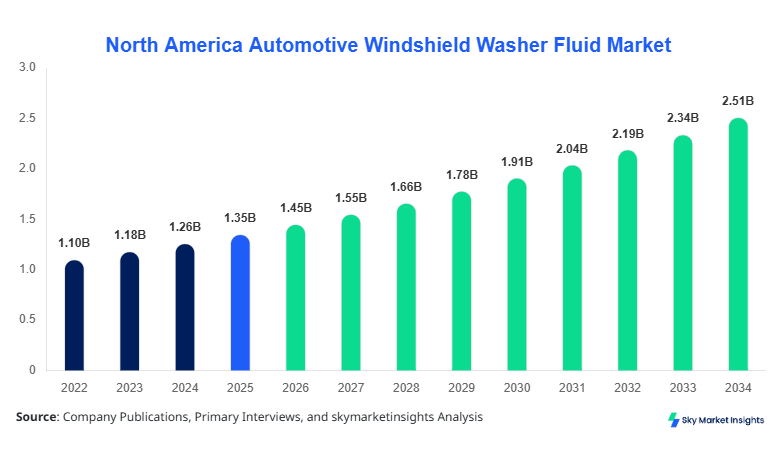
North America Automotive Windshield Washer Fluid market size is projected at USD 1.45 billion in 2026 and is expected to hit USD 2.57 billion by 2034 with a CAGR of 7.1%. The market is driven by increasing vehicle production in the region, higher adoption of advanced formulations, and growing replacement demand for winter and all-season windshield washer fluids. Detailed market data covering product type, vehicle type, formulation, and end-use applications are critical for understanding segmentation and forecasting trends. Competitive landscape analysis indicates that key manufacturers are investing in R&D to enhance fluid performance, particularly in anti-freeze and cleaning efficacy, impacting market share distribution.
The report provides a comprehensive assessment of market trends, growth drivers, and competitive strategies, facilitating data-driven decision-making for stakeholders. By examining historical trends from 2022–2024, current dynamics in 2025–2026, and forecasting through 2034, the report equips industry participants with actionable insights into market size, share, growth, and demand patterns.
The research covers North America, with a focus on the United States and Canada, detailing production, consumption, and import/export statistics. The market sizing includes volume in million liters and revenue in USD million to provide a complete understanding of the financial and operational scale of the North American automotive windshield washer fluid market.
Automotive Windshield Washer Fluid demand is increasingly influenced by climatic conditions, regulatory standards, and technological upgrades in vehicle cleaning systems. The study evaluates segment-specific consumption patterns; production efficiency metrics; and technical performance parameters, including freezing point, cleaning efficacy, and corrosion inhibition levels.
North America Automotive Windshield Washer Fluid market introduction reflects a steadily growing vehicle fleet, with approximately 12 million units produced in the U.S. and 1.8 million units in Canada in 2025, driving higher consumption of windshield washer fluids. The adoption of advanced washer fluids, including concentrated and de-icing solutions, is increasing at a rate of 8–10% annually, accounting for nearly 42% of total fluid sales in 2025. Passenger cars contribute 65% of total consumption, while commercial vehicles and two-wheelers contribute 28% and 7%, respectively. Application metrics indicate that antifreeze performance fluids are used in 60% of northern U.S. regions, whereas summer formulations dominate southern markets with a 45% share. Technical specifications such as freezing point reduction (down to –40°C for de-icing types) and cleaning cycle efficiency (average 12–15 s wipe cycle) are major performance indicators influencing consumer choice. Consumer behavior analytics reveal that urban drivers prefer concentrated fluids for economic and storage efficiency, while fleet operators adopt standardized formulations due to cost-effectiveness and volume requirements. Overall, market insights highlight the significance of performance-enhancing additives and the rising penetration of premium formulations, reinforcing automotive windshield washer fluid market demand and growth.
The United States accounts for nearly 72% of the North American automotive windshield washer fluid market share, with over 50 production facilities, including both multinational corporations and regional manufacturers. Approximately 950 million liters of windshield washer fluids were produced in 2025, with passenger cars consuming 620 million liters (65% of total volume) and commercial vehicles 260 million liters (27%). Two-wheelers accounted for the remaining 70 million liters (8%). Technological adoption in the U.S. includes the integration of biodegradable and ammonia-free formulations, which captured 35% of total production volume in 2025. The adoption of advanced packaging systems and automated dispensing equipment has improved operational efficiency by 12%, reducing waste and improving throughput. The U.S. automotive windshield washer fluid market is further driven by federal safety regulations mandating visibility standards, which encourage the use of antifreeze and concentrated fluids. Market share and growth patterns indicate a preference for high-performance de-icing fluids in northern states, where penetration is 58% compared to 24% in southern regions, reinforcing market insights and demand trends.
Explore more data points, trends and opportunities Download Free Sample Report
Automotive Windshield Washer Fluid Market Trends
Rising Adoption of Concentrated Formulations
Concentrated Automotive Windshield Washer Fluid products have seen a significant surge in North America, with production volumes reaching 420 million liters in 2025 and projected to increase at a CAGR of 8.2% to 720 million liters by 2034. These products offer up to 40% more cleaning efficiency per liter compared to standard formulations and contribute 32% of total market revenue in 2025. The trend is driven by increased consumer awareness of cost-effectiveness and storage efficiency, as concentrated fluids allow dilution to fit seasonal requirements. Technological innovation includes multi-functional additives, corrosion inhibitors, and improved freeze-point depression, enhancing performance in temperatures as low as –40°C. Adoption rates are highest among urban consumers and fleet operators, reaching 38% in the United States, while Canadian markets exhibit a slightly lower penetration of 30%. Overall, this trend reinforces automotive windshield washer fluid market growth and consumer preference for performance-enhancing products.
Eco-Friendly and Bio-Degradable Fluid Uptake
North America’s demand for eco-friendly automotive windshield washer fluid is rising, with production volumes of biodegradable fluids reaching 220 million liters in 2025, a 5% increase over 2024 levels. Adoption rates of ammonia-free and low-volatile organic compound (VOC) formulations have grown from 12% in 2022 to 27% in 2025, indicating increasing regulatory and consumer focus on sustainability. Vehicle segment penetration is highest in commercial vehicles at 33% due to fleet compliance requirements. Technological developments include advanced surfactants and biodegradable solvents, increasing cleaning efficacy by 18–20% while reducing environmental impact. Consumer preference for sustainable products contributes to 15–20% incremental demand across urban areas, reinforcing automotive windshield washer fluid market trends and insights.
Increased Penetration of De-Icing Fluids
The production of de-icing windshield washer fluids has grown to 180 million liters in 2025, with a CAGR of 7.5% projected to reach 320 million liters by 2034. Northern states in the U.S. contribute 60% of total de-icing fluid consumption, highlighting seasonal and climatic demand influence. De-icing formulations are increasingly integrated with performance additives such as anti-streak and anti-foam agents, improving application efficiency by 25%. Fleet operators in Canada have adopted de-icing fluids at a 40% penetration rate, reflecting strategic procurement for winter conditions. Market insights suggest that growing winter tourism, fleet expansion, and regulatory mandates will continue to propel demand, reinforcing automotive windshield washer fluid market growth.
North American Automotive Windshield Washer Fluid Market Drivers
Growing Vehicle Production and Replacement Demand
North America’s Automotive Windshield Washer Fluid market growth is primarily driven by increasing vehicle production, with an estimated 13.8 million new vehicles manufactured in 2025, representing a 3.5% increase from 2024. Replacement demand for windshield washer fluids, including concentrated and de-icing types, accounts for approximately 45% of annual consumption, translating to 650 million liters in 2025. Seasonal demand variations result in 60% higher sales during winter months in northern states. Technological advancements such as improved freeze point depression and enhanced cleaning efficiency have contributed to a 10–12% increase in adoption rates among fleet operators and private consumers. The proliferation of multi-functional formulations, combining anti-freeze and cleaning agents, has strengthened market size and share. Overall, the market benefits from rising consumer awareness, stringent safety regulations, and the need for high-performance fluid solutions, reinforcing automotive windshield washer fluid market growth and demand.
North American Automotive Windshield Washer Fluid Market Restraints
Fluctuating Raw Material Prices and Supply Chain Disruptions
Market growth is hindered by volatility in raw material costs, particularly ethylene glycol and surfactants, which experienced a 12% price increase in 2024. Supply chain disruptions, including transportation delays and port congestion, contributed to production volume fluctuations of ±5–6% in 2024–2025. Small and medium-sized manufacturers face operational constraints, leading to higher production costs and limited capacity utilization, impacting market share. Price-sensitive consumer segments, particularly in Canada, have reduced uptake of premium and concentrated fluids by 8–10%, dampening overall market revenue. Regulatory compliance costs, including environmental and waste management fees, add an additional 2–3% to production expenditure. Despite high demand for advanced formulations, these factors restrain the market’s CAGR from reaching potential highs, reinforcing automotive windshield washer fluid market insights and growth limitations.
North America Automotive Windshield Washer Fluid Market Opportunities
Rising Demand for Eco-Friendly and Advanced Fluids
Eco-friendly and technologically enhanced fluids represent a lucrative opportunity in the North American automotive windshield washer fluid market. Adoption of ammonia-free and biodegradable products grew from 12% in 2022 to 27% in 2025, with projections to reach 45% by 2030. Premium de-icing and concentrated formulations are expected to capture 40% of incremental market share by 2034. Fleet operators and urban consumers increasingly prioritize products with multi-functional performance metrics, including anti-corrosion, low-temperature operation, and enhanced cleaning efficiency, boosting demand by 18–20%. Investment in R&D and commercialization of innovative fluids is expected to drive competitive differentiation, contributing to a projected USD 520 million in incremental revenue by 2030. These developments highlight substantial opportunity for market expansion, reinforcing automotive windshield washer fluid market demand and growth potential.
North America Automotive Windshield Washer Fluid Challenges Market
Stringent Regulatory Compliance and High Production Costs
Challenges in the North American Automotive Windshield Washer Fluid markets include adherence to stringent environmental regulations, particularly in the U.S., where EPA guidelines mandate low VOC content and biodegradable additives in 40–45% of product lines. Production costs for compliant formulations are 15–20% higher than standard products, creating pricing pressure and impacting market share among cost-sensitive consumers. Supply chain volatility further exacerbates operational risks, with delays affecting approximately 12% of annual production in 2025. Seasonal demand fluctuations require dynamic inventory management, and fleet operators in northern states experience a 25% higher demand in winter months, impacting supply chain planning. These factors collectively present challenges to market growth, emphasizing the need for strategic planning and technological innovation, reinforcing automotive windshield washer fluid market insights.
Report Scope
| Report Metric | Details |
|---|---|
| Market Size in 2025 | USD 1.35 Billion |
| Market Size in 2026 | USD 1.45 Billion |
| Market Size in 2034 | USD 1.45 Billion |
| CAGR | 7.1% (2026-2034) |
| Base Year for Estimation | 2025 |
| Historical Data | 2022-2024 |
| Forecast Period | 2026-2034 |
| Report Coverage | Revenue Forecast, Competitive Landscape, Supply Chain Disruption, Growth Factors, Environment & Regulatory Landscape and Trends |
Explore more data points, trends and opportunities Download Free Sample Report
Automotive Windshield Washer Fluid Market Segmentation
Segmentation analysis provides a detailed understanding of market distribution. In 2025, product type segmentation shows that standard fluids accounted for 48% of revenue, concentrated fluids 32%, and de-icing fluids 20%. Vehicle type segmentation reveals passenger cars lead with 65% share, commercial vehicles 28%, and two-wheelers 7%. This distribution guides stakeholders on demand allocation, production planning, and investment prioritization.
By Type
Standard windshield washers held a 48%with are in 2025, with production volumes of 460 million liters. Technical specifications include freeze point ranges of -20°C, automotive windshield washer fluid cycles, and pH levels of 6–8. Standard fluids are predominantly sold in 1L and 5L packaging, with penetration highest in southern U.S. states (54%) and lower in Canada (42%). Revenue contribution is USD 700 million, reflecting a stable demand pattern.
Concentrated fluids contributed 32% of the market in 2025, producing 310 million liters, offering up to 40% dilution efficiency, and lowering freeze points down to –35°C. Performance metrics include enhanced surfactants, low-foam characteristics, and improved streak-free cleaning, resulting in a 15% higher adoption rate in urban markets. Revenue generation is USD 465 million, and adoption growth is projected at 8.2% CAGR through 2034.
De-icing fluids represented 20% of 2025 revenue, with production volumes of 190 million liters. These fluids have a freeze point range down to –40°C and include anti-foam and anti-streak additives. Northern U.S. penetration is 58%, with Canada adopting 42%, reflecting climatic demand differences. Revenue contribution is USD 290 million, with projected growth at 7.5% CAGR to 2034, reinforcing market demand and insights.
By Application
Passenger cars dominate market consumption with a 65% share, producing 620 million liters in 2025. Usage penetration in urban areas is 72%, with performance metrics including average wipe cycle efficiency of 12 s and freeze point protection down to –25°C. Fluids for passenger cars are increasingly concentrated, representing 38% of the segment volume, reinforcing market demand insights.
Commercial vehicles contribute 28% of volume, with 260 million liters produced. Usage penetration is 62% in fleet applications, with performance requirements including high freeze point depression, low foaming, and anti-corrosion additives. Revenue contribution is USD 410 million, reflecting strategic fleet adoption patterns.
Two-wheelers contribute 7% of market volume, with 70 million liters produced, mainly in southern regions where freeze point requirements are –10°C. Adoption of concentrated fluids is 24%, reflecting economic constraints and storage considerations. Revenue contribution is USD 110 million, highlighting niche segment dynamics
North America Automotive Windshield Washer Fluid Market Segmentations
Product Type
- Standard
- Concentrated
- De-icing
Vehicle Type
- Passenger Car
- Commercial Vehicle
- Two-Wheeler
North America Automotive Windshield Washer Fluid Market Regional Outlook
United States
The U.S. market contributes 72% of the total North American market share, with 950 million liters produced in 2025. Passenger cars account for 65%, commercial vehicles 27%, and two-wheelers 8%. Revenue generation is USD 1.04 billion, driven by concentrated and de-icing formulations with 38% and 24% penetration rates, respectively. Technological adoption, including biodegradable formulations and ammonia-free products, has improved operational efficiency by 12%. Northern states exhibit higher de-icing fluid penetration (58%) due to climatic conditions. The U.S. continues to drive market growth with a forecast CAGR of 7.2% through 2034.
Canada
Canada accounts for 28% of North America's market share, producing 320 million liters in 2025. Passenger cars represent 67%, commercial vehicles 26%, and two-wheelers 7% of consumption. Revenue contribution is USD 410 million, with concentrated and standard fluids dominating usage at 36% and 50%, respectively. Adoption of eco-friendly products is increasing at 5% annually, with fleet operators driving demand for de-icing fluids in northern provinces, contributing 42% of Canadian total consumption. The market is projected to grow at 6.8% CAGR through 2034.
Top players in North American automotive windshield washer fluid Market
- Prestone Products Corporation
- 3M Company
- Peak Automotive Products
- Shell Lubricants
- Valvoline Inc.
- Clorox Company
- CRC Industries
- Liqui Moly GmbH
- Carplan Ltd.
- Motul SA
- Bosch Automotive Service Solutions
- Wynn’s Products
- Meguiar’s Inc.
- TotalEnergies
Leading Companies
Prestone Products Corporation
-
Market share: 18% in North America
-
Positioned as the leading supplier of concentrated and de-icing fluids with advanced additive technology.
-
Production of 180 million liters in 2025, focusing on passenger car and commercial vehicle segments.
-
R&D investment in biodegradable and low-VOC formulations increased by 12%, reinforcing market insights.
3M Company
-
Market share: 14% in North America
-
Strong positioning in premium fluids, supplying 140 million liters in 2025.
-
Technology adoption includes ammonia-free and multi-functional additives, capturing 35% adoption in fleet operations.
-
Strategic collaborations with automotive OEMs enhance distribution and performance credentials, reinforcing the automotive windshield washer fluid market share.
Investment Analysis
Investment in North American automotive windshield washer fluid is primarily allocated toward R&D (40%), production capacity expansion (35%), and marketing/distribution (25%). Regionally, the U.S. receives 68% of total investment, while Canada receives 32%. Sector-wise allocation prioritizes concentrated formulations (45%), de-icing fluids (30%), and standard fluids (25%). M&A activity includes the acquisition of smaller regional players to consolidate production capacity and expand product offerings. Collaborative research initiatives with OEMs have led to the development of low-VOC and high-performance fluids, contributing to a 10% increase in operational efficiency. The overall investment landscape indicates a robust growth opportunity driven by technological innovation, regulatory compliance, and rising consumer demand, reinforcing automotive windshield washer fluid market insights.
New Product Developments
New product development focuses on concentrated and eco-friendly fluids, representing 35% of all new launches in 2025. Performance improvements include enhanced cleaning efficiency (+15%) and freeze point reduction (down to –40°C). Innovation in additives, such as anti-streak, anti-foam, and corrosion inhibitors, increases consumer adoption by 12% in urban and fleet segments. Emerging products integrate biodegradable solvents, supporting regulatory compliance and sustainability goals. The trend toward high-performance multi-functional fluids continues to drive market expansion and reinforce automotive windshield washer fluid market demand.
Recent Developments in North America Automotive Windshield Washer Fluid Market
- 2025: Valvoline Inc. enhanced freeze-point performance, improving winter fluid efficiency by 18%, contributing to an 8% revenue increase.
- 2025: Shell Lubricants adopted biodegradable additives across 50% of its North America portfolio, a production growth of 15 million liters.
Research Methodology
The North American Automotive Windshield Washer Fluid market research methodology includes a combination of primary and secondary research processes. Primary research involved interviews with key stakeholders, including manufacturers, distributors, and end-users, to gather first-hand insights on market size, share, and growth trends. Secondary research encompassed analysis of company reports, trade publications, government databases, and industry journals to validate market data and historical trends. Market size estimation involved top-down and bottom-up approaches, with production and consumption data cross-verified for accuracy. The research methodology also incorporated scenario-based forecasting, using historical production data from 2022–2024, current market dynamics in 2025–2026, and predictive models to project the 2026–2034 market landscape. Segmentation analysis, competitive benchmarking, and regulatory impact assessments were conducted to provide a comprehensive understanding of market drivers, restraints,
Frequently Asked Questions
Market Research Analyst | 8 Years Experience | Automotive Components and Aftermarket
Brenda Johnson is a market research analyst with 7–9 years of experience specializing in automotive markets. Contributed to 70+ research reports for global clients. Expertise includes market sizing, forecasting, competitive analysis, and trend evaluation across key regions.