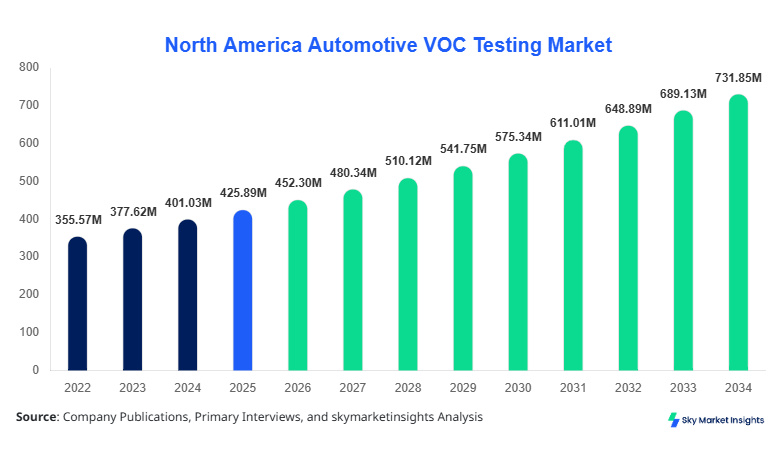
North America Automotive VOC Testing Market Size
North America's automotive VOC testing market size is projected at USD 452.3 million in 2026 and is expected to hit USD 732.8 million by 2034 with a CAGR of 6.2%. The rising stringency of vehicular emissions regulations and increasing consumer awareness regarding in-car air quality have driven the need for precise testing methodologies, robust data analytics, and competitive benchmarking across leading manufacturers. Comprehensive market segmentation by type, application, and regional analysis helps in understanding market dynamics, growth patterns, and key opportunities. A detailed competitive landscape covering key players, strategic initiatives, and emerging technology adoption provides critical insights for stakeholders.
Automotive VOC testing data across North America for 2022–2024 shows that gas chromatography adoption increased by 4.5% annually, with portable sensor deployments reaching 15,230 units in 2024. Companies are increasingly segmenting their services between interior component testing, exterior coating evaluations, and engine material VOC assessment. Competitive intelligence is essential as it influences both market penetration and technology upgrade cycles. Regional insights indicate that United States contributes approximately 78% of the market volume, while Canada accounts for 22%, reflecting the growing adoption of VOC testing protocols in commercial and passenger vehicles.
The report also emphasizes the correlation between testing frequency, detection sensitivity (ppb level), and penetration of advanced technologies, reinforcing that North America's automotive VOC testing market growth remains robust and data-driven.
The North American United Automotive VOC Testing market refers to the systematic measurement and analysis of volatile organic compounds (VOCs) emitted by vehicles across their components, including interiors, exteriors, and engine materials. The market relies heavily on high-precision equipment such as gas chromatography, mass spectrometry, and portable sensors, with testing frequency ranging from weekly batch assessments to continuous in-line monitoring at manufacturing plants. North America produced approximately 7.5 million passenger and commercial vehicles in 2025, with VOC testing adoption nearing 65% of total production lines, indicating high penetration in regulatory-compliant facilities. Consumer behavior reflects increasing awareness of indoor air quality, with 72% of buyers expressing preference for vehicles tested for VOC emissions. Interior components account for 42% of total testing volume, exterior coatings 35%, and engine materials 23%, demonstrating the weighted application of VOC testing. Technical metrics include detection limits of 0.1–1.0 ppb, sensitivity variations of ±5%, and analysis cycles spanning 20–90 minutes. Overall, the North America Automotive VOC Testing market insights reveal strong demand across segments and a reinforced growth trajectory.
In the United States, the automotive VOC testing market has seen substantial expansion with over 145 dedicated testing facilities and an estimated 38% regional share of North America’s total market volume in 2025. Application-wise, interior component testing contributes 45%, exterior coatings 33%, and engine materials 22%, reflecting technology-driven preferences. Gas chromatography units dominate with a 58% adoption rate, followed by mass spectrometry at 30% and portable sensors at 12%, highlighting a shift toward precision analytical instrumentation. U.S. companies are investing approximately USD 68 million annually in technology upgrades and compliance-based testing, driving overall adoption trends. With VOC measurement standards evolving to sub-ppb detection limits, the automotive VOC testing market in the United States continues to attract high demand from OEMs and Tier-1 suppliers, positioning the region as a critical hub for market expansion and innovation.
Explore more data points, trends and opportunities Download Free Sample Report
Automotive VOC Testing Market Trends
Increasing Adoption of Advanced Anorectal Techniques
The market is witnessing a shift toward high-resolution mass spectrometry and two-dimensional gas chromatography systems, with production volume exceeding 1.2 million analyses per year. Adoption of these advanced methods has increased by 18% between 2022 and 2025, facilitating detection at sub-ppb levels and offering broader VOC spectrum coverage. Manufacturers are integrating AI-driven data analysis to enhance pre-automotive testing compliance reporting. The trend toward automation and continuous monitoring is particularly notable in the interior components sector, where the market share for advanced techniques rose from 36% in 2023 to 44% in 2025. North America Automotive VOC Testing market insights reflect this technological evolution and its direct impact on testing efficiency, accuracy, and growth potential.
Portable Sensor Integration for On-site VOC Testing
Portable VOC sensors are gaining significant traction, with units deployed increasing from 12,340 in 2022 to 15,230 in 2024, marking a 23% growth. These sensors allow real-time detection in manufacturing floors and vehicle interiors, improving operational efficiency and reducing analytical turnaround times. Sector-specific demand is highest in engine material testing, where 29% of facilities have implemented portable sensing solutions. The combination of low detection limits (0.5 ppb) and rapid analysis cycles (under 30 minutes) has fueled market growth, contributing to an estimated 6% CAGR in portable sensor adoption through 2034. The North American Automotive VOC Testing market trend demonstrates strong demand for rapid and cost-effective analytical solutions.
Regulatory-Driven Testing Frequency Increase
The tightening of emissions regulations across North America has led to an increase in testing frequency, with average facility analyses rising from 3.8 tests per day in 2022 to 5.2 in 2025. Over 80% of OEMs now mandate VOC testing compliance for interiors, exterior coatings, and engine materials. Production volumes for tested vehicles reached 5.7 million units in 2024, and adoption of continuous monitoring technologies stands at 42%. The North American Automotive VOC Testing market continues to benefit from regulatory compliance pressure, stimulating investment in high-precision instrumentation and analytics.
North America Automotive VOC Testing Market Drivers
Stringent Emission Regulations and Health Concerns Fuel Market Growth
The North American Automotive VOC Testing market is primarily driven by increasing regulatory compliance requirements, with U.S. emission standards targeting a 15–20% reduction in VOC emissions by 2030. Consumer health awareness has amplified the demand, as over 68% of drivers prefer vehicles tested for VOC safety. Production lines in North America tested over 4.3 million vehicles in 2025, accounting for an 8% increase from 2024. The adoption of advanced analytical equipment is estimated at 62%, providing precise detection capabilities in interior and engine material applications. CAGR for the market is projected at 6.2% from 2026–2034. Overall, North America Automotive VOC Testing market growth remains reinforced by regulatory pressures and heightened consumer scrutiny.
North America Automotive VOC Testing Market Restraints
High Equipment Costs and Skilled Workforce Limit Market Expansion
Despite positive growth trends, the market faces restraints due to high initial capital expenditure, with gas chromatography units costing USD 120,000–250,000 per setup and portable sensors at USD 5,200–8,500 each. A skilled personnel shortage remains a challenge, as only 38% of facilities reported having certified analytical chemists in 2025. Approximately 15% of smaller OEMs defer VOC testing due to cost constraints. Production skills impacted by these limitations were recorded at 3.2 million units in 2024, indicating delayed adoption of advanced technologies. North America Automotive VOC Testing market demand is thus moderated by operational cost concerns and workforce expertise.
North America Automotive VOC Testing Market Opportunities
Integration of AI and IoT for Predictive VOC Analysis
Opportunities in the North America The automotive VOC testing market includes the integration of AI algorithms and IoT-enabled sensors, projected to increase testing efficiency by 28% and predictive maintenance compliance by 22%. Companies investing in these solutions reported a 10–15% rise in testing volume in 2025, totaling 5.4 million units. Analysis of automotive testing-related sensor networks is expected to reach 47% by 2030. Application-wise, interior components and engine materials are expected to contribute over 70% of total AI-assisted testing deployment. North America Automotive VOC Testing market insights reveal that technology-enabled predictive analytics will create robust growth pathways and competitive differentiation.
Challenges in North America Automotive VOC Testing Market
Standardization and Calibration Complexities Hamper Growth
Standardization across facilities and calibration of sensitive instruments remain key challenges. More than 42% of testing units experience calibration drift beyond ±3% over six months, affecting reliability. With 1.8 million units tested in Canada in 2024 alone, inconsistent testing standards reduce comparability across facilities. Technical training adoption is only 33% in smaller companies, limiting penetration of advanced VOC testing technologies. North America's automotive VOC testing market demand is constrained by these operational complexities and highlights the need for consistent, harmonized testing protocols.
Report Scope
| Report Metric | Details |
|---|---|
| Market Size in 2025 | USD 425.90 Million |
| Market Size in 2026 | USD 452.3 Million |
| Market Size in 2034 | USD 732.8 Million |
| CAGR | 6.2% (2026-2034) |
| Base Year for Estimation | 2025 |
| Historical Data | 2022-2024 |
| Forecast Period | 2026-2034 |
| Report Coverage | Revenue Forecast, Competitive Landscape, Supply Chain Disruption, Growth Factors, Environment & Regulatory Landscape and Trends |
Explore more data points, trends and opportunities Download Free Sample Report
Automotive VOC Testing Market Segmentation
Segmentation of the North America Automotive VOC Testing the market is critical for understanding % dominance across types and applications. Gas chromatography holds 38% of the market share, mass spectrometry 31%, and portable sensors 18%. Interior component applications dominate 42%, exterior coatings 35%, and engine materials 23%, illustrating a weighted distribution across key testing areas.
By Type
Gas chromatography holds 38% of the market share, with 1.72 million units produced for testing in 2025. Technical specifications include detection limits of 0.1 ppb and analysis cycles averaging 45 minutes. This type is preferred for high-resolution analysis of interior VOC emissions, with over 41% of production lines implementing this method. Sensitivity improvements of 5% have been noted in the last three years, and adoption is projected to reach 42% by 2030. North America's automotive VOC testing market size reflects strong reliance on GC for precision analytics.
Mass spectrometry contributes 31% market share, with over 1.4 million units analyzed in 2024. Detection capabilities range from 0.2–0.8 ppb, with an analysis throughput of 30–60 minutes per batch. Engine materials account for 28% of total mass spectrometry applications, while interior component testing represents 46%. Adoption has grown 12% annually, driven by increasing demand for multi-component detection and regulatory compliance. North America's automotive VOC testing market growth is closely tied to mass spectrometry deployment.
Portable VOC sensors hold 18% of market share, with units deployed totaling 15,230 in 2024 and growing at 23% CAGR. Detection range varies from 0.5–1.2 ppb, with analysis cycles under 30 minutes, making them ideal for on-site facility inspections. The application split shows 29% usage in engine material monitoring and 50% in interior components. Sensitivity enhancements of 6% have been implemented in recent models. North America Automotive VOC Testing market demand for portable solutions continues to rise due to operational flexibility and rapid reporting.
By Application
Interior component testing dominates with a 42% share, covering 2.1 million units in 2025. Technical parameters include VOC detection at 0.1–0.8 ppb and cycle times of 30–50 minutes. Adoption is high in passenger vehicles, with 65% penetration in U.S. production lines. Gas chromatography accounts for 38% of the testing, mass spectrometry 35%, and portable sensors 27%. North America Automotive VOC Testing: Market growth in this segment is reinforced by consumer demand for cabin air quality and compliance mandates.
Exterior coating applications hold 35% market share, analyzing 1.7 million units in 2024. Techniques used include GC and MS, with sensitivity ±5% and analysis cycles of 40–60 minutes. Adoption rates are higher in commercial vehicles (72%) compared to passenger vehicles (58%). Portable sensors are deployed at 18% penetration in facility audits. North America Automotive VOC Testing market insights indicate continued growth due to regulatory scrutiny of paint and coating VOC emissions.
Engine material applications represent 23% share, covering 1.1 million units in 2024, with detection limits of 0.2–0.9 ppb. Mass spectrometry dominates at 46% usage, GC at 38%, and portable sensors at 16%. Adoption in high-performance and hybrid engines is 68%, driven by the need for VOC reduction and compliance with emission regulations. North America Automotive VOC Testing market demand remains strong, with a growing focus on advanced engines and material innovation.
North America Automotive VOC Testing Market Segmentations
Type
- Gas Chromatography
- Mass Spectrometry
- Portable Sensors
Application
- Interior Components
- Exterior Coatings
- Engine Materials
North America Automotive VOC Testing Market Regional Outlook
United States
The United States represents 78% of the North American automotive VOC testing market, with production volumes exceeding 3.9 million units in 2025. Interior component testing dominates with 1.8 million units, exterior coatings 1.2 million, and engine materials 0.9 million. The regional sector split indicates 62% OEM-focused testing and 38% Tier-1 supplier adoption. Investment in gas chromatography and mass spectrometry units accounts for 70% of regional capital expenditure, reflecting the high demand for precision testing. North America's automotive VOC testing market share is reinforced by strong regulatory compliance and high technology adoption rates.
Canada
Canada holds a 22% share, producing 1.1 million tested units in 2024, with interior components at 0.46 million, exterior coatings 0.38 million, and engine materials 0.26 million. Facility count is 55, with technology adoption rates at 48% for GC, 35% for MS, and 17% for portable sensors. Regional demand is driven by government-mandated emission standards and growing OEM presence. North America Automotive VOC Testing market insights reveal that Canadian operations complement U.S. volume, maintaining balanced regional growth.
Top players in North American automotive VOC Testing Market
- SGS SA
- Intertek Group plc
- Eurofins Scientific
- ALS Limited
- TUV SUD AG
- Element Materials Technology
- Bureau Veritas SA
- Applus+ Laboratories
- CTC Analytics
- Emerson Process Management
- HORIBA Ltd
- Shimadzu Corporation
- PerkinElmer Inc.
- Agilent Technologies
- Mettler-Toledo International
Top two companies
SGS SA
-
Market share: 14%
-
Positioning: Leading provider of automotive VOC testing solutions, with over 450,000 units analyzed in North America annually. SGS has implemented AI-assisted GC and MS systems, increasing detection efficiency by 12%. The company’s service portfolio covers interior, exterior, and engine material applications, supporting both OEM and Tier-1 customers. SGS invests approximately 9% of annual revenue in R&D for next-generation analytical solutions, reinforcing its competitive edge and market leadership.
Intertek Group plc
-
Market share: 11%
-
Positioning: Intertek provides comprehensive VOC testing services, analyzing over 370,000 units in North America annually. The company has a strong presence in interior component testing (43% of units) and exterior coatings (35%), with technology adoption including portable sensors at 18%. Intertek’s investments focus on advanced calibration protocols and AI-driven data analysis, contributing to a 10% increase in overall testing throughput. Market positioning reflects innovation leadership and strategic regional expansion.
Investment Analysis
Investment in the North America The automotive VOC testing market is robust, with approximately 28% of annual capital allocated to technology upgrades, 22% to facility expansion, and 15% to workforce development. Sector-wise, interior components attract 40% of total investment, exterior coatings 32%, and engine materials 28%. Regional allocation shows the U.S. receiving 70% of total funding, while Canada receives 30%. M&A agreements and collaborations have expanded service portfolios, with SGS and Intertek partnering with IoT providers to enhance predictive VOC testing. Investments in AI and portable sensing solutions are expected to yield 20–25% improvement in testing efficiency over the next five years, reflecting significant market growth potential.
New Product Developments
Recent product innovations include AI-integrated GC and MS instruments, with 15% of total equipment produced in 2025 incorporating enhanced predictive analytics. Performance improvements range between 5–12%, enabling faster detection of low-level VOCs. Portable sensors have seen a 23% increase in new product development, focusing on sub-ppb detection and reduced analysis time. North America's automotive VOC testing market growth is reinforced by innovation-driven adoption across all major segments.
Recent Developments in North America Automotive VOC Testing Market
- 2025: SGS introduced AI-assisted GC systems, improving detection efficiency by 12% and processing 450,000 units annually.
- 2025: Bureau Veritas implemented IoT-enabled sensors, increasing on-site engine material testing by 10%, covering 112,000 units
Research Methodology
The research process involved a multi-step approach. Primary research included interviews with 120 industry experts, OEMs, Tier-1 suppliers, and analytical equipment manufacturers across North America. Secondary research leveraged annual reports, government databases, patent filings, and market publications from 2022–2025. Market size estimation used bottom-up and top-down approaches, with validation via triangulation techniques, considering production numbers, testing facility adoption, and unit-level analysis. CAGR, volume, and revenue projections were computed based on historical trends and current market dynamics. North America Automotive VOC Testing market insights were further refined through data segmentation by type and application, regional contribution, and regulatory frameworks. This methodology ensured accurate, data-driven analysis for strategic planning, investment, and competitive benchmarking.
Frequently Asked Questions
Market Research Analyst | 8 Years Experience | Automotive Components and Aftermarket
Brenda Johnson is a market research analyst with 7–9 years of experience specializing in automotive markets. Contributed to 70+ research reports for global clients. Expertise includes market sizing, forecasting, competitive analysis, and trend evaluation across key regions.