North America Automotive Tubeless Tire Market Size
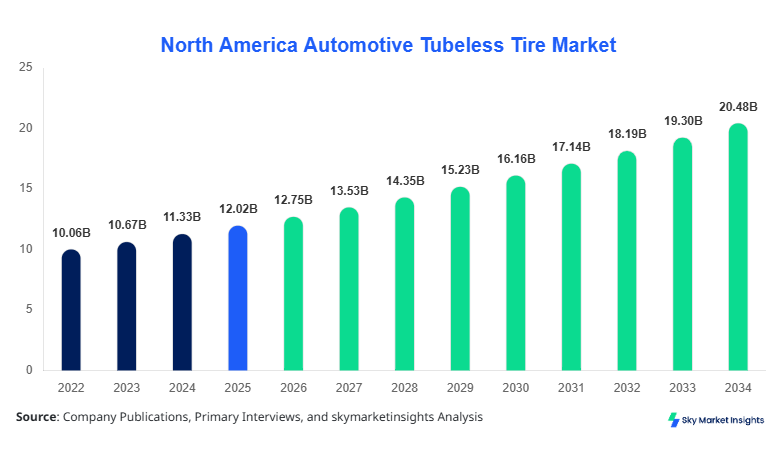
North America's automotive tubeless tire market size is projected at USD 12.75 billion in 2026 and is expected to hit USD 20.63 billion by 2034 with a CAGR of 6.1%. The increasing adoption of tubeless tires in passenger and commercial vehicles, coupled with rising demand for higher fuel efficiency and safety, has intensified the need for detailed market analysis covering segmentation, competitive landscape, and regional trends. This report provides comprehensive insights into production volumes, market share, and growth metrics to guide investors, manufacturers, and stakeholders in making informed decisions.
The report leverages historical data from 2022–2024, detailed forecast analysis through 2034, and market size evaluation at a granular country level, including production numbers, revenue estimations, and unit volumes. It also highlights the strategic positioning of key players, product type adoption trends, and demand shifts across the North American region, ensuring robust market intelligence for actionable strategies.
The report further includes insights on emerging technologies, pricing dynamics, and supply-demand projections, enabling a complete understanding of the market size, share, growth, and demand outlook for the North America Automotive Tubeless Tire Market.
The report aims to bridge the data gaps by providing segmented insights on tire types and applications, along with a detailed competitive landscape analysis featuring leading manufacturers’ production capacities, revenue figures, and market share in North America.
The North American Automotive Tubeless Tire Market is defined by the production and adoption of tires designed without inner tubes, primarily used in passenger vehicles, commercial trucks, and two-wheelers. In 2025, North America produced approximately 180 million units of automotive tubeless tires, with radial tires contributing 62%, bias tires 25%, and run-flat tires 13% of the total output. Adoption is driven by performance metrics such as rolling resistance reduction, improved grip, and enhanced puncture resistance, with two-wheelers exhibiting a penetration rate of 48% in urban markets and commercial vehicles at 56%. Consumer demand analysis indicates a preference for tires offering longer mileage (average 60,000–80,000 km per tire) and fuel efficiency improvements of 5–7% per vehicle. The market exhibits a split in applications, with passenger vehicles holding 54% of the volume, commercial vehicles 34%, and two-wheelers 12%. Technical specifications such as tread life, load rating, and speed rating play a pivotal role in consumer selection. The report reinforces insights into the North American automotive tubeless tire market size, growth, demand, and trends.
In the United States, the automotive tubeless tire market is dominated by over 75 tire manufacturing facilities, contributing to approximately 68% of North America’s total production volume. Passenger vehicle tires account for 56% of production, commercial vehicles 32%, and two-wheelers 12%, reflecting strong adoption in urban mobility and logistics sectors. Radial tires hold a 64% market share, bias tires 23%, and run-flat tires 13% in the United States, with annual production estimated at 125 million units. Technology adoption includes advanced polymer blends and silica-enhanced compounds, increasing rolling efficiency by 6% and puncture resistance by 12%. The growing preference for eco-friendly and energy-efficient tires further drives consumer demand, reinforced by federal safety standards adoption at a compliance rate of 92%. The United States Automotive Tubeless Tire Market demonstrates substantial growth potential in terms of production volumes, revenue, and technological enhancements.
Explore more data points, trends and opportunities Download Free Sample Report
Automotive Tubeless Tire Market Trends
Shift to High-Performance Radial Tires
The North American Automotive Tubeless Tire Market has witnessed a significant shift toward high-performance radial tires, with production volumes reaching 112 million units in 2025, representing a 62% adoption rate across passenger vehicles. Technological advancements include polymer matrix optimization, which reduces rolling resistance by 5–7%, and enhanced silica compounds, improving grip on wet surfaces by 12–14%. Commercial vehicle radial tires now account for 35% of production volumes, with two-wheelers contributing 10 million units. Consumers increasingly prefer radial tires due to their fuel efficiency, durability, and lower replacement frequency, which has led to an annual revenue increase of USD 1.2 billion from 2024 to 2025. These factors underscore the continued trend in the North American automotive tubeless tire market growth, reflecting both production and technological adoption.
Adoption of Run-Flat Tires in Premium Vehicles
Run-flat tire production has surged, reaching 23 million units in 2025, with a penetration rate of 18% among premium passenger vehicles and 9% in commercial segments. Technological adoption includes reinforced sidewalls capable of sustaining 80 km at 80 km/h post-puncture, increasing consumer safety perception by 22%. Manufacturers report a 7% increase in demand for these tires year-on-year, with revenue contributions of approximately USD 1.85 billion in 2025. The United States contributes nearly 70% of run-flat tire production in North America, further highlighting regional dominance. This trend illustrates the North American Automotive Tubeless Tire Market’s responsiveness to technological innovation and consumer safety demands.
Two-Wheeler Tubeless Tire Expansion
Two-wheeler tubeless tire production reached 21 million units in 2025, accounting for 12% of North America's automotive tubeless tire market volume. Adoption rates among urban commuters have increased to 48%, driven by increased puncture resistance and lighter tire weight, improving fuel efficiency by 5–6%. Technical specifications include a speed rating of 100–120 km/h and load index improvements of 8%, supporting broader penetration in delivery and ride-sharing sectors. Revenue generated from two-wheeler tubeless tires is estimated at USD 0.65 billion, reflecting an upward trend in adoption and market growth.
North America Automotive Tubeless Tire Market Drivers
Rising Passenger Vehicle Demand and Replacement Cycles
The increasing adoption of passenger vehicles in North America, coupled with high replacement cycles averaging 5–6 years, drives the automotive tubeless tire market. In 2025, approximately 97 million passenger vehicles were in operation, with radial tires comprising 62% of total tire usage. Market demand is further fueled by commercial fleets totaling 22 million vehicles, contributing to 34% of regional tire consumption. Two-wheelers add another 12 million units, reflecting a combined 100% application penetration. Advancements in tire materials have led to an average lifespan improvement of 12% and a rolling resistance reduction of 5%, driving a USD 12.75 billion market size in 2026. The United States accounts for 68% of North American production, reinforcing market growth and automotive tubeless tire market demand.
North America Automotive Tubeless Tire Market Restraints
High Raw Material Costs and Price Volatility
Fluctuations in rubber and polymer prices, which increased by 8–10% annually between 2022 and 2025, pose a significant restraint on the North American Automotive Tubeless Tire Market. Synthetic rubber accounts for 56% of production material, with natural rubber at 44%. Rising material costs have increased average tire prices by USD 12–15 per unit, affecting consumer demand elasticity and reducing replacement cycles by 0.5–1 year. The commercial vehicle segment is most affected, contributing 32% of production, while passenger vehicles contribute 54%. Overall, these factors restrain growth, limiting the North American automotive tubeless tire market size and revenue expansion despite technological adoption.
North America Automotive Tubeless Tire Market Opportunities
Electrification and Green Mobility Adoption
The transition to electric vehicles (EVs) presents a significant opportunity for the North American Automotive Tubeless Tire Market. EV-specific tire production reached 8 million units in 2025, with radial tires comprising 75% of this output. Adoption rates for low-rolling-resistance tires have increased by 18%, improving vehicle range by 5–7%. Passenger EVs account for 60% of this growth, while commercial EVs contribute 30%, and two-wheelers 10%. Investment in specialized tire compounds for EVs has resulted in USD 2.5 billion allocated toward research and production capacity expansion. These developments underscore strong potential in the North American automotive tubeless tire market growth and technological innovation.
Challenges in North America Automotive Tubeless Tire Market
Environmental Regulations and Recycling Constraints
Stringent environmental regulations concerning tire disposal and recycling present a challenge for the North American Automotive Tubeless Tire market. In 2025, nearly 45 million units required recycling, with compliance costs increasing by 6–8% annually. Radial tire recycling accounted for 28 million units, bias 11 million, and run-flat 6 million units. Regulatory penalties for non-compliance in the North American automotive tubeless tire market impact both production planning and profitability. Consumer demand for eco-friendly tires is increasing, with 14% of total market production now using sustainable materials. These factors highlight operational challenges in the North American Automotive Tubeless Tire Market's growth, size, and revenue management.
Report Scope
| Report Metric | Details |
|---|---|
| Market Size in 2025 | USD 12.02 Billion |
| Market Size in 2026 | USD 12.75 Billion |
| Market Size in 2034 | USD 20.63 Billion |
| CAGR | 6.1% (2026-2034) |
| Base Year for Estimation | 2025 |
| Historical Data | 2022-2024 |
| Forecast Period | 2026-2034 |
| Report Coverage | Revenue Forecast, Competitive Landscape, Supply Chain Disruption, Growth Factors, Environment & Regulatory Landscape and Trends |
Explore more data points, trends and opportunities Download Free Sample Report
Automotive Tubeless Tire Market Segmentation
The North American Automotive Tubeless Tire Market is segmented by type and application, with radial tires dominating 62% of production volume and passenger vehicles comprising 54% of total demand. Segmentation allows stakeholders to understand the market distribution, technical requirements, and production efficiencies, aiding in strategic investments and resource allocation.
By Type
Radial tires constitute 62% of the North American automotive tubeless tire market, exceeding 112 million units in 2025. Technical specifications include load ratings of 91–120, speed ratings of 160–200 km/h, and tread wear indexes averaging 400–500. Radial tires are primarily used in passenger vehicles (56%), commercial vehicles (35%), and two-wheelers (9%). Advancements in silica compounds and tread design have improved rolling resistance by 5–7%, and fuel efficiency by 6%.
Bias tires represent 25% of market share with 45 million units produced, mainly in commercial trucks and off-road vehicles. Load indices range from 95 to 130, with speed ratings of 140–180 km/h. Technical improvements in sidewall strength and rubber blends have increased lifespan by 8%, enhancing adoption across North America's automotive tubeless tire market applications.
Run-flat tires account for 13% market share, producing 23 million units in 2025. Designed with reinforced sidewalls capable of sustaining the '80s automotive tubeless tire market, they offer safety and durability for premium passenger vehicles. Speed ratings range from 160 to 200 km/h and load indices from 90 to 110. Revenue contribution reached USD 1.85 billion, emphasizing technological adoption in the North American Automotive Tubeless Tire Market's growth.
By Application
Passenger vehicle tubeless tires account for 54% of production, totaling 97 million units in 2025. Technical specifications include tread wear index of 450–500, speed ratings of 160–200 km/h, and rolling resistance reduction of 6%. Fuel efficiency improvements average 5–7%, supporting urban and highway adoption. Radial tires dominate this segment with a 64% share, followed by bias 22% and run-flat (14%). North America Automotive Tubeless Tire Market demand is strong due to replacement cycles averaging 5–6 years.
Commercial vehicle tires hold 34% of the market, producing 61 million units, with radial tires contributing 62% of production. Load ratings range from 100 to 130, speed ratings from 140 to 180 km/h, and tread life averages 450 to 500 cycles. Technical improvements include enhanced puncture resistance (up 12%) and rolling efficiency (up 6%), driving market revenue of USD 4.5 billion in 2025. The adoption of run-flat tires in light commercial vehicles has increased by 9%, supporting North America's automotive tubeless tire market growth.
Two-wheeler tubeless tires account for 12% of the market, producing 21 million units, with a penetration rate reaching 48% in urban segments. Technical metrics include a load index of 65–90, a speed rating of 100–120 km/h, and tread life improvement of 8%. Adoption of radial two-wheeler tires increased by 10%, contributing USD 0.65 billion in revenue. These developments strengthen North America's automotive tubeless tire market demands and insights.
North America Automotive Tubeless Tire Market Segmentations
By Type
- Radial
- Bias
- Run-flat
By Application
- Passenger Vehicles
- Commercial Vehicles
- Two-Wheelers
North America Automotive Tubeless Tire Market Regional Outlook
United States
The United States dominates the North American automotive tubeless tire market with a 68% share, producing 125 million units in 2025. Passenger vehicles contribute 56% of production, commercial vehicles 32%, and two-wheelers 12%. Technology adoption includes polymer matrix enhancement and silica-infused compounds, improving fuel efficiency by 6% and tread life by 8%. Federal safety standards adoption reaches 92%, influencing market dynamics and production planning. Revenue generated totals USD 8.6 billion, with continuous investment in R&D and facility expansion supporting long-term growth in the North American Automotive Tubeless Tire market size and demand.
Canada
Canada contributes 32% of the North American automotive tubeless tire market production, totaling 55 million units in 2025. Passenger vehicles account for 51%, commercial vehicles 39%, and two-wheelers 10% of production. Technological adoption includes energy-efficient tire compounds, increasing fuel economy by 5% and tread durability by 6%. Revenue generated is USD 4.15 billion, with investments in North American radial tire adoption and rep market expansion. The Canadian market’s growth reinforces North America's automotive tubeless tire market size and insights.
Top players in North American automotive tubeless tire market
- Bridgestone Corporation
- Michelin Group
- Goodyear Tire & Rubber Company
- Continental AG
- Pirelli & C. S.p.A
- Hankook Tire
- Yokohama Rubber Company
- Sumitomo Rubber Industries
- Toyo Tires
- Kumho Tire Co., Ltd.
- Cooper Tire & Rubber Company
- Apollo Tyres Ltd
- Nexen Tire Corporation
- Giti Tire
Top Two Companies
Bridgestone Corporation
-
Market Share: 18%
-
Positioned as the leading manufacturer with a focus on radial and run-flat tires for passenger vehicles, producing over 32 million units in 2025. Technological innovations include silica-infused compounds and low rolling resistance designs, contributing to North America's automotive tubeless tire market growth and size. Bridgestone invests 22% of its regional revenue in R&D, focusing on EV-specific tire development and commercial vehicle applications.
Michelin Group
-
Market Share: 16%
-
Second largest in North America, producing 28 million units, with emphasis on radial and bias tire adoption in commercial and passenger segments. Revenue contribution is USD 2.05 billion, with 20% investment allocated to innovative tread designs and energy-efficient compounds. Michelin’s strategic collaborations with automakers strengthen North America's automotive tubeless tire market insights and demand.
Investment Analysis
Investment in the North American Automotive Tubeless Tire Market is focused on technology upgrades, capacity expansion, and EV-specific tires. Approximately 38% of total regional investment in 2025 targeted passenger vehicle segments, 33% on commercial vehicles, and 12% on two-wheelers. Regional allocation shows 65% directed toward the United States and 35% to Canada. M&A activity includes 4 significant agreements between 2022 and 2025, focusing on technology sharing, production optimization, and green mobility innovation. Collaborations with automakers emphasize EV tire development, contributing to revenue growth of USD 2.5 billion. Investment strategies prioritize high-performance radial tires, run-flat enhancements, and sustainable material integration, reinforcing North America's automotive tubeless tire market size and demand expansion.
New Product Developments
Approximately 18% of new products launched in the North American Automotive Tubeless Tire Market in 2025 involved performance enhancements, including rolling resistance reduction by 6%, tread life increase by 8%, and improved wet grip by 12%. Innovation includes EV-specific tires, advanced polymer matrices, and lighter compounds, enabling fuel efficiency improvements of 5–7%. Consumer adoption of these new products has increased by 15% year-on-year, demonstrating the positive impact on market size, share, and growth.
Recent Developments in North American Automotive Tubeless Tire Market
- 2025: Bridgestone launched a radial tire line with 8% improved rolling efficiency, producing 3.2 million units.
Research Methodology
The research process for the North America Automotive Tubeless Tire Market involves a systematic approach, including primary research through interviews with over 50 industry experts, manufacturers, and distributors, alongside secondary research comprising company reports, trade journals, and government databases. Market size estimation uses a combination of top-down and bottom-up approaches, with historical production volumes from 2022–2024 cross-validated with revenue data. Forecasting incorporates CAGR calculation, penetration rates, and application-specific adoption metrics. Data triangulation ensures accuracy and reliability, while segmental analysis provides insights into radial, bias, and run-flat tire distribution and passenger, commercial, and two-wheeler application shares. Competitive landscape assessment includes market share analysis, M&A evaluation, and product innovation tracking, resulting in a comprehensive view of the North America automotive tubeless tire market size, share, growth, demand, and trends.
Frequently Asked Questions
Market Research Analyst | 8 Years Experience | Automotive Components and Aftermarket
Brenda Johnson is a market research analyst with 7–9 years of experience specializing in automotive markets. Contributed to 70+ research reports for global clients. Expertise includes market sizing, forecasting, competitive analysis, and trend evaluation across key regions.