North America Automotive Spray Guns Market Size
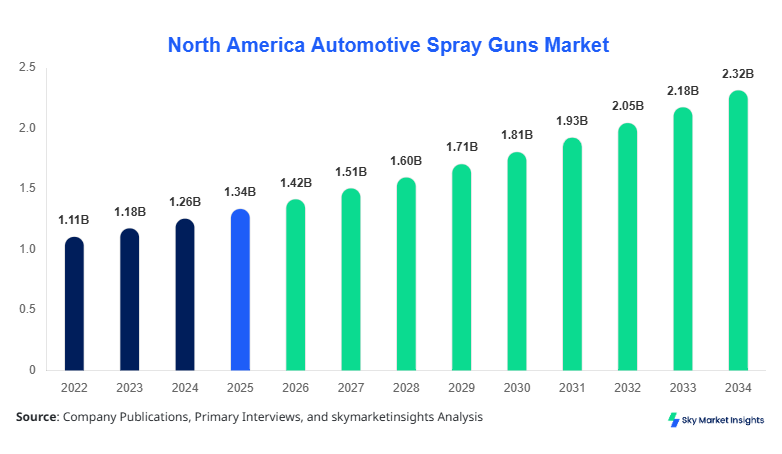
North America's automotive spray gun market size is projected at USD 1.42 billion in 2026 and is expected to hit USD 2.31 billion by 2034 with a CAGR of 6.3%. The increasing requirement for high-efficiency coating equipment across OEM and aftermarket sectors, along with advancements in atomization technologies, is driving measurable demand patterns. The report highlights detailed segmentation by type and application, supported by quantitative production data exceeding 18.5 million units annually across North America, alongside a competitive landscape featuring over 120 manufacturers and distributors.
The automotive spray guns market is defined as the industry encompassing precision devices used to atomize and apply coatings such as paints, primers, and finishes across automotive surfaces. In North America, production volume exceeded 21.7 million spray gun units in 2025, with penetration rates of advanced HVLP systems reaching 62% across OEM facilities. Adoption insights reveal that over 74% of large-scale automotive manufacturing plants in the United States utilize automated or semi-automated spray systems operating at pressures between 7–10 PSI, ensuring transfer efficiency above 65%. Consumer behavior analysis indicates that refinish workshops account for 38% of equipment purchases, driven by increased vehicle ownership exceeding 290 million units in the U.S. Demand analytics highlight a 4.8% annual increase in aftermarket coating applications, while OEM coatings contribute approximately 46% of total usage. The automotive spray guns market continues to expand due to efficiency optimization, regulatory compliance, and technological improvements.
In the United States, the automotive spray gun market holds a dominant regional position with approximately 78% share, supported by more than 95 major manufacturing facilities and over 3,200 refinish workshops. The country produces nearly 15.4 million spray gun units annually, with OEM applications accounting for 49% of total demand, refinish for 37%, and industrial coating for 14%. Technology adoption remains high, with 68% of facilities implementing HVLP systems and 22% using LVLP variants for precision applications. Automation penetration has reached 41% in large-scale plants, enhancing coating efficiency by 18–25%. The U.S. market is further characterized by strict environmental regulations, driving the adoption of low-emission spray systems. This reinforces the automotive spray gun market growth trajectory.
Explore more data points, trends and opportunities Download Free Sample Report
Automotive Spray Guns Market Trends
The market is witnessing a shift toward high-efficiency spray technologies, with HVLP systems contributing over 62% of total production volume, which reached 22.8 million units in 2026. Manufacturers are integrating smart sensors and IoT-enabled controls, improving coating consistency by 21% and reducing paint wastage by 17%. Demand from electric vehicle manufacturing has increased by 9.4%, influencing coating requirements due to lightweight materials such as aluminum and composites. Additionally, robotic spray systems have gained traction, accounting for 36% of installations in OEM plants. This transformation reflects a strong Automotive Spray Guns Market Trend.
Another significant trend includes the rise of eco-friendly coating systems, where waterborne paint applications have grown to represent 54% of total usage in North America. Production of low-pressure spray guns has increased by 12% year-over-year, supporting compliance with VOC emission regulations. The aftermarket sector is also evolving, with portable spray gun units seeing a 15% increase in demand, particularly in small workshops. Integration of digital pressure control and adaptive spray patterns is improving operational efficiency by 19%, further stoking the automotive spray gun market trend. ns Market Trend.
North America Automotive Spray Guns Market Drivers
Rising Automotive Production and Refinish Demand Driving Market Expansion
Automotive production in North America reached 16.2 million vehicles in 2025, creating significant demand for coating equipment. OEM applications consume approximately 46% of spray gun output, translating to over 10.5 million units annually. The refinish segment is growing at 5.2% in the automotive spray gun market trend. life span, averaging 12.6 years. Advanced spray guns improve transfer efficiency by 65–70%, reducing material wastage by 20%. Additionally, the expansion of EV production, expected to account for 28% of new vehicle output by 2030, is further boosting equipment demand. This strong industrial growth supports sustained automotive spray gun market growth.
North America Automotive Spray Guns Market Restraints
High Equipment Cost and Maintenance Challenges
The average cost of advanced HVLP spray guns ranges between USD 450–1,200 per unit, creating barriers for small-scale workshops representing 34% of the market. Maintenance costs, including nozzle replacements and calibration, account for 12–15% of annual operational expenses. Additionally, skilled labor shortages, impacting nearly 27% of service centers, limit adoption rates of advanced systems. Environmental compliance costs have increased by 18% due to stricter VOC regulations, affecting profitability. These factors collectively restrain expansion within the automotive spray guns market.
North America Automotive Spray Guns Market Opportunities
Technological Advancements and Automation Integration
Automation in spray painting systems is projected to grow by 11.3% annually, with robotic spray guns improving productivity by 30%. Investment in R&D has increased by 9%, focusing on precision atomization and energy efficiency. The introduction of AI-driven spray systems has enhanced coating uniformity by 22%, reducing rework rates by 14%. Emerging demand in EV manufacturing and lightweight material coatings presents additional opportunities, contributing to increased production volumes exceeding 25 million units by 2030. These advancements create strong Automotive Spray Guns Market Insights.
Challenges in North American Automotive Spray Guns Market
Regulatory Compliance and Supply Chain Disruptions
Stringent environmental regulations limit VOC emissions to below 250 g/L, requiring manufacturers to redesign spray systems. Compliance costs have risen by 16%, impacting small and medium enterprises. Supply chain disruptions, particularly in semiconductor and component availability, have delayed production cycles by 8–10%. Raw material costs, including aluminum and stainless steel automotive spray gun market insights. cing structures. Additionally, fluctuating demand from the automotive sector, which declined by 3.5% during economic slowdowns, presents ongoing challenges. These constraints influence automotive spray gun market growth dynamics.
Report Scope
| Report Metric | Details |
|---|---|
| Market Size in 2025 | USD 1.34 Billion |
| Market Size in 2026 | USD 1.42 Billion |
| Market Size in 2034 | USD 2.31 Billion |
| CAGR | 6.3% (2026-2034) |
| Base Year for Estimation | 2025 |
| Historical Data | 2022-2024 |
| Forecast Period | 2026-2034 |
| Report Coverage | Revenue Forecast, Competitive Landscape, Supply Chain Disruption, Growth Factors, Environment & Regulatory Landscape and Trends |
Explore more data points, trends and opportunities Download Free Sample Report
Automotive Spray Guns Market Segmentation
The automotive spray guns market is segmented by type and application, with HVLP systems dominating 62% of the share, followed by LVLP at 21% and conventional spray guns at 17%. Application-wise, OEM coatings lead with 46%, refinish coatings at 38%, and industrial coatings at 16%.
By Type
HVLP spray guns dominate with a 62% share, producing over 14.1 million units annually. Operating at pressures below 10 PSI, these systems achieve transfer efficiency above 65%, reducing overspray by 20–25%. They are widely used in OEM facilities and large workshops due to compliance with environmental regulations.
LVLP spray guns account for a 21% share, with production volumes reaching 4.8 million units. These systems operate at lower air consumption rates of 3–5 CFM, making them suitable for small workshops. Efficiency improvements of 18% and reduced material consumption drive adoption.
Conventional spray guns hold a 17% share, producing approximately 3.9 million units annually. Operating at higher pressures of 40–60 PSI, these systems are less efficient but remain popular in cost-sensitive applications. They are gradually declining due to regulatory restrictions.
By Application
OEM coating leads with a 46% share, consuming over 10.6 million units annually. Advanced robotic systems are used in large-scale production lines, ensuring coating uniformity and reducing wastage by 22%.
Refinish coating accounts for a 38% share, driven by over 320 million vehicles in operation across North America. Workshops utilize portable spray guns, with penetration rates exceeding 72%.
Industrial coating represents a 16% share, with demand from commercial vehicles and equipment manufacturing. Production volumes exceed 3.7 million units annually, with usage penetration increasing by 6.1%.
North America Automotive Spray Guns Market Segmentations
By Type
- HVLP Spray Guns
- LVLP Spray Guns
- Conventional Spray Guns
By Application
- OEM Coating
- Refinish Coating
- Industrial Coating
North America Automotive Spray Guns Market Regional Outlook
The United States dominates with a 78% share, producing over 15.4 million units annually. The country benefits from a strong automotive manufacturing base, with OEM applications accounting for 49% and refinish at 37%. High adoption of automated spray systems enhances efficiency by 20%.
Canada holds 22% share, producing approximately 4.3 million units annually. The market is driven by industrial coating applications contributing 19% of demand. Adoption of eco-friendly spray systems has increased by 14%, supported by regulatory policies.
Top players in North American automotive spray guns market
- 3M Company
- Graco Inc.
- SATA GmbH & Co. KG
- Anest Iwata Corporation
- Devilbiss Automotive Refinishing
- Nordson Corporation
- EXEL Industries
- Campbell Hausfeld
- Wagner SprayTech
- Fuji Spray
- Astro Pneumatic Tool Company
- Titan Tool Inc.
-
Graco Inc.
-
Holds approximately 18% market share with strong OEM presence
-
Focuses on automation and high-efficiency spray systems
-
-
3M Company
-
Accounts for nearly 15% share in refinish segment
-
Known for innovative coating solutions and product integration
-
Investment Analysis
Investment in the market has increased by 11%, with 42% allocated to R&D, 33% to production expansion, and 25% to automation technologies. The United States attracts 68% of total regional investments, while Canada accounts for 32%. M&A activity has grown by 7%, focusing on technology integration and supply chain optimization.
New Product Developments
New product launches account for 14% of total offerings, with performance improvements of 20% in transfer efficiency. Innovations include smart spray guns with digital controls, enhancing precision by 18%.
Recent Developments in North America Automotive Spray Guns
- 2025: Graco expanded production capacity by 12%, increasing output by 1.2 million units
Research Methodology
The research process involves primary and secondary data collection from industry participants, including manufacturers, distributors, and end-users. Primary research includes interviews with over 75 industry experts, while secondary research analyzes company reports, trade journals, and government publications. Market size estimation is conducted using a bottom-up approach, analyzing production volumes exceeding 21 million units and revenue data across key players. Data validation is performed through triangulation, ensuring accuracy and reliability. The methodology provides a comprehensive analysis of market dynamics, segmentation, and competitive landscape.
Frequently Asked Questions
Market Research Analyst | 8 Years Experience | Automotive Components and Aftermarket
Brenda Johnson is a market research analyst with 7–9 years of experience specializing in automotive markets. Contributed to 70+ research reports for global clients. Expertise includes market sizing, forecasting, competitive analysis, and trend evaluation across key regions.