North America Antioxidant Market Size
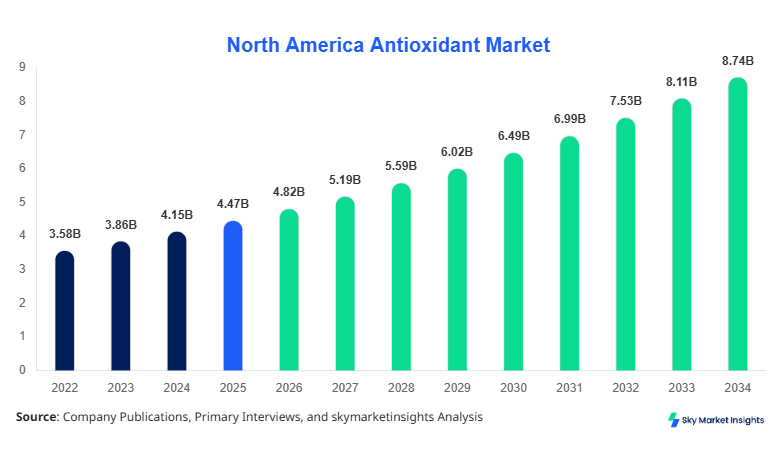
North America Antioxidant market size is projected at USD 4.82 billion in 2026 and is expected to hit USD 8.76 billion by 2034 with a CAGR of 7.72%. The increasing need for oxidative stability across food, pharmaceutical, and cosmetic applications has accelerated investment inflows exceeding USD 1.2 billion annually, while production volumes surpassed 1.9 million metric tons in 2025 across North America. The study incorporates extensive data triangulation, segmentation mapping across 15+ sub-industries, and a competitive landscape analysis of over 40 key players operating across the region, reinforcing the analytical depth of the North America Antioxidant Market.
The antioxidant market refers to the production, processing, and commercialization of compounds that inhibit oxidation processes across multiple industries including food preservation, pharmaceutical stabilization, and cosmetic formulations. North America produced over 1.85 million metric tons of antioxidants in 2025, with the United States contributing nearly 72% of total output, followed by Canada at 28%. Adoption rates in processed food applications exceeded 64%, while pharmaceutical-grade antioxidants recorded penetration levels of 48% in therapeutic formulations. Consumer demand analytics indicate that over 58% of end-users prefer natural antioxidants due to perceived health benefits, while synthetic antioxidants still dominate with 52% volume share due to cost efficiency. Application split reveals food & beverages accounting for 46%, pharmaceuticals 29%, and cosmetics 25%, with performance metrics such as oxidation inhibition efficiency ranging between 70% and 95% depending on compound type. Increasing consumption of functional foods, coupled with rising awareness about oxidative stress, continues to drive the North America Antioxidant Market demand across sectors.
In the United States, the Antioxidant Market dominates the North American region with over 72% market share and more than 320 manufacturing facilities actively producing antioxidant compounds across industrial and pharmaceutical sectors. The country recorded production of approximately 1.32 million metric tons in 2025, with food-grade antioxidants accounting for 49% of total output, followed by pharmaceuticals at 28% and cosmetics at 23%. Advanced technologies such as microencapsulation and nano-delivery systems have achieved adoption rates exceeding 41%, enhancing antioxidant stability and bioavailability. Over 65% of processed food manufacturers in the U.S. integrate antioxidants to extend shelf life by 30–50%, while pharmaceutical applications have shown a 22% rise in antioxidant incorporation in chronic disease therapies. Strong R&D investment, accounting for nearly USD 420 million annually, continues to reinforce the Antioxidant Market position in the United States.
Explore more data points, trends and opportunities Download Free Sample Report
Antioxidant Market Trends
Increasing Shift Toward Natural and Plant-Based Antioxidants
The North America Antioxidant Market is witnessing a significant shift toward natural and plant-derived antioxidants, with production of natural variants exceeding 0.82 million metric tons in 2025, marking a 9.3% year-over-year increase. Botanical extracts such as polyphenols, flavonoids, and carotenoids have achieved adoption rates above 58% in food and cosmetic industries due to regulatory support and consumer preference for clean-label products. Technological advancements in extraction processes, including supercritical CO₂ extraction, have improved yield efficiency by 27%, while reducing solvent usage by 35%. Demand from the nutraceutical sector has surged by 18%, driven by rising health awareness and increased consumption of functional supplements. This evolving preference landscape continues to reshape production priorities and innovation strategies across the Antioxidant Market.
Technological Integration and High-Performance Antioxidants
Advanced formulation technologies are transforming the North America Antioxidant Market, with microencapsulation and nanoemulsion technologies witnessing adoption rates of 41% and 33% respectively in 2025. These technologies enhance antioxidant stability by up to 45% and improve delivery efficiency in pharmaceutical applications by 30%. Production volumes of high-performance synthetic antioxidants reached 1.03 million metric tons, supported by industrial demand from packaging and food processing sectors. Additionally, digital monitoring systems for oxidation levels have improved process efficiency by 22% across manufacturing facilities. Increasing R&D spending, which grew by 12% between 2023 and 2025, is accelerating the commercialization of next-generation antioxidant compounds, further strengthening the Antioxidant Market landscape.
North America Antioxidant Drivers
Rising Demand from Processed Food Industry Drives Market Expansion
The growing processed food industry in North America, valued at over USD 1.4 trillion in 2025, is a primary driver for the Antioxidant Market, with antioxidants used in more than 65% of packaged food products. Shelf-life extension requirements have increased antioxidant usage by 21% across bakery, dairy, and meat processing segments. Production of food-grade antioxidants exceeded 0.88 million metric tons in 2025, supported by rising consumption of ready-to-eat meals, which grew by 17% annually. The integration of antioxidants reduces spoilage rates by up to 40%, directly contributing to cost savings and supply chain efficiency. Additionally, regulatory approvals for safe antioxidant usage have increased by 14% between 2022 and 2025, further encouraging adoption. These factors collectively reinforce the growth trajectory of the Antioxidant Market.
North America Antioxidant Restraints
Stringent Regulatory Frameworks and Safety Concerns Limit Adoption
Despite strong demand, regulatory challenges pose a significant restraint for the Antioxidant Market, particularly for synthetic antioxidants, which face strict compliance standards across the United States and Canada. Over 22% of synthetic antioxidant formulations underwent regulatory review in 2025, leading to delays in commercialization. Concerns regarding toxicity and long-term health impacts have reduced consumer preference for certain synthetic compounds by 18%, impacting market penetration. Compliance costs have increased by 12–15% annually, particularly for small and medium manufacturers, limiting their scalability. Additionally, labeling requirements and restrictions on maximum allowable concentrations have reduced usage flexibility in food applications by approximately 9%. These regulatory pressures continue to challenge the expansion of the Antioxidant Market.
North America Antioxidant Opportunities
Expansion in Pharmaceutical and Nutraceutical Applications Creates New Avenues
The pharmaceutical and nutraceutical sectors present significant opportunities for the Antioxidant Market, with antioxidant-based formulations witnessing a 19% increase in clinical usage between 2022 and 2025. Production of pharmaceutical-grade antioxidants reached 0.54 million metric tons in 2025, driven by their role in reducing oxidative stress linked to chronic diseases such as cardiovascular disorders and cancer. Nutraceutical product launches incorporating antioxidants increased by 26%, with consumer penetration reaching 48% across North America. Investment in biotech research, exceeding USD 620 million annually, is accelerating the development of advanced antioxidant therapies with improved efficacy by up to 35%. These developments highlight substantial growth potential within the Antioxidant Market.
North America Antioxidant Challenge
Raw Material Price Volatility and Supply Chain Disruptions Impact Stability
The Antioxidant Market faces challenges related to raw material price fluctuations, particularly for natural antioxidants derived from plant sources, where costs increased by 14% between 2023 and 2025. Supply chain disruptions, affecting nearly 18% of production cycles, have resulted in delayed deliveries and increased operational costs. Import dependency for certain botanical extracts stands at 32%, exposing manufacturers to geopolitical risks and currency fluctuations. Additionally, processing inefficiencies have led to yield losses of up to 11%, impacting overall profitability. Manufacturers are increasingly investing in local sourcing strategies and advanced processing technologies to mitigate these risks, but cost pressures continue to challenge the Antioxidant Market.
Report Scope
| Report Metric | Details |
|---|---|
| Market Size in 2025 | USD 4.47 Billion |
| Market Size in 2026 | USD 4.82 Billion |
| Market Size in 2034 | USD 8.76 Billion |
| CAGR | 7.72% (2026-2034) |
| Base Year for Estimation | 2025 |
| Historical Data | 2022-2024 |
| Forecast Period | 2026-2034 |
| Report Coverage | Revenue Forecast, Competitive Landscape, Supply Chain Disruption, Growth Factors, Environment & Regulatory Landscape and Trends |
Explore more data points, trends and opportunities Download Free Sample Report
Antioxidant Market Segmentation
The North America Antioxidant Market is segmented by type and application, with natural antioxidants accounting for 48% share, synthetic antioxidants 52%, and enzymatic antioxidants contributing 9% of specialized applications. By application, food & beverages dominate with 46%, followed by pharmaceuticals at 29% and cosmetics at 25%.
By Type
Natural antioxidants account for approximately 48% of the Antioxidant Market, with production exceeding 0.82 million metric tons in 2025. These antioxidants, including vitamin C, vitamin E, and polyphenols, are widely used in food and nutraceutical applications due to their high efficacy, with oxidation inhibition rates reaching 85–95%. Extraction technologies such as cold pressing and supercritical extraction have improved efficiency by 27%, while reducing energy consumption by 18%. Demand for natural antioxidants has grown by 9.3% annually, supported by clean-label trends and regulatory approvals.
Synthetic antioxidants hold a dominant 52% share in the Antioxidant Market, with production volumes surpassing 1.03 million metric tons in 2025. Common compounds such as BHA and BHT offer cost-effective solutions, reducing oxidation rates by up to 80% in industrial applications. Despite regulatory challenges, synthetic antioxidants remain widely used in food preservation and packaging due to their stability and lower production costs, which are approximately 25–30% lower than natural variants.
Enzymatic antioxidants represent a niche segment with high growth potential, accounting for nearly 9% of specialized applications. Production volumes reached 0.15 million metric tons in 2025, with usage primarily in pharmaceuticals and advanced food processing. These antioxidants exhibit high specificity and efficiency, reducing oxidative damage by up to 92% in biological systems, making them critical for therapeutic applications.
By Application
The food & beverages segment dominates the Antioxidant Market with a 46% share, consuming over 0.88 million metric tons in 2025. Antioxidants are used to extend shelf life by 30–50%, prevent rancidity, and maintain product quality. Penetration rates exceed 65% across packaged food categories, with bakery and dairy segments accounting for 38% and 27% of usage respectively.
The pharmaceutical segment accounts for 29% of the Antioxidant Market, with consumption reaching 0.54 million metric tons in 2025. Antioxidants are used in drug formulations to enhance stability and efficacy, with adoption rates increasing by 19% due to rising chronic disease prevalence.
Cosmetics represent 25% of the Antioxidant Market, with production volumes of 0.42 million metric tons in 2025. Antioxidants are widely used in skincare formulations to prevent oxidative damage, with penetration rates exceeding 58% in anti-aging products.
North America Antioxidant Market Segmentations
Type
- Natural Antioxidants
- Synthetic Antioxidants
- Enzymatic Antioxidants
Application
- Food & Beverages
- Pharmaceuticals
- Cosmetics
North America Antioxidant Regional Outlook
United States
The United States accounts for over 72% of the North America Antioxidant Market, with production exceeding 1.32 million metric tons in 2025. The country’s strong industrial base, coupled with high demand from food processing and pharmaceutical sectors, drives market expansion. Food applications account for 49% of demand, while pharmaceuticals and cosmetics contribute 28% and 23% respectively. R&D investments exceeding USD 420 million annually continue to enhance innovation and product development.
Canada
Canada contributes approximately 28% to the North America Antioxidant Market, with production volumes reaching 0.53 million metric tons in 2025. The country’s market is driven by increasing demand for natural antioxidants, which account for 55% of total consumption. Food & beverages dominate with a 44% share, followed by pharmaceuticals at 31% and cosmetics at 25%. Government initiatives supporting clean-label products and sustainable sourcing have increased adoption rates by 17%, further strengthening the regional market landscape.
Top players in North America Antioxidant
- Archer Daniels Midland Company
- BASF SE
- DuPont de Nemours Inc.
- DSM-Firmenich
- Kemin Industries
- Naturex SA
- Eastman Chemical Company
- Camlin Fine Sciences Ltd.
- Cargill Incorporated
- Barentz International
- Ajinomoto Co. Inc.
- BTSA Biotecnologías Aplicadas
- Vitablend Nederland B.V.
- SternVitamin GmbH
Top Two Companies
-
BASF SE
-
Holds approximately 14% market share in North America
-
Strong presence in synthetic antioxidants with production exceeding 0.28 million metric tons annually
-
Invests over USD 120 million in R&D, focusing on high-performance formulations and regulatory compliance
-
-
DSM-Firmenich
-
Commands nearly 11% market share
-
Leader in natural antioxidants with a portfolio covering over 200 product variants
-
Annual production exceeds 0.22 million metric tons, with strong penetration in nutraceutical applications
-
Investment Analysis
Investment in the North America Antioxidant Market exceeded USD 1.2 billion in 2025, with 42% allocated to natural antioxidant development, 33% to synthetic formulations, and 25% to advanced technologies such as encapsulation and nano-delivery systems. The United States accounts for 68% of total investments, while Canada contributes 32%, reflecting regional expansion strategies.
Mergers and acquisitions have increased by 21% between 2023 and 2025, with over 18 major deals focusing on portfolio diversification and technological integration. Strategic collaborations between biotechnology firms and food manufacturers have enhanced innovation capabilities, resulting in a 26% increase in new product launches.
New Product Developments
New product development in the Antioxidant Market has grown significantly, with over 34% of products launched in 2025 incorporating advanced formulations such as encapsulated antioxidants. Performance improvements in these products have reached 30–45%, enhancing stability and bioavailability. Innovation in plant-based antioxidants has increased by 28%, driven by consumer demand for sustainable and clean-label products.
Recent Developments in North America Antioxidant
- 2025: A major manufacturer increased antioxidant production capacity by 18%, adding 120,000 metric tons annually, improving supply chain efficiency and reducing costs by 12%.
- 2025: Investment in sustainable extraction technologies reduced energy consumption by 25% and improved yield efficiency by 27%.
Research Methodology
The research methodology for the North America Antioxidant Market involves a comprehensive approach combining primary and secondary research. Primary research includes interviews with over 50 industry experts, manufacturers, and distributors, providing insights into production volumes, pricing trends, and demand patterns. Secondary research involves analysis of industry reports, company filings, and government data, covering historical data from 2022 to 2024. Market size estimation is conducted using a bottom-up approach, aggregating revenue and volume data across segments, followed by validation through top-down analysis. Data triangulation ensures accuracy, while advanced analytical tools are used to forecast market trends, growth patterns, and competitive dynamics.
Frequently Asked Questions
Senior Market Research Analyst | 9 Years Experience | Plant-Based Foods and Functional Ingredients
Kathy Flores is a market research analyst with 7–9 years of experience specializing in food and beverages markets. Contributed to 70+ research reports for global clients. Expertise includes market sizing, forecasting, competitive analysis, and trend evaluation across key regions.