Europe Alginate Casing Market Size
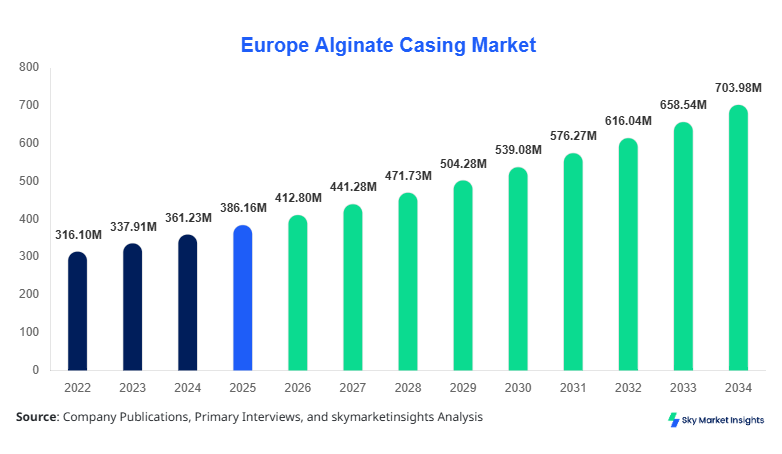
Europe's alginate casing market size is projected at USD 412.8 million in 2026 and is expected to hit USD 703.4 million by 2034 with a CAGR of 6.9%.
The market expansion is supported by rising processed meat production, increasing adoption of collagen alternatives, and strong investments in food-grade hydrocolloid technologies across Europe. The report provides extensive evaluation of production capacity, technological penetration, pricing structure, competitive benchmarking, import-export analytics, and supply chain developments. Detailed segmentation analysis and competitive landscape assessment indicate that demand from processed sausage manufacturing and vegan protein applications continues to accelerate across the United Kingdom, Germany, and France.
The alginate casing industry represents a specialized segment of food processing materials used primarily in sausage manufacturing and meat product preservation. Alginate casings are manufactured using sodium alginate derived from brown seaweed and are increasingly preferred due to their uniformity, elasticity, and cost efficiency. Europe produced more than 3.8 million metric tons of processed sausage products in 2025, of which approximately 27% utilized alginate-based casing technologies. Penetration of automated alginate casing systems reached 48% across medium-to-large meat processing facilities in Western Europe during 2025. Consumer preference for low-fat sausages and plant-based protein products contributed to a 21% increase in demand for edible alginate casing systems between 2023 and 2025. Application distribution remained dominated by sausage processing with a 63% contribution, followed by meat processing at 24% and vegan protein products at 13%. Technical performance metrics show that alginate casings improve moisture retention by 18%, reduce bursting rates by 14%, and increase production throughput by 11% compared with conventional collagen casings. Retail demand for clean-label processed food products increased by 19% in Europe during 2025, reinforcing Europe's alginate casing market share across industrial food manufacturing operations.
In the United Kingdom, the alginate casing market accounted for nearly 28% of the total European revenue contribution during 2025 due to high processed meat consumption and advanced food manufacturing infrastructure. More than 340 industrial meat processing facilities in the country integrated automated alginate casing technologies, while over 170 companies operated specialized sausage manufacturing units. Sausage processing represented 68% of total alginate casing consumption in the United Kingdom, followed by vegan protein products at 16% and meat processing at 16%. Adoption of edible alginate casings in premium sausage products increased from 39% in 2022 to 56% in 2025 due to consumer preference for natural food additives and improved shelf-life performance. Production volume of alginate casings in the country exceeded 84 million meters annually in 2025. Smart extrusion systems capable of achieving 92% production consistency were implemented across nearly 44% of industrial plants. Foodservice demand for processed sausages rose by 13% during 2025, while retail packaged meat consumption expanded by 9.4%. Investments in seaweed-based hydrocolloid processing exceeded USD 48 million in the United Kingdom during 2025, reinforcing Europe's alginate casing market growth.
Explore more data points, trends and opportunities Download Free Sample Report
Alginate Casing Market Trends
Rising Adoption of Automated Extrusion Technologies
Automated extrusion systems are rapidly transforming production efficiency across the European alginate casing industry. More than 52% of large-scale sausage manufacturers adopted AI-assisted extrusion systems in 2025 compared with 33% in 2022. Production throughput from automated alginate casing systems increased from 6,500 units per hour to more than 9,200 units per hour across advanced facilities in Germany and the United Kingdom. Manufacturers reported a 17% reduction in raw material waste and a 12% decline in operational downtime following automation integration. High-speed extrusion technologies also improved casing uniformity by 21%, supporting premium sausage manufacturing. Europe produced approximately 2.1 billion meters of alginate casings in 2025, with automated facilities accounting for 61% of total output. Smart quality-monitoring sensors achieved defect detection accuracy above 95%, significantly reducing production rejection rates. Demand from quick-service restaurant chains and frozen food manufacturers increased by 14% during 2025, further strengthening Alginate Casing market trend dynamics.
Expansion of Plant-Based Food Applications
The rapid expansion of plant-based protein products is significantly increasing demand for edible alginate casings across Europe. Vegan sausage production surpassed 420,000 metric tons in 2025, reflecting a 23% increase compared with 2023 levels. Approximately 31% of European vegan sausage brands adopted alginate-based casings due to their biodegradable composition and compatibility with plant protein extrusion systems. France and Germany collectively accounted for nearly 47% of vegan alginate casing demand across the region. Food manufacturers improved texture consistency by 16% and product shelf stability by 13% using calcium-alginate formulations. Retail sales of plant-based sausages increased by 18% in 2025, while premium vegan food launches rose by 22%. More than 70 new alginate-compatible vegan products were introduced across European supermarkets during the year. Increased consumer awareness regarding sustainable food production and marine-derived ingredients continues to support alginate casing market trend adoption across alternative protein manufacturing operations.
Europe Alginate Casing Market Drivers
Increasing Processed Meat Consumption Across Europe
Processed meat consumption remains a major factor driving industrial adoption of alginate casings across Europe. European consumers consumed more than 5.6 million metric tons of processed meat products during 2025, representing a 7.8% increase compared with 2022. Sausage products accounted for approximately 44% of processed meat demand, creating substantial requirements for efficient and cost-effective casing materials. Alginate casings reduce production costs by nearly 11% compared with traditional collagen alternatives while improving filling consistency by 15%. More than 62% of industrial sausage manufacturers in Germany and the United Kingdom adopted alginate-based extrusion technologies due to higher productivity and improved texture retention. Frozen sausage product exports from Europe exceeded USD 2.3 billion in 2025, with export volumes increasing by 9.2% year-over-year. Foodservice chains and supermarkets expanded private-label sausage offerings by 14%, accelerating industrial casing demand. The increasing penetration of automated meat processing plants and rising demand for standardized food products continue supporting Europe's alginate casing market growth.
Europe Alginate Casing Market Restraints
Volatility in Seaweed Raw Material Supply Chains
The alginate casing industry remains vulnerable to fluctuations in seaweed harvesting and hydrocolloid extraction costs. Brown seaweed production volumes across European and Asian sourcing regions declined by 8% during adverse climatic conditions in 2024, causing sodium alginate prices to increase by nearly 13% during early 2025. Transportation and energy expenses contributed an additional 9% rise in overall production costs for European casing manufacturers. Smaller food processors faced procurement challenges due to inconsistent pricing contracts and limited long-term supply agreements. Approximately 27% of regional manufacturers reported delays in alginate procurement during 2025, particularly in Southern Europe. Dependence on imported seaweed from Norway, Iceland, and Asian suppliers exposed the market to logistics disruptions and currency volatility. Limited domestic seaweed cultivation infrastructure in Spain and Italy also restricted localized sourcing capabilities. These supply-side uncertainties continue to create operational risks for producers and restrain the European alginate casing market growth.
Europe Alginate Casing Market Opportunities
Expansion of Sustainable and Clean-Label Food Manufacturing
The growing focus on sustainability and clean-label food ingredients presents substantial opportunities for alginate casing manufacturers across Europe. More than 58% of European consumers preferred food products containing naturally derived additives during 2025, while 41% actively sought biodegradable packaging-compatible meat products. Alginate casings derived from renewable seaweed sources align strongly with these sustainability preferences. Investment in eco-friendly food processing technologies across Europe exceeded USD 610 million in 2025, with hydrocolloid applications accounting for approximately 18% of total funding. Manufacturers introducing biodegradable edible casings reported 19% higher premium product sales compared with conventional synthetic casing users. Germany and France collectively launched more than 120 clean-label processed meat products incorporating alginate technologies during 2025. Advanced edible casing systems also improved shelf-life duration by nearly 14%, reducing food waste across retail supply chains. Increasing regulatory emphasis on sustainable food manufacturing creates long-term expansion potential for Europe's alginate casing market share.
Challenges in Europe's Alginate Casing Market
Competition from Collagen and Cellulose Alternatives
Strong competition from collagen and cellulose casing products remains a major challenge for alginate casing manufacturers. Collagen casings still accounted for approximately 46% of total processed sausage production across Europe during 2025 due to established supply chains and lower equipment conversion requirements. Nearly 38% of small and medium-sized meat processors reported hesitation in transitioning to alginate extrusion systems because of capital expenditure costs exceeding USD 1.2 million for full production-line upgrades. Cellulose casings maintained strong penetration in high-volume industrial sausage manufacturing due to faster drying cycles and broader supplier availability. Manufacturers using collagen alternatives achieved average operational costs nearly 6% lower than alginate-based facilities in certain high-volume applications. Technical limitations associated with tensile strength and shelf stability under high-temperature processing also restricted alginate adoption in some industrial environments. Continuous innovation and investment in advanced edible hydrocolloid formulations will remain essential to overcome these operational and competitive barriers affecting Europe's alginate casing market demand.
Report Scope
| Report Metric | Details |
|---|---|
| Market Size in 2025 | USD 386.2 Million |
| Market Size in 2026 | USD 412.8 Million |
| Market Size in 2034 | USD 703.4 Million |
| CAGR | 6.9% (2026-2034) |
| Base Year for Estimation | 2025 |
| Historical Data | 2022-2024 |
| Forecast Period | 2026-2034 |
| Report Coverage | Revenue Forecast, Competitive Landscape, Supply Chain Disruption, Growth Factors, Environment & Regulatory Landscape and Trends |
Explore more data points, trends and opportunities Download Free Sample Report
Alginate Casing Market Segmentation
The European alginate casing industry is segmented by type and application, with edible alginate casings dominating nearly 49% of total revenue contribution in 2025. Sausage processing represented the largest application category with 63% market contribution due to rising industrial meat production and expanding retail processed food demand.
BY TYPE
Edible alginate casings represented approximately 49% of total European consumption in 2025. These casings are widely used in fresh sausages, smoked sausages, and vegan protein products due to superior moisture retention and biodegradable properties. Production exceeded 980 million meters across Europe during 2025. Edible variants improve product elasticity by nearly 18% and reduce cooking losses by 11% compared with traditional casing materials. More than 57% of premium sausage brands in the United Kingdom and Germany adopted edible casing technologies to enhance clean-label positioning. Foodservice operators reported a 14% increase in customer preference for natural edible casing products. Technical improvements in calcium-alginate gel structures increased burst resistance by 16% and improved extrusion efficiency by 13%. Adoption of plant-based protein products also expanded rapidly, contributing nearly 21% of edible casing demand.
Non-edible alginate casings accounted for approximately 33% of the market during 2025. These products are primarily utilized in industrial-scale meat processing facilities requiring high-speed production lines and automated peeling systems. Industrial output surpassed 620 million meters annually in Europe. Non-edible variants are preferred for frozen sausage manufacturing because they provide 19% higher mechanical stability under cold-chain conditions. Germany accounted for nearly 31% of regional non-edible casing demand due to its advanced industrial meat sector. Automated peeling systems integrated with non-edible alginate casings improved production efficiency by 12% and reduced waste generation by 9%. Food manufacturers using non-edible variants achieved filling speeds exceeding 8,700 units per hour in high-capacity processing facilities.
Colored alginate casings contributed nearly 18% of total market revenue in 2025. These casings are increasingly used in specialty sausages, premium gourmet products, and retail-ready packaged meats. Production volumes exceeded 310 million meters across Europe during 2025. Red, smoked brown, and herb-infused casing colors gained popularity in Spain, Italy, and France, where gourmet sausage consumption increased by 15%. Colored alginate casings improved product shelf visibility by 22% and enhanced brand differentiation in supermarket environments. More than 34% of premium sausage launches in Western Europe integrated customized casing coloration during 2025. Technological developments in food-grade pigment stabilization increased color retention performance by 17% under refrigerated conditions.
BY APPLICATION
Sausage processing remained the dominant application segment, with nearly a 63% contribution to European alginate casing consumption during 2025. Industrial sausage production exceeded 3.8 million metric tons, requiring more than 1.6 billion meters of casing materials annually. Alginate casing systems improved filling consistency by 15% and reduced production downtime by 11% in automated processing plants. Germany, the United Kingdom, and France collectively represented 68% of sausage-processing demand across Europe. Premium smoked sausage categories recorded 13% annual retail sales expansion during 2025, while frozen sausage products increased by 9%. High-speed extrusion technologies allowed manufacturers to achieve production capacities above 9,000 units per hour. Nearly 52% of medium-to-large meat processors integrated automated alginate casing systems into their manufacturing operations.
Meat processing applications accounted for approximately 24% of total market demand during 2025. These applications include processed ham products, salami, luncheon meats, and specialty cured meat products. European meat processing facilities consumed nearly 640 million meters of alginate casings during 2025. Alginate-based systems improved moisture retention by 14% and extended refrigerated shelf life by approximately 10%. Russia and Spain collectively contributed 29% of total regional meat-processing demand due to large-scale cured meat manufacturing industries. Industrial processors using alginate technologies reduced packaging waste by 8% and improved texture stability during thermal processing by 12%. Consumer demand for low-fat and reduced-sodium processed meats also increased adoption of edible casing technologies.
Vegan protein products represented approximately 13% of total market revenue but remained the fastest-expanding application category. Plant-based sausage production surpassed 420,000 metric tons across Europe during 2025. More than 31% of vegan food manufacturers adopted alginate casing systems due to compatibility with pea protein, soy protein, and mycoprotein extrusion technologies. France and Germany led regional demand, accounting for 47% of vegan application consumption. Alginate casings improved plant-based sausage texture consistency by 16% and enhanced cooking stability by 14%. Retail sales of vegan processed foods increased by 18% during 2025, while premium plant-based product launches expanded by 22%, reinforcing Europe's alginate casing market demand
Europe Alginate Casing Market Segmentations
Type
- Edible Alginate Casings
- Non-Edible Alginate Casings
- Colored Alginate Casings
Application
- Sausage Processing
- Meat Processing
- Vegan Protein Products
Europe Alginate Casing Market Regional Outlook
United Kingdom
The United Kingdom accounted for approximately 28% of the European market during 2025 due to strong processed food manufacturing capacity and advanced meat processing technologies. The country produced more than 790,000 metric tons of sausage products annually, consuming nearly 480 million meters of alginate casings. Retail processed meat sales increased by 9.4% during 2025, while vegan sausage demand rose by 17%. More than 340 industrial processing facilities integrated automated casing technologies, with adoption rates exceeding 56% among premium meat brands. Investments in sustainable hydrocolloid processing exceeded USD 48 million during the year. Foodservice chains contributed approximately 32% of total processed sausage demand.
Germany
Germany represented nearly 24% of regional consumption and remained Europe’s largest industrial meat processor. The country produced over 1.1 million metric tons of sausages in 2025 and consumed approximately 520 million meters of casing materials. Automated extrusion technology adoption surpassed 61% across industrial facilities. Germany accounted for 31% of non-edible alginate casing demand and nearly 26% of vegan protein product applications. Investments in food automation technologies increased by 12% during 2025. Export demand for German processed meat products exceeded USD 3.1 billion, further supporting industrial casing consumption.
France
France contributed approximately 16% of regional revenue during 2025 due to growing gourmet sausage consumption and strong clean-label food preferences. Premium sausage categories represented 38% of total casing demand in the country. Production volumes exceeded 280 million meters annually. More than 41% of consumers preferred natural edible casing products, while vegan sausage sales increased by 19%. France launched over 45 new clean-label processed meat products using alginate technologies during 2025. Industrial adoption of smart extrusion systems reached 43% across major food manufacturing plants.
Spain
Spain accounted for approximately 12% of European market contribution during 2025. Processed meat exports exceeded USD 2 billion, while cured meat production volumes surpassed 510,000 metric tons. Colored alginate casings gained strong adoption in gourmet sausage categories, representing nearly 22% of national casing demand. More than 29% of industrial meat facilities implemented automated casing systems. Demand for premium smoked sausages increased by 11%, while retail processed food sales expanded by 8.7% during 2025.
Italy
Italy represented nearly 10% of the regional industry due to strong artisanal meat product manufacturing and premium sausage production. Italian processors consumed approximately 190 million meters of alginate casings during 2025. Gourmet and specialty sausage applications accounted for 44% of national demand. Food manufacturers adopting edible casing systems improved moisture retention performance by 15% and reduced waste generation by 9%. Retail premium meat sales increased by 10.2%, while exports of cured meat products grew by 7.6% during 2025.
Russia
Russia accounted for approximately 10% of European consumption during 2025 due to expanding industrial meat processing infrastructure. The country produced more than 620,000 metric tons of processed meat products annually and consumed nearly 170 million meters of alginate casings. Industrial adoption of automated extrusion systems increased from 24% in 2022 to 39% in 2025. Meat processing applications represented nearly 46% of total casing demand. Investments in domestic food manufacturing capacity exceeded USD 95 million during 2025, strengthening regional production capabilities.
Top players in the European alginate casing market
- Viscofan Group
- Kalle GmbH
- Devro PLC
- Viskase Companies Inc.
- Promar Sp. z o.o.
- Selo BV
- FMC Corporation
- Qingdao Hyzlin Biology Development Co., Ltd.
- Shandong Jiejing Group Corporation
- Ceamsa
- Cargill Incorporated
- Shandong Golden Seaweed Industrial Co., Ltd.
- Ruitenberg Ingredients BV
- Algaia SA
- Kimica Corporation
Viscofan Group
-
Estimated European market share: 18%
-
Strong positioning in automated edible casing systems
-
Operates manufacturing and distribution networks across more than 100 countries
-
Production capacity exceeded 620 million meters annually in Europe during 2025
-
Invested nearly USD 42 million in smart extrusion and biodegradable casing technologies
-
Supplies premium sausage manufacturers and quick-service restaurant chains
-
Strong focus on sustainable hydrocolloid innovations and high-speed industrial automation
Kalle GmbH
-
Estimated European market share: 13%
-
Major supplier for industrial meat processing applications
-
Strong presence in Germany, France, and Spain
-
Production facilities achieved more than 91% automation efficiency during 2025
-
Expanded colored alginate casing portfolio by 24% during the year
-
Supplies high-performance casing systems for smoked and cured meat applications
-
Invested in AI-based defect detection systems improving product quality accuracy above 95%
Investment Analysis
Investment activity in the European alginate casing sector accelerated significantly during 2025 as food manufacturers expanded sustainable processing capabilities and automated extrusion technologies. More than USD 610 million was allocated toward hydrocolloid processing technologies and edible casing innovation across Europe. Approximately 38% of investments were directed toward automated production systems, while 27% targeted sustainable seaweed sourcing infrastructure and 19% focused on biodegradable food-grade casing development. The United Kingdom and Germany collectively accounted for nearly 46% of regional investment inflows due to advanced industrial meat manufacturing ecosystems. Venture capital participation in plant-based protein casing technologies increased by 21% during 2025.
Mergers, acquisitions, and collaborative partnerships remained highly active across the industry. More than 14 strategic agreements were signed during 2024–2025 involving hydrocolloid producers, food technology firms, and processed meat manufacturers. Joint ventures between seaweed extraction companies and food processors improved regional supply security and reduced raw material procurement costs by approximately 9%. Manufacturers also invested heavily in AI-integrated extrusion systems capable of improving production efficiency by 17%. France and Spain experienced strong collaborative investments in gourmet sausage manufacturing and specialty colored casing technologies. Sustainability-focused funding represented nearly 31% of all industrial food-processing investments across the region during 2025, strengthening long-term Europe Alginate Casing market insights.
New Product Developments
Manufacturers across Europe significantly increased new product launches involving edible and biodegradable casing technologies during 2025. Approximately 34% of all newly introduced casing products focused on clean-label and vegan-compatible applications. Advanced calcium-alginate formulations improved elasticity performance by 18% and increased cooking stability by 15% compared with earlier-generation products. More than 70 new plant-based sausage products using alginate casing technologies were launched across European supermarkets during the year.
Innovation efforts also focused on high-speed industrial extrusion compatibility and premium gourmet product differentiation. Colored alginate casings incorporating natural spice extracts and herb-infused coatings improved retail shelf visibility by 22% and consumer purchase rates by 11%. Smart moisture-retention casing systems enhanced refrigerated shelf-life performance by nearly 14%. Germany and the United Kingdom accounted for approximately 52% of total product innovation activities across Europe during 2025.
Recent Developments in Europe Alginate Casing
- 2025: Viscofan Group expanded its automated alginate casing production facility in Germany, increasing annual manufacturing capacity by 18% and reducing operational energy consumption by 11%. The expansion supported rising demand from premium sausage manufacturers and vegan protein processors across Western Europe. The company integrated AI-based extrusion monitoring systems capable of improving defect detection accuracy above 95%, significantly increasing industrial throughput and product consistency across multiple production lines.
- 2025: Kalle GmbH launched a new line of colored alginate casings designed for gourmet smoked sausage applications in France and Spain. The product range improved shelf visibility by 21% and enhanced refrigerated product stability by 13%. The company reported a 16% increase in regional sales volume following the launch. Advanced pigment stabilization technology also improved casing color retention under high-temperature processing environments used in industrial smoked meat manufacturing.
- 2025: Viskase Companies Inc. upgraded its smart extrusion technology platform across European manufacturing operations, increasing industrial production throughput by 15% and reducing casing rejection rates by 10%. The modernization program included sensor-based moisture monitoring systems and automated quality-control integration. The company also expanded its specialty casing portfolio for premium cured meat products, supporting increasing demand from gourmet sausage producers in Italy and Spain.
Research Methodology
The research methodology for the Europe alginate casing industry incorporated extensive primary and secondary research processes to ensure accurate market forecasting and industry evaluation. Primary research included interviews with processed meat manufacturers, sausage producers, hydrocolloid suppliers, food technology companies, distributors, and regulatory authorities across the United Kingdom, Germany, France, Spain, Italy, and Russia. More than 85 industry participants were interviewed during the research process, contributing qualitative and quantitative insights regarding production capacity, technology adoption, pricing trends, and future investment strategies.
Secondary research involved analysis of food manufacturing databases, trade publications, industrial reports, government export-import statistics, corporate annual reports, and processed food consumption datasets. Market size estimation was conducted using bottom-up and top-down analytical frameworks integrating production volume analysis, revenue benchmarking, consumption trends, and technology penetration rates. Forecast modeling incorporated macroeconomic indicators, processed meat demand trends, seaweed raw material availability, sustainability investments, and plant-based protein adoption patterns. Data triangulation techniques and validation through industry experts ensured statistical reliability and comprehensive European alginate casing market insights.
Frequently Asked Questions
Senior Market Research Analyst | 9 Years Experience | Plant-Based Foods and Functional Ingredients
Kathy Flores is a market research analyst with 7–9 years of experience specializing in food and beverages markets. Contributed to 70+ research reports for global clients. Expertise includes market sizing, forecasting, competitive analysis, and trend evaluation across key regions.