Europe Alternative Sweeteners Market Size
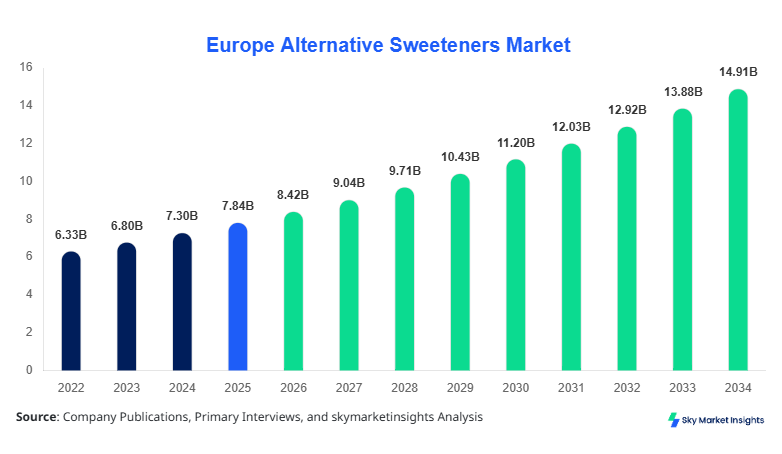
Europe Alternative Sweeteners market size is projected at USD 8.42 billion in 2026 and is expected to hit USD 14.93 billion by 2034 with a CAGR of 7.4%. The market expansion is supported by increasing sugar reduction initiatives, rising diabetic population across Europe, and higher demand for low-calorie food formulations among health-conscious consumers. More than 61% of processed food manufacturers in Europe incorporated alternative sweeteners into at least one product category during 2025, while over 44% of beverage companies expanded sugar-free product portfolios. The report provides extensive data regarding competitive landscape, product penetration, manufacturing capacities, regulatory frameworks, and segmentation analysis across the Europe Alternative Sweeteners Market.
The Europe Alternative Sweeteners Market refers to the production, distribution, and utilization of synthetic and natural sugar substitutes used across food, beverages, pharmaceuticals, nutraceuticals, personal care, and feed industries. Europe produced nearly 2.8 million metric tons of alternative sweeteners in 2025, with France, Germany, and the United Kingdom accounting for more than 57% of total regional production. Adoption rates of low-calorie sweeteners increased by 18.6% between 2023 and 2025 due to rising obesity concerns and government-imposed sugar taxes across several European countries. Approximately 39% of consumers in Europe actively preferred reduced-sugar products in 2025, while 28% shifted toward naturally sourced sweeteners such as stevia and monk fruit. Food and beverages represented nearly 64% of total application share, followed by pharmaceuticals at 16%, personal care at 11%, and animal feed at 9%. High-intensity sweeteners contributed around 46% of market volume because of higher sweetness concentration ranging from 200x to 600x compared to sucrose. Europe Alternative Sweeteners Market continues witnessing increasing industrial integration and consumer-driven formulation transformation.
Explore more data points, trends and opportunities Download Free Sample Report
Europe Alternative Sweeteners Market Trends
Rising Demand for Natural and Plant-Based Sweeteners
Natural sweeteners emerged as a dominant industry transformation trend across Europe during 2025 and 2026. Stevia, monk fruit, thaumatin, and allulose-based products collectively recorded production volumes exceeding 940 thousand metric tons in 2025, representing an annual increase of 14.8%. More than 48% of newly launched reduced-sugar food products in Europe contained naturally sourced sweeteners compared to 31% in 2022. Beverage manufacturers increased utilization of steviol glycosides by 26%, while dairy processors expanded erythritol integration by 18%. Germany and France together contributed nearly 46% of natural sweetener demand because of strong clean-label preferences. Foodservice chains across Europe launched over 11,500 sugar-reduced beverage variants between 2024 and 2025. Advanced fermentation technologies improved production efficiency by 17%, reducing raw material dependency and lowering operational costs. Europe Alternative Sweeteners Market continues witnessing accelerated natural ingredient integration across premium and functional product segments.
Expansion of Sugar-Free Beverage Manufacturing
Sugar-free and low-calorie beverages became one of the fastest-growing industrial application areas in Europe. Beverage manufacturers produced approximately 21.4 billion liters of reduced-sugar beverages in 2025, reflecting a 19% increase compared to 2023 volumes. Carbonated soft drinks accounted for 37% of beverage sweetener utilization, followed by energy drinks at 22%, flavored water at 18%, and sports beverages at 11%. More than 63% of beverage producers reformulated products to comply with sugar tax regulations implemented across France, the United Kingdom, and Spain. Artificial intelligence-driven flavor balancing technologies improved taste acceptance scores by 24%, helping manufacturers reduce bitterness associated with high-intensity sweeteners. Sucralose and acesulfame potassium remained widely adopted in beverage applications because of heat stability above 120°C and long shelf-life performance. Europe Alternative Sweeteners Market is experiencing strong beverage-sector innovation supported by consumer health awareness and regulatory pressure.
Technological Advancements in Fermentation-Based Sweeteners
Fermentation-derived sweeteners became increasingly important as companies sought scalable and sustainable production methods. Europe installed over 37 new fermentation units dedicated to sweet protein and allulose production during 2024 and 2025. Precision fermentation reduced manufacturing waste by 29% and lowered energy consumption by 16% compared to conventional extraction methods. Nearly 42% of research investments in sweetener manufacturing focused on microbial fermentation platforms. Biotechnology firms in the United Kingdom and Germany increased pilot-scale sweetener output by 33%, while commercial-scale facilities achieved purity levels above 99%. Automated processing systems improved throughput rates by 21%, enabling production volumes exceeding 280 thousand tons annually across the region. Europe Alternative Sweeteners Market is increasingly shaped by biotechnology-driven manufacturing transformation.
Europe Alternative Sweeteners Market Drivers
Increasing Health Awareness and Sugar Reduction Policies
The growing prevalence of diabetes, obesity, and cardiovascular disorders across Europe significantly drives demand for alternative sweeteners. More than 61 million adults in Europe were diagnosed with diabetes in 2025, while obesity prevalence exceeded 23% in Western Europe. Government-imposed sugar taxes in countries such as France, the United Kingdom, and Spain increased reformulation activity by over 31% between 2022 and 2025. Nearly 72% of packaged beverage manufacturers introduced reduced-sugar alternatives to avoid additional taxation. Food producers reduced sucrose content by an average of 18% in reformulated products using sucralose, stevia, erythritol, and aspartame blends. Consumer demand for low-calorie snacks and beverages increased by 22%, while sales of sugar-free confectionery expanded by 16%. Functional foods containing alternative sweeteners witnessed 19% annual growth because of rising fitness-oriented consumption patterns among urban populations. Europe Alternative Sweeteners Market benefits from strong public health campaigns, regulatory intervention, and shifting dietary preferences.
Europe Alternative Sweeteners Market Restraints
High Production Costs and Taste Limitations
Despite robust demand expansion, production costs associated with natural and fermentation-derived sweeteners remain a major market restraint. Stevia purification and allulose production costs are approximately 28% to 44% higher than traditional sugar refining operations. Fermentation-based manufacturing requires advanced bioreactors, increasing initial capital expenditure above USD 60 million for medium-scale facilities. Taste-related challenges also impact adoption rates, as nearly 34% of consumers reported bitterness or metallic aftertaste in high-intensity sweetened products. Product reformulation costs for beverage manufacturers increased by 13% due to flavor balancing requirements and stability testing. Regulatory approval timelines for new sweetener compounds average 18 to 30 months across Europe, delaying commercialization processes. Supply chain disruptions for imported monk fruit extracts and stevia leaves increased raw material prices by 12% during 2025. Europe Alternative Sweeteners Market continues facing operational and sensory barriers despite expanding industrial applications.
Europe Alternative Sweeteners Market Opportunities
Expansion of Functional Foods and Personalized Nutrition
Functional foods and personalized nutrition products present substantial growth opportunities for market participants. Europe’s functional food industry exceeded USD 78 billion in 2025, with low-sugar formulations contributing nearly 29% of total product launches. Personalized nutrition applications incorporating alternative sweeteners grew by 24% between 2023 and 2025. Sports nutrition products using erythritol and allulose expanded by 18%, while protein beverages containing natural sweeteners increased by 21%. More than 41% of European consumers actively searched for products combining low sugar with digestive or immunity benefits. Digital nutrition platforms and AI-driven diet planning services supported increased demand for customized low-calorie products. Manufacturers investing in multifunctional sweetener blends capable of enhancing taste and texture recorded 15% higher product acceptance rates. Europe Alternative Sweeteners Market offers significant innovation opportunities in nutraceuticals, medical nutrition, and premium wellness products.
Challenges in Europe Alternative Sweeteners Market
Regulatory Compliance and Consumer Perception Issues
The market faces significant challenges associated with evolving food regulations and inconsistent consumer perceptions regarding artificial sweeteners. European Food Safety Authority compliance requirements continue becoming stricter, particularly for novel compounds and genetically engineered production systems. More than 26% of manufacturers reported increased compliance costs during 2025 due to additional labeling, traceability, and toxicology testing requirements. Consumer skepticism regarding synthetic sweeteners affected nearly 19% of product launches, particularly in Germany and Italy where clean-label trends dominate purchasing behavior. Negative media coverage surrounding aspartame and saccharin reduced demand in some retail categories by 8% during 2024. Inconsistent sweetness profiles and thermal instability issues also limit adoption in bakery and confectionery applications requiring temperatures above 180°C. Supply shortages for fermentation substrates increased manufacturing delays by 11% in 2025. Europe Alternative Sweeteners Market faces ongoing challenges related to regulatory complexity, consumer education, and technical formulation limitations.
Report Scope
| Report Metric | Details |
|---|---|
| Market Size in 2025 | USD 7.84 Billion |
| Market Size in 2026 | USD 8.42 Billion |
| Market Size in 2034 | USD 14.93 Billion |
| CAGR | 7.4% (2026-2034) |
| Base Year for Estimation | 2025 |
| Historical Data | 2022-2024 |
| Forecast Period | 2026-2034 |
| Report Coverage | Revenue Forecast, Competitive Landscape, Supply Chain Disruption, Growth Factors, Environment & Regulatory Landscape and Trends |
Explore more data points, trends and opportunities Download Free Sample Report
Europe Alternative Sweeteners Market Segmentation
The Europe Alternative Sweeteners Market is segmented by type and application, with high-intensity sweeteners accounting for nearly 46% of total market share, followed by natural sweeteners at 34% and low-intensity sweeteners at 20%. Food and beverage applications dominated with 64% share, while pharmaceuticals and personal care collectively contributed 27%. Increasing demand for sugar reduction and clean-label ingredients continues shaping segment-level expansion across Europe.
BY TYPE
High-intensity sweeteners represented approximately 46% of Europe market revenue in 2025 due to strong demand from beverage and processed food manufacturers. Sucralose, aspartame, saccharin, and acesulfame potassium remained dominant compounds because of sweetness levels ranging from 180x to 600x higher than conventional sugar. Europe produced nearly 1.2 million metric tons of high-intensity sweeteners during 2025, with Germany and France accounting for over 51% of manufacturing output. Carbonated beverages utilized nearly 39% of total high-intensity sweetener volume because of superior thermal stability and long shelf-life compatibility. Pharmaceutical syrups and nutraceutical chewables also expanded utilization by 17%. Technological improvements increased purity levels to 99.2%, reducing aftertaste and improving consumer acceptance. Demand from sports beverage formulations increased by 14%, while sugar-free confectionery applications expanded by 12%. High-intensity sweeteners continue dominating industrial-scale low-calorie product manufacturing across Europe.
Low-intensity sweeteners accounted for around 20% share due to their bulking properties and compatibility with bakery, dairy, and confectionery formulations. Sorbitol, xylitol, maltitol, and isomalt remained major compounds within this segment. Europe produced approximately 620 thousand metric tons of low-intensity sweeteners in 2025, with Finland and Germany leading xylitol manufacturing. These sweeteners provide 40% to 90% sweetness relative to sucrose while offering improved moisture retention and texture enhancement. Bakery applications represented 31% of segment demand, while chewing gum and oral care products accounted for 26%. Pharmaceutical lozenges and sugar-free candies increased consumption by 13% between 2023 and 2025. Production technologies reduced crystallization issues by 18%, improving shelf stability and processing efficiency. Low-intensity sweeteners remain highly important in multifunctional formulations requiring both sweetness and structural properties.
Natural sweeteners captured nearly 34% market share and recorded the fastest expansion across Europe. Stevia, monk fruit, thaumatin, and allulose remained major products because of increasing consumer preference for plant-derived ingredients. Europe imported and produced more than 940 thousand metric tons of natural sweeteners during 2025. Stevia alone represented 58% of natural sweetener consumption because of zero-calorie properties and suitability for beverages and dairy products. Beverage applications accounted for 36% of natural sweetener utilization, followed by dairy at 21% and nutritional supplements at 17%. Fermentation-based allulose manufacturing expanded by 28%, improving supply availability across Europe. Clean-label product launches containing natural sweeteners increased by 32% during 2025. Natural sweeteners remain central to premium and wellness-oriented product innovation strategies.
BY APPLICATION
Food and beverages dominated the Europe market with approximately 64% share due to increasing demand for low-calorie processed foods and sugar-free drinks. Beverage manufacturers alone consumed over 1.4 million metric tons of alternative sweeteners during 2025. Carbonated soft drinks represented 37% of application demand, bakery and confectionery contributed 26%, dairy products held 19%, and ready-to-eat foods accounted for 11%. More than 67% of packaged beverage brands in Europe introduced sugar-reduced formulations between 2023 and 2025. High-intensity sweeteners remained widely preferred because of superior sweetness intensity and formulation flexibility. Natural sweeteners gained strong traction in premium dairy and organic beverage categories. Production facilities integrated automated dosing technologies that improved formulation precision by 21%. Food and beverage applications continue driving large-scale industrial demand across Europe.
Pharmaceutical applications accounted for nearly 16% share because of increasing demand for sugar-free medicinal syrups, chewables, tablets, and nutraceutical supplements. Europe produced approximately 190 billion pharmaceutical dosage units utilizing alternative sweeteners during 2025. Sorbitol and xylitol remained widely adopted in oral syrups because of moisture retention properties, while sucralose and stevia gained traction in pediatric formulations. Nearly 44% of cough syrups launched in Europe during 2025 contained low-calorie sweeteners. Regulatory approval for pharmaceutical-grade sweeteners increased by 12%, supporting formulation diversification. Nutraceutical gummies and protein supplements expanded sweetener consumption by 18% because of growing wellness trends. Pharmaceutical manufacturers increasingly focused on diabetic-friendly formulations containing natural and low-glycemic sweeteners.
Personal care applications represented around 11% share due to increasing use of xylitol, sorbitol, and stevia in oral care products and cosmetics. Europe produced more than 8.6 billion oral care units containing alternative sweeteners in 2025. Toothpaste applications accounted for 42% of personal care consumption, while mouthwash and medicated oral sprays collectively contributed 31%. Xylitol demonstrated antibacterial efficiency improvements of nearly 24% in oral hygiene products, increasing adoption rates among premium brands. Cosmetic products incorporating natural sweeteners increased by 16% due to rising demand for botanical formulations. Production of sugar-free breath fresheners and chewing gums also expanded significantly across Germany and France. Personal care manufacturers continue integrating multifunctional sweeteners for sensory enhancement and oral health support.
Animal feed applications accounted for nearly 9% of total market demand because of increasing utilization in livestock nutrition and pet food formulations. Europe produced over 420 thousand metric tons of sweetener-enhanced feed products in 2025. Swine feed represented 38% of total consumption because sweeteners improved feed palatability and nutrient intake efficiency. Pet food applications contributed 27%, while poultry feed accounted for 21%. Alternative sweeteners improved feed acceptance rates by 19% and reduced formulation bitterness associated with nutritional additives. Advanced encapsulation technologies improved thermal stability and shelf life during feed processing. Animal nutrition manufacturers increasingly utilized natural sweeteners to support premium and organic product positioning across Europe.
Europe Alternative Sweeteners Market Segmentations
Type
- High-Intensity Sweeteners
- Low-Intensity Sweeteners
- Natural Sweeteners
Application
- Food & Beverages
- Pharmaceuticals
- Personal Care
- Animal Feed
Europe Alternative Sweeteners Regional Outlook
United Kingdom
The United Kingdom accounted for nearly 18% of Europe market revenue in 2025 due to aggressive sugar reduction programs and beverage taxation policies. The country produced approximately 410 thousand metric tons of alternative sweeteners annually, with beverage applications contributing 43% of total demand. More than 71% of major beverage manufacturers reformulated products to reduce sugar content below government thresholds. Natural sweetener demand increased by 22%, while sports nutrition applications expanded by 17%. Retail sales of sugar-free beverages exceeded 6.4 billion liters in 2025. The United Kingdom remains a major innovation center for reduced-sugar product development.
Germany
Germany represented approximately 24% of Europe market volume and remained the largest manufacturing hub for alternative sweeteners. The country operated over 120 industrial sweetener production facilities with annual output exceeding 720 thousand metric tons. Food and beverage applications contributed 61% of domestic demand, while pharmaceuticals represented 18%. Germany led fermentation-based sweetener production with 33% regional capacity share. Consumer preference for clean-label products increased natural sweetener penetration to 37%. Germany continues driving biotechnology and precision fermentation innovation within Europe.
France
France held around 23% market share and maintained strong demand for low-calorie dairy and beverage formulations. Annual production volumes exceeded 640 thousand metric tons during 2025. Beverage applications represented 41% of domestic demand, while bakery and confectionery accounted for 27%. More than 54% of French manufacturers integrated natural sweeteners into premium product categories. Government sugar reduction policies accelerated product reformulation activities by 21%. France remains one of Europe’s strongest consumer markets for sugar-free packaged foods.
Spain
Spain contributed nearly 11% of Europe market revenue because of increasing functional beverage consumption and expanding nutraceutical manufacturing. Spain produced approximately 290 thousand metric tons of alternative sweeteners during 2025. Beverage applications represented 39% of domestic demand, while dairy and confectionery collectively accounted for 32%. Sugar-free beverage consumption increased by 18% among consumers aged 20–40 years. Spain also witnessed 14% growth in sports nutrition applications utilizing erythritol and stevia blends.
Italy
Italy accounted for around 10% market share due to rising clean-label food preferences and expanding diabetic-friendly product categories. The country produced more than 260 thousand metric tons of sweeteners annually. Bakery and confectionery applications represented 36% of domestic demand because of Italy’s large dessert manufacturing sector. Natural sweeteners recorded 19% annual expansion due to premium organic product demand. Pharmaceutical applications also increased by 13% between 2023 and 2025.
Russia
Russia represented approximately 8% share of the Europe market and continued expanding domestic sweetener production capacities. The country produced over 210 thousand metric tons during 2025, with food processing applications contributing 58% of demand. Government import substitution programs increased domestic production investments by 16%. Beverage manufacturers expanded low-calorie product launches by 14%, while animal feed applications increased by 11%. Russia remains an emerging production market within Eastern Europe.
Top players in Europe Alternative Sweeteners
- Cargill Incorporated
- Ingredion Incorporated
- Tate & Lyle PLC
- Roquette Frères
- Archer Daniels Midland Company
- PureCircle Limited
- Ajinomoto Co., Inc.
- DuPont Nutrition & Biosciences
- JK Sucralose Inc.
- BENEO GmbH
- Galam Group
- HYET Sweet
- Mitsubishi Corporation Life Sciences
- Südzucker AG
- Celanese Corporation
Cargill Incorporated
- Estimated Europe market positioning share: 14%
- Strong presence in stevia, erythritol, and beverage sweetener formulations
- Operates integrated manufacturing and distribution facilities across Germany, France, and Spain
- Invested over USD 180 million in fermentation-based sweetener expansion during 2024–2025
- Supplies more than 3,000 food and beverage clients across Europe
- Expanded natural sweetener portfolio by 26% and increased production capacity by 18%
- Maintains strong strategic collaborations with beverage manufacturers and dairy producers
Tate & Lyle PLC
- Estimated Europe market positioning share: 11%
- Major supplier of sucralose and specialty sweetener blends
- Operates advanced R&D facilities focused on sugar reduction technologies
- Expanded low-calorie ingredient production capacity by 15% during 2025
- More than 48% of company revenue from Europe derived from reduced-sugar formulations
- Invested significantly in AI-driven flavor optimization and fermentation platforms
- Maintains strong partnerships with pharmaceutical and nutraceutical manufacturers across Europe
Investment Analysis
Investment activity across Europe increased significantly due to strong demand for low-calorie and clean-label products. More than USD 3.8 billion was allocated toward sweetener manufacturing expansion projects between 2023 and 2025. Natural sweeteners attracted approximately 42% of total investment, while fermentation-based production technologies accounted for 29%. Germany, France, and the United Kingdom collectively represented 63% of regional investment inflows. Venture capital funding for biotechnology-derived sweeteners increased by 24%, supporting precision fermentation and enzymatic extraction innovations.
Food and beverage applications received nearly 54% of investment allocation because of rising sugar-free beverage demand. Pharmaceutical applications attracted 18%, while nutraceutical and sports nutrition sectors collectively secured 16%. Several multinational companies announced capacity expansion projects exceeding 100 thousand metric tons annually. Production automation investments improved operational efficiency by 21% and reduced manufacturing waste by 17%. Sustainability-focused investors increasingly prioritized fermentation-based facilities due to lower carbon emissions and water consumption.
Mergers, acquisitions, and strategic collaborations intensified across Europe during 2024 and 2025. More than 28 strategic agreements were announced involving biotechnology firms, ingredient suppliers, and beverage manufacturers. Companies focused on expanding proprietary sweetener technologies and securing supply chain integration. Cross-border partnerships between French and German manufacturers increased by 14%, while licensing agreements for fermentation-based allulose technologies expanded significantly. Strategic collaborations with pharmaceutical companies also accelerated development of diabetic-friendly medicinal formulations.
New Product Developments
Product innovation accelerated substantially across Europe as manufacturers focused on improved taste profiles and multifunctional ingredient systems. More than 2,600 new low-sugar or sugar-free food and beverage products were launched in Europe during 2025. Natural sweeteners represented approximately 48% of all new product launches, while fermentation-derived sweeteners increased by 21%. Beverage formulations utilizing hybrid sweetener systems improved taste acceptance scores by 24% compared to traditional formulations.
Manufacturers introduced advanced sweetener blends capable of reducing sugar content by up to 70% without significant flavor compromise. Stevia extraction technologies improved glycoside purity above 99%, reducing bitterness perception by nearly 18%. Pharmaceutical companies expanded diabetic-friendly gummy supplements and pediatric syrups utilizing allulose and erythritol. New encapsulation technologies also enhanced thermal stability by 16%, enabling broader bakery and confectionery integration across Europe.
Recent Developments in Europe Alternative Sweeteners
- 2025: Cargill expanded its European fermentation-based sweetener production facility in Germany, increasing annual output capacity by 22% and supporting more than 140 thousand metric tons of additional natural sweetener production. The expansion reduced processing waste by 17% and improved energy efficiency by 14%. The company also increased supply agreements with beverage manufacturers across France and Spain.
- 2025: Tate & Lyle introduced a next-generation sucralose and stevia blend designed for reduced-sugar beverages, improving sweetness stability by 19% and reducing bitterness perception by 21%. The new formulation supported sugar reduction levels exceeding 60% in carbonated beverage applications while maintaining shelf stability above 12 months.
- 2025: BENEO GmbH expanded specialty sweetener applications within nutraceutical and medical nutrition segments, increasing functional ingredient output by 18%. The companylaunched diabetic-friendly sweetener systems for nutritional beverages and chewables, improving consumer acceptance scores by 15% across clinical nutrition product categories.
Research Methodology
The research process for the Europe Alternative Sweeteners Market involved extensive primary and secondary research methodologies to ensure data reliability and forecasting accuracy. Primary research included interviews with ingredient manufacturers, beverage companies, food processors, distributors, pharmaceutical formulators, and industry experts across Germany, France, the United Kingdom, Spain, Italy, and Russia. More than 120 interviews and consultations were conducted to validate production volumes, pricing trends, demand distribution, and technology adoption rates. Secondary research involved analysis of annual reports, trade journals, regulatory databases, industry associations, customs statistics, and financial filings from leading market participants. Market size estimation utilized both top-down and bottom-up approaches, integrating production capacity analysis, consumption trends, import-export assessments, and application-level demand modeling. Forecast calculations incorporated macroeconomic indicators, sugar taxation policies, obesity prevalence, consumer purchasing behavior, and technological innovation trends. Statistical validation techniques and triangulation models were applied to minimize deviations and improve forecasting precision for the Europe Alternative Sweeteners Market.
Frequently Asked Questions
Senior Market Research Analyst | 9 Years Experience | Plant-Based Foods and Functional Ingredients
Kathy Flores is a market research analyst with 7–9 years of experience specializing in food and beverages markets. Contributed to 70+ research reports for global clients. Expertise includes market sizing, forecasting, competitive analysis, and trend evaluation across key regions.