Europe Alternative Flours Market Size
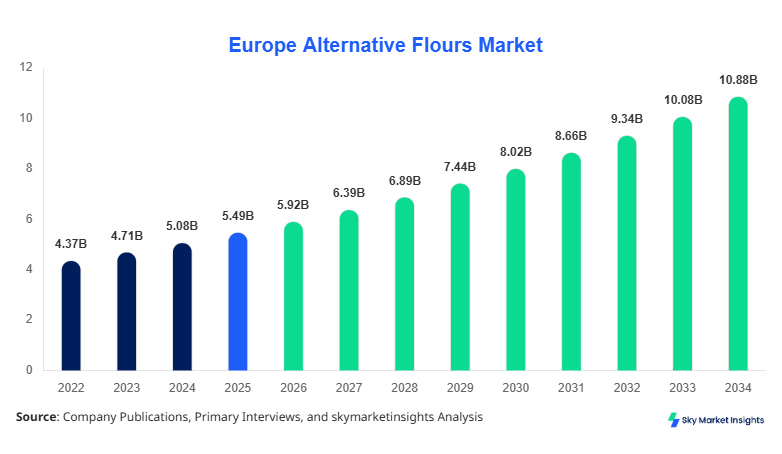
Europe Alternative Flours market size is projected at USD 5.92 billion in 2026 and is expected to hit USD 10.84 billion by 2034 with a CAGR of 7.9%. The market recorded a valuation of USD 5.41 billion in 2025, while historical revenue generation stood at USD 4.36 billion in 2022, USD 4.71 billion in 2023, and USD 5.05 billion in 2024. More than 3.8 million metric tons of alternative flour products were consumed across Europe in 2025, with bakery applications accounting for over 42% of total demand. Increasing gluten-free product penetration, rising vegan food adoption, and expanding investments in functional food processing are strengthening industry expansion across Germany, France, Italy, and the United Kingdom. The competitive landscape includes multinational ingredient manufacturers, specialty milling companies, and private-label food processors focusing on protein enrichment, fiber optimization, and sustainable grain sourcing.
The alternative flours industry refers to the production, processing, and commercialization of non-wheat flour products derived from nuts, legumes, rice, coconut, oats, cassava, and ancient grains for food manufacturing applications. Europe produced approximately 4.1 million metric tons of alternative flour products in 2025, compared with 3.2 million metric tons in 2022, reflecting strong adoption in bakery, confectionery, and health-focused packaged foods. Gluten-free product penetration surpassed 21% among urban consumers in Western Europe, while vegan and plant-based dietary adoption crossed 18% in Germany and 16% in the United Kingdom during 2025. Consumer purchasing behavior indicates that 63% of buyers prefer clean-label bakery products containing low-carbohydrate or high-protein flour blends, while nearly 41% of millennials actively seek allergen-free packaged food products. Almond flour contributed 27% of product consumption, rice flour accounted for 24%, and coconut flour represented nearly 16% of overall volume demand. Bakery products held 42% application share, snacks and convenience foods represented 31%, and infant nutrition contributed 11% of total consumption. Functional protein concentration in premium flour blends ranges between 18% and 42%, while fiber content varies from 9 g to 22 g per 100 g depending on raw material composition. Growing demand for organic food ingredients, clean-label processing, and protein-fortified products continues reinforcing Europe Alternative Flours market expansion.
Explore more data points, trends and opportunities Download Free Sample Report
Europe Alternative Flours Market Trends
Rising Demand for Protein-Enriched and Gluten-Free Flour Blends
The increasing popularity of protein-enriched food products is significantly transforming the European alternative flour ecosystem. In 2025, more than 1.4 million metric tons of gluten-free flour blends were sold across Europe, reflecting a 13.6% increase compared with 2023 volumes. Almond flour and chickpea flour are experiencing strong adoption because of their protein concentrations exceeding 20%, compared with conventional wheat flour protein content averaging 11%–13%. Approximately 38% of newly launched bakery products in Europe incorporated alternative flour ingredients in 2025, while private-label health food products expanded by 16%. Germany, France, and the United Kingdom collectively represented over 61% of premium flour product launches. Food manufacturers are increasingly utilizing low-glycemic and fiber-rich flour formulations to target diabetic and health-conscious consumers. Automated cold-milling systems improved nutrient retention by 17% and reduced oxidation losses by 11%, increasing product quality across commercial applications. Expanding adoption of vegan diets, keto lifestyles, and allergen-free packaged food products continues reinforcing Europe Alternative Flours market demand.
Expansion of Organic and Sustainable Ingredient Processing
Sustainable ingredient sourcing and organic food manufacturing are becoming dominant operational priorities across the industry. Europe processed approximately 920 thousand metric tons of organic alternative flour products in 2025, compared with 670 thousand metric tons in 2022. Organic-certified flour blends represented 24% of premium retail product launches across Western Europe. Carbon-neutral milling facilities increased by 21% during 2024–2025, while renewable energy utilization in processing plants exceeded 32% in Germany and France. Manufacturers are adopting water-efficient milling technologies that lower operational consumption by 14% and reduce waste generation by nearly 19%. Demand for cassava flour and oat flour increased by 12% and 15%, respectively, due to sustainable sourcing benefits and lower environmental impact. Digital supply chain monitoring solutions were implemented by over 43% of leading processors to improve traceability and inventory management efficiency. Growing emphasis on sustainable food manufacturing practices continues supporting Europe Alternative Flours market adoption.
Growth of Functional Nutrition and Infant Food Applications
Functional nutrition products are increasingly incorporating nutrient-dense flour formulations across Europe. In 2025, infant nutrition applications consumed approximately 420 thousand metric tons of alternative flour ingredients, while sports nutrition accounted for 310 thousand metric tons. Rice flour represented nearly 34% of infant food formulations due to hypoallergenic properties and digestibility advantages. Fiber-enhanced flour blends improved digestive health functionality by 28%, while omega-enriched formulations expanded by 18% across nutritional snack products. More than 52% of European consumers actively reviewed ingredient labels before purchasing packaged food products in 2025, increasing demand for clean-label formulations. The integration of micronutrient-fortified flour products increased by 14% across hospital nutrition and clinical food applications. These evolving consumption patterns continue accelerating Europe Alternative Flours market penetration.
Europe Alternative Flours Market Drivers
Increasing Gluten-Free Consumption and Functional Food Adoption
The rapid expansion of gluten-free and functional food consumption across Europe is a major driver supporting industry expansion. Approximately 72 million European consumers purchased gluten-free packaged foods at least once per month during 2025, while nearly 19 million consumers followed fully gluten-free dietary lifestyles. Bakery manufacturers increased alternative flour procurement by 17% between 2023 and 2025 to support premium product launches. Almond flour, rice flour, and oat flour collectively accounted for more than 61% of gluten-free product formulations across Europe. Functional food retail sales surpassed USD 48 billion in 2025, with alternative flour ingredients contributing significantly to high-protein snacks, low-carb bakery products, and fortified cereals. Food processing investments exceeded USD 1.6 billion during 2024–2025 for ingredient innovation, automated milling technologies, and organic processing infrastructure. The integration of fiber-rich formulations improved digestive health claims by 23%, while protein-enhanced flour products improved consumer retention rates by 18%. Strong demand for allergen-free, plant-based, and health-oriented food products continues driving Europe Alternative Flours market expansion.
Europe Alternative Flours Market Restraints
High Raw Material Costs and Supply Chain Volatility
The volatility of raw material pricing remains a significant challenge for industry participants across Europe. Almond prices increased by approximately 14% during 2024 due to climate-related agricultural disruptions, while coconut import costs rose by nearly 11%. Transportation and logistics expenses contributed 18%–22% of total production costs for imported flour ingredients. More than 36% of small-scale processors reported profitability pressure caused by fluctuating nut and grain procurement expenses. Energy-intensive milling operations experienced electricity cost increases exceeding 9% in several European countries during 2025. Supply shortages in cassava and specialty grain imports disrupted nearly 12% of planned production schedules among mid-sized manufacturers. Furthermore, premium organic certifications increased operational costs by 7%–10%, limiting affordability for price-sensitive consumers. Retail price premiums for alternative flour products remain 28%–55% higher than conventional wheat flour equivalents, restricting penetration in lower-income demographics. These pricing and supply-related barriers continue constraining Europe Alternative Flours market expansion.
Europe Alternative Flours Market Opportunities
Expansion of Plant-Based Nutrition and Premium Bakery Products
The growing adoption of plant-based nutrition and premium bakery innovation creates substantial growth opportunities for market participants. Europe recorded more than 24 million vegan consumers in 2025, while flexitarian dietary adoption exceeded 41% across urban populations. Plant-based bakery product launches increased by 19% during 2024–2025, creating higher procurement volumes for almond, chickpea, and oat flour ingredients. Premium bakery chains increased alternative flour integration by 22% across artisanal bread, protein muffins, and low-carb pastry products. Retail shelf allocation for gluten-free packaged foods expanded by 15% in supermarkets across Germany, France, and the United Kingdom. Investments in functional nutrition exceeded USD 920 million in 2025, with nearly 34% allocated toward ingredient innovation and clean-label flour formulations. Foodservice demand for keto-friendly menu items increased by 17%, supporting commercial adoption across restaurants and cafes. Expanding consumer preference for protein-rich, allergen-free, and sustainable food ingredients continues creating favorable Europe Alternative Flours market opportunities.
Challenges in Europe Alternative Flours Market
Standardization and Product Texture Limitations
Achieving texture consistency and product standardization remains a major operational challenge for alternative flour manufacturers. Approximately 29% of food processors reported formulation instability issues when replacing conventional wheat flour with nut- or legume-based alternatives. Moisture retention inconsistency increased production rejection rates by 8%–11% across bakery applications. Coconut flour absorbs nearly four times more liquid compared with wheat flour, requiring complex formulation adjustments that increase development costs by 13%. Shelf-life performance for gluten-free baked products remains 17% shorter than traditional bakery products due to reduced gluten structure stability. More than 26% of consumers identified texture inconsistency as a purchasing concern in premium gluten-free food categories. Small manufacturers face technical limitations because advanced cold-milling and enzyme stabilization technologies require capital investments exceeding USD 4 million per facility. Additionally, allergen labeling regulations and cross-contamination prevention standards increased compliance expenditures by approximately 9% during 2025. These technical and operational constraints continue affecting Europe Alternative Flours market scalability.
Report Scope
| Report Metric | Details |
|---|---|
| Market Size in 2025 | USD 5.49 Billion |
| Market Size in 2026 | USD 5.92 Billion |
| Market Size in 2034 | USD 10.84 Billion |
| CAGR | 7.9% (2026-2034) |
| Base Year for Estimation | 2025 |
| Historical Data | 2022-2024 |
| Forecast Period | 2026-2034 |
| Report Coverage | Revenue Forecast, Competitive Landscape, Supply Chain Disruption, Growth Factors, Environment & Regulatory Landscape and Trends |
Explore more data points, trends and opportunities Download Free Sample Report
Europe Alternative Flours Market Segmentation
The market is segmented based on type and application, with bakery products dominating approximately 42% of overall consumption volume during 2025. Almond flour maintained the leading product position with 27% revenue contribution, while rice flour represented 24% of total market demand. Increasing functional nutrition adoption and gluten-free dietary penetration are driving broader utilization across food manufacturing sectors.
BY TYPE
Almond flour represented approximately 27% of total industry revenue in 2025 and exceeded 1.02 million metric tons in annual European consumption. Protein concentration ranging between 21% and 24% makes almond flour highly suitable for keto bakery products, sports nutrition, and premium gluten-free snacks. Germany and France collectively contributed nearly 46% of almond flour processing activities in Europe. Bakery applications accounted for 49% of almond flour demand, while confectionery represented 18% and protein bars accounted for 11%. Advanced ultra-fine milling technologies improved texture consistency by 16% and reduced oxidation losses by nearly 12%. Organic almond flour products expanded by 19% during 2024–2025 due to strong clean-label demand. Premium retail pricing averaged 38% higher than traditional flour categories because of raw material sourcing complexity.
Coconut flour accounted for nearly 16% of Europe’s alternative flour consumption volume in 2025, with total production surpassing 610 thousand metric tons. High fiber concentration ranging from 35% to 42% supports utilization in digestive health products, low-carb bakery applications, and vegan snacks. More than 31% of keto-focused packaged foods launched in Europe utilized coconut flour formulations during 2025. Italy and Spain together represented approximately 37% of regional coconut flour imports and processing capacity. Technological improvements in drying and milling processes reduced moisture variability by 14%, improving baking stability. Foodservice applications contributed 21% of coconut flour demand, while premium retail packaged foods represented nearly 52%.
Rice flour maintained approximately 24% share of overall industry demand during 2025 due to hypoallergenic properties and strong infant nutrition utilization. Europe processed nearly 910 thousand metric tons of rice flour products during the year. Infant nutrition applications contributed 34% of rice flour consumption, while bakery products represented 39%. Fine-particle milling systems improved digestibility performance by 13% and enhanced shelf stability by 15%. France and Germany accounted for more than 43% of rice flour processing facilities across Europe. Organic rice flour demand increased by 17% between 2024 and 2025 due to rising clean-label food adoption.
BY APPLICATION
Bakery products dominated the application landscape with nearly 42% share of total consumption in 2025. More than 1.6 million metric tons of alternative flour ingredients were utilized across bread, muffins, cakes, pastries, and cookies. Gluten-free bakery product launches increased by 18% during 2024–2025, while protein-enriched bakery innovations expanded by 14%. Almond flour and rice flour collectively represented over 57% of bakery ingredient utilization. Premium bakery chains across Germany, France, and the United Kingdom increased procurement volumes by approximately 16%. Technical enhancements in flour blending improved moisture retention by 12% and product texture stability by 15%.
Snacks and convenience foods represented approximately 31% of overall market demand during 2025, consuming nearly 1.2 million metric tons of alternative flour ingredients. Protein snacks, granola bars, chips, and vegan crackers increasingly integrated chickpea, coconut, and almond flour formulations. More than 48% of urban consumers purchased healthier snack alternatives at least twice monthly during 2025. Low-glycemic snack products expanded by 21% across Europe, while clean-label convenience food launches increased by 17%. Automation technologies reduced production waste by 13% in snack manufacturing facilities utilizing alternative flour ingredients.
Infant nutrition accounted for approximately 11% of application revenue in 2025 and consumed nearly 420 thousand metric tons of alternative flour products. Rice flour remained the dominant ingredient with 34% formulation share due to digestibility and hypoallergenic performance. Organic infant food products expanded by 18% during 2024–2025 across Europe. Germany and France collectively represented more than 44% of infant nutrition product manufacturing activities. Nutrient-fortified flour formulations improved vitamin retention by 12% and shelf-life performance by 9%. Increasing parental preference for allergen-free and clean-label infant foods continues supporting application expansion.
Europe Alternative Flours Market Segmentations
Type
- Almond Flour
- Coconut Flour
- Rice Flour
Application
- Bakery Products
- Snacks & Convenience Foods
- Infant Nutrition
Europe Alternative Flours Market Regional Outlook
United Kingdom
The United Kingdom accounted for approximately 19% of regional revenue generation in 2025, supported by increasing demand for gluten-free bakery and vegan packaged foods. The country consumed nearly 720 thousand metric tons of alternative flour ingredients during the year. Bakery applications represented 44% of domestic consumption, while snacks contributed 28%. More than 39% of health-focused retail product launches in the United Kingdom utilized alternative flour formulations. Organic-certified products accounted for 23% of premium retail shelf placements. Investments in automated milling technologies increased by 14% during 2024–2025, improving processing efficiency and product quality.
Germany
Germany remained the largest contributor with approximately 28% regional revenue share in 2025. Domestic production exceeded 980 thousand metric tons, while bakery applications represented 45% of overall demand. More than 180 specialty flour processing facilities operate across the country. Vegan food penetration exceeded 18%, while gluten-free consumer adoption surpassed 21%. Germany also accounted for nearly 31% of Europe’s organic alternative flour sales. Investments in sustainable milling technologies increased by 17% during 2025, reducing operational emissions and energy consumption.
France
France represented nearly 17% of regional industry revenue during 2025, consuming more than 650 thousand metric tons of alternative flour ingredients. Bakery and confectionery applications accounted for 51% of domestic utilization. Rice flour and almond flour collectively contributed 58% of overall consumption. Organic food retail penetration exceeded 19%, while clean-label packaged food launches increased by 16% during 2025. French manufacturers increasingly adopted low-temperature milling technologies that improved nutrient preservation by approximately 14%.
Spain
Spain accounted for approximately 11% of total regional revenue in 2025. Coconut flour imports increased by 13% year-over-year due to expanding keto bakery demand. Snacks and convenience foods represented 33% of application utilization across the country. More than 120 specialty food processors incorporated alternative flour formulations into vegan packaged foods. Retail demand for allergen-free snacks increased by 15% during 2025, while functional bakery product launches expanded by 12%.
Italy
Italy represented nearly 10% of regional revenue generation in 2025, supported by premium artisanal bakery innovation and expanding clean-label food manufacturing. The country processed more than 410 thousand metric tons of alternative flour products during the year. Coconut flour and rice flour collectively represented 39% of domestic demand. Organic bakery product launches increased by 18%, while premium gluten-free pasta innovation expanded by 14%. Investments in automated packaging technologies improved operational efficiency by 11%.
Russia
Russia accounted for approximately 8% of regional revenue in 2025 and consumed nearly 310 thousand metric tons of alternative flour products. Rice flour represented 29% of domestic utilization due to expanding infant nutrition demand. Local production capacity increased by 12% during 2024–2025 to reduce import dependency. Bakery applications contributed 41% of domestic demand, while convenience foods represented 27%. Urban retail demand for plant-based packaged foods increased by 16% during 2025.
Top players in Europe Alternative Flours
- Archer Daniels Midland Company
- Cargill Incorporated
- Bob’s Red Mill Natural Foods
- Associated British Foods Plc
- Bunge Limited
- Hain Celestial Group
- King Arthur Baking Company
- General Mills Inc.
- The Scoular Company
- SunOpta Inc.
- Nature’s Path Foods
- Ingredion Incorporated
- Parrish and Heimbecker
- Grain Millers Inc.
- Conagra Brands Inc.
Archer Daniels Midland Company
- Holds approximately 12% regional market share across Europe.
- Strong positioning in gluten-free ingredient supply and industrial bakery partnerships.
- Operates diversified milling and ingredient processing facilities across Germany, France, and the United Kingdom.
- Invested more than USD 210 million in sustainable ingredient sourcing and protein-enriched flour innovation between 2024 and 2025.
- Expanded almond flour and rice flour production capacity by nearly 15% to support growing bakery and nutritional snack demand.
Cargill Incorporated
- Accounts for nearly 10% of regional industry revenue.
- Maintains extensive distribution networks across functional food and infant nutrition sectors.
- Focused on clean-label ingredient innovation and low-carbon milling operations.
- Increased investment allocation toward organic flour formulations by 18% during 2025.
- Collaborated with packaged food manufacturers to develop high-protein bakery applications and allergen-free snack products across Western Europe.
Investment Analysis
Europe recorded more than USD 2.8 billion in alternative flour processing and functional food investments during 2024–2025. Approximately 34% of total investments were allocated toward sustainable ingredient sourcing and organic production expansion, while 29% targeted automated milling technologies and production efficiency improvements. Germany accounted for nearly 31% of total regional investments, followed by France at 19% and the United Kingdom at 17%. Venture capital funding in plant-based food startups increased by 21% during 2025. Private equity firms increasingly focused on clean-label ingredient manufacturers and gluten-free bakery innovation platforms.
Mergers, acquisitions, and strategic collaborations remain highly active across the industry. More than 26 partnership agreements were announced across Europe between 2024 and 2025, with significant focus on supply chain integration and ingredient innovation. Food manufacturers increasingly collaborated with agricultural cooperatives to secure stable almond, coconut, and rice supply chains amid raw material volatility. Approximately 18% of strategic agreements involved sustainability and carbon-neutral production initiatives. Cross-border partnerships between German and French processors improved export volumes by nearly 13%. Ingredient technology licensing agreements increased by 16%, particularly in enzyme stabilization and nutrient retention systems. Large multinational food companies allocated nearly 24% of innovation budgets toward protein-enriched and fiber-enhanced flour product development, reflecting strong long-term growth potential.
New Product Developments
Manufacturers launched more than 1,240 new alternative flour-based packaged food products across Europe during 2025, representing a 17% increase compared with 2024. Gluten-free bakery launches accounted for 38% of total new products, while protein-enriched snack innovations represented 26%. Advanced milling technologies improved nutrient retention performance by approximately 15% and extended shelf stability by 11%. Organic-certified flour blends contributed nearly 29% of all product launches.
Innovation in low-carb and keto-friendly food applications accelerated significantly across Germany, France, and the United Kingdom. Rice flour infant nutrition formulations improved digestibility performance by 13%, while fiber-enhanced coconut flour bakery products achieved moisture stability improvements of 16%. More than 41% of newly launched premium bakery products incorporated blended flour formulations containing almond, oat, and chickpea ingredients to improve protein and fiber content.
Recent Developments in Europe Alternative Flours
- 2025: Archer Daniels Midland expanded its Germany-based almond flour processing facility by 18%, increasing annual production capacity above 160 thousand metric tons. The investment improved supply chain efficiency and reduced delivery lead times by approximately 12% for bakery manufacturers across Western Europe.
- 2025: Cargill Incorporated introduced a new protein-enriched rice flour formulation designed for infant nutrition and sports nutrition applications. The innovation improved protein concentration by 14% while reducing processing waste by nearly 9% during commercial-scale production.
- 2025: Associated British Foods Plc invested nearly USD 90 million in advanced cold-milling technologies across its European facilities. The upgrade improved nutrient retention efficiency by 15% and enhanced texture consistency for premium gluten-free bakery products.
Research Methodology
The research process involved extensive primary and secondary data collection methods to evaluate the Europe Alternative Flours industry. Primary research included interviews with ingredient manufacturers, food processors, distributors, retail chains, packaging companies, and industry experts across Germany, France, Italy, Spain, Russia, and the United Kingdom. More than 85 industry participants contributed operational insights regarding production capacity, pricing trends, technological advancements, and consumer purchasing behavior. Secondary research included analysis of trade journals, annual reports, government food statistics, import-export databases, sustainability reports, and corporate financial disclosures. Market size estimation utilized both top-down and bottom-up analytical frameworks incorporating production volume analysis, application-level consumption, and regional demand assessment. Historical performance from 2022–2024 was benchmarked against processing capacity, retail penetration, and packaged food innovation activity. Forecast modeling for 2026–2034 incorporated macroeconomic indicators, food consumption trends, gluten-free adoption rates, investment activity, and technological innovation patterns across Europe.
Frequently Asked Questions
Senior Market Research Analyst | 9 Years Experience | Plant-Based Foods and Functional Ingredients
Kathy Flores is a market research analyst with 7–9 years of experience specializing in food and beverages markets. Contributed to 70+ research reports for global clients. Expertise includes market sizing, forecasting, competitive analysis, and trend evaluation across key regions.