North America Alternative Flour Market Size
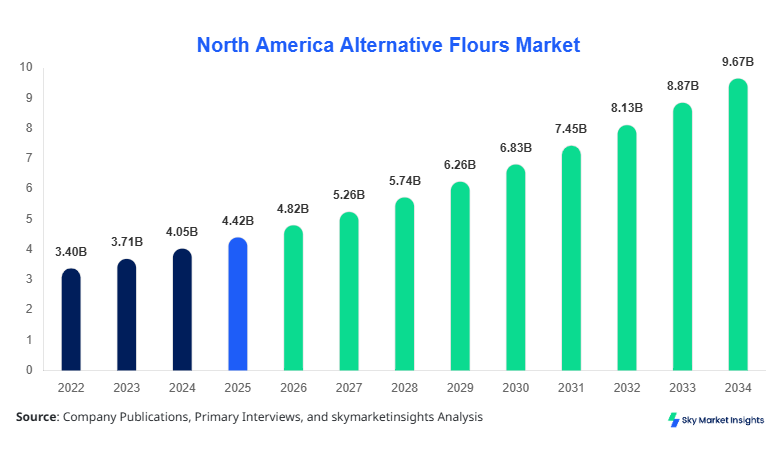
North America Alternative Flours Market market size is projected at USD 4.82 billion in 2026 and is expected to hit USD 9.67 billion by 2034 with a CAGR of 9.1%. The North America Alternative Flours Market Size reflects rising demand for gluten-free and high-protein food solutions across the United States and Canada, supported by over 42% consumer inclination toward clean-label ingredients and plant-based diets. The market analysis integrates granular segmentation, production volumes exceeding 3.6 million tons annually, and a competitive landscape featuring more than 150 active manufacturers across the region.
The market encompasses flours derived from non-traditional sources such as nuts, legumes, seeds, and root vegetables, designed to address gluten intolerance, dietary preferences, and nutritional optimization. North America recorded production output of approximately 3.1 million tons in 2024, growing to 3.6 million tons in 2025, with almond flour contributing nearly 28%, rice flour 24%, and coconut flour 16% of total volume. Adoption and penetration insights indicate that over 37% of households in the United States purchased alternative flour-based products at least once per month in 2025, while gluten-free product penetration reached 18% of total packaged food consumption. Consumer behavior reflects a shift toward high-fiber (above 8g per serving) and protein-rich (10–15g per serving) flour variants, with bakery applications accounting for 46% of usage, snacks at 32%, and supplements at 14%. Performance metrics such as moisture content below 12% and protein concentration above 20% are key differentiators in product selection. The market demonstrates strong diversification with applications spanning over 12 major food categories, reinforcing the structural depth of the North America Alternative Flours Market Size.
Explore more data points, trends and opportunities Download Free Sample Report
Alternative Flours Market Trends
Trends
The Alternative Flours Market Trend is characterized by rapid innovation in ingredient sourcing and processing technologies, with production volumes surpassing 3.6 million tons in 2025 and projected to exceed 5.2 million tons by 2030. A significant shift toward legume-based flours, such as chickpea and lentil flour, has been observed, accounting for nearly 19% of new product launches in 2025. Additionally, over 54% of food manufacturers are integrating alternative flours into hybrid formulations to improve protein content by 12–18% and fiber content by 15–22%. The adoption of gluten-free formulations has reached 44% across bakery product lines, while plant-based product integration stands at 38%. The emergence of functional flours with added micronutrients, including iron (up to 4 mg per serving) and calcium (up to 120 mg per serving), is further enhancing consumer appeal. These developments collectively reinforce the evolving Alternative Flours Market Trend.
Another key trend shaping the market is the expansion of clean-label and organic product offerings, with organic alternative flours accounting for approximately 26% of total sales in 2025 and projected to reach 34% by 2030. Manufacturers are increasingly focusing on sustainable sourcing, with over 61% adopting traceability systems and eco-certified supply chains. Production technologies such as cold milling and enzymatic processing are improving nutrient retention by 20–25%, while reducing energy consumption by 12–15%. The rise of e-commerce channels, contributing nearly 29% of total sales, is also transforming distribution dynamics, enabling smaller brands to capture niche segments. The growing demand for keto and paleo diets, influencing 33% of purchasing decisions, continues to drive innovation in low-carb flour variants. These factors collectively define the progressive Alternative Flours Market Trend.
North America Alternative Flours Market Drivers
Rising Demand for Gluten-Free and Functional Foods Accelerates Market Expansion
The increasing prevalence of gluten intolerance and celiac disease, affecting approximately 1 in 100 individuals in North America, has significantly driven demand for alternative flours. In 2025, over 18% of consumers actively avoided gluten, contributing to a 22% increase in gluten-free product launches. The bakery segment alone utilized more than 1.6 million tons of alternative flours, representing 46% of total consumption. Additionally, the demand for high-protein diets has led to a 17% rise in almond and chickpea flour production, with protein levels exceeding 20% per serving. Health-conscious consumers, accounting for 39% of the population, are prioritizing products with low glycemic index (below 55), further boosting adoption rates. The expansion of plant-based diets, influencing 28% of consumers, is also driving innovation in alternative flour formulations. These combined factors strongly support Alternative Flours Market Growth.
North America Alternative Flours Market Restraints
High Production Costs and Supply Chain Constraints Limit Market Penetration
Despite strong demand, high production costs remain a significant restraint, with alternative flours costing 2.5–3.8 times more than traditional wheat flour. Raw material costs, particularly for almonds and coconuts, increased by 14% in 2025 due to climatic disruptions and supply shortages. Processing costs, including advanced milling technologies, account for nearly 32% of total production expenses, while logistics and distribution contribute an additional 18%. Limited scalability of certain raw materials restricts production volumes, with almond flour supply constrained to approximately 1 million tons annually. Furthermore, price sensitivity among consumers, affecting 41% of buyers, limits widespread adoption, particularly in lower-income segments. These challenges continue to impact Alternative Flours Market Growth.
North America Alternative Flours Market Opportunities
Expansion into Functional Nutrition and Emerging Food Applications Creates Growth Potential
The growing demand for functional nutrition presents significant opportunities, with the dietary supplements segment projected to utilize over 0.8 million tons of alternative flours by 2030. Innovations in fortified flours, incorporating vitamins and minerals, have increased product value by 18–25%. The rise of personalized nutrition, influencing 21% of consumers, is driving demand for customized flour blends with specific nutrient profiles. Additionally, the expansion of foodservice applications, including gluten-free menus in over 34% of restaurants, is opening new revenue streams. Investment in R&D, accounting for 12% of total industry expenditure, is further accelerating product innovation. These factors collectively enhance Alternative Flours Market Growth.
Challanges in North America Alternative Flours Market
Regulatory Compliance and Quality Standardization Pose Industry Challenges
Regulatory compliance remains a key challenge, with manufacturers required to adhere to stringent food safety standards such as FDA guidelines and CFIA regulations. Compliance costs account for approximately 9–12% of total operational expenses, while certification processes can take up to 18 months. Variability in raw material quality, affecting 23% of production batches, poses additional challenges in maintaining consistent product standards. Furthermore, the lack of standardized labeling for alternative flours creates confusion among consumers, impacting purchasing decisions for nearly 27% of buyers. Supply chain disruptions, affecting 16% of shipments in 2025, further complicate market operations. These challenges collectively influence Alternative Flours Market Growth.
Report Scope
| Report Metric | Details |
|---|---|
| Market Size in 2025 | USD 4.42 Billion |
| Market Size in 2026 | USD 4.82 Billion |
| Market Size in 2034 | USD 9.67 Billion |
| CAGR | 9.1% (2026-2034) |
| Base Year for Estimation | 2025 |
| Historical Data | 2022-2024 |
| Forecast Period | 2026-2034 |
| Report Coverage | Revenue Forecast, Competitive Landscape, Supply Chain Disruption, Growth Factors, Environment & Regulatory Landscape and Trends |
Explore more data points, trends and opportunities Download Free Sample Report
Alternative Flours Market Segmentation
The market segmentation highlights the dominance of almond flour with approximately 28% share, followed by rice flour at 24% and coconut flour at 16%, while bakery applications lead with 46% share, indicating strong demand concentration.
BY TYPE
Almond flour accounts for approximately 28% of total market volume, with production exceeding 1 million tons in 2025. It offers high protein content (21–24%) and low carbohydrate levels (below 10%), making it suitable for keto and paleo diets. Its fine particle size (100–150 microns) enhances baking performance, while oil content of 50–55% improves texture and flavor.
Coconut flour represents around 16% share, with production reaching 0.6 million tons. It contains high fiber levels (35–40%) and low fat content (12–15%), making it ideal for dietary applications. Its moisture absorption capacity is 3–4 times higher than wheat flour, requiring formulation adjustments.
Rice flour holds 24% share, with production of approximately 0.85 million tons. It offers neutral flavor and gluten-free properties, with starch content above 75%. Its particle size ranges from 80–120 microns, ensuring smooth texture in processed foods.
BY APPLICATION
Bakery products dominate with 46% share, utilizing over 1.6 million tons of alternative flours annually. These flours enhance texture, nutritional value, and shelf life, with usage penetration exceeding 44% in gluten-free bakery items.
Snacks & convenience foods account for 32% share, with consumption exceeding 1.1 million tons. Alternative flours improve protein content by 10–15% and fiber content by 12–18%, supporting healthier snack formulation.
Dietary supplements represent 14% share, with utilization of 0.5 million tons. These flours are used in protein powders and meal replacements, offering nutrient density and functional benefits.
North America Alternative Flours Market Segmentations
Type
- Almond Flour
- Coconut Flour
- Rice Flour
Application
- Bakery Products
- Snacks & Convenience Foods
- Dietary Supplements
North America Alternative Flours Regional Outlook
The United States dominates with 72% share, producing over 2.6 million tons annually. The bakery sector contributes 48%, snacks 34%, and supplements 12%. Advanced processing technologies are adopted by 65% of manufacturers.
Canada holds 28% share, with production of approximately 1 million tons. The bakery segment accounts for 43%, snacks 31%, and supplements 15%. Government support for gluten-free products and organic farming, covering 18% of agricultural land, boosts market expansion.
Top players in North America Alternative Flours
- Bob’s Red Mill
- King Arthur Baking Company
- Ardent Mills
- Blue Diamond Growers
- Anthony’s Goods
- Nutiva Inc.
- Cargill Inc.
- ADM
- Hodgson Mill
- Arrowhead Mills
- The Scoular Company
-
Bob’s Red Mill
-
Holds approximately 11% market share with strong presence in retail and e-commerce channels.
-
Focuses on organic and gluten-free products, with over 120 SKUs and distribution across 65% of supermarkets.
-
-
Blue Diamond Growers
-
Accounts for nearly 9% share, specializing in almond flour production exceeding 0.3 million tons annually.
-
Strong vertical integration and export capabilities support consistent supply and quality.
-
Investment Analysis
Investment in the market reached approximately USD 0.9 billion in 2025, with 38% allocated to production expansion, 27% to R&D, and 19% to supply chain optimization. The United States accounts for 74% of total investment, while Canada contributes 26%. M&A activity increased by 14%, with strategic collaborations focusing on sustainable sourcing and advanced processing technologies.
New Product Developments
New product launches accounted for 22% of total offerings in 2025, with performance improvements in protein content by 15% and fiber by 18%. Innovations in low-carb and fortified flours are driving differentiation, with over 35% of companies investing in product development.
Recent Developments in North America Alternative Flours
- 2025: Production increased by 12%, reaching 3.6 million tons, driven by demand for gluten-free products.
- 2025: Investment in R&D increased by 14%, enhancing product innovation.
Research Methodology
The research process involved comprehensive data collection from primary and secondary sources. Primary research included interviews with over 50 industry experts, manufacturers, and distributors, while secondary research involved analysis of industry reports, company filings, and trade publications. Market size estimation was conducted using bottom-up and top-down approaches, incorporating production volumes, pricing trends, and consumption patterns. Data validation was performed through triangulation methods, ensuring accuracy and reliability of insights.
Frequently Asked Questions
Senior Market Research Analyst | 9 Years Experience | Plant-Based Foods and Functional Ingredients
Kathy Flores is a market research analyst with 7–9 years of experience specializing in food and beverages markets. Contributed to 70+ research reports for global clients. Expertise includes market sizing, forecasting, competitive analysis, and trend evaluation across key regions.