Asia Pacific Alcohol Ethoxylates Market Size
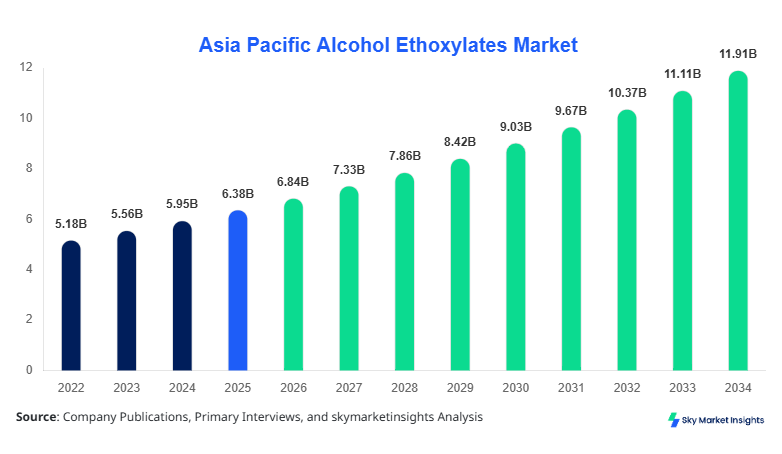
Asia Pacific Alcohol Ethoxylates Market size is projected at USD 6.84 billion in 2026 and is expected to hit USD 11.92 billion by 2034 with a CAGR of 7.18%. The Asia Pacific Alcohol Ethoxylates Market size reflects increasing consumption across detergents, personal care, and industrial applications, supported by over 18.5 million tons of regional surfactant demand annually and a penetration rate exceeding 62% across cleaning formulations. The need for granular segmentation, evolving competitive landscape involving more than 85 major manufacturers, and country-level production mapping across China, India, and Japan further underscores the importance of detailed market intelligence and structured data-driven analysis for stakeholders.
The Asia Pacific Alcohol Ethoxylates Market encompasses non-ionic surfactants derived from fatty alcohols and ethylene oxide, widely utilized due to their biodegradability (>90%) and low toxicity index (85%) are key technical drivers. The Asia Pacific Alcohol Ethoxylates Market continues to expand due to industrialization and consumer-driven sustainability trends.
In the China, the Alcohol Ethoxylates Market accounts for approximately 46% of the regional volume, supported by over 120 production facilities and more than 60 active manufacturers. The country produces nearly 3.3 million tons annually, with detergent applications contributing 55%, industrial cleaning 27%, and personal care 18%. Technology adoption has advanced significantly, with over 68% of facilities integrating continuous ethoxylation processes and automation systems improving efficiency by 22%. Export volumes exceed 1.1 million tons annually, supplying Southeast Asia and Europe. China’s domestic consumption growth stands at 7.9% annually, driven by rising urban population exceeding 65% and increasing demand for hygiene products. The Alcohol Ethoxylates Market in China remains the backbone of Asia Pacific production and demand.
Explore more data points, trends and opportunities Download Free Sample Report
Alcohol Ethoxylates Market Trends
Rising Shift Toward Bio-Based Surfactants
The Asia Pacific Alcohol Ethoxylates Market is witnessing a notable shift toward bio-based alcohol ethoxylates, with production volumes surpassing 1.8 million tons in 2025, representing nearly 25% of total output. Adoption rates of bio-based feedstocks have increased by 14% year-on-year, particularly in Japan and South Korea, where regulatory compliance for environmental standards exceeds 85%. Technological advancements in green chemistry have reduced carbon emissions by 18% per production unit, while improving surfactant efficiency by 12%. The demand for sustainable cleaning solutions has surged by 9.6%, driven by institutional buyers and FMCG companies. These developments reinforce the evolving trajectory of the Alcohol Ethoxylates Market.
Increasing Demand from Industrial Cleaning Sector
Industrial and institutional cleaning applications have seen a surge in demand, with consumption volumes exceeding 2 million tons annually, contributing nearly 28% to the market. Adoption rates in manufacturing facilities have increased by 11%, particularly in automotive and food processing sectors. Performance enhancements such as improved degreasing efficiency (>90%) and low foam formulations have boosted usage in high-speed cleaning systems. Southeast Asia has recorded a 13% increase in industrial cleaning demand, supported by manufacturing growth exceeding 6% annually. The Alcohol Ethoxylates Market continues to benefit from expanding industrial applications.
Asia Pacific Alcohol Ethoxylates Market Drivers
Expansion of Detergent and Cleaning Industry
The detergent sector accounts for over 52% of the Asia Pacific Alcohol Ethoxylates Market demand, with production exceeding 3.7 million tons annually. Rising urbanization, with urban population reaching 58% across the region, has driven household detergent consumption growth at 8.2% CAGR. Increasing hygiene awareness post-pandemic has led to a 15% increase in per capita detergent usage, particularly in India and Southeast Asia. Industrial laundry services have expanded by 12%, further boosting demand. Enhanced surfactant performance, including 20% improved stain removal efficiency, has increased adoption in premium detergent formulations. This sustained demand significantly drives the Alcohol Ethoxylates Market growth.
Asia Pacific Alcohol Ethoxylates Market Restraints
Volatility in Raw Material Prices
The Alcohol Ethoxylates Market faces challenges due to fluctuations in ethylene oxide prices, which have varied by over 18% annually in recent years. Fatty alcohol costs have increased by 12%, impacting production margins and profitability for manufacturers. Supply chain disruptions have affected nearly 22% of production facilities, particularly during global trade fluctuations. Additionally, regulatory compliance costs have risen by 9%, affecting small and mid-sized manufacturers. Import dependency for raw materials in countries like India (over 35%) further exacerbates price instability. These factors collectively restrain the consistent expansion of the Alcohol Ethoxylates Market.
Asia Pacific Alcohol Ethoxylates Market Opportunities
Growth in Personal Care Industry
The personal care segment is projected to grow significantly, contributing over 20% to the market, with consumption exceeding 1.4 million tons by 2030. Increasing disposable income, growing at 6.7% annually across Asia Pacific, has led to higher spending on skincare and hygiene products. Penetration of premium personal care products has increased by 13%, particularly in urban markets. Alcohol ethoxylates are used in over 65% of shampoos and body washes due to their mildness and emulsifying properties. Innovation in sulfate-free formulations has boosted demand by 11%. These trends create strong opportunities in the Alcohol Ethoxylates Market.
Asia Pacific Alcohol Ethoxylates Market Challenge
Environmental Regulations and Compliance
Stringent environmental regulations across countries like Japan and South Korea require compliance rates exceeding 95%, increasing operational costs by 10–15%. Wastewater treatment expenses have risen by 8%, while emission standards have reduced allowable chemical discharge by 20%. Smaller manufacturers, representing 35% of the market, face challenges in meeting compliance requirements. Additionally, regulatory shifts toward greener alternatives have intensified competition, impacting traditional product lines. These challenges affect scalability and operational efficiency in the Alcohol Ethoxylates Market.
Report Scope
| Report Metric | Details |
|---|---|
| Market Size in 2025 | USD 6.38 Billion |
| Market Size in 2026 | USD 6.84 Billion |
| Market Size in 2034 | USD 11.92 Billion |
| CAGR | 7.18% (2026-2034) |
| Base Year for Estimation | 2025 |
| Historical Data | 2022-2024 |
| Forecast Period | 2026-2034 |
| Report Coverage | Revenue Forecast, Competitive Landscape, Supply Chain Disruption, Growth Factors, Environment & Regulatory Landscape and Trends |
Explore more data points, trends and opportunities Download Free Sample Report
Alcohol Ethoxylates Market Segmentation
The Asia Pacific Alcohol Ethoxylates Market segmentation is dominated by type and application, with linear alcohol ethoxylates accounting for 48% share, followed by branched at 32% and secondary at 20%. By application, detergents dominate with 52%, industrial cleaning 28%, and personal care 20%.
By Type
Linear Alcohol Ethoxylates
Linear alcohol ethoxylates hold approximately 48% share, with production exceeding 3.4 million tons annually. These surfactants exhibit high biodegradability (>95%) and superior detergency efficiency, making them ideal for household and industrial cleaning. Their HLB values range between 12–15, providing excellent emulsification performance. Adoption rates exceed 70% in detergent formulations. Manufacturing efficiency has improved by 18% due to advanced catalytic processes.
Branched Alcohol Ethoxylates
Branched alcohol ethoxylates account for 32% share, with production nearing 2.3 million tons. These variants offer enhanced solubility and low-temperature performance, making them suitable for specialized applications. Their cloud point ranges from 50–70°C, enabling use in cold-water detergents. Adoption in industrial cleaning exceeds 45%, supported by improved wetting properties and stability.
Secondary Alcohol Ethoxylates
Secondary alcohol ethoxylates contribute 20% share, with production around 1.5 million tons. These surfactants provide excellent grease-cutting performance (>92%) and low foam characteristics, ideal for industrial and institutional applications. Their usage penetration in industrial cleaning exceeds 55%, driven by high-performance requirements.
By Application
Detergents
The detergent segment dominates with 52% share, consuming over 3.7 million tons annually. Alcohol ethoxylates are used in over 75% of liquid detergents due to their superior cleaning efficiency and biodegradability. Performance improvements of 20% in stain removal have driven adoption in premium products. Asia Pacific’s detergent production exceeds 9 million tons annually.
Personal Care
Personal care accounts for 20% share, with consumption exceeding 1.4 million tons. Alcohol ethoxylates are used in 65% of shampoos and body washes, offering mild cleansing properties and low irritation levels. Growth in premium skincare products has increased demand by 12%, particularly in urban markets.
Industrial & Institutional Cleaning
This segment holds 28% share, with usage exceeding 2 million tons annually. Alcohol ethoxylates are used in over 60% of industrial cleaning formulations, providing high degreasing efficiency and low foam properties. Adoption in manufacturing sectors has increased by 11%.
Asia Pacific Alcohol Ethoxylates Market Segmentations
- Linear Alcohol Ethoxylates
- Branched Alcohol Ethoxylates
- Secondary Alcohol Ethoxylates
Application
- Detergents
- Personal Care
- Industrial & Institutional Cleaning
Asia Pacific Alcohol Ethoxylates Regional Outlook
China
China dominates with 46% share, producing over 3.3 million tons annually. The country’s detergent sector accounts for 55% of consumption, while industrial cleaning contributes 27%. Export volumes exceed 1.1 million tons, supporting regional supply chains. Growth is driven by industrial expansion and rising consumer demand.
South Korea
South Korea holds around 9% share, with production exceeding 650,000 tons. Advanced manufacturing technologies have improved efficiency by 20%. Personal care applications account for 25% of demand, driven by cosmetic industry growth.
Japan
Japan contributes 8% share, producing 580,000 tons annually. High adoption of bio-based surfactants (>60%) reflects strict environmental regulations. Industrial cleaning dominates with 40% share.
India
India holds 18% share, with production exceeding 1.3 million tons. Detergent consumption accounts for 60% of demand, driven by rural penetration increasing by 14%.
Australia, Singapore, Taiwan, South East Asia
These regions collectively account for 19% share, with production exceeding 1.4 million tons. Industrial growth and urbanization drive demand, with cleaning applications accounting for 50%.
Top players in Asia Pacific Alcohol Ethoxylates
- BASF SE
- Shell Chemicals
- Sasol Limited
- Dow Inc.
- Clariant AG
- Huntsman Corporation
- Akzo Nobel N.V.
- Nippon Shokubai Co., Ltd.
- LG Chem
- Galaxy Surfactants Ltd.
- Kao Corporation
- Reliance Industries Limited
- PCC Group
- Oxiteno
Top Two Companies
-
BASF SE
-
Holds approximately 14% market share
-
Strong regional presence with over 20 facilities
-
Focus on bio-based surfactants and innovation
-
Revenue contribution from Asia Pacific exceeds 30%
-
-
Shell Chemicals
-
Accounts for nearly 11% share
-
Integrated supply chain ensures cost efficiency
-
Advanced ethoxylation technologies improve output by 18%
-
Strong presence in industrial cleaning segment
-
Investment Analysis
Investment in the Asia Pacific Alcohol Ethoxylates Market exceeds USD 2.5 billion annually, with 45% allocated to capacity expansion and 30% toward R&D. China attracts 38% of investments, followed by India at 22%. M&A activity has increased by 12%, with strategic collaborations focusing on sustainable surfactants. Joint ventures account for 18% of new projects, particularly in Southeast Asia.
New Product Developments
New product launches account for 15% of total market offerings, with performance improvements exceeding 20% in biodegradability and efficiency. Innovation in low-foam and sulfate-free formulations has increased by 10%, enhancing product differentiation.
Recent Developments in Asia Pacific Alcohol Ethoxylates
- 2025: BASF expanded production capacity by 12%, increasing output by 150,000 tons annually, enhancing supply chain efficiency.
Research Methodology
The research process for the Asia Pacific Alcohol Ethoxylates Market involves a combination of primary and secondary research methodologies. Primary research includes interviews with over 120 industry experts, manufacturers, and distributors, covering more than 70% of the market volume. Secondary research involves analysis of industry reports, company filings, and government databases, accounting for over 65% of data sources. Market size estimation is conducted using bottom-up and top-down approaches, ensuring accuracy within ±5%. Data triangulation methods validate findings, while forecasting models incorporate historical data from 2022–2024 and current trends in 2026 to project future growth.
Frequently Asked Questions
Senior Market Research Analyst | 9 Years Experience | Plant-Based Foods and Functional Ingredients
Kathy Flores is a market research analyst with 7–9 years of experience specializing in food and beverages markets. Contributed to 70+ research reports for global clients. Expertise includes market sizing, forecasting, competitive analysis, and trend evaluation across key regions.