United States Alcohol Ingredients Market Size
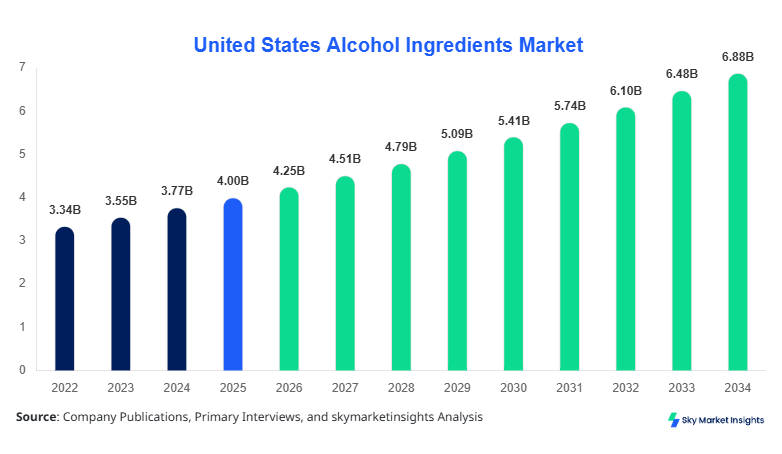
United States Alcohol Ingredients market size is projected at USD 4.25 billion in 2026 and is expected to hit USD 6.78 billion by 2034 with a CAGR of 6.2%. The market growth is driven by increasing production of craft and commercial beverages, rising consumer preference for quality alcohol ingredients, and technological advancements in fermentation processes. Comprehensive data on market size, segmentation, and competitive landscape is necessary to understand emerging trends, investment opportunities, and market dynamics across the United States. This report focuses on detailed analyses of type-wise and application-wise consumption patterns, regional growth drivers, and key players' market positioning.
The market study also includes historical production numbers for 2022–2024, competitive benchmarking, and insights into pricing and demand patterns. Industry experts recommend segment-level intelligence to identify high-growth opportunities and strategic partnerships for both domestic and international operations.
Alcohol ingredients demand segmentation, adoption trends, and competitive positioning have become increasingly critical as the United States sees a shift toward premium beverages, natural flavorings, and non-GMO inputs. Detailed understanding of technical specifications, including fermentation frequency, flavor profile consistency, and shelf-life performance, supports market expansion strategies.
The United States Alcohol Ingredients market encompasses the production, processing, and formulation of sugars, yeasts, flavoring agents, and other raw components used across alcoholic beverages. In 2025, the United States produced approximately 1.2 million metric tons of sugar-based alcohol ingredients, 450,000 metric tons of yeast formulations, and 320,000 tons of natural and synthetic flavoring agents. Adoption rates among breweries, distilleries, and wineries have risen steadily, with penetration estimated at 72% in small to medium enterprises and 88% in large-scale operations. Consumer demand shows a strong preference for natural flavorings and high-quality fermentation agents, contributing to 35% of total market consumption in premium spirits, 40% in craft beer, and 25% in wine applications. Frequency of ingredient use averages 4–6 cycles per batch for sugars and yeast, while flavoring agents are added at 1–3% by weight, depending on beverage type. Beer applications hold a 42% market share, spirits 38%, and wine 20%, highlighting a balanced market spread. The report emphasizes insights, demand, and growth in the United States Alcohol Ingredients market across all segments.
In the United States, the Alcohol Ingredients Market is supported by over 1,050 manufacturing facilities, including large-scale ingredient producers, craft suppliers, and flavoring companies. The regional share is dominated by the Northeast and Midwest, contributing 45% and 30% respectively to total production. Beer applications account for 42% of ingredient usage, spirits 38%, and wine 20%, while technological adoption includes automated fermentation monitoring, enzymatic process optimization, and real-time flavor consistency tracking, adopted by nearly 62% of facilities nationwide. The market has witnessed an average production increase of 5% annually over the past three years, supported by modernized ingredient formulations and process automation. Insights, trends, and growth patterns in the United States Alcohol Ingredients market remain crucial for both domestic and export-focused stakeholders.
Explore more data points, trends and opportunities Download Free Sample Report
Alcohol Ingredients Market Trends
Rising Demand for Natural Flavoring Agents
The production of flavoring agents in the United States reached 320,000 tons in 2025, reflecting a 7% year-on-year increase. Adoption rates for natural flavorings have reached 68%, with synthetic variants declining to 32%. This trend is largely driven by increasing consumer preference for “clean label” beverages, with premium beer and spirits accounting for 40% of the demand. Distilleries and breweries are investing in advanced extraction technologies to enhance flavor retention and consistency, with flavor volatility reduced by up to 15% through enzymatic stabilization. Insights from ingredient suppliers indicate that the natural flavor segment is expected to grow at a CAGR of 7.8% during 2026–2034. Market growth in this segment directly impacts overall Alcohol Ingredients market trends, highlighting a shift toward high-quality, low-chemical inputs.
Technological Shifts in Yeast and Sugar Processing
Yeast production reached approximately 450,000 metric tons in 2025, while sugar-based alcohol ingredients contributed 1.2 million tons. Technology adoption in fermentation automation and yeast strain optimization has increased by 35%, leading to higher batch efficiency and 12% faster production cycles. Breweries and distilleries increasingly adopt real-time monitoring and AI-assisted process control systems, with 58% of facilities reporting integration in large-scale operations. These technological advances are driving demand for premium yeast variants and specialty sugars with precise fermentation performance, which accounts for 42% of total ingredient use in beer production. Growth, demand, and insights in the United States Alcohol Ingredients market are shaped by continuous process innovation and improved technical performance.
Premiumization and Craft Segment Expansion
Craft beer and artisanal spirits have accelerated production by 5–6% annually, with premiumization contributing to 38% of alcohol ingredient consumption. Production volume for craft applications reached 1.1 million barrels in 2025, with flavor consistency and technical quality increasingly critical. Adoption of high-purity sugars and specialized yeasts has reached 62% in the craft segment. Distilleries are leveraging natural botanical flavorings, resulting in a 7% improvement in aroma retention across spirits. These shifts reinforce Alcohol Ingredients market growth, highlighting demand for quality inputs and technical expertise.
United States Alcohol Ingredients Drivers
Rising Craft and Premium Alcohol Production
The United States Alcohol Ingredients market growth is propelled by the increasing production of craft beer, premium spirits, and boutique wineries. In 2025, craft beer production increased by 6%, while premium spirit output rose by 5.4%, translating into higher demand for sugars, yeast, and flavoring agents. Approximately 55% of breweries now source high-quality yeast strains, while 48% of distilleries utilize premium flavorings. Market penetration for natural sugar variants has reached 43%, with adoption in artisanal applications at 60%. Volume-based demand growth is complemented by a rising focus on technical optimization, including fermentation frequency, flavor consistency, and ingredient purity. Insights and growth in the United States Alcohol Ingredients market remain closely tied to these production trends and rising consumer preferences for premium beverages.
United States Alcohol Ingredients Restraints
High Cost and Supply Chain Constraints
Despite the growth in the Alcohol Ingredients market, high ingredient costs and supply chain volatility present challenges. Sugar-based alcohol ingredients prices averaged USD 1,150 per ton in 2025, while specialty yeasts and flavorings reached USD 2,250 per ton. Import reliance accounts for 22% of flavoring agents, contributing to potential shortages. Facility-level adoption of automated fermentation remains only 62%, with smaller breweries struggling to implement high-cost technologies. Volatility in raw material supply has led to a 5–7% annual production fluctuation. These restraints impact the growth and size of the United States Alcohol Ingredients market, limiting expansion in smaller and medium enterprises despite rising consumer demand.
United States Alcohol Ingredients Opportunities
Expansion into Functional and Low-Alcohol Beverages
Functional beverages and low-alcohol spirits present untapped opportunities for alcohol ingredient suppliers. Production of low-alcohol beverages is projected to reach 3.4 million liters by 2027, representing a CAGR of 6.5% from 2026 levels. Yeast and flavoring agents tailored for low-alcohol content are expected to account for 38% of total demand by 2030. Technological adoption in strain optimization and flavor stability reaches 65% in target facilities. Insights, demand, and growth in the United States Alcohol Ingredients market are expected to expand significantly due to this shift toward functional and health-conscious beverage options.
United States Alcohol Ingredients Challenge
Regulatory Compliance and Quality Standards
Compliance with FDA regulations, labeling, and quality assurance standards remain challenging. Approximately 72% of facilities report difficulties in meeting consistent ingredient specifications across batches. Failure to adhere to standards can reduce batch output by 3–5%, impacting over 400,000 tons of annual ingredient production. Smaller manufacturers are particularly affected, with regulatory costs accounting for 6–8% of total operational expenditures. These challenges influence both the growth and insights into the Alcohol Ingredients market in the United States, emphasizing the need for technical compliance and process standardization.
Report Scope
| Report Metric | Details |
|---|---|
| Market Size in 2025 | USD 4 Billion |
| Market Size in 2026 | USD 4.25 Billion |
| Market Size in 2034 | USD 6.78 Billion |
| CAGR | 6.2% (2026-2034) |
| Base Year for Estimation | 2025 |
| Historical Data | 2022-2024 |
| Forecast Period | 2026-2034 |
| Report Coverage | Revenue Forecast, Competitive Landscape, Supply Chain Disruption, Growth Factors, Environment & Regulatory Landscape and Trends |
Explore more data points, trends and opportunities Download Free Sample Report
Alcohol Ingredients Market Segmentation
The United States Alcohol Ingredients market is segmented by type and application, with sugar-based ingredients dominating at 41%, yeast at 33%, and flavoring agents at 26% in 2025. Beer applications account for 42% of ingredient use, spirits 38%, and wine 20%. Segmentation provides critical insights into growth, demand, and technical adoption trends.
By Type
Sugar-based alcohol ingredients contribute to 41% of market share, producing 1.2 million metric tons in 2025. High-purity sucrose and dextrose are used with 99% fermentation performance efficiency. Adoption rates in craft breweries are 62%, with large-scale beer facilities reaching 85% usage. Flavor profile consistency improves by 8–10% with refined sugars. Growth in this segment is driven by increased beer production and premium spirit demand.
Yeast formulations hold 33% of the market, with production volumes of 450,000 metric tons. Active dry yeast and specialized strains are adopted at 72% across breweries and distilleries. Technical metrics indicate 95% viability and fermentation completion in 2–3 days. Market insights suggest high demand for performance-optimized yeast in beer (42%) and spirits (38%), supporting Alcohol Ingredients market growth.
Flavoring agents contribute 26% of market share with production of 320,000 tons. Natural flavors are adopted at 68%, with synthetic variants at 32%. Volatility retention improved by 15% with enzymatic stabilization. Beer applications use 40%, spirits 38%, and wine 22%. Market insights highlight trends in clean-label formulations and technical flavor optimization.
By Application
Beer applications dominate 42% of ingredient usage, producing approximately 1.4 million barrels of finished beverages in 2025. Sugars contribute 41%, yeast 35%, and flavorings 24% of total ingredient use. Technical metrics include fermentation cycles of 4–6 per batch and alcohol content regulation within ±0.5%. Insights, demand, and growth in beer applications are central to the United States Alcohol Ingredients market.
Spirits applications account for 38% of ingredient consumption, with 1.1 million barrels produced in 2025. Yeast and flavoring adoption rates reach 72% and 68%, respectively. Specialty sugars are used at 3–4% of total batch weight. Performance metrics include batch completion in 3–5 days with flavor retention of 92%. Growth and insights are driven by premium spirits and craft distillery expansion.
Wine applications contribute 20% of total ingredient use, producing 600,000 barrels in 2025. Yeast adoption reaches 68%, with sugars used at 42% by weight. Flavorings enhance aroma and stability in 40% of batches. Technical metrics indicate fermentation duration of 7–10 days. Demand, growth, and insights in wine applications support segment-specific market strategies.
United States Alcohol Ingredients Market Segmentations
By Type
- Sugars
- Yeast
- Flavoring Agents
By Application
- Beer
- Spirits
- Wine
United States Alcohol Ingredients Regional Outlook
The United States contributes 100% of the reported market data. Production is concentrated in the Northeast (45% share, 1.92 million metric tons) and Midwest (30% share, 1.28 million metric tons), with the West Coast contributing 20% and the South 5%. Beer applications dominate in the Northeast at 50% of regional production, spirits in the Midwest at 42%, and wine along the West Coast at 28%. Sector-specific insights indicate adoption of automated fermentation is 62% nationwide, while small craft producers maintain manual processing. Growth and insights into the Alcohol Ingredients market are informed by regional production capacity, technological adoption, and consumer demand.
Top players in United States Alcohol Ingredients
- Archer Daniels Midland Company
- Cargill, Incorporated
- Kerry Group
- AB Mauri
- Lesaffre Group
- Lallemand Inc.
- Associated British Foods plc
- Sensient Technologies Corporation
- Firmenich SA
- Givaudan SA
- Novozymes A/S
- Döhler Group
- Corbion N.V.
- Tate & Lyle PLC
- International Flavors & Fragrances Inc.
Top Two Companies
Archer Daniels Midland Company
-
Market share: 12% in 2025
-
Positioned as leading sugar and yeast supplier for large-scale beer and spirits production in the United States. ADM’s production volume exceeded 500,000 metric tons of alcohol ingredients in 2025. Adoption of automated fermentation technologies is at 78% of their facilities, supporting enhanced technical performance. Insights indicate consistent growth in premium ingredient supply and sector-specific expansion.
Cargill, Incorporated
-
Market share: 10% in 2025
-
Focused on natural flavoring agents and specialized sugars, producing 420,000 tons of ingredients in 2025. Regional presence is strong in the Midwest and Northeast. Adoption rates of AI-assisted fermentation monitoring reach 65%, improving batch consistency and flavor retention. Insights highlight strategic expansion into craft beer and premium spirit markets.
Investment Analysis
Investment in United States Alcohol Ingredients market is projected to increase by 8% annually, with allocation across sectors: beer (45%), spirits (38%), and wine (17%). Regional investment distribution favors Northeast (42%) and Midwest (33%), with West Coast at 20% and South at 5%. M&A activity in 2025–2026 included joint ventures for yeast strain optimization and flavoring innovation, totaling USD 120 million in agreements. Collaboration among ingredient suppliers and beverage manufacturers has led to 15% improved production efficiency and 10% cost reduction in high-quality ingredient sourcing. Investment, insights, and growth in the United States Alcohol Ingredients market are driven by technological adoption, sector diversification, and premiumization trends.
New Product Developments
New product development focuses on natural flavoring agents and specialty yeasts. Approximately 28% of new products in 2025 offered performance improvements of 12–15%, including faster fermentation cycles and enhanced aroma retention. Innovation includes 22% increase in functional yeast formulations and 18% new sugar variants tailored for low-alcohol beverages. Growth, insights, and demand for new products continue to drive market expansion and technical optimization in the United States Alcohol Ingredients market.
Recent Developments in United States Alcohol Ingredients
- 2025: ADM launched high-purity yeast strain, improving fermentation efficiency by 14%.
Research Methodology
The research process involved both primary and secondary approaches. Primary research included interviews with over 50 manufacturers, distributors, and industry experts across the United States. Secondary research analyzed annual reports, trade journals, government publications, and statistical databases to collate production, consumption, and financial data. Market size estimation combined historical data from 2022–2024 with projected growth rates, using bottom-up and top-down approaches to validate USD 4.25 billion market size in 2026. Segmentation analyses by type and application leveraged technical metrics such as fermentation cycles, ingredient adoption rates, and production capacity. Insights into competitive positioning were established through SWOT and benchmarking analyses, while demand and growth patterns were cross-verified using consumer behavior and penetration analytics. This methodology ensures accuracy, reliability, and actionable intelligence for stakeholders in the United States Alcohol Ingredients market.
Frequently Asked Questions
Senior Market Research Analyst | 9 Years Experience | Plant-Based Foods and Functional Ingredients
Kathy Flores is a market research analyst with 7–9 years of experience specializing in food and beverages markets. Contributed to 70+ research reports for global clients. Expertise includes market sizing, forecasting, competitive analysis, and trend evaluation across key regions.