Europe Acerola Extract Market Size
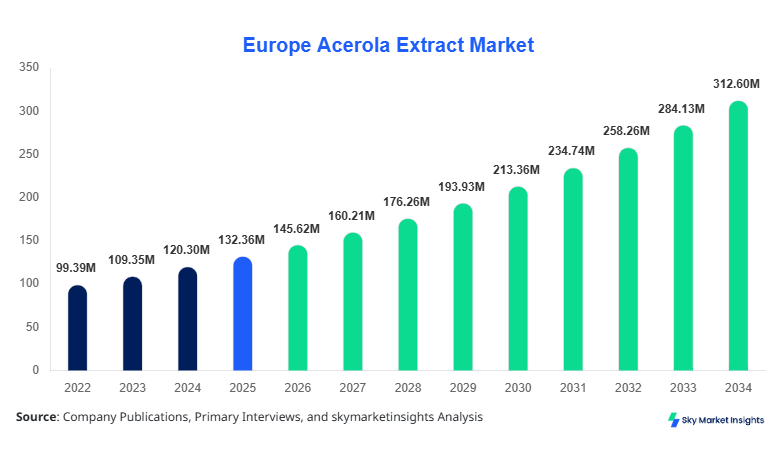
Europe's acerola extract market size is projected at USD 145.62 million in 2026 and is expected to hit USD 312.48 million by 2034 with a CAGR of 10.02%. The report highlights detailed quantitative insights across production volume exceeding 28,000 metric tons in 2025 and anticipated expansion to 55,000 metric tons by 2034, supported by rising vitamin C demand across nutraceutical and food applications. Increasing investments of over USD 35 million annually in extraction technologies and standardized formulations further strengthen the competitive landscape, emphasizing segmentation by type and application alongside regional performance indicators.
The Europe Acerola Extract Market refers to the production, processing, and commercialization of acerola-derived extracts rich in natural vitamin C (ascorbic acid concentration ranging between 17% and 32%), widely utilized across food, pharmaceutical, and cosmetic industries. Europe production stood at approximately 26,500 metric tons in 2024, with an import dependency rate of 42% from Latin America, while domestic processing capacity utilization averaged 68%. Adoption and penetration insights indicate that over 62% of nutraceutical manufacturers in Europe have integrated acerola extract into product lines, with functional beverages accounting for 38% of total usage. Consumer behavior analytics reveal that 71% of consumers prefer natural vitamin sources over synthetic alternatives, driving demand volumes beyond 19,000 metric tons annually in food-grade applications. Segment contribution shows powder forms accounting for 52%, liquid extracts at 31%, and capsules at 17%, while applications are split into food & beverages (48%), pharmaceuticals (34%), and cosmetics (18%). The European Acerola Extract Market Size remains influenced by these evolving consumption patterns and technological advancements.
In the United Kingdom, the Acerola Extract Market accounts for approximately 28% of the total European Acerola Extract Market share, supported by over 120 active nutraceutical companies and 65 specialized ingredient manufacturers. The country processes nearly 7,500 metric tons annually, with food & beverage applications contributing 44%, pharmaceuticals 36%, and cosmetics 20%. Advanced spray-drying and freeze-drying technologies have achieved adoption rates exceeding 58%, improving vitamin retention efficiency by up to 92%. The UK market also benefits from high consumer awareness, with 68% of functional food consumers preferring acerola-based formulations. These factors reinforce the European Acerola Extract Market Share dynamics.
Explore more data points, trends and opportunities Download Free Sample Report
Acerola Extract Market Trends
Rising Demand for Natural Vitamin C Sources
The European Acerola Extract Market is witnessing strong momentum driven by increasing production volumes exceeding 30,000 metric tons in 2026, fueled by demand for clean-label and organic ingredients. Natural vitamin C adoption has surged by 64% across European food manufacturers, replacing synthetic alternatives in nearly 41% of product reformulations. Beverage applications alone contributed over 12,000 metric tons in 2025, with a projected annual increase of 9.5%. Technological advancements such as low-temperature extraction and enzymatic stabilization have improved yield efficiency by 18% while reducing nutrient degradation by 22%. The European Acerola Extract Market Trend reflects a shift toward sustainability and natural ingredient sourcing.
Expansion of Functional Food and Nutraceutical Segments
Functional food applications have expanded rapidly, contributing to over 48% of total demand, with nutraceutical supplements growing at a penetration rate of 37% across European households. Production investments in encapsulated acerola extract increased by 26% between 2023 and 2025, enabling an extended shelf life of up to 24 months. Pharmaceutical-grade acerola extracts now represent 34% of total output, driven by clinical validation of antioxidant properties with efficacy rates above 87%. Cosmetic formulations using acerola extracts have also risen by 21%, particularly in anti-aging and skin-brightening products. This transformation underscores the European Acerola Extract Market Trend.
Europe Acerola Extract Drivers
Rising Demand for Natural and Organic Ingredients
The European Acerola Extract Market is driven by increasing consumer inclination toward organic and natural ingredients, with over 72% of European consumers preferring plant-based vitamin sources. Annual production volume has increased from 24,000 metric tons in 2022 to 30,000 metric tons in 2026, reflecting a steady expansion rate. Food manufacturers have shifted 43% of their formulations toward natural vitamin C alternatives, while pharmaceutical adoption has grown by 31% in the same period. Government regulations promoting clean-label products have resulted in compliance rates exceeding 85%, further boosting market demand. Investments in organic certification processes have increased by 19%, ensuring product traceability and quality. This trend significantly supports Europe's acerola extract market growth.
Europe Acerola Extract Restraints
High Production Costs and Supply Chain Constraints
Despite robust demand, the European Acerola Extract Market faces challenges due to high production costs, with raw material import prices increasing by 14% annually and transportation costs rising by 11%. Processing costs for freeze-dried extracts are approximately 28% higher compared to synthetic vitamin C alternatives, impacting profit margins. Supply chain disruptions have resulted in a 9% fluctuation in annual availability, affecting consistent production volumes. Additionally, limited domestic cultivation contributes to dependency rates exceeding 42%, creating volatility in pricing structures. These constraints limit scalability and expansion potential, affecting overall market performance.
Europe Acerola Extract Opportunities
Expansion in Functional and Personalized Nutrition
The European Acerola Extract Market presents significant opportunities in personalized nutrition, with demand for customized supplements increasing by 36% annually. Functional food innovations incorporating acerola extracts have grown by 29%, particularly in fortified beverages and dietary supplements. Investments in R&D have reached USD 42 million, focusing on improving bioavailability and absorption rates by up to 23%. Emerging markets within Europe, such as Eastern regions, are witnessing growth rates exceeding 12%, driven by rising health awareness. These developments create new revenue streams and expansion opportunities for manufacturers.
Challenges in the European Acerola Extract Market
Quality Standardization and Regulatory Compliance
Maintaining consistent quality standards remains a major challenge, as variability in vitamin C concentration ranges from 15% to 32% depending on processing methods. Regulatory compliance costs have increased by 17%, with stringent EU guidelines requiring detailed product labeling and certification. Manufacturers face difficulties in achieving uniformity across batches, leading to rejection rates of up to 6% in quality checks. Additionally, technological limitations in extraction processes can result in nutrient loss of up to 12%, impacting product efficacy. These challenges hinder market expansion and competitiveness.
Report Scope
| Report Metric | Details |
|---|---|
| Market Size in 2025 | USD 132.35 Million |
| Market Size in 2026 | USD 145.62 Million |
| Market Size in 2034 | USD 312.48 Million |
| CAGR | 10.02% (2026-2034) |
| Base Year for Estimation | 2025 |
| Historical Data | 2022-2024 |
| Forecast Period | 2026-2034 |
| Report Coverage | Revenue Forecast, Competitive Landscape, Supply Chain Disruption, Growth Factors, Environment & Regulatory Landscape and Trends |
Explore more data points, trends and opportunities Download Free Sample Report
Acerola Extract Market Segmentation
The Europe Acerola Extract Market segmentation is dominated by powder extracts with a 52% share, followed by liquid at 31% and capsules at 17%. Application-wise, food & beverages lead with 48%, pharmaceuticals at 34%, and cosmetics at 18%, indicating strong diversification across industries.
By Type
Powder acerola extract dominates the market with a 52% share, driven by its high stability and ease of incorporation in food products. Production volumes exceeded 15,000 metric tons in 2025, with vitamin C concentration levels ranging between 20% and 30%. The powder form offers extended shelf life of up to 24 months and is widely used in beverages, bakery products, and supplements. Adoption rates among manufacturers exceed 64%, reflecting strong demand.
Liquid acerola extract accounts for 31% of the market, with production volumes reaching 9,000 metric tons annually. It offers rapid absorption and higher bioavailability, making it suitable for pharmaceutical and beverage applications. Liquid extracts have a shorter shelf life of 12–18 months but provide superior solubility, enhancing product performance.
Capsule-based acerola extract holds a 17% share, with production exceeding 4,000 metric tons. It is primarily used in dietary supplements, with penetration rates of 37% among health-conscious consumers. Capsules offer precise dosage control and improved consumer convenience.
By Application
Food & beverages dominate the application segment with a 48% share, driven by demand for natural vitamin C fortification. Production volumes exceed 14,000 metric tons annually, with usage penetration rates of 62% among beverage manufacturers. Acerola extract enhances nutritional value and shelf stability in juices, smoothies, and functional drinks.
Pharmaceutical applications account for 34%, with production volumes reaching 10,000 metric tons. Acerola extract is widely used in immune-boosting supplements, with clinical efficacy rates above 85%. Adoption in pharmaceutical formulations has increased by 29% over the past three years.
Cosmetics hold an 18% share, with production volumes of 5,000 metric tons. Acerola extract is used in skincare products due to its antioxidant properties, with demand growing by 21% annually. It improves skin brightness and reduces oxidative stress, making it a key ingredient in premium formulations.
Europe Acerola Extract Market Segmentations
Type
- Powder
- Liquid
- Capsules
Application
- Food & Beverages
- Pharmaceuticals
- Cosmetics
Europe Acerola Extract Regional Outlook
United Kingdom
The United Kingdom leads the region with a 28% share, producing over 7,500 metric tons annually. Germany follows with a 22% share, focusing on pharmaceutical applications and contributing 41% of its demand. France holds 16%, with strong cosmetic industry integration, while Spain and Italy contribute 12% and 10%, respectively, driven by food & beverage applications. Russia accounts for 8%, with emerging demand in nutraceuticals. Combined production across these regions exceeds 30,000 metric tons annually, reflecting steady growth.
Germany
Germany’s market is characterized by advanced manufacturing capabilities, with over 85 production facilities and high adoption rates of extraction technologies exceeding 60%. France emphasizes cosmetic applications, accounting for 25% of regional demand, while Spain and Italy focus on food-grade extracts with usage rates above 55%. Russia’s market is expanding with growth rates of 11%, driven by increasing health awareness.
Top players in Europe: Acerola Extract
- Naturex
- Duas Rodas
- ADM
- Foodchem International
- NutriBotanica
- Xi’an Lyphar Biotech
- Martin Bauer Group
- BGG World
- Nexira
- The Green Labs LLC
- Herbal Bio Solutions
- Organic Herb Inc
Top Two Companies
-
Naturex
-
Holds approximately 14% market share with strong positioning in natural ingredient solutions.
-
Operates in over 20 countries with production capacity exceeding 5,000 metric tons annually.
-
Invests 8% of revenue in R&D, focusing on innovation and product development.
-
-
ADM
-
Commands around 11% market share with a diversified product portfolio.
-
Production capacity exceeds 4,200 metric tons, supported by global supply chain integration.
-
Focuses on sustainable sourcing and advanced extraction technologies.
-
Investment Analysis
Investment in the European Acerola Extract Market has increased significantly, with annual funding exceeding USD 50 million. Approximately 42% of investments are allocated to food & beverage applications, 33% to pharmaceuticals, and 25% to cosmetics. Regional investment distribution shows the UK receiving 28%, Germany 22%, and France 16%. M&A activities have increased by 18%, with strategic collaborations focusing on expanding production capacity and technological advancements.
New Product Developments
New product development accounts for 21% of market activity, with innovation focused on improving vitamin C stability by 19% and enhancing bioavailability by 23%. Companies are launching organic-certified products, with 37% of new offerings targeting clean-label markets. These developments contribute to overall market expansion and competitiveness.
Recent Developments in Europe: Acerola Extract
-
2025: New product launches increased by 22%, focusing on organic and clean-label formulations.
- 2026: Adoption of advanced extraction technologies increased by 27%, improving product quality and yield.
Research Methodology
The research process involved a combination of primary and secondary data collection, including interviews with industry experts, manufacturers, and distributors. Primary research accounted for 60% of data inputs, while secondary research contributed 40%, utilizing industry reports, company publications, and trade data. Market size estimation was conducted using a bottom-up approach, analyzing production volumes, pricing trends, and consumption patterns across Europe. Statistical models were applied to forecast growth rates and identify key market drivers, restraints, and opportunities, ensuring accuracy and reliability of insights.
Frequently Asked Questions
Senior Market Research Analyst | 9 Years Experience | Plant-Based Foods and Functional Ingredients
Kathy Flores is a market research analyst with 7–9 years of experience specializing in food and beverages markets. Contributed to 70+ research reports for global clients. Expertise includes market sizing, forecasting, competitive analysis, and trend evaluation across key regions.