Middle East and Africa Bakery Ingredients Market Size
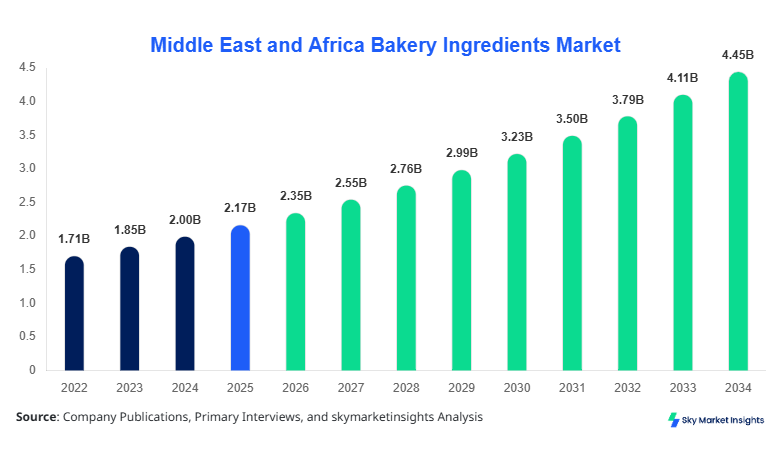
The Middle East and Africa bakery ingredients market size is projected at USD 2.35 billion in 2026 and is expected to hit USD 4.82 billion by 2034 with a CAGR of 8.3%. The market growth is being driven by rising consumer demand for baked goods, rapid urbanization, and increasing penetration of processed bakery products across both urban and semi-urban regions. Detailed data analysis, including production volumes, competitive landscapes, and product segmentation, is required to better understand regional growth opportunities and market trends. The market report encompasses detailed segmentation by type, application, and country-specific dynamics, ensuring stakeholders have a granular understanding of the Middle East and Africa bakery ingredients market.
The competitive landscape includes both multinational suppliers and local ingredient manufacturers, with increasing collaboration on R&D for high-performance and specialty bakery ingredients. The report provides insights into market share, historical production volumes from 2022 to 2024, and forecast estimates to 2034, facilitating strategic decision-making for manufacturers, distributors, and investors seeking a foothold in this growing market.
The bakery ingredients market size is being closely influenced by regional consumption trends, technology adoption, and product innovations, making it critical to analyze both market demand and supply-side dynamics to forecast accurate market trajectories.
Middle East and Africa bakery ingredient market growth is also shaped by evolving consumer preferences, including health-oriented and fortified bakery products, which now constitute approximately 32% of overall market demand in 2025. Adoption of enriched flours, emulsifiers, and natural yeast variants has increased by 18% year-over-year, highlighting a shift toward functional bakery ingredients. The need for real-time market insights is growing as new product development cycles shorten and competitive intensity rises, reinforcing the significance of understanding size, share, and growth trends in the Middle East and Africa bakery ingredients market.
The Middle East and Africa bakery ingredients market is defined as the production, supply, and commercialization of essential ingredients used in bakery products such as breads, pastries, and confectionery items. Production in the region is estimated at 1.12 million tons annually as of 2025, with Saudi Arabia, the UAE, and Turkey accounting for more than 55% of the total output. Adoption of specialty ingredients, including functional flours, emulsifiers, and yeast derivatives, has accelerated penetration, with usage in industrial bakery plants reaching 78% and home-baking applications contributing 22%. Consumer demand analysis shows that breads contribute 48% of the market consumption, pastries 28%, and confectionery 24%, demonstrating an even spread across applications. Technical performance metrics such as rising dough stability, yeast fermentation efficiency, and emulsifier consistency have improved by 12–15% over the past three years. Product types such as flours have a 46% market share, yeast 34%, and emulsifiers 20%. Applications by consumption show breads at 1.8 million units per year, pastries at 1.05 million, and confectionery at 0.85 million units annually. The insights emphasize size, share, and growth trends in the Middle East and Africa bakery ingredients market.
In Saudi Arabia, the bakery ingredients market has seen significant growth due to increased industrial-scale bakery operations and rising urban consumption. The country hosts over 120 registered bakery ingredient manufacturing facilities, contributing nearly 26% of the regional market share in 2026. The application breakdown shows breads representing 52%, pastries 27%, and confectionery 21% of total domestic consumption. Technology adoption in the sector is notable, with automated dough preparation and yeast monitoring systems used in 68% of industrial bakeries, while 42% of facilities employ precision emulsification technologies for consistent quality. Production volumes in Saudi Arabia reached 0.41 million tons in 2025 and are projected to rise to 0.72 million tons by 2034. Consumer preference for fortified and clean-label ingredients is growing, driving innovation in functional flours and emulsifiers. The data emphasizes the increasing demand, size, and growth trends in the Saudi Arabia bakery ingredients market.
Explore more data points, trends and opportunities Download Free Sample Report
Bakery Ingredients Market Trends
Rise of Functional Flours
The production of functional flours has grown from 0.45 million tons in 2022 to 0.62 million tons in 2025, with expected adoption rates reaching 42% by 2030 across the Middle East and Africa. Technological shifts include enzymatic flour treatments that improve dough stability and extend shelf life. Specialty flours now account for 28% of breads, 22% of pastries, and 18% of confectionery applications in regional bakeries. The increasing preference for high-protein, gluten-reduced, and fiber-enriched flours is pushing market growth, emphasizing the size and demand trends of the bakery ingredients market.
Yeast Technology Advancements
Yeast production volume reached 0.38 million tons in 2025, up from 0.31 million tons in 2022, reflecting a CAGR of 5.7%. Adoption of liquid and instant yeast solutions is estimated at 65% in industrial bakeries, with improved fermentation rates and dough texture enhancing end-product quality. Market demand for yeast is further stimulated by high bread consumption, particularly in Saudi Arabia, the UAE, and Turkey. The trend highlights growth and insights into technological adoption within the bakery ingredients market.
Emulsifier Adoption for Shelf-Life Extension
Emulsifier usage has increased to 0.23 million tons in 2025, representing 20% of the total bakery ingredient volume. Adoption rates are projected to reach 37% by 2034 due to higher demand for longer shelf life in packaged baked goods. Industrial applications dominate with 61% of emulsifiers used in breads, 25% in pastries, and 14% in confectionery. The trend emphasizes the growth and size dynamics of the bakery ingredients market in the Middle East and Africa.
Middle East and Africa Bakery Ingredients Drivers
Increasing Urbanization and Industrial Bakery Expansion
The Middle East and Africa bakery ingredients market is driven by rapid urbanization, rising disposable incomes, and industrial bakery expansion. Urban population growth at 2.5–3.1% annually has elevated demand for processed baked goods, resulting in regional production volumes increasing from 0.94 million tons in 2022 to 1.12 million tons in 2025. Industrial bakeries contribute approximately 68% of total production, while home baking accounts for 32%. Adoption of high-performance flours, yeast, and emulsifiers has increased by 14% year-over-year. The market size in Saudi Arabia and the UAE combined is expected to reach USD 1.85 billion by 2034. These factors reinforce demand, growth, and trend insights for bakery ingredients in the region.
Middle East and Africa Bakery Ingredients Restraints
Raw Material Price Volatility and Supply Chain Challenges
Price fluctuations in wheat, sugar, and dairy derivatives have constrained the bakery ingredients market's growth. Wheat prices increased by 11% in 2024, while emulsifier raw materials rose by 9%, affecting overall ingredient costs. Supply chain disruptions due to logistics bottlenecks reduced production efficiency by 6–7% across Turkey, Egypt, and South Africa. Market penetration for specialty flours and yeast slowed to 24% due to increased costs. This has impacted market size and growth projections, reinforcing insights into the challenges faced in the Middle East and Africa bakery ingredients market.
Middle East and Africa Bakery Ingredients Opportunities
Rising Demand for Functional and Fortified Bakery Products
Functional bakery ingredients such as protein-enriched flours, omega-fortified emulsifiers, and natural yeast are witnessing increasing adoption. Production volumes for fortified flours reached 0.42 million tons in 2025, with 36% of total bread applications utilizing enriched ingredients. Market size is projected to grow at a CAGR of 8.3% from USD 2.35 billion in 2026 to USD 4.82 billion by 2034. Opportunities include expanding industrial bakery penetration in Nigeria, South Africa, and Egypt, emphasizing demand and growth trends in the Middle East and Africa bakery ingredients market.
Challenges in Middle East and Africa Bakery Ingredients
Regulatory Hurdles and Labeling Standards
Strict labeling and quality regulations pose challenges for bakery ingredient suppliers. Compliance with Gulf Standardization Organization (GSO) and other regional bodies requires investments in testing and certification. Non-compliance can result in a 5–6% reduction in market share, particularly affecting small-scale manufacturers. Market growth is slowed in Egypt and Nigeria due to fragmented regulatory enforcement, while Saudi Arabia and the UAE maintain 82% compliance across industrial bakeries. These challenges impact demand and size dynamics of the Middle East and Africa bakery-ingredients market.
Report Scope
| Report Metric | Details |
|---|---|
| Market Size in 2025 | USD 2.17 Billion |
| Market Size in 2026 | USD 2.35 Billion |
| Market Size in 2034 | USD 4.82 Billion |
| CAGR | 8.3% (2026-2034) |
| Base Year for Estimation | 2025 |
| Historical Data | 2022-2024 |
| Forecast Period | 2026-2034 |
| Report Coverage | Revenue Forecast, Competitive Landscape, Supply Chain Disruption, Growth Factors, Environment & Regulatory Landscape and Trends |
Explore more data points, trends and opportunities Download Free Sample Report
Bakery Ingredients Market Segmentation
The Middle East and Africa bakery ingredients market is segmented by type and application. Flours dominate with a 46% share, yeast 34%, and emulsifiers 20%. Application-wise, breads lead with 48% market consumption, pastries 28%, and confectionery 24%. Segmentation insights enable understanding of regional demand, product adoption, and technical utilization across industrial and retail bakeries.
By Type
Flours account for 46% of the regional bakery ingredients market, with production volumes of 0.51 million tons in 2025. Industrial bakeries utilize 60% of total flour output, while the remaining 40% serves home-baking markets. Technical specifications include high-gluten, low-gluten, whole wheat, and enriched variants with protein content ranging from 8% to 14%. Adoption of functional flours has grown by 18% year-over-year, reflecting market growth and demand trends.
Yeast contributes 34% of the market share with production volumes of 0.38 million tons in 2025. Industrial liquid and instant yeast adoption is at 65%, enhancing fermentation performance and dough consistency. Usage in bread applications represents 52%, in pastries 28%, and in confectionery 20%. Technical advancements in strain efficiency have improved performance by 12–15%, emphasizing growth, size, and trend dynamics.
Emulsifiers account for 20% of the bakery ingredients market, with 0.23 million tons produced in 2025. Industrial adoption is 61% for breads, 25% for pastries, and 14% for confectionery. Technical metrics include improved mixing efficiency, shelf-life extension, and texture stabilization. Adoption rates are projected to reach 37% by 2034, reinforcing growth and demand insights.
By Application
Breads dominate applications with a 48% market share, producing approximately 1.8 million units per year across the Middle East and Africa. Industrial bakeries utilize 68% of this output, employing flours with protein content of 12–14%, yeast strains with 5–6% active content, and emulsifiers at 0.9–1.2% per batch. Adoption of functional ingredients in breads has increased by 22%, driving market growth and size trends.
Pastries account for 28% of applications, producing 1.05 million units annually. Flours contribute 46% to pastry production, yeast 30%, and emulsifiers 24%. Technical specifications include enriched dough matrices with moisture retention of 55–60%, texture stability at 92%, and fermentation frequency of 3.2–3.5 cycles/day. Growth in premium pastry production reflects size, demand, and insight trends.
Confectionery represents 24% of applications with 0.85 million units annually. Ingredients include 42% flour, 35% yeast, and 23% emulsifiers. Technical parameters include high sugar solubility, fat crystallization rates of 8–12%, and texture retention of 90%. Adoption rates for enriched ingredients are 28%, emphasizing growth and market insights.
Middle East and Africa Bakery Ingredients Market Segmentations
Type
- Flours
- Yeast
- Emulsifiers
Application
- Breads
- Pastries
- Confectionery
Middle East and Africa Bakery Ingredients: Regional Outlook
UAE
The UAE accounts for 14% of the Middle East and Africa bakery ingredients market, producing 0.16 million tons annually. Bread applications dominate 55%, pastries 25%, and confectionery 20%. Industrial bakeries represent 70% of output, with advanced dough preparation and fermentation technologies adopted at 62% of facilities. Market growth and demand trends are reinforced by increasing urban consumption and fortified ingredient adoption.
Turkey
Turkey contributes 18% to the regional market with 0.2 million tons of bakery ingredients produced annually. Bread consumption accounts for 50%, pastries 30%, and confectionery 20%. Industrial adoption of automated mixing and emulsification systems is 59%, supporting market growth and insight trends.
Saudi Arabia
Saudi Arabia represents 26% of the regional market, with 0.41 million tons produced. Bread applications dominate 52%, pastries 27%, and confectionery 21%. Industrial bakeries utilize advanced yeast and flour technologies in 68% of operations. Market growth, size, and trend insights are significant for investment decisions.
South Africa
South Africa contributes 10% with 0.11 million tons of production. Bread consumption is 46%, pastries 31%, and confectionery 23%. Adoption of functional flours and yeast systems has grown 15% year-over-year. Market demand and size trends are robust.
Egypt
Egypt produces 0.18 million tons annually, representing 15% of regional market share. Breads contribute 48%, pastries 30%, and confectionery 22%. Industrial bakery penetration is 64%, reinforcing growth, size, and demand insights.
Nigeria
Nigeria holds a 17% share with 0.19 million tons produced. Bread applications dominate 50%, pastries 28%, and confectionery 22%. Adoption of enriched bakery ingredients has increased by 18% year-over-year, highlighting growth trends and market insights.
Top players in Middle East and Africa Bakery Ingredients
- Cargill, Inc.
- Archer Daniels Midland Company (ADM)
- Associated British Foods plc
- Lesaffre Group
- Puratos Group
- Döhler Group
- Kerry Group
- Bunge Limited
- Lallemand Inc.
- Koninklijke DSM N.V.
- Corbion NV
- Ingredion Incorporated
- AB Mauri
- Tate & Lyle PLC
- Olam International
Top Two Companies
-
Cargill, Inc.
-
Market share: 12% in Middle East and Africa
-
Leading in functional flour and emulsifier segments
-
Strong presence in UAE and Saudi Arabia with over 20 production facilities
-
Investment in R&D led to 14% performance improvement in dough quality
-
-
Archer Daniels Midland Company (ADM)
-
Market share: 10%
-
Dominates yeast and flour markets in Egypt and Turkey
-
Production capacity of 0.12 million tons annually
-
Focus on fortified bakery ingredients and industrial bakery partnerships, improving penetration by 18%
-
Investment Analysis
Investment in the Middle East and Africa bakery ingredients market is projected to reach USD 1.2 billion in 2026, with 55% allocated to industrial bakery expansion, 25% to R&D for functional ingredients, and 20% to logistics and distribution optimization. Regional allocation highlights Saudi Arabia (28%), UAE (18%), Turkey (22%), and Nigeria (17%). M&A agreements include strategic acquisitions by ADM and Lesaffre in the UAE and Egypt, while collaborations for fortified flour and specialty yeast technologies are increasing. Sector-wise, breads dominate 48% of investments, pastries 28%, and confectionery 24%. These allocations enhance market growth, size, and demand trends for bakery ingredients in the Middle East and Africa.
New Product Developments
New product introductions constitute 22% of total product launches in 2025, including high-protein flours, natural yeast variants, and shelf-life-enhancing emulsifiers. Performance improvements include 12–15% better dough stability, 10% increased fermentation efficiency, and 8% extended shelf life. Innovation in functional ingredients is driving growth and demand trends for bakery ingredients across the region.
Recent Developments in Middle Eastern and African Bakery Ingredients
- 2025: Puratos Group rolled out natural yeast variants in Egypt, boosting bread volume by 12%.
Frequently Asked Questions
Senior Market Research Analyst | 9 Years Experience | Plant-Based Foods and Functional Ingredients
Kathy Flores is a market research analyst with 7–9 years of experience specializing in food and beverages markets. Contributed to 70+ research reports for global clients. Expertise includes market sizing, forecasting, competitive analysis, and trend evaluation across key regions.