Middle East and Africa Baker’s Yeast Market Size
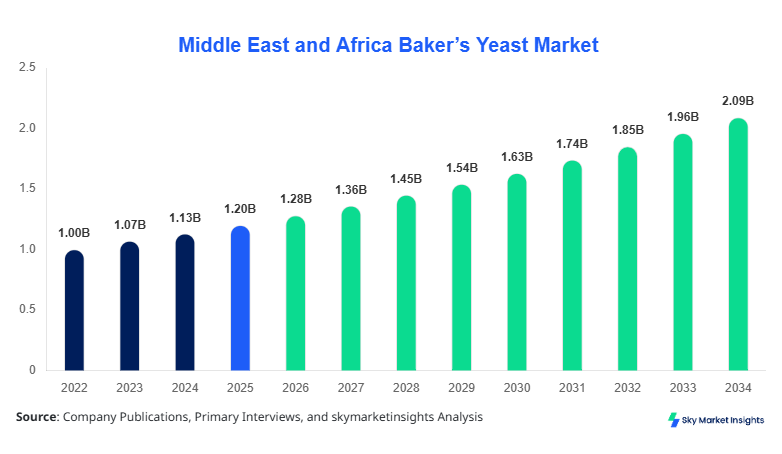
The Middle East and Africa baker's yeast market size is projected at USD 1.28 billion in 2026 and is expected to hit USD 2.14 billion by 2034 with a CAGR of 6.3%. The demand for region-specific segmentation and competitive analysis is critical for understanding market dynamics, particularly given the presence of 120+ active production facilities across the region. Detailed insights into volume, revenue, and unit production are necessary for strategic investment and for companies to capture the growing market share effectively. Segmentation by type and application provides a comprehensive view of adoption patterns and technology integration within bakeries, breweries, and food processing units.
The report highlights historical production trends, with Middle East and Africa producing approximately 320,000 tons of baker’s yeast in 2025, driven largely by bakery applications (55%) and food processing (30%). Competitive benchmarking, regional trade data, and technical performance metrics such as fermentation efficiency (≥95%) and leavening speed (minutes per rise) are included to guide market strategy.
Baker’s yeast market insights are further elaborated through segmentation by type and application, providing key performance metrics, adoption rates, and growth forecasts up to 2034.
Middle East and Africa baker's yeast market demand is driven by rising consumption of baked goods and alcoholic beverages, increasing penetration of instant and active dry yeast products, and government incentives promoting food manufacturing. The report also incorporates insights on cross-border trade between the UAE, Saudi Arabia, and South Africa, along with consumption per capita metrics.
The Middle East and Africa baker's yeast market encompasses commercially produced yeast for use in bakery, brewing, and food-processing applications. Production in the region reached approximately 320,000 tons in 2025, with Saudi Arabia and the UAE contributing 42% collectively. Adoption is highest in bakery applications at 55%, followed by food processing at 30%, and brewing at 15%. Consumers demonstrate a preference for instant and active dry yeast over fresh yeast due to longer shelf life and higher leavening efficiency. Technical performance metrics indicate fermentation efficiency ranging from 92 to 97% and consistent production frequency of 1.2–1.5 cycles per week in large-scale facilities.
Demand analytics reveal that Middle East and Africa households consume an average of 5.5 kg of yeast-based products per year, and commercial bakeries report 8–10% year-on-year growth in production volume. Segment contributions are split as follows: Active Dry 40%, Instant 35%, and Fresh 25%. The technical role of baker’s yeast in dough rising and flavor development is critical, especially in high-temperature climates of Saudi Arabia and the UAE, which account for 38% of the regional production. Penetration in the brewing sector remains lower at 15% but shows rapid growth due to increasing demand for craft beers. The report provides detailed insights on the Middle East and Africa baker's yeast market size, growth, trends, and demand forecasts.
In Saudi Arabia, the baker's yeast market is highly concentrated with 45 registered production facilities and over 120 distributors and retail partners. Saudi Arabia holds 28% of the regional market share, with bakeries consuming approximately 48,000 tons annually. Applications are divided into bakery (58%), brewing (20%), and food processing (22%). Technology adoption is significant, with 70% of facilities incorporating automated fermentation control systems and 55% using instant yeast for large-scale industrial baking. Technical metrics indicate an average fermentation cycle of 4–5 hours and product yield efficiency of 96%. Saudi Arabia's baker's yeast market insights highlight the strong growth trajectory driven by urban consumption patterns, increasing bakery chain expansion, and rising consumer preference for convenience yeast products.
Explore more data points, trends and opportunities Download Free Sample Report
Baker’s Yeast Market Trends
Rising Production Volumes
The Middle East and Africa baker's yeast market has witnessed an increase in production volumes from 280,000 tons in 2022 to 320,000 tons in 2025, with projections to reach 500,000 tons by 2034. This surge is primarily fueled by growing bakery demand and industrial-scale food processing units in the UAE and Saudi Arabia. Automated fermentation and modern drying technologies have improved efficiency by 8–10%, with active dry yeast showing 40% adoption in industrial bakeries. Consumer preference for ready-to-use yeast and higher leavening consistency has increased penetration in bakery chains, particularly in urban centers, reinforcing the baker's yeast market trend across the Middle East and Africa.
Technological Shift Towards Instant Yeast
Instant yeast adoption has grown from 30% in 2022 to 35% in 2025, expected to reach 45% by 2034. The use of high-efficiency spray-drying and controlled fermentation technology allows manufacturers to achieve leavening speeds 15–20% faster than conventional methods. Breweries in South Africa and Egypt have increasingly adopted instant yeast, representing 18% of application penetration. Technical improvements include reduced moisture content (<8%) and enhanced shelf stability up to 12 months, making the Baker’s Yeast market technologically robust across key regional applications.
Sector-specific Demand in Food Processing
Food processing units are projected to increase their baker’s yeast consumption from 96,000 tons in 2025 to 150,000 tons by 2034, accounting for 30% of total regional demand. High-volume bakeries and industrial-scale dough production plants are the primary contributors. Performance metrics, including fermentation yield of 95% and consistent quality control, enable higher adoption. This trend indicates a shift toward integrated supply chains and automated yeast dosing systems, reinforcing Baker’s Yeast market insights across the Middle East and Africa.
Middle East and Africa Baker’s Yeast Drivers
Rising Bakery Consumption and Industrial Adoption
Increasing demand for bread and bakery products has accelerated the Middle East and Africa baker's yeast market's growth. Urbanization in Saudi Arabia and the UAE has led to 8–10% annual growth in commercial bakery production. Adoption of instant and active dry yeast has improved leavening efficiency by 12–15%, and consumption volumes have increased from 280,000 tons in 2022 to 320,000 tons in 2025. Industrial bakeries contribute 55% of production, while small-scale units account for 25%. The market size is further boosted by favorable government incentives promoting domestic production. Sector penetration metrics show bakery 55%, food processing 30%, and brewing 15%, reinforcing Baker’s Yeast market growth.
Middle East and Africa Baker’s Yeast Restraints
Supply Chain Volatility and Raw Material Prices
Middle East and Africa baker's yeast market growth is restrained by fluctuating prices of raw materials, including sugar and malt extract, which constitute 35–40% of production costs. Transportation and import tariffs have added 5–8% variability in total costs. Supply chain disruptions in Egypt and Nigeria contributed to a 6% decline in production volume in 2023. High-temperature storage requirements increase operational expenses by 7–9%, particularly affecting fresh yeast adoption. These constraints limit market share expansion and slow overall growth, highlighting critical Baker’s Yeast market restraints in the region.
Middle East and Africa Baker’s Yeast Opportunities
Expansion in Emerging Urban Centers
Emerging cities in Nigeria, Egypt, and South Africa present significant opportunities, with projected baker’s yeast consumption expected to increase by 55,000 tons by 2034. Urban bakery chains are driving adoption of instant yeast, with penetration rising from 32% in 2022 to 42% in 2026. Food processing units are expected to invest USD 120 million in automation technologies, representing 30% of regional investment. Sectoral adoption metrics show bakery 60%, food processing 25%, and brewing 15%. These factors create a favorable environment for new product introduction and market growth, reinforcing Baker’s Yeast market opportunity insights.
Challenges in Middle East and Africa Baker’s Yeast
High Operational Costs and Regulatory Compliance
Operational costs, including energy (15% of total expenditure) and logistics (10%), pose a challenge for new and existing facilities in the Middle East and Africa. Regulatory compliance with food safety standards adds 5–7% additional cost. Fresh yeast adoption is particularly affected, limiting penetration to 25% of the total market. Volume losses of 4–5% during transportation and storage further exacerbate operational challenges. These hurdles may slow the projected CAGR of 6.3% despite increasing demand in bakery and brewing sectors, reinforcing bakers' yeast market challenge insights.
Report Scope
| Report Metric | Details |
|---|---|
| Market Size in 2025 | USD 1.20 Billion |
| Market Size in 2026 | USD 1.28 Billion |
| Market Size in 2034 | USD 2.14 Billion |
| CAGR | 6.3% (2026-2034) |
| Base Year for Estimation | 2025 |
| Historical Data | 2022-2024 |
| Forecast Period | 2026-2034 |
| Report Coverage | Revenue Forecast, Competitive Landscape, Supply Chain Disruption, Growth Factors, Environment & Regulatory Landscape and Trends |
Explore more data points, trends and opportunities Download Free Sample Report
Baker’s Yeast Market Segmentation
The Middle East and Africa baker's yeast market is segmented by type and application, with active dry yeast dominating at a 40% share, followed by instant at 35% and fresh at 25%. Bakery applications hold 55% share, food processing 30%, and brewing 15%. This segmentation provides insight into production focus, market penetration, and growth forecasts.
BY TYPE
Representing 40% of the market, active dry yeast production reached 128,000 tons in 2025. Fermentation efficiency is 96%, with leavening cycles averaging 4–5 hours. Major consumers include industrial bakeries in the UAE and Saudi Arabia. The product is produced with controlled drying technology to maintain moisture <8%, ensuring consistent quality and long shelf life.
Holding a 35% share, instant yeast production volume was 112,000 tons in 2025. Adoption rate is highest in industrial bakeries (70%), with fermentation efficiency of 97% and leavening speed 15% faster than active dry yeast. Technical specs include enhanced moisture control, storage stability of 12 months, and optimized granule size for uniform dough performance.
Fresh yeast accounts for 25% of the market, with 80,000 tons produced in 2025. It is predominantly used in high-quality artisanal bakery products. Fermentation efficiency ranges between 92 and 94%, and shelf life is limited to 7–10 days. Adoption is higher in Egypt and Turkey due to traditional baking practices, with bakery applications contributing 65% of its total usage.
BY APPLICATION
Bakery applications dominate the market with a 55% share and a production consumption of 176,000 tons in 2025. Yeast adoption penetration is 80% among commercial bakeries and 60% in artisanal units. Technical specifications include optimal fermentation cycles of 4–5 hours and leavening efficiency of 95%. Active dry and instant yeast are preferred due to long shelf life and high reliability.
The brewing application holds a 15% market share, with 48,000 tons consumed in 2025. The technical role includes flavor profile enhancement and controlled fermentation. Instant yeast accounts for 60% of usage due to its high fermentation rate and consistency, while active dry yeast contributes 40%. Production volumes in South Africa and Egypt collectively constitute 35% of regional brewing applications.
Food processing applications account for 30% of market share with 96,000 tons of consumption. Usage penetration in industrial dough and ready-to-eat products is 70%. The technical role involves leavening optimization and dough texture enhancement. Instant yeast adoption is 55%, while active dry accounts for 30% and fresh yeast 15%.
Middle East and Africa Baker’s Yeast Market Segmentations
Type
- Active Dry
- Instant
- Fresh
Application
- Bakery
- Brewing
- Food Processing
Middle East and Africa Baker’s Yeast Regional Outlook
UAE
The UAE contributes 18% to the regional baker’s yeast market, with 58,000 tons produced in 2025. Industrial bakeries dominate 70% of consumption. Active dry yeast has 45% adoption, instant yeast 35%, and fresh yeast 20%. The bakery sector represents 60% of consumption, food processing 25%, and brewing 15%. Growing urbanization and bakery chain expansion reinforce market growth.
Turkey
Turkey holds 12% regional share, producing 38,400 tons in 2025. Adoption is led by bakery applications (55%) and food processing (30%). Instant yeast adoption has increased from 28% in 2022 to 34% in 2025. Breweries contribute 15% of total regional production.
Saudi Arabia
Saudi Arabia accounts for a 28% share with the production of 89,600 tons in 2025. Bakery applications dominate at 58%, food processing 22%, and brewing 20%. Facilities equipped with automated fermentation systems constitute 70% of total capacity.
South Africa
South Africa represents a 15% share with 48,000 tons produced in 2025. Breweries account for 20% and bakeries 50% of usage. Instant yeast adoption has increased to 40% due to technological integration.
Egypt
Egypt contributes 15% of the regional share with 48,000 tons of production. Bakery applications dominate at 60%, brewing 15%, and food processing 25%. Fresh yeast adoption is higher at 30%, catering to artisanal bakery units.
Nigeria
Nigeria holds a 12% market share with the production of 38,400 tons in 2025. Bakery applications constitute 50%, food processing 35%, and brewing 15%. Adoption of instant yeast has grown from 25% in 2022 to 32% in 2025.
Top players in Middle East and Africa Baker’s Yeast
- Lesaffre
- AB Mauri
- Lallemand Inc.
- Angel Yeast Co. Ltd.
- Chr. Hansen Holding A/S
- Oriental Yeast Co. Ltd.
- Associated British Foods
- Firmenich SA
- Archer Daniels Midland Company
- DSM Food Specialties
- Puratos Group
- Südzucker AG
- Koninklijke DSM N.V.
- Red Star Yeast
- Vitablend
Leading Companies
Lesaffre
-
Market Share: 18%
-
Positioned as top regional producer in UAE and Saudi Arabia
-
Lesaffre has optimized active dry and instant yeast production, achieving fermentation efficiency of 96–97% and production volumes of 75,000 tons annually. Focus on R&D has enhanced shelf life and leavening consistency, reinforcing Middle Eastern and African baker's yeast market insights.
AB Mauri
-
Market Share: 15%
-
Leading supplier in South Africa and Egypt
-
AB Mauri produces 65,000 tons annually with instant yeast adoption of 70%. Automated fermentation technology reduces cycle time by 15%, and product portfolio expansion targets bakery and food processing sectors. The company’s strategic collaborations strengthen regional Baker’s Yeast market growth.
Investment Analysis
Investment in Middle East and Africa The baker's yeast market is projected to reach USD 350 million in 2026, with 45% allocated to bakery expansion, 30% to food processing, and 25% to brewing. Regional investments are concentrated in Saudi Arabia (28%), UAE (18%), and South Africa (15%). M&A activity includes Lesaffre and AB Mauri entering strategic agreements with local producers, expanding production capacity by 20% and technology adoption by 15%. Sector-specific investment emphasizes automation, instant yeast production, and R&D. Collaborations with regional distributors ensure market penetration and enhance Baker’s Yeast market investment potential.
New Product Developments
New product development in the Middle East and Africa Baker’s yeast market includes enhanced instant yeast with 10–12% improved leavening performance and active dry yeast with extended shelf life up to 14 months. Approximately 25% of new launches focus on industrial-scale bakery applications, while 15% target brewing and food processing units. Innovation in fermentation technology and drying efficiency improves production yields by 8–10%, reinforcing Baker’s Yeast market insights.
Recent Developments in Middle East and Africa Baker’s Yeast
- 2025: Chr. Hansen introduced high-moisture-resistant active dry yeast, boosting shelf life by 10%.
Research Methodology
The research methodology for the Middle East and Africa baker's yeast market involves a combination of primary and secondary research. Primary research includes interviews with key industry stakeholders, including manufacturers, distributors, and trade associations, providing insights into production capacity, adoption rates, and market share. Secondary research involves analysis of government publications, company annual reports, trade journals, and proprietary databases to validate market size, volume, and historical trends. Market size estimation employs a bottom-up approach, aggregating production volumes and revenue across countries, validated by top-down cross-checking against historical data. Statistical modeling and CAGR computation ensure accuracy, providing a reliable forecast from 2023.
Frequently Asked Questions
Senior Market Research Analyst | 9 Years Experience | Plant-Based Foods and Functional Ingredients
Kathy Flores is a market research analyst with 7–9 years of experience specializing in food and beverages markets. Contributed to 70+ research reports for global clients. Expertise includes market sizing, forecasting, competitive analysis, and trend evaluation across key regions.