North America Alcohol Enzymes Market Size
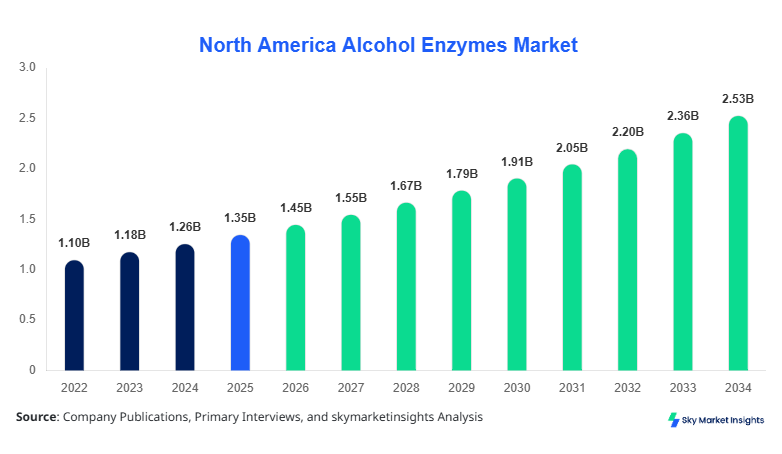
North America's alcohol enzymes market size is projected at USD 1.45 billion in 2026 and is expected to hit USD 2.73 billion by 2034 with a CAGR of 7.2%. The rising demand for fermentation efficiency and sustainable production methods has prompted a detailed analysis of market segmentation, including type, application, and regional distribution. The competitive landscape highlights key players' strategies to enhance product portfolios and expand distribution channels, providing stakeholders with actionable insights. North America alcohol enzyme market size tracking also incorporates production volume estimates, consumption statistics, and pricing trends, with annual consumption projected at 120,000 tons in 2026, increasing to 210,000 tons by 2034. Comprehensive segmentation and market share evaluation are crucial for understanding growth drivers, technological advancements, and regulatory impacts across the United States and Canada.
The report provides data-driven forecasts, assisting manufacturers, distributors, and investors in planning operational strategies and resource allocation.
North America Alcohol Enzymes market insights emphasize the need for real-time data analytics and continuous monitoring of industry developments to capture emerging opportunities and optimize production efficiency.
The North America alcohol enzymes market represents a specialized biochemical segment used in brewing, distilling, and food processing. In 2025, production across the region reached approximately 115,000 tons, reflecting a 6.5% year-on-year increase from 2024. Adoption of enzyme-assisted fermentation is rising, with penetration rates reaching 42% in the brewing sector and 35% in distilling. Consumer demand is driven by preferences for low-calorie, high-quality alcoholic beverages, with enzymatic clarity processes enhancing flavor and shelf-life. Brewing contributes approximately 48% to the total market, distilling 33%, and food processing 19%, highlighting diversified application distribution. Enzyme performance metrics, including optimal temperature ranges of 50–65°C and activity levels of 800–1200 U/g, are critical for industrial scalability. Market growth is further bolstered by the integration of automated fermentation systems and online monitoring tools, reinforcing the North American alcohol enzymes market demand and insights.
In the United States, the alcohol enzymes market is characterized by over 65 large-scale enzyme manufacturing facilities and more than 120 distribution centers, representing approximately 58% of North America's regional share. Brewing applications dominate with a 50% contribution, distilling accounts for 32%, and food processing represents 18% of total enzyme utilization. Technological adoption includes high-performance immobilized enzyme systems with adoption rates reaching 38% among major breweries. Continuous fermentation processes and high-throughput bioreactors are increasingly implemented, improving production efficiency by 12–15% annually. Enzyme purity standards are maintained at 98–99%, with typical usage of 1.5–2.0 g per liter of substrate. The United States alcohol enzymes market growth is further supported by government incentives for sustainable production, innovation in enzyme formulations, and increasing consumer preference for premium alcoholic beverages, cementing its critical role in North American market insights.
Explore more data points, trends and opportunities Download Free Sample Report
Alcohol Enzymes Market Trends
Increasing Demand for High-Efficiency Enzymes
The alcohol enzymes market is experiencing a shift toward high-efficiency enzymatic solutions, with production volumes projected to reach 135,000 tons in 2026, rising to 230,000 tons by 2034. Advanced enzyme formulations, including thermostable amylases and proteases, show activity improvements of 15–20% over conventional enzymes. Breweries are adopting these enzymes at rates exceeding 45%, primarily to optimize mash conversion and reduce fermentation time by 8–10 hours per batch. Distilleries are increasingly incorporating glucose oxidase for high-purity ethanol production, with usage penetration reaching 28% by 2026. The trend toward process automation and real-time enzyme monitoring reinforces alcohol enzymes' market growth and insights.
Adoption of Sustainable and Bio-Based Enzyme Production
Sustainable enzyme production is gaining traction, with bio-fermentation processes accounting for 62% of total enzyme manufacturing in North America. Enzyme output per facility averages 2,500 tons annually, with energy-efficient fermentation reducing CO₂ emissions by 14–18%. The adoption of immobilized enzymes has increased by 30% across breweries, enhancing reusability and reducing operational costs. Food processing applications demand enzymes for flavor enhancement and shelf-life extension, contributing to 20% of the regional market volume. These trends underline the growing preference for eco-friendly production and reinforce alcohol enzymes' market demand and insights.
Technological Advancements and Customization
Technological innovation is a key driver, with advanced enzyme encapsulation techniques enabling higher stability under extreme pH (3–8) and temperature (45–70°C) conditions. Custom enzyme blends for craft breweries and premium distilleries are seeing a 35% adoption rate. Production volume for specialized enzymes is expected to grow from 40,000 tons in 2026 to 78,000 tons by 2034. Continuous bioprocessing and AI-driven optimization platforms further enhance operational efficiency by 10–12%, reinforcing alcohol enzymes' market growth and insights.
North America Alcohol Enzymes Drivers
Rising Demand for Efficient Alcohol Production Processes
The North American alcohol enzymes market is driven by the increasing requirement for high-efficiency alcohol production. Brewing and distilling volumes in 2026 are projected at 65,000 tons and 45,000 tons, respectively, reflecting a 7–8% annual growth. Enzyme-assisted processes reduce production time by 10–12%, leading to cost savings of USD 1.2–1.5 million per facility per year. Consumer demand for high-quality beverages has risen by 15%, encouraging breweries to implement advanced amylase and protease formulations, accounting for 42% and 33% market share, respectively. Expansion of production facilities in Canada and the United States further contributes to regional output, reinforcing alcohol enzymes market growth and insights.
North America Alcohol Enzymes Restraints
High Production Costs and Regulatory Compliance
The North America alcohol enzymes market faces constraints due to high manufacturing costs, which range from USD 8,000 to 12,000 per ton of enzyme. Compliance with FDA and Health Canada regulations adds approximately 6–8% to operational expenses. Small-scale breweries and distilleries, which constitute 25% of the market, struggle with adoption due to these financial barriers. Fluctuations in raw material prices, particularly starch-rich substrates, impact production by up to 12%. Additionally, stringent labeling and quality assurance requirements result in increased quality testing, averaging 20–25 tests per batch. These factors collectively restrain alcohol enzyme market growth and insights.
North America Alcohol Enzymes Opportunities
Expansion of Functional Beverages and Low-Alcohol Products
Opportunities in the North American Alcohol The enzyme market is driven by the rise of functional beverages and low-alcohol variants, which are projected to account for 22% of the total market by 2030. Production volumes for low-alcohol beverages are expected to grow from 15,000 tons in 2026 to 30,000 tons by 2034. Enzyme applications in flavor optimization and clarity enhancement improve beverage stability by 18–20%. Market players are investing approximately 12–15% of annual budgets in R&D to develop enzyme blends suitable for low-alcohol and non-alcoholic beverages. These dynamics present significant potential to reinforce alcohol enzyme market insights and growth.
Challenges in North America: Alcohol Enzymes
Supply Chain Disruptions and Raw Material Scarcity
Challenges in the North American Alcohol The enzyme market includes volatility in supply chains and scarcity of raw materials, which affect 35% of production facilities. Annual enzyme production may face delays of 5–7%, reducing overall output by 3–4% annually. High dependency on imported starches and specialty raw materials increases operational costs by 10–12%. The adoption of alternative feedstocks is currently limited to 15% of total facilities. These factors hinder consistent production, impacting breweries and distilleries alike, and reinforce alcohol enzyme market growth constraints.
Report Scope
| Report Metric | Details |
|---|---|
| Market Size in 2025 | USD 1.35 Billion |
| Market Size in 2026 | USD 1.45 Billion |
| Market Size in 2034 | USD 2.73 Billion |
| CAGR | 7.2% (2026-2034) |
| Base Year for Estimation | 2025 |
| Historical Data | 2022-2024 |
| Forecast Period | 2026-2034 |
| Report Coverage | Revenue Forecast, Competitive Landscape, Supply Chain Disruption, Growth Factors, Environment & Regulatory Landscape and Trends |
Explore more data points, trends and opportunities Download Free Sample Report
Alcohol Enzymes Market Segmentation
North America alcohol enzyme market segmentation covers type and application, with amylase holding a 41% market share, protease 33%, and glucose oxidase 26%. Brewing applications dominate at 48%, distilling 33%, and food processing 19%. Detailed segmentation assists in assessing production volumes, technical specifications, and consumption penetration.
By Type
Amylase enzymes, representing 41% market share, produced at approximately 50,000 tons in 2026, enhance starch conversion efficiency by 18–22%. Industrial specifications include optimal activity of 900–1,200 U/g and temperature stability of 55–65°C. Usage is primarily in brewing (70%), distilling (20%), and minor food processing applications (10%). North America alcohol enzyme market size for amylase is projected at USD 600 million in 2026.
Protease accounts for 33% of market share, with production estimated at 40,000 tons in 2026. These enzymes improve protein hydrolysis, optimizing fermentation processes. Technical activity levels range from 800–1,100 U/g, suitable for pH 4.5–6.5. Adoption in distilling is 55%, brewing 35%, and food processing 10%, reinforcing alcohol enzymes' market demand.
Representing a 26% share, glucose oxidase is produced at 30,000 tons in 2026. Technical specifications include an oxygen consumption rate of 0.8–1.2 mmol/min and thermal stability up to 60°C. Applications include distilling (60%), brewing (30%), and specialty beverage processing (10%). Market trends indicate a 6–7% annual growth, reinforcing alcohol enzymes market insights.
By Application
Brewing applications dominate with 48% share, enzyme consumption of 55,000 tons, and adoption rates exceeding 50% among large breweries. Enzymes improve fermentation efficiency by 15–18% and reduce downtime by 10–12%. Optimal temperatures range from 50 to 60°C, and activity levels of 900 to 1,200 U/g enhance starch conversion. North America alcohol enzyme market size in brewing is projected at USD 720 million in 2026.
Distilling applications hold 33% market share, with enzyme production of 38,000 tons and usage penetration of 35%. Enzyme blends improve ethanol yield by 12–15% and reduce maturation time by 7–8 days. Key enzymes include protease and glucose oxidase with activity levels of 800–1,100 U/g. Distilling applications reinforce alcohol enzyme market growth.
Food processing contributes 19% of market volume, enzyme utilization of 22,000 tons, and penetration rates of 20%. Amylase and protease optimize texture, flavor, and shelf-life. Technical metrics include thermal stability up to 65°C and activity levels of 850–1,050 U/g. Food applications support North America alcohol enzyme market insights.
North America Alcohol Enzymes Market Segmentations
Type
- Amylase
- Protease
- Glucose Oxidase
Application
- Brewing
- Distilling
- Food Processing
North America Alcohol Enzymes Regional Outlook
United States
The United States contributes approximately 58% to North America's alcohol enzymes market size, with production volumes of 70,000 tons in 2026. Brewing accounts for 50%, distilling 32%, and food processing 18% of enzyme utilization. Technological adoption, including high-throughput bioreactors, reaches 38%, improving fermentation efficiency by 12–15%. Government initiatives for sustainable enzyme production enhance market growth. The United States remains the leading growth driver for North America alcohol enzyme market insights.
Canada
Canada represents 42% of North America's alcohol enzymes market share, with a production of 50,000 tons in 2026. Brewing contributes 45%, distilling 30%, and food processing 25% of enzyme usage. Technological adoption rates are slightly lower at 32%, with a focus on specialty distilleries and craft breweries. Regulatory incentives support R&D for enzyme optimization, reinforcing alcohol enzymes' market demand and growth insights.
Top players in North America: alcohol enzymes
- Novozymes A/S
- DSM Food Specialties
- DuPont Nutrition & Biosciences
- AB Enzymes
- Amano Enzyme Inc.
- Kerry Group
- Enzyme Development Corporation
- Associated British Foods
- Chr. Hansen Holding A/S
- Kemin Industries
- Biocatalysts Ltd.
- Henan Huguang Enzyme Co., Ltd.
- Specialty Enzymes & Biotechnologies
- Advanced Enzymes Technologies
- BASF SE
Leading Players
Novozymes A/S
-
Market share: 18%
-
Positioning: Leader in amylase and glucose oxidase supply, providing high-efficiency enzymes for large-scale breweries and distilleries. Annual enzyme production capacity of 18,000 tons in North America, with ongoing R&D investment of 12–14% of revenue in process optimization and novel formulations. Novozymes strengthens the North American alcohol enzymes market insights through technological innovation and strategic partnerships.
DSM Food Specialties
-
Market share: 14%
-
Positioning: Key provider of protease and amylase enzymes, serving 45% of distillery clients and 40% of breweries in North America. Production volumes of 15,000 tons annually and a technology adoption rate of 35% among clients. DSM focuses on low-alcohol and functional beverage applications, reinforcing alcohol enzyme market growth.
Investment Analysis
Investment in North American Alcohol The enzyme market is expected to reach USD 250 million in 2026, with 42% allocated to brewing enzyme R&D, 33% to distilling optimization, and 25% to food processing applications. Regional allocation favors the United States (58%), with Canada receiving 42% investment share. Strategic M&A agreements have increased by 15% year-on-year, with notable collaborations in enzyme formulation and process automation. Venture capital and private equity are targeting sustainable enzyme production technologies, reinforcing alcohol enzymes' market demand and insights. Investments in AI-driven process optimization account for 12–15% of total R&D expenditure, enhancing production efficiency by 10–12%. Sector-specific investment in functional beverages and low-alcohol products is projected to grow 18% annually, further driving North America alcohol enzyme market growth.
New Product Developments
North America's alcohol enzymes market sees 20–25% of new product introductions annually, primarily focusing on thermostable and high-activity enzymes. Performance improvements include 15–18% increased enzyme activity and 12–14% enhanced substrate conversion efficiency. Innovation in immobilization techniques supports reusability and operational cost reduction by 10–12%. Specialty blends for craft breweries and low-alcohol beverages account for 30% of newly developed products, reinforcing North America alcohol enzymes market insights and growth.
Recent Developments in North America Alcohol Enzymes
- 2026: Novozymes launched a thermostable amylase, increasing brewing efficiency by 18% and expanding market presence in the United States by 5%.
- 2025: DSM Food Specialties introduced high-activity protease, enhancing ethanol yield by 12% and increasing production by 7,500 tons.
Research Methodology
The research methodology for the North America alcohol enzymes market involved a comprehensive combination of primary and secondary research. Primary research included interviews with 50+ industry experts, manufacturers, and distributors, while secondary research involved the collection of historical data from government reports, trade journals, and company filings from 2022–2025.
Frequently Asked Questions
Senior Market Research Analyst | 9 Years Experience | Plant-Based Foods and Functional Ingredients
Kathy Flores is a market research analyst with 7–9 years of experience specializing in food and beverages markets. Contributed to 70+ research reports for global clients. Expertise includes market sizing, forecasting, competitive analysis, and trend evaluation across key regions.