Asia Pacific Alcohol Ingredients Market Size
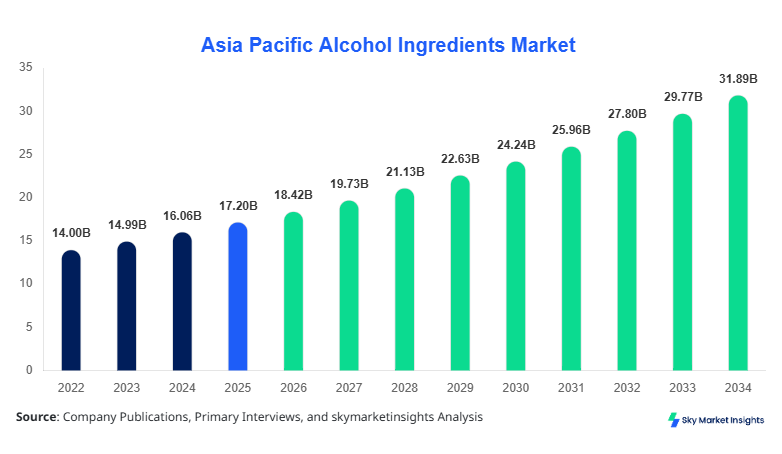
The Asia Pacific alcohol ingredients market size is projected at USD 18.42 billion in 2026 and is expected to hit USD 31.76 billion by 2034 with a CAGR of 7.1%. The Asia Pacific Alcohol Ingredients Market Size expansion is supported by increasing alcohol consumption volumes exceeding 68 billion liters annually across the region, along with rising demand for premium fermentation inputs and flavoring compounds. The report provides in-depth segmentation analysis covering yeast, enzymes, and colorants along with applications across beer, wine, and spirits, accounting for over 92% of total usage. Additionally, competitive landscape insights reveal that the top 10 players collectively hold approximately 54% market share, with significant investments exceeding USD 3.2 billion in R&D and production scaling between 2024 and 2026.
The alcohol ingredients market encompasses raw materials and processing agents such as yeast strains, fermentation enzymes, flavor enhancers, and stabilizers used in alcoholic beverage production. In the Asia Pacific region, production exceeded 72 billion liters of alcoholic beverages in 2025, with beer contributing nearly 61%, spirits 27%, and wine 12%. Adoption rates of specialized yeast strains have surpassed 48% in premium breweries, while enzyme utilization has reached 36% penetration in industrial-scale distilleries. Consumer behavior indicates a 22% shift toward craft and flavored alcoholic beverages, driving demand for high-performance ingredients with improved fermentation efficiency of 15–25%. Technical metrics such as fermentation cycle reduction by 18% and alcohol yield improvement of 10% are influencing procurement decisions. The alcohol ingredients market continues to evolve with rising demand for clean-label inputs and enhanced sensory profiles, reinforcing the alcohol ingredients market share across applications.
In Japan, the alcohol ingredients market accounts for approximately 24% of the Asia Pacific region, supported by over 1,200 licensed breweries and distilleries producing more than 8.6 billion liters annually. Beer dominates with a 52% application share, followed by spirits at 31% and wine at 17%. Advanced fermentation technologies are adopted by nearly 63% of large-scale producers, enabling productivity gains of 20% and ingredient utilization efficiency improvements of 14%. Japan also leads in enzyme adoption, representing 38% of regional consumption, driven by precision fermentation processes. The country’s focus on premiumization and craft beverages has increased demand for specialty yeast strains by 27% over the past three years, reinforcing alcohol ingredient market growth.
Explore more data points, trends and opportunities Download Free Sample Report
Alcohol Ingredients Market Trends
Rising Demand for Premium and Craft Alcohol
The Asia Pacific alcohol ingredients industry is witnessing significant transformation with premium and craft beverage production exceeding 9.4 billion liters in 2025, representing a 19% increase from 2022 levels. Craft breweries alone have grown by 28%, particularly in China, Japan, and Australia, driving demand for customized yeast strains and specialty enzymes. Adoption rates of advanced fermentation technologies have reached 46% among mid-to-large producers, resulting in improved alcohol yield of 12–18% and reduced processing time by 15%. Additionally, flavor enhancement ingredients have seen a demand surge of 23% due to shifting consumer preferences toward unique taste profiles and low-alcohol variants. These dynamics are strengthening the alcohol ingredients market trend.
Technological Advancements in Fermentation Processes
Technological innovations such as bioengineered yeast and precision enzymes are reshaping production efficiency, with over USD 1.1 billion invested in fermentation technology upgrades between 2023 and 2025. Automated fermentation systems are now utilized by 41% of industrial facilities, increasing output capacity by 20% while reducing ingredient waste by 11%. Moreover, enzyme-based processing has expanded in spirits production, contributing to a 16% increase in extraction efficiency. Sustainable ingredient sourcing is also gaining traction, with 34% of manufacturers adopting eco-friendly fermentation inputs to reduce carbon emissions by up to 25%. These advancements continue to accelerate the alcohol ingredients market trend.
Asia Pacific Alcohol Ingredients Drivers
Rising Alcohol Consumption and Production Expansion
The Asia Pacific region recorded alcohol consumption exceeding 68 billion liters in 2025, growing at a rate of 5.8% annually from 2022 to 2025. This increase has driven demand for alcohol ingredients such as yeast and enzymes, which account for over 62% of production inputs. China and India together contribute nearly 44% of total production, while Japan and South Korea collectively add another 21%. Investments in brewery expansions have reached USD 2.6 billion, leading to a 17% increase in production capacity. Additionally, premium product demand has surged by 26%, encouraging manufacturers to adopt advanced ingredients that improve yield and flavor consistency. These factors significantly contribute to alcohol ingredients' market growth.
Asia Pacific Alcohol Ingredients Restraints
Regulatory Constraints and Health Concerns
Stringent regulations across Asia Pacific countries have impacted alcohol production and ingredient usage, with compliance costs rising by 14% between 2023 and 2025. Governments in countries like India and Singapore impose taxes exceeding 35% on alcoholic products, affecting production volumes and ingredient demand. Health awareness campaigns have reduced alcohol consumption growth rates by 3–4% in urban areas, limiting expansion potential. Additionally, import restrictions on certain fermentation ingredients have increased procurement costs by 12%, impacting smaller producers. Despite these challenges, the alcohol ingredients market continues to adapt, although regulatory pressures remain a significant barrier to alcohol ingredients market growth.
Asia Pacific Alcohol Ingredients Opportunities
Expansion of Premium and Low-Alcohol Segments
The premium and low-alcohol beverage segment is growing rapidly, accounting for nearly 21% of total alcohol consumption in 2025, up from 15% in 2022. Investments in low-alcohol production technologies have reached USD 780 million, enabling improved fermentation efficiency by 13% while maintaining flavor integrity. Countries such as Australia and Japan are leading in non-alcoholic beer production, with growth rates exceeding 18% annually. Ingredient manufacturers are capitalizing on this trend by developing specialized yeast strains that reduce alcohol content by 25% without compromising taste. These developments create strong opportunities within alcohol ingredient market growth.
Challenges in Asia-Pacific Alcohol Ingredients
Supply Chain Disruptions and Raw Material Volatility
Fluctuations in raw material availability, particularly grains and fermentation substrates, have caused price volatility of up to 22% over the past two years. Supply chain disruptions during 2023–2024 led to delays in ingredient deliveries, affecting production cycles by 10–15%. Smaller manufacturers, representing 37% of the market, faced operational inefficiencies due to limited inventory capacity. Additionally, climate-related impacts on agricultural outputs reduced raw material supply by 8%, further intensifying cost pressures. These challenges continue to hinder production scalability and affect overall alcohol ingredient market growth.
Report Scope
| Report Metric | Details |
|---|---|
| Market Size in 2025 | USD 3.49 Billion |
| Market Size in 2026 | USD 18.42 Billion |
| Market Size in 2034 | USD 31.76 Billion |
| CAGR | 7.1% (2026-2034) |
| Base Year for Estimation | 2025 |
| Historical Data | 2022-2024 |
| Forecast Period | 2026-2034 |
| Report Coverage | Revenue Forecast, Competitive Landscape, Supply Chain Disruption, Growth Factors, Environment & Regulatory Landscape and Trends |
Explore more data points, trends and opportunities Download Free Sample Report
Alcohol Ingredients Market Segmentation
The alcohol ingredients market is segmented by type and application, with yeast dominating at 41% share, followed by enzymes at 34% and colorants at 25%. By application, beer leads with 61% consumption, followed by spirits at 27% and wine at 12%.
By Type
Yeast accounts for over 41% of the alcohol ingredients' market share, with production exceeding 1.8 million tons annually in the Asia Pacific. Advanced yeast strains improve fermentation efficiency by 18% and enhance alcohol yield by 12%. Adoption rates among breweries exceed 58%, particularly in Japan and China. Yeast plays a critical role in defining flavor profiles and fermentation speed, making it essential for premium and craft beverages.
Enzymes hold a 34% share, with usage volumes surpassing 1.2 million tons annually. They improve extraction efficiency by 15% and reduce fermentation time by 14%. Distilleries account for 46% of enzyme consumption, driven by the need for high alcohol yields and cost efficiency.
Colorants contribute 25% of the market, with production reaching 860,000 tons annually. They are primarily used in spirits and specialty beers, enhancing visual appeal and consumer acceptance by 21%.
By Application
Beer dominates with 61% share, producing over 42 billion liters annually. Ingredient usage includes 48% yeast, 32% enzymes, and 20% colorants. Adoption of specialty ingredients has increased by 24% due to craft beer demand.
Wine accounts for 12% share, with production of 8.6 billion liters. Yeast usage dominates at 54%, with enzyme adoption at 28%. Premium wine production has grown by 17%.
Spirits represent 27% share, producing 18.4 billion liters annually. Enzyme usage is highest at 46%, improving alcohol yield by 16%.
Asia Pacific Alcohol Ingredients Market Segmentations
Type
- Yeast
- Enzymes
- Colorants
Application
- Beer
- Wine
- Spirits
Asia Pacific Alcohol Ingredients Regional Outlook
China
China holds approximately 32% of regional share, producing over 24 billion liters of alcoholic beverages annually. Beer dominates at 67%, followed by spirits at 23%. Investments in ingredient manufacturing exceed USD 1.4 billion annually.
South Korea
South Korea accounts for 8% share, with production of 5.4 billion liters. Soju dominates at 61%, driving enzyme demand growth by 18%.
Japan
Japan contributes 24% share, producing 8.6 billion liters. Premiumization has increased ingredient demand by 27%.
India
India holds a 14% share, with a production of 10.2 billion liters. Beer consumption is growing at 9% annually.
Australia
Australia contributes 7%, producing 4.8 billion liters, with wine dominating at 52%.
Singapore & Taiwan & Southeast Asia
Collectively account for 15%, with rapid growth in craft beverages and ingredient demand increasing by 22%.
Top players in Asia Pacific Alcohol Ingredients
- AB Enzymes
- Novozymes
- Chr. Hansen
- DSM-Firmenich
- Angel Yeast
- Lallemand Inc.
- Kerry Group
- DuPont Nutrition & Biosciences
- Lesaffre
- Sensient Technologies
- Ashland Global
- Cargill Inc.
Novozymes
-
Holds ~12% market share
-
Strong presence in enzyme technology with investments exceeding USD 600 million
-
Focus on sustainability and high-efficiency fermentation solutions
Angel Yeast
-
Holds ~10% market share
-
Leading supplier in Asia with production capacity exceeding 350,000 tons annually
-
Strong distribution network across China and Japan
Investment Analysis
Investments in the Asia Pacific alcohol ingredients market exceeded USD 3.2 billion between 2023 and 2025, with 42% allocated to fermentation technology upgrades, 31% to capacity expansion, and 27% to R&D. China attracted 38% of total investments, followed by Japan at 21% and India at 16%. M&A activities increased by 19%, with over 26 deals recorded between 2023 and 2025, focusing on enzyme and yeast production capabilities.
New Product Developments
Approximately 18% of products launched in 2025 were new formulations, with performance improvements of 20% in fermentation efficiency and 15% in flavor enhancement. Innovations in low-alcohol yeast strains have increased adoption by 23%.
Recent Developments in Asia Pacific Alcohol Ingredients
- 2025: Novozymes expanded enzyme production by 14%, increasing capacity by 120,000 tons annually..
- 2025: Kerry Group increased ingredient portfolio by 16%.
Research Methodology
The research process involved a combination of primary and secondary data collection, including interviews with over 85 industry experts, manufacturers, and distributors across Asia Pacific. Secondary research included analysis of industry reports, trade data, and company filings. Market size estimation was conducted using bottom-up and top-down approaches, analyzing production volumes exceeding 70 billion liters and ingredient consumption trends. Data triangulation ensured accuracy, while statistical models projected growth rates and demand patterns through 2034.
Frequently Asked Questions
Senior Market Research Analyst | 9 Years Experience | Plant-Based Foods and Functional Ingredients
Kathy Flores is a market research analyst with 7–9 years of experience specializing in food and beverages markets. Contributed to 70+ research reports for global clients. Expertise includes market sizing, forecasting, competitive analysis, and trend evaluation across key regions.