Europe Alcohol Enzymes Market Size
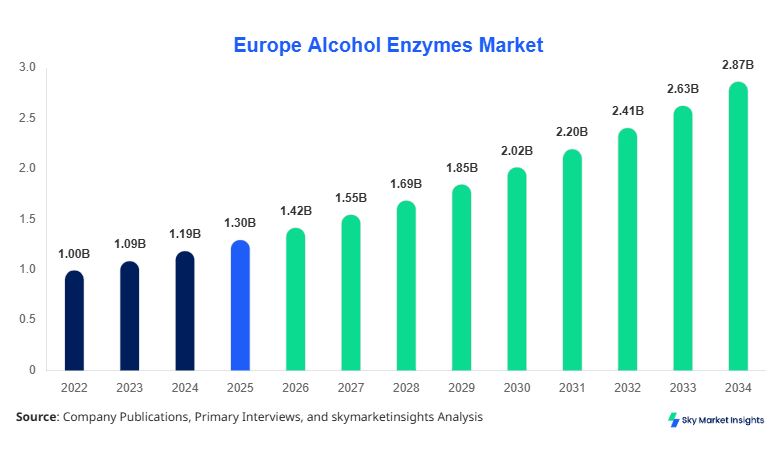
Europe's alcohol enzyme market size is projected at USD 1.42 billion in 2026 and is expected to hit USD 2.87 billion by 2034 with a CAGR of 9.2%. The market expansion is being driven by rising industrial alcohol production, increasing enzyme-assisted fermentation adoption, and higher efficiency requirements across breweries and distilleries throughout Europe. Growing utilization of specialty enzymes in starch conversion, fermentation acceleration, and flavor optimization is reshaping production economics across commercial alcohol manufacturing facilities.
The European alcohol enzymes market is witnessing substantial demand from brewing, wine processing, and distilled spirit manufacturers due to increasing production volumes exceeding 41.8 billion liters annually across the region. The report evaluates market segmentation, production technologies, application penetration, pricing structures, regulatory compliance, and the competitive landscape among leading biotechnology and industrial enzyme suppliers operating within the European alcohol processing ecosystem.
The alcohol enzymes market comprises industrial enzymes used during alcohol fermentation and beverage processing to enhance starch hydrolysis, sugar conversion, fermentation yield, flavor consistency, and filtration efficiency. Alcohol enzymes such as amylases, glucanases, proteases, and lipases are increasingly integrated into automated alcohol production systems across Europe. European alcohol manufacturing facilities processed more than 118 million metric tons of grain and sugar feedstock during 2025, while enzyme-assisted fermentation penetration reached 71.4% among large-scale beverage processors. Brewing applications accounted for nearly 46% of total enzyme consumption volume, followed by wine production at 29% and distilled spirits at 25%.
Consumer behavior patterns indicate increasing preference for premium alcoholic beverages, craft beer formulations, low-calorie spirits, and flavor-stabilized wine products. More than 63% of European breweries adopted advanced fermentation enzyme systems during 2025 to improve alcohol yield efficiency by 12%–18%. Commercial distilleries reduced fermentation cycle times by nearly 21 hours through optimized enzyme blends, while wineries achieved turbidity reductions of 28% using pectinase-based processing systems. France, Germany, and the United Kingdom collectively represented over 58% of regional alcohol and enzyme consumption. Rising investments in bio-based fermentation technologies, sustainability-focused brewing processes, and higher ethanol extraction efficiency continue strengthening Europe's alcohol enzymes market expansion.
In France, the alcohol enzymes market accounted for nearly 24.8% of the total European revenue share during 2025 owing to the country’s dominant wine production ecosystem and growing premium spirits manufacturing capacity. France operated more than 4,600 industrial wineries, 380 commercial distilleries, and approximately 2,100 brewing facilities utilizing enzyme-assisted fermentation technologies. Wine production applications represented 48% of alcohol enzyme demand within the country, followed by brewing at 31% and distilled spirits at 21%. Advanced enzyme utilization in Bordeaux and Burgundy wine-processing facilities increased by 19% during 2025 due to growing exports of clarified premium wines.
France also witnessed substantial adoption of automated fermentation control systems integrated with protease and amylase enzyme solutions. Nearly 74% of large-scale alcohol manufacturers in France implemented enzyme optimization systems capable of reducing sugar conversion losses by 13%–17%. Commercial breweries achieved filtration efficiency improvements of 26% through enzyme-supported mash processing, while spirit distilleries improved ethanol yield output by nearly 9.4%. Increasing production of craft alcoholic beverages, premium cognac exports, and organic wine formulations continues to reinforce Europe's alcohol enzymes market expansion.
Explore more data points, trends and opportunities Download Free Sample Report
Alcohol Enzymes Market Trends
Rising Adoption of Precision Fermentation Technologies
The European alcohol processing industry is increasingly adopting precision fermentation technologies integrated with multifunctional enzyme blends to improve fermentation consistency, product stability, and production scalability. During 2025, more than 68% of industrial breweries across Europe integrated automated enzyme dosing systems, compared with 51% in 2022. Industrial alcohol production volumes exceeded 41.8 billion liters in Europe, while enzyme-assisted fermentation throughput surpassed 29 billion liters. Advanced amylase formulations improved starch hydrolysis efficiency by 22%, while glucanase-based clarification systems reduced filtration time by nearly 31%. Germany, France, and the United Kingdom collectively invested more than USD 340 million in enzyme-assisted beverage processing technologies during 2025. Increased adoption of AI-monitored fermentation systems and temperature-stable enzyme formulations continues accelerating alcohol enzymes' market expansion.
Growing Demand for Sustainable Brewing and Bio-Optimized Alcohol Production
Sustainability-focused brewing operations are becoming a major trend across the European alcohol manufacturing ecosystem. More than 57% of breweries and distilleries across Europe introduced enzyme-assisted low-energy fermentation processes during 2025 to reduce water consumption and carbon emissions. Enzyme-enabled brewing systems lowered energy utilization by approximately 16% and reduced processing waste generation by 24%. Commercial beer manufacturers processed nearly 392 million hectoliters of beer using enzyme-optimized mash conversion systems. Lipase and protease enzymes increasingly gained traction in flavor enhancement and foam stabilization applications, particularly among premium beer producers. Organic wine manufacturers across France and Italy reported 18% growth in enzyme-supported clarification methods to reduce chemical additive dependence. Continuous investment in eco-efficient fermentation solutions is strengthening the alcohol enzymes market penetration across Europe.
Expansion of Craft Alcohol Production Facilities
Craft beer and specialty spirit production facilities are significantly contributing to rising enzyme demand across Europe. More than 11,300 craft breweries operated across the region during 2025, representing a 14% increase from 2022 levels. Small and medium breweries increasingly adopted enzyme formulations to improve batch consistency and reduce fermentation variability. Specialty spirit producers reported fermentation yield improvements of 11%–15% after integrating customized enzyme systems. Wine producers processing premium grape varieties also increased utilization of pectinases and cellulases to improve juice extraction efficiency by nearly 18%. Growing premiumization trends, flavored alcoholic beverage launches, and low-alcohol product innovation continue boosting the alcohol enzymes market adoption.
Europe Alcohol Enzymes Drivers
Increasing Industrial Alcohol Production and Brewing Automation
The rapid expansion of industrial alcohol manufacturing capacity across Europe is significantly driving demand for advanced enzyme solutions. European alcohol production volumes increased by 12.6% between 2022 and 2025, supported by rising consumption of premium beer, wine, and distilled spirits. More than 71% of large-scale breweries implemented automated fermentation systems integrated with industrial enzymes to improve throughput and reduce operational losses. Enzyme-supported brewing technologies reduced fermentation cycle times by 14%–19% while increasing alcohol extraction efficiency by approximately 11%. Commercial distilleries utilizing advanced amylase and protease blends processed more than 9.6 billion liters of spirits during 2025. France, Germany, and Spain collectively accounted for over 61% of total automated brewing investments across Europe. Furthermore, demand for low-calorie beer formulations and premium flavored alcoholic beverages is increasing adoption of specialty enzyme solutions for flavor optimization and starch conversion efficiency. Growing investments in industrial biotechnology, fermentation automation, and process optimization are accelerating Europe's alcohol enzymes market development.
Europe Alcohol Enzymes Restraints
High Enzyme Production Costs and Regulatory Compliance Burden
Despite growing adoption, high production costs associated with specialty alcohol enzymes continue restraining market expansion across Europe. Industrial enzyme manufacturing requires advanced microbial fermentation infrastructure, temperature-controlled processing facilities, and high-purity stabilization systems, increasing production expenditures by nearly 22% compared with conventional processing aids. Commercial breweries operating on limited production margins face challenges in adopting premium enzyme formulations due to higher procurement costs. Regulatory compliance under European food safety and biotechnology standards also increases operational complexity for manufacturers. More than 38% of small breweries reported delays in enzyme integration due to certification procedures and documentation requirements. Import dependency for certain microbial enzyme strains further increased raw material costs by approximately 14% during 2025. In addition, fluctuations in grain prices and agricultural feedstock availability affected alcohol production economics across Germany, Italy, and Russia. These financial and regulatory barriers continue limiting rapid alcohol enzyme market penetration among small- and medium-scale alcohol manufacturers.
Europe Alcohol Enzymes Opportunities
Expansion of Premium Alcoholic Beverage Manufacturing
The growing premium alcoholic beverage sector across Europe is creating substantial opportunities for industrial enzyme suppliers. Premium beer, organic wine, and specialty spirit production volumes increased by 17.3% between 2022 and 2025, driving higher demand for precision fermentation technologies. More than 46% of consumers across Western Europe preferred premium or craft alcoholic beverages during 2025, encouraging manufacturers to invest in flavor-enhancing and clarification enzyme systems. Enzyme-assisted wine clarification improved transparency levels by 27% while reducing processing residues by 18%. Craft breweries increasingly adopted specialty proteases and glucanases capable of improving flavor stability and foam consistency by more than 21%. Distilleries producing aged whiskey and cognac also increased utilization of enzyme-assisted fermentation to enhance alcohol extraction yield and reduce production waste. Rising export demand for European premium alcoholic beverages, particularly from Asia-Pacific and North America, is expected to generate strong alcohol enzyme market opportunities throughout the forecast period.
Challenges in Europe: Alcohol Enzymes
Raw Material Volatility and Fermentation Standardization Issues
One of the major challenges affecting the European alcohol enzymes market is the volatility in agricultural raw material supply combined with difficulties in fermentation standardization. Industrial alcohol manufacturers across Europe rely heavily on grain, sugar beet, corn, and fruit feedstocks, all of which experienced significant pricing fluctuations exceeding 18% during 2025 due to climatic instability and trade disruptions. Variations in starch content and sugar concentration negatively impact enzyme performance efficiency and fermentation consistency. More than 34% of medium-sized breweries reported inconsistent alcohol yields linked to feedstock variability. Additionally, integrating customized enzyme formulations into existing fermentation systems requires substantial process calibration and operational expertise. Distilleries implementing new enzyme blends reported initial efficiency losses of 6%–9% during transition phases. Shortage of skilled fermentation technicians and microbiology specialists across Eastern Europe also restricted technology deployment in smaller production facilities. Maintaining stable fermentation performance while meeting stringent product quality standards remains a critical challenge influencing alcohol enzyme market scalability across Europe.
Report Scope
| Report Metric | Details |
|---|---|
| Market Size in 2025 | USD 1.30 Billion |
| Market Size in 2026 | USD 1.42 Billion |
| Market Size in 2034 | USD 2.87 Billion |
| CAGR | 9.2% (2026-2034) |
| Base Year for Estimation | 2025 |
| Historical Data | 2022-2024 |
| Forecast Period | 2026-2034 |
| Report Coverage | Revenue Forecast, Competitive Landscape, Supply Chain Disruption, Growth Factors, Environment & Regulatory Landscape and Trends |
Explore more data points, trends and opportunities Download Free Sample Report
Alcohol Enzymes Market Segmentation
The European alcohol enzymes market is segmented based on type and application. Brewing applications dominated the market with approximately 46% revenue contribution during 2025 due to increasing commercial beer production and rapid adoption of enzyme-assisted mash conversion systems. By type, amylases accounted for nearly 41% of total market demand owing to extensive utilization in starch hydrolysis and sugar conversion processes.
By Type
Amylases represented the leading enzyme category within the Europe alcohol enzymes market, accounting for nearly 41% of total revenue during 2025. More than 18.6 million metric tons of starch-based feedstock were processed using amylase enzyme systems across breweries and distilleries in Europe. These enzymes are extensively utilized for starch liquefaction and saccharification during beer and ethanol production processes. Commercial breweries integrating thermostable amylases reported fermentation efficiency improvements ranging from 14% to 22%, while reducing residual sugar losses by approximately 19%. Germany and France collectively accounted for over 53% of regional amylase consumption due to large-scale beer and wine manufacturing operations. Advanced fungal amylase variants capable of operating at temperatures exceeding 85°C gained significant traction among industrial processors seeking higher throughput and lower energy consumption. Rising demand for low-carbohydrate alcoholic beverages and premium spirits is further increasing deployment of precision amylase formulations across the European alcohol enzymes market.
Proteases accounted for approximately 27% of the European alcohol enzymes market during 2025 owing to their increasing role in protein degradation, foam stabilization, and clarification processes. More than 8.9 billion liters of beer production utilized protease-supported fermentation technologies during the year. Commercial breweries adopting protease systems achieved haze reduction improvements of nearly 29% while increasing product shelf stability by 18%. Proteases also improved yeast nutrient availability during fermentation, enhancing alcohol yield efficiency across wine and spirit production facilities. France and the United Kingdom emerged as major adopters due to growing premium alcoholic beverage manufacturing. Industrial protease systems demonstrated effective operational stability within pH ranges between 3.5 and 7.0, making them suitable for multiple alcohol processing environments. Increased focus on flavor consistency, sediment reduction, and premium beverage quality continues driving protease adoption within the European alcohol enzymes market.
Lipases represented nearly 18% of market demand during 2025, supported by growing utilization in flavor enhancement and specialty alcohol production applications. More than 2,700 premium spirit manufacturers across Europe integrated lipase-assisted fermentation technologies to improve aroma complexity and ester formation. Lipase enzymes contributed to nearly 13% improvements in flavor retention among premium whiskey and cognac products. Italy and Spain witnessed increasing adoption of lipase systems in wine production to optimize fruity flavor profiles and fermentation balance. Industrial lipase formulations operating within temperature ranges of 25°C–60°C gained popularity among craft breweries producing specialty flavored beers. Demand for unique alcoholic beverage formulations, premiumization trends, and innovation in sensory enhancement technologies continues boosting lipase integration across the European alcohol enzymes market.
By Application
Brewing dominated the European alcohol Enzymes market with nearly 46% share during 2025 due to the region’s extensive beer manufacturing infrastructure and rising craft brewery penetration. European breweries produced more than 392 million hectoliters of beer during 2025, with enzyme-assisted mash processing utilized in nearly 74% of large-scale production facilities. Amylases and proteases are heavily used during brewing operations to improve starch conversion, filtration efficiency, foam stability, and fermentation speed. Breweries implementing advanced enzyme formulations reduced processing time by approximately 17% and improved alcohol extraction yield by nearly 11%. Germany, the United Kingdom, and Belgium represented the leading brewing markets utilizing industrial alcohol enzymes. Rising demand for gluten-free beer formulations and low-calorie alcoholic beverages is also accelerating adoption of specialty enzyme blends within brewing operations across Europe.
Wine production accounted for approximately 29% of the Europe alcohol enzymes market during 2025, driven primarily by France, Italy, and Spain. European wineries processed nearly 162 million hectoliters of wine using enzyme-assisted clarification and fermentation technologies. Pectinases and proteases are widely used to improve juice extraction efficiency, sediment reduction, and flavor stabilization. Commercial wineries integrating advanced enzyme systems reported juice yield improvements of 15%–21% and turbidity reduction levels exceeding 28%. Nearly 64% of premium wineries adopted enzyme-assisted clarification systems to reduce chemical additive dependency and improve organic certification compliance. Demand for sparkling wines, premium organic wine products, and export-quality formulations continues strengthening enzyme adoption within wine manufacturing operations across the European alcohol enzymes market.
Distilled spirits represented nearly 25% of total market demand during 2025 owing to increasing whiskey, vodka, gin, and cognac production across Europe. More than 9.6 billion liters of distilled alcoholic beverages were manufactured using enzyme-supported fermentation systems. Distilleries integrating thermostable amylase formulations improved ethanol conversion efficiency by approximately 14%, while reducing fermentation waste by nearly 18%. France and the United Kingdom emerged as major consumers of specialty enzyme blends within premium spirit production facilities. Lipase and protease enzymes increasingly gained traction for aroma enhancement and maturation optimization applications. Growing international demand for European whiskey, gin, and cognac products is expected to further stimulate alcohol enzyme market adoption across distilled spirit manufacturing facilities.
Europe Alcohol Enzymes Market Segmentations
Type
- Amylases
- Proteases
- Lipases
Application
- Brewing
- Wine Production
- Distilled Spirits
Europe Alcohol Enzymes: Regional Outlook
United Kingdom
The United Kingdom accounted for approximately 18% of the European alcohol enzymes market during 2025 due to rising craft brewery penetration and expanding premium spirit production. More than 2,400 breweries and 380 distilleries operated across the country utilizing enzyme-assisted fermentation technologies. Brewing applications represented nearly 52% of national enzyme demand, followed by distilled spirits at 31%. Advanced enzyme dosing systems improved beer production efficiency by 16% while reducing fermentation duration by approximately 14 hours. Demand for flavored gin, low-alcohol beverages, and premium whiskey products continues driving industrial enzyme adoption across the United Kingdom.
Germany
Germany represented nearly 21% of regional market revenue during 2025 owing to its dominant beer manufacturing sector. The country produced more than 87 million hectoliters of beer and operated over 1,500 commercial breweries utilizing advanced amylase and protease systems. Brewing accounted for 68% of national enzyme consumption. Large-scale breweries integrating automated enzyme optimization technologies reduced mash conversion losses by approximately 19%. Rising export demand for German beer and non-alcoholic beer innovation continues supporting alcohol enzyme market development across Germany.
France
France maintained approximately 24.8% regional market share during 2025, supported by strong wine and cognac manufacturing operations. More than 4,600 wineries and 380 distilleries implemented enzyme-assisted clarification and fermentation systems. Wine production represented nearly 48% of national enzyme demand. Premium wine producers adopting pectinase technologies improved extraction efficiency by approximately 21%. Export-oriented cognac production and rising organic wine manufacturing continue reinforcing France’s leadership within the European alcohol enzymes market.
Spain
Spain accounted for nearly 13% of regional market revenue due to increasing wine exports and specialty beer production. The country processed more than 36 million hectoliters of wine utilizing enzyme-supported clarification technologies. More than 61% of industrial wineries adopted advanced fermentation enzymes to improve flavor consistency and reduce sedimentation. Brewing applications also gained traction with rising craft beer consumption across urban regions. Increasing investment in sustainable wine processing technologies is driving alcohol enzyme market expansion in Spain.
Italy
Italy represented approximately 14% of total market demand during 2025 due to extensive wine production and premium spirit manufacturing. Italian wineries utilized pectinases and cellulases to improve grape juice extraction efficiency by 18%–23%. Wine production applications accounted for nearly 57% of national enzyme consumption. More than 1,900 wineries integrated automated clarification systems during 2025. Premium sparkling wine manufacturing and export-driven alcohol production continue boosting Alcohol Enzymes market adoption across Italy.
Russia
Russia accounted for nearly 9% of regional market revenue during 2025 owing to increasing industrial spirit production and expanding beer manufacturing capacity. Distilled spirits represented approximately 44% of enzyme demand within the country. Industrial distilleries integrating advanced amylase systems improved ethanol yield efficiency by nearly 12%. More than 320 large-scale alcohol manufacturing facilities adopted automated fermentation technologies. Rising domestic alcohol consumption and modernization of brewing infrastructure continue supporting alcohol enzymes' market penetration across Russia.
Top players in Europe: alcohol enzymes
- Novozymes A/S
- DSM-Firmenich
- AB Enzymes GmbH
- DuPont Nutrition & Biosciences
- Chr. Hansen Holding A/S
- Associated British Foods Plc
- Advanced Enzyme Technologies
- Amano Enzyme Inc.
- Biocatalysts Ltd.
- Kerry Group Plc
- BASF SE
- Lesaffre Group
- Dyadic International Inc.
- Enzyme Development Corporation
- SternEnzym GmbH
Novozymes A/S
-
Novozymes A/S accounted for approximately 19% share of the Europe Alcohol Enzymes market during 2025 due to its extensive industrial biotechnology portfolio and large-scale brewery partnerships across Europe.
-
The company supplies thermostable amylases, proteases, and fermentation optimization systems to more than 2,800 alcohol production facilities across the region.
-
Novozymes invested over USD 95 million in enzyme innovation programs focused on high-yield brewing and sustainable fermentation technologies.
-
Its advanced enzyme formulations improved starch conversion efficiency by nearly 24% in commercial brewery applications.
DSM-Firmenich
-
DSM-Firmenich represented nearly 14% of the European alcohol enzymes market owing to strong penetration within wine and distilled spirit manufacturing sectors.
-
The company operates multiple biotechnology production facilities supplying precision fermentation enzymes to premium alcohol manufacturers across France, Germany, and Italy.
-
DSM-Firmenich introduced next-generation protease systems capable of reducing clarification time by 27% during 2025.
-
Strategic collaborations with wineries and distilleries enhanced the company’s regional positioning within premium alcoholic beverage processing technologies.
Investment Analysis
The European alcohol enzymes market attracted substantial investment activity during 2025, with total biotechnology and fermentation optimization investments exceeding USD 1.1 billion. Nearly 38% of total investment allocation targeted brewing technology modernization, while wine production applications accounted for 31% and distilled spirits represented 22%. France, Germany, and the United Kingdom collectively attracted more than 64% of regional investment inflows due to their extensive alcohol manufacturing infrastructure. Industrial enzyme manufacturers increasingly focused on expanding microbial fermentation capacity and automated processing facilities to address rising demand for premium alcoholic beverages.
Mergers, acquisitions, and strategic collaborations significantly increased across the European alcohol enzymes market. More than 19 partnership agreements involving industrial biotechnology firms and commercial breweries were recorded during 2025. Large enzyme manufacturers invested heavily in research partnerships focused on thermostable enzyme formulations and low-energy fermentation technologies. Biotechnology companies allocated approximately 16% of annual R&D budgets toward enzyme optimization for alcohol processing applications. Cross-border collaborations between French wineries and Scandinavian enzyme developers also increased by nearly 21% during the year. Sustainability-focused investment initiatives supporting reduced water consumption and carbon-neutral brewing operations are expected to create substantial long-term opportunities within the European alcohol enzymes market.
New Product Developments
Industrial enzyme manufacturers introduced several advanced alcohol-processing enzyme systems during 2025 focused on improving fermentation yield, flavor stability, and energy efficiency. Nearly 28% of newly launched enzyme products targeted brewing optimization applications, while wine clarification solutions represented approximately 24% of product launches. Thermostable amylase formulations improved starch conversion efficiency by 26%, while advanced protease blends reduced beer haze formation by 31%.
Manufacturers also launched multifunctional enzyme systems capable of operating across broader temperature and pH ranges. More than 41% of new product innovations focused on reducing fermentation cycle time and improving alcohol extraction efficiency. AI-integrated fermentation monitoring systems combined with enzyme optimization technologies gained strong commercial adoption across large breweries and premium distilleries. Continuous innovation in sustainable brewing and precision fermentation systems continues accelerating technological transformation across the European alcohol enzymes market.
Recent Developments in Europe Alcohol Enzymes
- 2025: Novozymes A/S expanded its industrial enzyme production capacity in Denmark by 18% to support rising brewery demand across Europe. The expansion increased annual alcohol-processing enzyme output by nearly 14,000 metric tons while reducing production energy consumption by 12%. The project strengthened the company’s supply network across Germany, France, and the United Kingdom.
- 2025: DSM-Firmenich introduced advanced wine clarification enzyme systems capable of improving juice extraction efficiency by 21% and reducing filtration waste by approximately 17%. More than 600 premium wineries across France and Italy adopted the technology within the first year of commercialization.
Research Methodology
The Europe Alcohol Enzymes market research study was developed using a comprehensive combination of primary research, secondary research, and advanced market estimation techniques. The research process included extensive analysis of industrial alcohol production statistics, brewery output data, wine manufacturing volumes, and biotechnology investment trends across Europe from 2022 to 2025. Primary research involved interviews with brewery operators, industrial enzyme manufacturers, biotechnology suppliers, winery executives, distillery managers, and fermentation technology specialists operating across France, Germany, the United Kingdom, Spain, Italy, and Russia.
Secondary research included evaluation of annual reports, regulatory publications, trade journals, industrial biotechnology databases, beverage production statistics, and company financial disclosures. Market size estimation utilized bottom-up and top-down analytical frameworks supported by production volume analysis, enzyme consumption ratios, pricing benchmarks, and regional demand modeling. Quantitative forecasting models incorporated alcohol production capacity expansion, brewing automation adoption rates, premium alcoholic beverage demand, and biotechnology investment trends. The study also assessed competitive positioning, supply chain dynamics, regulatory frameworks, and innovation pipelines influencing the Europe alcohol enzymes market throughout the forecast period from 2026 to 2034.
Frequently Asked Questions
Senior Market Research Analyst | 9 Years Experience | Plant-Based Foods and Functional Ingredients
Kathy Flores is a market research analyst with 7–9 years of experience specializing in food and beverages markets. Contributed to 70+ research reports for global clients. Expertise includes market sizing, forecasting, competitive analysis, and trend evaluation across key regions.