Europe Alcohol Ingredients Market Size
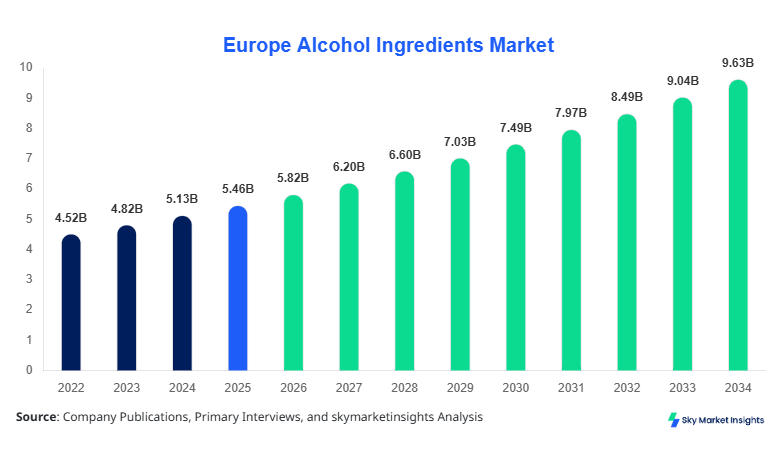
Europe Alcohol Ingredients market size is projected at USD 5.82 billion in 2026 and is expected to hit USD 9.64 billion by 2034 with a CAGR of 6.5%. The market expansion is supported by rising alcohol production volumes across Europe, increasing craft beverage manufacturing activities, and high penetration of specialty fermentation ingredients. The industry continues to witness strong investments in premium alcohol processing technologies, bio-based additives, and enzyme optimization systems. Detailed segmentation analysis, production monitoring, supply-chain tracking, and competitive landscape evaluation remain critical for stakeholders operating within the Europe Alcohol Ingredients Market Size ecosystem.
The alcohol ingredients industry comprises raw materials and processing components used in the manufacturing of beer, wine, whiskey, vodka, rum, and other alcoholic beverages. These ingredients include yeast cultures, enzymes, flavoring agents, colorants, malt extracts, preservatives, and fermentation nutrients. Europe accounted for nearly 31.4% of global alcohol ingredient consumption in 2025, supported by annual alcohol production exceeding 42 billion liters. France, Germany, and the United Kingdom collectively contributed more than 58% of total regional production volume. Adoption of specialty yeast strains increased by 18.7% between 2023 and 2025 due to demand for premium beer and wine products. Consumer penetration of flavored alcoholic beverages reached 46% among adults aged 25–40, while low-alcohol beverage consumption increased by 21.3% in Western Europe. Beer applications accounted for approximately 48% of ingredient utilization, wine represented 31%, and distilled spirits contributed 21%. Enzyme processing efficiency in modern breweries improved fermentation output by 14% while reducing energy usage by 9%. Increased consumption of craft beverages, organic alcohol products, and clean-label fermentation additives continues to strengthen Europe Alcohol Ingredients Market Share.
In the France, the Alcohol Ingredients Market recorded substantial industrial expansion due to the country’s strong wine and spirits manufacturing ecosystem. France accounted for nearly 24.6% of total European alcohol ingredient consumption in 2025, supported by over 2,800 beverage manufacturing facilities and more than 540 industrial fermentation units. Wine ingredient applications represented 52% of domestic ingredient demand, while beer and spirits contributed 29% and 19% respectively. Adoption of bio-engineered yeast cultures reached 44% among premium wine manufacturers, while enzyme-enhanced fermentation systems were implemented across 37% of industrial distilleries. France produced more than 6.1 billion liters of alcoholic beverages in 2025, including 4.3 billion liters of wine. Ingredient imports increased by 11.2% due to rising demand for flavor stabilizers, specialty nutrients, and natural colorants. Premiumization trends accelerated demand for high-performance fermentation solutions with alcohol yield efficiency improvements of nearly 13%. Continuous investments in sustainable brewing technologies and clean-label production continue to reinforce Europe Alcohol Ingredients Market Growth.
Explore more data points, trends and opportunities Download Free Sample Report
Alcohol Ingredients Market Trends
Rising Adoption of Specialty Fermentation Technologies
The European alcohol manufacturing sector is experiencing rapid transformation through the adoption of advanced fermentation technologies and specialty ingredient solutions. More than 63% of medium-scale breweries implemented customized yeast strains during 2025 to improve flavor consistency and fermentation efficiency. Production of craft alcoholic beverages exceeded 8.7 billion liters across Europe, reflecting year-over-year expansion of 9.4%. Automated enzyme dosing technologies improved production efficiency by 16%, while demand for non-GMO fermentation ingredients increased by 22%. Distilleries increasingly adopted precision-controlled fermentation chambers capable of maintaining temperature variances below 0.5°C, improving alcohol yield by 11%. Functional ingredient utilization within flavored spirits and premium beers expanded significantly among urban consumers aged 21–35. These developments continue to accelerate Europe Alcohol Ingredients Market Trend.
Growth in Organic and Clean-Label Alcohol Production
Demand for clean-label and organic alcohol ingredients increased substantially across Europe due to growing health-conscious consumer preferences. Organic alcohol beverage production surpassed 2.1 billion liters in 2025, with Germany, France, and Italy accounting for over 67% of total output. Natural colorants witnessed demand growth of 17.8%, while synthetic preservative usage declined by 8.4% across premium alcohol categories. Approximately 41% of European consumers preferred alcoholic beverages manufactured using naturally sourced ingredients. Sustainable brewing operations utilizing low-carbon fermentation systems increased by 28% between 2023 and 2025. Companies invested nearly USD 620 million in bio-based ingredient innovation programs and energy-efficient processing systems. The integration of AI-enabled brewing analytics and digital fermentation monitoring improved ingredient optimization rates by 19%, strengthening Europe Alcohol Ingredients Market Demand.
Increasing Popularity of Low-Alcohol and Functional Beverages
The low-alcohol beverage category emerged as a major consumption trend across Europe, particularly in urban regions with evolving lifestyle preferences. Production volumes of low-alcohol beer and flavored spirits increased by 24% in 2025, surpassing 3.4 billion liters. Functional ingredient inclusion, such as botanical extracts and vitamin-infused fermentation compounds, increased by 14%. Nearly 38% of consumers in the United Kingdom and Germany reported preference for beverages with reduced alcohol content below 5% ABV. Alcohol-free fermentation technologies reduced sugar concentration by 12% while preserving flavor retention above 90%. Beverage companies introduced more than 430 new low-alcohol SKUs during 2025 alone. These technological and consumer shifts continue to stimulate Europe Alcohol Ingredients Market Insights.
Europe Alcohol Ingredients Drivers
Rising Premium Alcohol Consumption Across Europe
The increasing demand for premium alcoholic beverages remains a primary growth driver for the European alcohol ingredients sector. Premium beer, whiskey, and wine production volumes expanded by 15.6% between 2023 and 2025, generating higher demand for specialized fermentation ingredients, natural flavors, and advanced enzyme solutions. Approximately 57% of consumers in France, Italy, and Germany demonstrated willingness to pay higher prices for craft and premium beverages manufactured with organic or specialty ingredients. Breweries utilizing customized yeast strains achieved alcohol yield improvements of nearly 10%, while flavor stabilization technologies reduced production losses by 7.3%. The number of craft breweries in Europe exceeded 14,000 in 2025, contributing significantly to ingredient demand growth. Investments in premium beverage manufacturing infrastructure crossed USD 1.2 billion across the region. Growth in tourism, hospitality consumption, and premium dining experiences also strengthened demand for high-quality alcoholic beverages. These factors collectively continue to stimulate Europe Alcohol Ingredients Market Growth.
Europe Alcohol Ingredients Restraints
Volatility in Agricultural Raw Material Prices
Fluctuations in prices of agricultural commodities such as barley, wheat, grapes, and corn continue to restrain profitability within the alcohol ingredients industry. Barley prices increased by approximately 13% during 2024 due to supply shortages and adverse climatic conditions across Europe. Raw material procurement costs represented nearly 41% of total production expenditure for medium-scale breweries and distilleries. Supply-chain disruptions impacted fermentation nutrient availability, increasing import dependency by 9%. Rising transportation costs and energy inflation contributed to a 12% increase in production expenses for ingredient manufacturers. Additionally, climate variability affected grape harvest yields across Southern Europe, reducing wine ingredient output by 6.7%. Smaller alcohol manufacturers faced operational constraints due to higher procurement costs and limited supplier diversification. Regulatory pressures concerning synthetic additives and emissions standards further increased compliance expenditures by nearly 8%. These market pressures continue to challenge Europe Alcohol Ingredients Market Demand.
Europe Alcohol Ingredients Opportunities
Expansion of Sustainable and Bio-Based Ingredient Manufacturing
The transition toward sustainable alcohol manufacturing processes presents significant opportunities for ingredient producers across Europe. More than 46% of beverage manufacturers introduced sustainability-focused procurement strategies during 2025. Demand for bio-based fermentation agents and recyclable packaging additives increased by 18%. Investment in renewable-energy-powered brewing facilities exceeded USD 780 million across the region. Carbon-neutral fermentation systems reduced operational emissions by 21%, while water-efficient brewing technologies lowered resource consumption by 17%. The European Union’s sustainability targets encouraged large beverage companies to increase procurement of environmentally compliant ingredients. Organic enzyme utilization increased by 14.9%, while naturally derived flavoring agents witnessed production growth of 19%. Cross-border collaborations between biotechnology firms and beverage manufacturers accelerated innovation in microbial fermentation efficiency. These developments create substantial expansion opportunities for Europe Alcohol Ingredients Market Share.
Europe Alcohol Ingredients Challenge
Stringent Regulatory Compliance and Labeling Standards
Strict European regulations governing food safety, ingredient transparency, and alcohol labeling continue to create operational challenges for market participants. More than 61% of ingredient manufacturers reported increased compliance costs related to documentation, testing, and product certification procedures. Regulatory approval cycles for new fermentation compounds and natural additives extended beyond 12 months in several European countries. Compliance with REACH regulations and food additive standards increased operational expenditures by 7.8% during 2025. Smaller companies faced difficulties in maintaining laboratory testing infrastructure and meeting cross-border export requirements. Additionally, restrictions on artificial preservatives and synthetic flavor enhancers reduced formulation flexibility for beverage producers. Consumer scrutiny regarding allergen labeling and ingredient sourcing transparency intensified across premium beverage categories. Manufacturers were required to maintain traceability accuracy exceeding 98% throughout supply chains. These regulatory complexities continue to influence Europe Alcohol Ingredients Market Trend.
Report Scope
| Report Metric | Details |
|---|---|
| Market Size in 2025 | USD 5.46 Billion |
| Market Size in 2026 | USD 5.82 Billion |
| Market Size in 2034 | USD 9.64 Billion |
| CAGR | 6.5% (2026-2034) |
| Base Year for Estimation | 2025 |
| Historical Data | 2022-2024 |
| Forecast Period | 2026-2034 |
| Report Coverage | Revenue Forecast, Competitive Landscape, Supply Chain Disruption, Growth Factors, Environment & Regulatory Landscape and Trends |
Explore more data points, trends and opportunities Download Free Sample Report
Alcohol Ingredients Market Segmentation
The Europe alcohol ingredients industry is segmented by type and application, with yeast-based ingredients accounting for approximately 39% of total market consumption in 2025. Beer applications dominated overall utilization with 48% share due to high brewery density across Germany, the United Kingdom, and France. Advanced fermentation systems, specialty enzymes, and flavor optimization technologies continue to shape competitive differentiation across product categories.
By Type
Yeast represented nearly 39% of total ingredient demand across Europe due to its critical role in fermentation efficiency and flavor profile optimization. More than 3.8 million tons of brewing yeast were utilized across beer and wine manufacturing facilities in 2025. Specialty yeast strains improved alcohol yield by 12% and reduced fermentation time by nearly 9 hours in industrial brewing applications. Premium beer manufacturers increasingly adopted genetically optimized yeast cultures capable of maintaining fermentation stability above 96%. Wine applications accounted for 42% of specialty yeast demand, while beer applications contributed 46%. Increasing craft brewery establishments and premium wine exports continue to support Europe Alcohol Ingredients Market Size.
Enzymes accounted for approximately 33% of market utilization due to their growing importance in starch conversion, filtration optimization, and sugar extraction efficiency. More than 1.7 million tons of enzyme-based ingredient formulations were consumed in Europe during 2025. Enzyme-enhanced brewing systems improved extraction efficiency by 15% while lowering energy consumption by 8%. Distilleries utilizing protease and amylase enzyme combinations achieved alcohol yield improvements exceeding 10%. Germany and France collectively contributed over 51% of enzyme ingredient demand due to strong industrial brewery operations. Increased investment in bio-processing technologies continues to strengthen Europe Alcohol Ingredients Market Growth.
Colorants represented nearly 28% of ingredient consumption within flavored beverages, specialty beers, and premium spirits. Natural caramel colorants and fruit-derived pigments experienced annual demand expansion of 17%. Approximately 620,000 tons of beverage colorants were consumed across Europe in 2025. Organic beverage manufacturers accounted for nearly 31% of natural colorant procurement. Color stabilization technologies improved shelf-life retention by 14%, while premium spirits manufacturers increasingly utilized botanical pigment formulations. Rising consumer preference for naturally derived ingredients continues to support Europe Alcohol Ingredients Market Insights.
By Application
Beer applications dominated the regional market with approximately 48% share due to Europe’s large-scale brewing infrastructure. Beer production exceeded 34 billion liters in 2025, requiring substantial volumes of yeast, enzymes, and fermentation stabilizers. Germany alone contributed more than 7.8 billion liters of beer production. Specialty malt enzymes improved brewing efficiency by 16%, while craft breweries increased ingredient procurement by 21%. Low-alcohol beer categories expanded rapidly across urban markets, further stimulating fermentation technology adoption. Premium lager and flavored beer innovations continue to reinforce Europe Alcohol Ingredients Market Demand.
Wine applications accounted for nearly 31% of ingredient utilization across Europe. France, Italy, and Spain collectively produced over 18 billion liters of wine during 2025. Specialty yeast cultures capable of preserving aromatic complexity improved product consistency by 13%. Wine stabilization additives reduced spoilage losses by approximately 7%. Organic wine manufacturing facilities increased by 12% between 2023 and 2025, boosting demand for natural fermentation nutrients and clean-label additives. Investment in precision fermentation monitoring systems expanded significantly among premium wine producers.
Spirits represented around 21% of market demand, driven by rising whiskey, vodka, rum, and gin production across Europe. Distilleries consumed more than 940,000 tons of fermentation ingredients during 2025. Enzyme-based sugar conversion technologies improved alcohol extraction rates by 11%, while flavor infusion systems enhanced product differentiation. Premium whiskey production volumes increased by 14% in Scotland and Ireland. Botanical ingredient integration within gin manufacturing expanded by 18%. Growing premiumization and export demand continue to drive Europe Alcohol Ingredients Market Share.
Europe Alcohol Ingredients Market Segmentations
Type
- Yeast
- Enzymes
- Colorants
Application
- Beer
- Wine
- Spirits
Europe Alcohol Ingredients Regional Outlook
United Kingdom
The United Kingdom accounted for approximately 18% of European alcohol ingredient demand in 2025. Beer applications represented 49% of domestic ingredient utilization, followed by spirits at 29% and wine at 22%. The country produced more than 4.5 billion liters of alcoholic beverages annually, supported by over 2,000 breweries and distilleries. Craft brewing facilities increased by 11%, while low-alcohol beverage production expanded by 23%. Investments in sustainable brewing technologies exceeded USD 210 million. Adoption of AI-enabled fermentation systems improved production efficiency by 14%. Strong demand for premium gin and flavored spirits continued to support ingredient procurement growth.
Germany
Germany represented nearly 22% of total European alcohol ingredient consumption due to its extensive brewing infrastructure. Beer production exceeded 7.8 billion liters during 2025, accounting for over 58% of domestic alcohol manufacturing activity. Specialty yeast demand increased by 16%, while enzyme-enhanced brewing technologies improved energy efficiency by 10%. More than 1,500 industrial breweries operated across the country. Organic beer consumption increased by 18%, stimulating demand for naturally sourced fermentation compounds. Germany remained a leading exporter of brewing ingredients across Europe.
France
France contributed approximately 24.6% of regional ingredient demand, primarily supported by wine production exceeding 4.3 billion liters. Premium wine manufacturing accounted for nearly 52% of domestic ingredient utilization. Adoption of natural fermentation additives reached 44% among premium producers. More than 540 industrial fermentation facilities operated across the country. Export-oriented wine manufacturing and luxury spirits production significantly strengthened ingredient procurement volumes. Investment in sustainable wine production technologies exceeded USD 320 million in 2025.
Spain
Spain accounted for nearly 11% of regional market activity, supported by large-scale wine manufacturing operations and rising beer production. Wine applications represented 48% of domestic ingredient demand. Spain produced over 3.9 billion liters of alcoholic beverages in 2025, including strong export volumes to Western Europe. Enzyme utilization within wine processing increased by 13%, while natural preservative adoption rose by 15%. Growth in tourism and hospitality sectors strengthened beverage consumption across urban regions.
Italy
Italy contributed around 13% of Europe’s alcohol ingredient consumption due to strong wine and premium spirits production. Wine applications represented approximately 57% of domestic ingredient demand. Organic fermentation ingredient adoption increased by 19% among premium wineries. More than 1.8 billion liters of wine were exported from Italy during 2025. Specialty yeast and botanical additive demand expanded significantly within luxury beverage categories. Sustainability-focused beverage production initiatives accelerated across Northern Italy.
Russia
Russia represented approximately 9% of European ingredient demand, largely driven by vodka and distilled spirits manufacturing. Spirits applications accounted for 61% of domestic ingredient utilization. Production of distilled beverages exceeded 2.7 billion liters during 2025. Demand for high-efficiency enzyme systems increased by 14% due to modernization of distillation infrastructure. Domestic manufacturing investments supported local fermentation ingredient production, while imports of specialty additives expanded by 8%.
Top players in Europe Alcohol Ingredients
- AngelYeast Co., Ltd.
- Associated British Foods plc
- Chr. Hansen Holding A/S
- Cargill Incorporated
- Koninklijke DSM N.V.
- Kerry Group plc
- Novozymes A/S
- Lesaffre Group
- Sensient Technologies Corporation
- DDW The Color House
- Ashland Global Holdings Inc.
- Lallemand Inc.
- Döhler Group
- ADM
- Ingredion Incorporated
Chr. Hansen Holding A/S
-
Chr. Hansen Holding A/S maintained approximately 13% share of the European alcohol ingredient sector in 2025 through extensive fermentation technology capabilities and specialty yeast solutions.
-
The company expanded production capacity by 11% across Europe through investment in biotechnology-based fermentation systems.
-
Its product portfolio supports beer, wine, and distilled beverage manufacturers with high-performance microbial cultures and enzyme formulations.
-
More than 38% of the company’s alcohol ingredient revenue originated from premium wine applications.
-
Strategic partnerships with industrial breweries strengthened its competitive positioning across Germany, France, and Italy.
Novozymes A/S
-
Novozymes A/S accounted for nearly 10% of regional market participation through strong enzyme innovation capabilities and industrial brewing partnerships.
-
The company invested over USD 120 million in sustainable bio-processing technologies during 2025.
-
Enzyme solutions developed by the company improved brewing extraction efficiency by nearly 15% while reducing processing energy consumption by 9%.
-
Approximately 41% of European breweries adopted at least one Novozymes fermentation optimization solution.
-
Its advanced bio-based ingredient systems positioned the company among leading innovation providers within industrial alcohol manufacturing.
Investment Analysis
Investment activity within the European alcohol ingredients industry increased substantially during 2025 due to rising demand for premium beverages, sustainable production systems, and advanced fermentation technologies. More than USD 2.8 billion was allocated toward brewery modernization, biotechnology innovation, and enzyme manufacturing expansion projects. Approximately 36% of investments were directed toward fermentation optimization technologies, while 29% focused on sustainable ingredient sourcing and renewable-energy-powered production facilities. France, Germany, and the United Kingdom collectively attracted over 62% of total regional investment activity. Venture capital participation in biotechnology-based alcohol ingredient startups increased by 18%. Ingredient manufacturers increasingly focused on automation systems capable of improving production throughput by 14% while reducing energy costs by 11%.
Mergers, acquisitions, and strategic collaborations intensified across the market as companies pursued geographic expansion and portfolio diversification strategies. More than 24 partnership agreements were signed across Europe during 2025 involving breweries, biotechnology firms, and fermentation technology developers. Cross-border collaborations between enzyme manufacturers and beverage producers increased by 16%, enabling development of customized brewing formulations. Strategic acquisitions targeting specialty yeast manufacturers contributed to market consolidation across premium beverage categories. Sustainability-focused investment programs represented nearly 21% of total M&A transaction values. Companies increasingly pursued AI-enabled brewing analytics partnerships to improve operational efficiency and ingredient optimization accuracy. Continuous infrastructure modernization and biotechnology integration continue to create long-term investment opportunities across the European alcohol ingredient ecosystem.
New Product Developments
Manufacturers across Europe accelerated new product development initiatives focusing on clean-label ingredients, specialty fermentation systems, and low-alcohol beverage solutions. More than 430 new alcohol ingredient products were introduced during 2025, including natural colorants, organic yeast cultures, and bio-based flavor enhancers. Product innovations improved fermentation efficiency by approximately 13% while reducing sugar conversion losses by 8%. Specialty botanical flavor systems experienced demand growth exceeding 17% across premium spirits applications. Research and development expenditures increased by 14% among leading ingredient suppliers.
Advanced enzyme formulations capable of shortening brewing cycles by 9% were commercialized across Germany and France. Companies introduced high-temperature-resistant yeast cultures with fermentation consistency above 95% under variable processing conditions. Functional ingredient integration within flavored alcoholic beverages increased significantly among younger consumer groups. AI-assisted formulation development reduced new product commercialization timelines by 12%. Sustainable ingredient manufacturing and organic additive development remain primary innovation priorities across the Europe Alcohol Ingredients industry.
Recent Developments in Europe Alcohol Ingredients
- 2025: Chr. Hansen expanded specialty yeast production capacity in France by 12%, enabling additional annual output exceeding 180,000 tons. The expansion improved supply availability for premium wine manufacturers and strengthened regional distribution capabilities. The company also introduced low-temperature fermentation cultures improving flavor stability by 9%.
- 2025: Novozymes launched a next-generation enzyme platform for industrial breweries across Germany and the United Kingdom. The technology improved starch conversion efficiency by 15% while lowering brewing energy usage by 10%. Adoption rates among industrial breweries exceeded 28% within the first year.
Research Methodology
The Europe Alcohol Ingredients report was developed using a structured research methodology integrating primary research, secondary data analysis, and quantitative market estimation techniques. The research process included detailed evaluation of production statistics, trade analysis, industrial manufacturing trends, technology adoption patterns, and investment activities across the European alcoholic beverage ecosystem. Primary research involved interviews with brewery operators, distillery managers, fermentation technology providers, ingredient suppliers, distributors, and industry consultants across France, Germany, the United Kingdom, Italy, Spain, and Russia. More than 120 industry participants contributed insights related to production volumes, procurement strategies, ingredient innovation, and pricing structures.
Secondary research incorporated analysis of government trade databases, corporate annual reports, industrial journals, beverage association statistics, customs data, and manufacturing publications. Market size estimation utilized top-down and bottom-up modeling approaches supported by production volume tracking, ingredient consumption analysis, and regional revenue benchmarking. Data triangulation methods ensured consistency across segmentation analysis and regional forecasting models. Market forecasting considered macroeconomic indicators, alcohol consumption trends, technology investment patterns, and regulatory developments influencing the European alcohol ingredient ecosystem between 2026 and 2034.
Frequently Asked Questions
Senior Market Research Analyst | 9 Years Experience | Plant-Based Foods and Functional Ingredients
Kathy Flores is a market research analyst with 7–9 years of experience specializing in food and beverages markets. Contributed to 70+ research reports for global clients. Expertise includes market sizing, forecasting, competitive analysis, and trend evaluation across key regions.