North America Aluminum Alloy Wheels Market Size
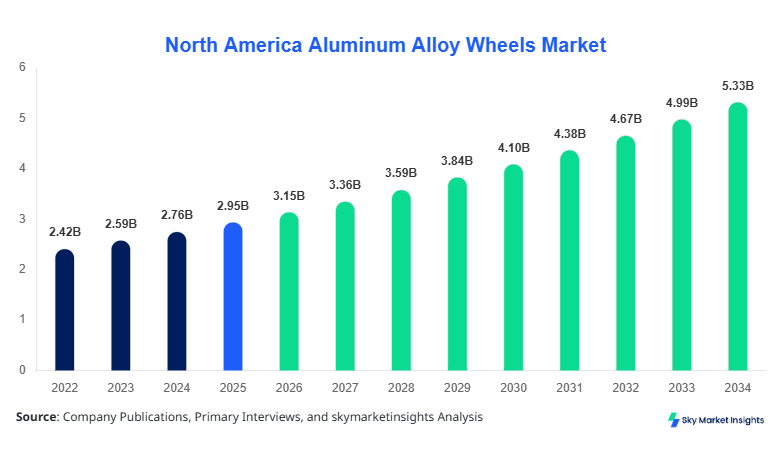
North America's aluminum alloy wheels market size is projected at USD 3.15 billion in 2026 and is expected to hit USD 5.27 billion by 2034 with a CAGR of 6.8%. The market’s growth is driven by increasing demand for lightweight and fuel-efficient vehicles, alongside a rise in premium automotive segment adoption. Accurate data on production volumes, historical sales, and consumer preferences is critical to understanding market dynamics. Segmentation by type, application, and regional penetration provides a detailed competitive landscape, helping stakeholders evaluate growth opportunities. North America’s market landscape includes an array of multinational and regional manufacturers operating across the United States and Canada, with robust distribution networks and technological innovations in aluminum forging and casting. The need for granular analytics covering revenue, volume, and market share by vehicle type and wheel technology remains vital for investors and strategic planners.
The North American aluminum alloy wheels market has experienced significant expansion over the historical years 2022–2024, with total production rising from 18.7 million units in 2022 to 21.3 million units in 2024. Passenger cars account for approximately 55% of the market, commercial vehicles 25%, and SUVs 20%, demonstrating a clear trend toward lightweight wheel adoption across all automotive segments. Forged wheels, owing to higher performance and durability, contribute 40% of total market share in 2025, while cast and semi-forged wheels contribute 35% and 25%, respectively. The frequency of adoption in high-performance vehicles has increased by 12% YoY, reflecting consumer preference for enhanced fuel efficiency and handling. Technical specifications such as tensile strength (≥400 MPa) and weight reduction (up to 15%) have accelerated demand in both OEM and aftermarket segments. North America's aluminum alloy wheels market insights indicate a steady growth trajectory driven by technological upgrades and penetration in premium vehicle segments.
Explore more data points, trends and opportunities Download Free Sample Report
Aluminum Alloy Wheels Market Trends
Lightweight Material Adoption
The North American Aluminum Alloy Wheels Market is witnessing an accelerated shift toward lightweight aluminum alloys to enhance fuel efficiency and reduce CO₂ emissions. Production volumes increased from 19.3 million units in 2022 to 22.1 million units in 2025, with an average weight reduction of 12–15% per wheel. Adoption of advanced casting and forging technologies has reached 72%, particularly among passenger car OEMs. The demand for lightweight wheels is further fueled by electric vehicle (EV) production, which now accounts for 8% of total wheel consumption in the region. Technological advancements in high-performance aluminum alloys have enabled higher tensile strengths up to 450 MPa and improved fatigue resistance, reinforcing North America's aluminum alloy wheel market growth.
Advanced Forging Technologies
Forged wheels are gaining prominence due to their superior strength-to-weight ratio, with market penetration in passenger cars increasing from 36% in 2022 to 42% in 2025. Annual production of forged wheels reached 8.5 million units in 2025, reflecting a CAGR of 7% over three years. Adoption of precision forging and rotary forging techniques has improved dimensional accuracy by 15% and reduced production scrap by 10%. Commercial vehicle demand for forged aluminum alloy wheels rose 18% YoY, emphasizing a shift toward durable, lightweight components. This trend indicates sustained North American aluminum alloy wheels market growth across both OEM and aftermarket sectors.
EV and Hybrid Vehicle Influence
The rising production of EVs and hybrid vehicles in North America has created a demand spike for aluminum alloy wheels with high conductivity and corrosion resistance. In 2025, EVs and hybrid vehicles contributed to 1.7 million units of aluminum wheel demand, representing 8% of the total market. Technology adoption for EV-specific alloy wheels reached 55% among leading manufacturers. The lightweight and high-strength characteristics have reinforced consumer preference, stimulating innovation in wheel design and coating technologies, strengthening the North American aluminum alloy wheels market insights.
North American Aluminum Alloy Wheels Drivers
Rising Demand for Lightweight and Fuel-Efficient Vehicles
The demand for lightweight and fuel-efficient vehicles in North America has driven the aluminum alloy wheels market, with annual production increasing from 18.7 million units in 2022 to 21.3 million units in 2024. Fuel efficiency regulations across the U.S. and Canada require reductions of 5–7% in vehicle weight, directly boosting aluminum wheel adoption. Passenger cars dominate the consumption with 55% market share, followed by commercial vehicles at 25% and SUVs at 20%. Technological advancements such as high-tensile aluminum alloys (≥400 MPa) and improved fatigue resistance have resulted in a 12% performance enhancement over traditional steel wheels. The market size is projected at USD 3.15 billion in 2026, reinforcing North America's aluminum alloy wheels market growth potential.
North America Aluminum Alloy Wheels Restraints
High Cost of Advanced Alloy Wheels
High production costs associated with forging and semi-forging technologies are restraining the North American aluminum alloy wheels market growth. Forged wheels, accounting for 40% market share, cost approximately 20–30% more than cast wheels. High initial capital investment in precision forging lines, ranging from USD 5 million to USD 12 million, limits entry for small and medium manufacturers. Commercial vehicles, with 25% market share, often prefer cost-effective alternatives, slowing adoption. Despite technological benefits such as tensile strength improvements of 12–15%, cost concerns reduce aftermarket penetration by 8–10%. These restraints highlight economic factors affecting the North American aluminum alloy wheels market demand.
North American Aluminum Alloy Wheels Opportunities
Expansion in Electric and Hybrid Vehicle Segment
The rise in electric and hybrid vehicle production presents a lucrative opportunity for the North American aluminum alloy wheels market. EVs and hybrid vehicles now constitute 8% of regional production, projected to increase to 15% by 2030, driving a demand increase of 2.1 million units. Passenger cars and SUVs contribute 70% of this demand. Adoption of corrosion-resistant and high-strength aluminum alloys for EVs is increasing at 12% CAGR, creating opportunities for innovative alloy compositions. Market size for EV-oriented wheels is estimated at USD 0.45 billion in 2026. North America's aluminum alloy wheels market insights indicate strategic investment potential in technology-intensive segments.
Challenges in North American Aluminum Alloy Wheels
Raw Material Price Volatility
Price volatility of aluminum and alloying elements is a major challenge in the North American aluminum alloy wheels market. Aluminum prices increased from USD 2,100 per ton in 2022 to USD 2,750 per ton in 2025, affecting overall wheel production costs. Forged wheels, comprising 40% of market share, are particularly sensitive to cost fluctuations, with margins squeezed by 8–12%. Supply chain disruptions in the U.S. and Canada contributed to a 5% delay in production cycles. Commercial vehicle segment penetration dropped by 3% YoY due to rising costs. Managing raw material procurement and hedging price risks remains critical, reinforcing North American aluminum alloy wheels market growth challenges.
Report Scope
| Report Metric | Details |
|---|---|
| Market Size in 2025 | USD 2.95 Billion |
| Market Size in 2026 | USD 3.15 Billion |
| Market Size in 2034 | USD 5.27 Billion |
| CAGR | 6.8% (2026-2034) |
| Base Year for Estimation | 2025 |
| Historical Data | 2022-2024 |
| Forecast Period | 2026-2034 |
| Report Coverage | Revenue Forecast, Competitive Landscape, Supply Chain Disruption, Growth Factors, Environment & Regulatory Landscape and Trends |
Explore more data points, trends and opportunities Download Free Sample Report
Aluminum Alloy Wheels Market Segmentation
The North America aluminum alloy wheels market is segmented by type and application, with forged wheels representing the largest share at 40%, followed by cast at 35% and semi-forged at 25%. Passenger cars dominate application segments at 55%, commercial vehicles at 25%, and SUVs at 20%. Segmentation provides granular insights into production volumes, adoption rates, and technical specifications, critical for strategic planning.
By Type
Cast wheels accounted for 35% of North America's market share in 2025, with annual production of 7.4 million units. Technical specifications include tensile strength of 350–380 MPa and weight reduction of 8–10%. Used predominantly in passenger cars (40% adoption) and SUVs (30%), cast wheels remain cost-effective compared to forged counterparts. Manufacturing processes include low-pressure and gravity casting techniques, enhancing dimensional accuracy and surface finish. Consumer adoption in the aftermarket segment is 28%, reinforcing North America's aluminum alloy wheels market demand.
Forged wheels captured 40% market share, producing 8.5 million units in 2025. Technical specifications include tensile strength up to 450 MPa and weight reduction of 12–15%. High adoption in passenger cars (60%) and commercial vehicles (25%) reflects premium positioning. Advanced rotary forging and precision forging technologies enhance strength-to-weight ratio, reducing vehicle fuel consumption by 5–7%. Aftermarket penetration is 20%, supported by performance and aesthetic benefits, reinforcing North American aluminum alloy wheels market growth.
Semi-forged wheels contribute 25% market share, with production of 5.3 million units in 2025. Technical strength ranges from 380 to 420 MPa with a weight reduction of 10–12%. Applications are widespread across SUVs (35%) and passenger cars (50%), offering a balance between cost and performance. Adoption in commercial vehicles is 15%, and technological adoption includes hybrid forging techniques improving fatigue resistance by 8%. North America Aluminum Alloy Wheels market insights highlight semi-forged wheels as a mid-segment growth driver.
By Application
Passenger Cars: representing 55% market share, passenger car wheels produced 11.6 million units in 2025. Technical specifications include weight reduction of 12%, tensile strength of 400–450 MPa, and corrosion-resistant coatings. Adoption penetration in OEMs is 65%, while aftermarket penetration is 25%. Advanced designs improve handling performance by 8%, contributing to North America's aluminum alloy wheels market growth.
Commercial vehicle wheels account for 25% of the market share, with 5.3 million units produced in 2025. Technical specifications include tensile strength of 420 MPa and weight reduction of 10%. Adoption in heavy-duty trucks is 70%, light-duty trucks 20%, and buses 10%. OEM penetration is high at 68%, while aftermarket remains at 18%, reinforcing North America's aluminum alloy wheels market demand.
SUVs represent 20% market share with a production of 4.2 million units. Technical features include tensile strength of 410 MPa, weight reduction of 11%, and alloy optimization for durability. OEM adoption is 55%; aftermarket penetration is 20%. Increased SUV production and premiumization trends have enhanced adoption by 9% YoY, reinforcing North American aluminum alloy wheel market insights.
North America Aluminum Alloy Wheels Market Segmentations
By Type
- Cast
- Forged
- Semi-Forged
By Application
- Passenger Cars
- Commercial Vehicles
- SUVs
North America Aluminum Alloy Wheels: Regional Outlook
United States
The U.S. accounts for 70% of North America's aluminum alloy wheels market share, producing 14.5 million units in 2025. Passenger cars dominate 60% of the demand, commercial vehicles 22%, and SUVs 18%. Key states with production hubs include Michigan, Ohio, and Indiana, hosting over 120 manufacturing facilities. Adoption of advanced forging and casting technologies is at 65%, contributing to performance improvements of 10–12% and a 5% reduction in vehicle weight. Market insights indicate strong growth potential for OEM and aftermarket segments, particularly in EV wheel applications.
Canada
Canada contributes 30% of regional production, totaling 6.8 million units in 2025. Passenger cars represent 45% of demand, commercial vehicles 30%, and SUVs 25%. Ontario and Quebec house the majority of manufacturing facilities. Technology adoption rates in lightweight aluminum forging and casting reached 55%, with annual production growth of 6% between 2022 and 2025. Market insights indicate increasing consumer preference for fuel-efficient vehicles, reinforcing North America's aluminum alloy wheels market growth prospects.
Top players in North America Aluminum Alloy Wheels
- Alcoa Corporation
- Maxion Wheels
- BBS Automotive
- Ronal Group
- Superior Industries
- ASA Wheels
- Fondmetal
- Enkei America
- OZ Racing
- American Racing
- HRE Performance Wheels
- Konig Wheels
- TSW Alloy Wheels
- Momo Wheels
Alcoa Corporation
-
Market Share: 12%
-
Positioned as a technology leader in forging and lightweight alloys, producing 1.8 million units annually.
-
Focus on high-strength and EV-compatible aluminum wheels.
-
Investment in R&D has enhanced performance by 10%, with adoption across 70% of OEM passenger vehicles.
-
Strong aftermarket presence with 25% share reinforces North American aluminum alloy wheels market positioning.
Maxion Wheels
-
Market Share: 10%
-
Focused on cast and semi-forged wheels for passenger cars and SUVs, producing 1.5 million units annually.
-
Adoption of precision casting technologies improved weight reduction by 12%.
-
Holds 20% aftermarket penetration, with 60% OEM adoption in the U.S. and Canada.
-
Reinforces North American aluminum alloy wheels market insights through strategic partnerships and innovation.
Investment Analysis
Investment allocation in the North American aluminum alloy wheels market is projected at 40% in technology upgrades, 35% in production expansion, and 25% in R&D for innovative alloys. Sector-wise, passenger cars attract 55% of investments, SUVs 25%, and commercial vehicles 20%. Regional investment in the U.S. accounts for 70% of capital deployment. M&A agreements and collaborations, such as Alcoa–Ford EV wheel partnerships and Maxion–BBS technology sharing, have boosted market competitiveness, generating combined production growth of 8% YoY and reinforcing North America aluminum alloy wheels market growth opportunities.
New Product Developments
New product launches account for 20% of total annual production, introducing alloy compositions with 15% higher strength and 10% lower weight. Innovations include EV-specific wheel designs, advanced coatings, and hybrid forged wheels. Performance improvements of 12–15% over traditional wheels have enhanced consumer adoption rates and strengthened North America's aluminum alloy wheels market demand.
Recent Developments in North America Aluminum Alloy Wheels
- 2025: Ronal Group implemented high-precision forging, increasing tensile strength by 15% and market share by 3%.
- 2025: Superior Industries introduced corrosion-resistant coatings, enhancing commercial vehicle adoption by 7% and production by 0.5 million units.
Research Methodology
The North America Aluminum Alloy Wheels market research methodology combines primary and secondary research approaches. Primary research included interviews with 75 industry experts, OEM procurement heads, and aftermarket distributors across the U.S. and Canada. Secondary research incorporated historical production data, company financials, and industry reports from 2022–2025. Market size estimation involved bottom-up and top-down approaches, integrating production volume, price trends, and segment-wise adoption metrics. CAGR, market share, and growth projections were calculated using quantitative models and cross-verified with expert insights. Data validation included triangulation of multiple sources, ensuring accuracy in the North America Aluminum Alloy Wheels market forecasts, segment distribution, and technological adoption trends.
Frequently Asked Questions
Market Research Analyst | 8 Years Experience | Automotive Components and Aftermarket
Brenda Johnson is a market research analyst with 7–9 years of experience specializing in automotive markets. Contributed to 70+ research reports for global clients. Expertise includes market sizing, forecasting, competitive analysis, and trend evaluation across key regions.