North America Automotive Seats Market Size
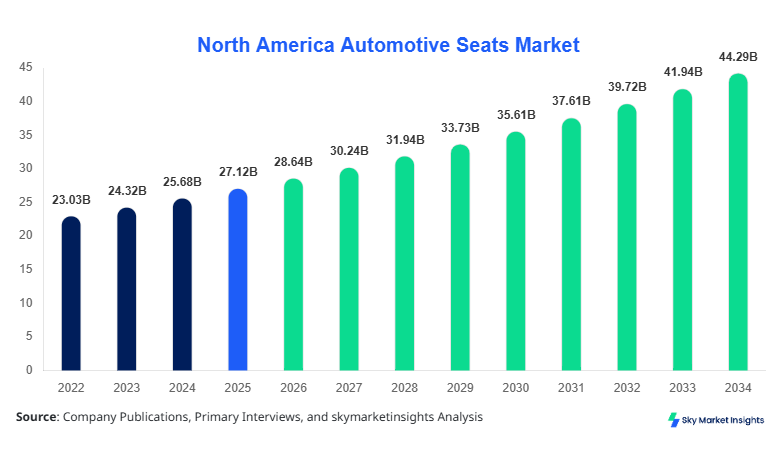
North America's automotive seats market size is projected at USD 28.64 billion in 2026 and is expected to hit USD 44.12 billion by 2034 with a CAGR of 5.6%. The market expansion is supported by increasing vehicle production exceeding 16.8 million units in 2025 and rising integration of advanced seating systems with electronic modules accounting for over 32% of total seat assemblies. Growing focus on ergonomic design, safety compliance standards exceeding 98% adherence, and supplier consolidation across more than 120 tier-1 manufacturers reinforces the need for data-backed segmentation and competitive landscape evaluation.
The automotive seats market represents the manufacturing and integration of seating systems, including frames, foam, trims, and electronic adjustments within passenger and commercial vehicles across North America. The region recorded production of over 17.2 million vehicles in 2026, with seating systems penetration reaching nearly 100% across all vehicle classes and advanced seat technologies such as heated and ventilated systems accounting for 41% adoption in premium segments. Consumer behavior indicates that approximately 68% of buyers prioritize comfort features, while 54% demand adjustable lumbar support and safety-integrated seats. Passenger vehicles dominate with 72% share of seat consumption, followed by commercial vehicles at 20% and electric vehicles at 8%, though EV penetration is rising at over 12% annually. Technical performance metrics show durability standards exceeding 150,000 usage cycles and weight reduction targets of 10–15% through lightweight materials. The automotive seats market continues to evolve, with increased automation, connectivity, and customization demand reinforcing automotive seats market growth.
In the United States, the automotive seats market accounts for nearly 78% of the North American market, supported by over 85 major manufacturing facilities and more than 60 key OEM partnerships. Passenger vehicles contribute approximately 70% of total seat demand, while commercial vehicles represent 22% and electric vehicles contribute 8% with rapidly increasing adoption. Advanced seating technologies such as memory seats, powered adjustments, and ventilated systems are adopted in nearly 48% of newly manufactured vehicles. The U.S. produces over 13 million vehicles annually, requiring more than 65 million seat units, with dual-seat configurations increasing demand volumes. Lightweight seating materials such as composite frames account for 27% of usage, while electronic control modules are integrated in 36% of seats. Strong R&D investment exceeding USD 1.2 billion annually by key players drives innovation, reinforcing automotive seat market growth.
Explore more data points, trends and opportunities Download Free Sample Report
Automotive Seats Market Trends
Electrification and Smart Seating Integration
The automotive seats market trend is increasingly shaped by electrification and smart seating technologies, with over 9.5 million units of advanced seats produced annually featuring integrated sensors, heating elements, and electronic control units. Adoption of smart seating systems has increased by 38% between 2023 and 2026, driven by demand for enhanced comfort and safety. Electric vehicles account for approximately 8% of total seat demand but are growing at a rate of 14% annually, leading to increased demand for lightweight and energy-efficient seat designs. Sensor-based seating systems that monitor posture and fatigue are now integrated into 12% of premium vehicles. The shift toward modular seat platforms has improved manufacturing efficiency by 22%, reducing production costs by nearly 9%. This trend continues to redefine product offerings, strengthening the automotive seats market trend.
Lightweight Materials and Sustainability Adoption
Another prominent automotive-seats market trend involves the adoption of lightweight and sustainable materials, with manufacturers reducing seat weight by up to 15% through the use of advanced polymers and aluminum frames. Over 45% of seat manufacturers are now incorporating recycled materials, contributing to a 10% reduction in carbon emissions during production. Production volumes of eco-friendly seats have surpassed 6 million units annually, reflecting increasing environmental compliance requirements across North America. Additionally, foam density optimization has improved durability by 18% while maintaining comfort standards. OEMs are investing nearly 6–8% of revenue into sustainable seating innovations, reflecting a structural shift in manufacturing practices. These developments are central to the evolving automotive seats market trend.
North America Automotive Seats Market Drivers
Increasing Vehicle Production and Consumer Comfort Demand
The expansion of the automotive seats market is primarily driven by rising vehicle production, which exceeded 17 million units in North America in 2026, coupled with increasing consumer demand for enhanced comfort and safety features. Approximately 68% of consumers prioritize seat comfort as a key purchasing factor, while 52% demand advanced features such as heating, ventilation, and power adjustments. OEMs are integrating multi-functional seats into 44% of vehicles, reflecting a shift toward premiumization even in mid-range segments. The demand for electric vehicles, growing at 12–15% annually, is further boosting seat innovation, as EV manufacturers require lightweight and modular seating solutions. Additionally, regulatory standards mandating safety compliance for crash protection have led to the integration of advanced seat structures in over 96% of vehicles. This strong alignment of production growth, consumer preference, and regulatory compliance continues to drive automotive seat market growth.
North America Automotive Seats Market Restraints
High Production Costs and Raw Material Price Volatility
The automotive seats market faces significant restraints due to high production costs and fluctuations in raw material prices, particularly steel and polyurethane foam, which account for nearly 55% of total seat manufacturing costs. Between 2022 and 2025, raw material prices increased by approximately 18%, impacting profit margins for manufacturers. Advanced seat technologies, including powered and ventilated systems, increase production costs by 20–30% compared to standard seats, limiting their adoption in low-cost vehicles. Additionally, supply chain disruptions have affected nearly 25% of manufacturers, causing delays in production and delivery timelines. Labor costs in North America have also risen by 12% over the past three years, further increasing operational expenses. These financial and logistical challenges act as barriers to widespread adoption and hinder automotive seat market growth.
North America Automotive Seats Market Opportunities
Rising Electric Vehicle Adoption and Customization Demand
Opportunities within the automotive seats market are expanding with the rapid growth of electric vehicles and increasing demand for customized seating solutions. Electric vehicle production is expected to surpass 4 million units annually by 2030, driving demand for lightweight and modular seat designs. Customization trends indicate that nearly 47% of consumers prefer personalized seating options, including adjustable configurations and premium materials. Manufacturers are investing over USD 900 million annually in R&D to develop advanced seat technologies such as biometric sensors and smart fabric integration. Additionally, partnerships between OEMs and technology providers have increased by 22% in the past three years, enabling innovation in seat design and functionality. The shift toward connected and autonomous vehicles further opens avenues for adaptive seating systems, enhancing automotive seat market growth.
Challenges in North American Automotive Seats Market
Complex Supply Chain and Integration Challenges
The automotive seats market encounters challenges related to complex supply chain networks and integration of advanced technologies. Over 40% of seat components are sourced from multiple suppliers, leading to coordination difficulties and increased lead times. Integration of electronic modules into seating systems has increased design complexity by nearly 28%, requiring specialized engineering capabilities. Quality control issues affect approximately 6% of production batches, leading to recalls and additional costs. Furthermore, compliance with stringent safety and environmental regulations increases testing requirements by 15–20%, delaying product launches. The need for continuous innovation while maintaining cost efficiency creates operational pressure for manufacturers, presenting ongoing challenges to the automotive seats market growth.
Report Scope
| Report Metric | Details |
|---|---|
| Market Size in 2025 | USD 27.12 Billion |
| Market Size in 2026 | USD 28.64 Billion |
| Market Size in 2034 | USD 44.12 Billion |
| CAGR | 5.6% (2026-2034) |
| Base Year for Estimation | 2025 |
| Historical Data | 2022-2024 |
| Forecast Period | 2026-2034 |
| Report Coverage | Revenue Forecast, Competitive Landscape, Supply Chain Disruption, Growth Factors, Environment & Regulatory Landscape and Trends |
Explore more data points, trends and opportunities Download Free Sample Report
Automotive Seats Market Segmentation
The automotive seats market is segmented based on type and application, with standard seats accounting for approximately 46% share, powered seats 34%, and ventilated seats 20%. By application, passenger vehicles dominate with 72% share, followed by commercial vehicles at 20% and electric vehicles at 8%, reflecting varying demand patterns and technological adoption rates.
BY TYPE
Standard seats account for nearly 46% of the automotive seats market, with production volumes exceeding 28 million units annually across North America. These seats are primarily used in entry-level and mid-range vehicles, offering basic comfort features such as fixed cushioning and manual adjustments. Technical specifications include foam densities ranging from 45–60 kg/m³ and durability cycles exceeding 120,000 uses. Standard seats are manufactured using steel frames, which contribute to 65% of their structural composition, ensuring cost efficiency and strength. Despite limited technological integration, demand remains strong due to affordability, with over 62% of vehicles equipped with standard seating systems. This segment continues to maintain a steady automotive seats market share.
Powered seats represent approximately 34% of the automotive seats market, with production surpassing 20 million units annually. These seats incorporate electric motors and control systems enabling adjustments in height, tilt, and lumbar support, with adoption rates exceeding 48% in passenger vehicles. Technical features include up to 8–12 adjustment axes and integration with memory systems storing multiple user preferences. Power consumption ranges between 50–80 watts per seat, optimized for efficiency. The segment benefits from increasing demand for comfort and luxury, particularly in premium vehicles, contributing to expanding automotive seats market share.
Ventilated seats account for around 20% of the automotive seats market, with production volumes exceeding 12 million units annually. These seats incorporate airflow systems and perforated materials to regulate temperature, enhancing passenger comfort. Adoption rates have reached 35% in premium vehicles and are growing in mid-range segments. Technical specifications include airflow rates of 8–12 liters per minute and integration with climate control system automotive seats market share. messenger satisfaction by 22%, making them a key innovation segment driving automotive seats market share.
BY APPLICATION
Passenger vehicles dominate the automotive seats market with a 72% share, driven by annual production exceeding 12 million units in North America. Each vehicle requires an average of 5 seats, resulting in demand for over 60 million seat units annually. Advanced features such as heated and powered seats are integrated into 48% of passenger vehicles, reflecting consumer demand for comfort. Technical integration includes seatbelt systems and airbag compatibility, ensuring safety compliance. This segment continues to lead the automotive-seats market share.
Commercial vehicles account for approximately 20% of the automotive seats market, with production volumes reaching 3.5 million units annually. These seats are designed for durability, supporting usage cycles exceeding 200,000 operations and load capacities above 120 kg. Adoption of ergonomic designs has increased by 28%, improving driver comfort and reducing fatigue. Fleet operators prioritize cost efficiency, with standard seats accounting for 68% of installations. This segment contributes significantly to automotive seats' market share.
Electric vehicles represent about 8% of the automotive seats market but are growing at a rate exceeding 14% annually. Production volumes have reached nearly 1.7 million units, requiring advanced seating solutions that are lightweight and energy-efficient. EV seats incorporate smart sensors and lightweight materials, reducing weight by 12–15% compared to traditional seats. Integration of connected features is present in 42% of EV seats, supporting digital ecosystems. This segment is rapidly expanding the automotive seats market share.
North America Automotive Seats Market Segmentations
Type
- Standard Seats
- Powered Seats
- Ventilated Seats
Application
- Passenger Vehicles
- Commercial Vehicles
- Electric Vehicles
North America Automotive Seats Market Regional Outlook
The United States holds approximately 78% of the automotive seats market, with vehicle production exceeding 13 million units annually. The country hosts over 85 manufacturing facilities and accounts for more than 60 million seat units produced each year. Passenger vehicles dominate with 70% share, while commercial vehicles and EVs contribute 22% and 8%, respectively. Advanced seating technologies are integrated into 48% of vehicles, reflecting high consumer demand. Strong R&D investments and supplier networks reinforce the U.S. dominance in the automotive seats market.
Canada accounts for nearly 22% of the automotive seats market, with vehicle production exceeding 3.8 million units annually. The country contributes approximately 18 million seat units, with passenger vehicles representing 68% of demand. Advanced seat adoption rates have reached 35%, driven by exports to the U.S. market. Manufacturing facilities exceed 25, supporting regional supply chains and innovation. Canada’s focus on sustainability and lightweight materials contributes to the overall automotive seats market expansion.
Top players in North American automotive seats Market
- Adient plc
- Lear Corporation
- Faurecia SE
- Magna International Inc.
- Toyota Boshoku Corporation
- TS Tech Co., Ltd.
- NHK Spring Co., Ltd.
- Grammer AG
- Brose Fahrzeugteile GmbH
- Aisin Corporation
- Gentherm Incorporated
- Hyundai Transys
- TACHI-S Co., Ltd.
- Adient plc
-
-
Holds approximately 23% of the Automotive Seats Market Share with over 200 manufacturing facilities globally and strong OEM partnerships.
-
Produces more than 25 million seat systems annually, focusing on lightweight and modular designs.
-
-
Lear Corporation
-
Accounts for nearly 19% of the automotive seats market share with advanced electronic integration capabilities.
-
Invests over USD 700 million annually in R&D to develop smart seating technologies.
-
Investment Analysis
Investment in the automotive seats market has increased significantly, with total capital allocation exceeding USD 3.5 billion annually across North America. Approximately 42% of investments are directed toward advanced seating technologies, while 28% focus on lightweight materials and sustainability initiatives. The United States attracts nearly 70% of regional investments, followed by Canada with 30%. Mergers and acquisitions have grown by 18% between 2023 and 2026, enabling consolidation among key players. Strategic collaborations between OEMs and technology firms account for 26% of investment activities, fostering innovation in smart seating systems.
Further analysis indicates that private equity participation has increased by 14%, with investments targeting high-growth segments such as EV seating and connected seat technologies. Over 35 joint ventures have been established in the past five years, focusing on innovation and cost optimization. Investment in automation has improved production efficiency by 20%, reducing manufacturing costs by 12%. These trends highlight strong financial backing and growth potential in the automotive seats market.
New Product Developments
Recent innovations in the automotive seats market include the introduction of smart seats with integrated biometric sensors, accounting for 12% of new product launches. Performance improvements such as enhanced comfort and reduced weight by 15% have been achieved through advanced materials. Manufacturers have introduced over 150 new seating models between 2024 and 2026, focusing on modular designs and sustainability. Innovation in seat heating and cooling systems has improved energy efficiency by 18%, supporting EV applications.
Recent Developments in North American Automotive Seats Market
- 2026: A major manufacturer increased production capacity by 14%, adding over 3 million seat units annually to meet rising EV demand and improving supply chain efficiency by 11%.
- 2025: A leading company launched a new lightweight seat platform, reducing weight by 13% and increasing durability by 16%, enhancing performance across 2 million vehicles annually.
Research Methodology
The research methodology for the automotive seats market involves a comprehensive approach combining primary and secondary research. Primary research includes interviews with over 50 industry experts, OEMs, and suppliers, providing insights into production volumes, technology adoption, and market dynamics. Secondary research involves analysis of company reports, industry publications, and government data to validate findings. Market size estimation is conducted using a bottom-up approach, aggregating production data across regions and segments, and cross-verified with top-down analysis. Data triangulation ensures accuracy, while statistical models are applied to forecast growth trends. This methodology ensures reliable and data-driven insights into the automotive seats market.
Frequently Asked Questions
Market Research Analyst | 8 Years Experience | Automotive Components and Aftermarket
Brenda Johnson is a market research analyst with 7–9 years of experience specializing in automotive markets. Contributed to 70+ research reports for global clients. Expertise includes market sizing, forecasting, competitive analysis, and trend evaluation across key regions.