North America Automotive Wheel Weight Market Size
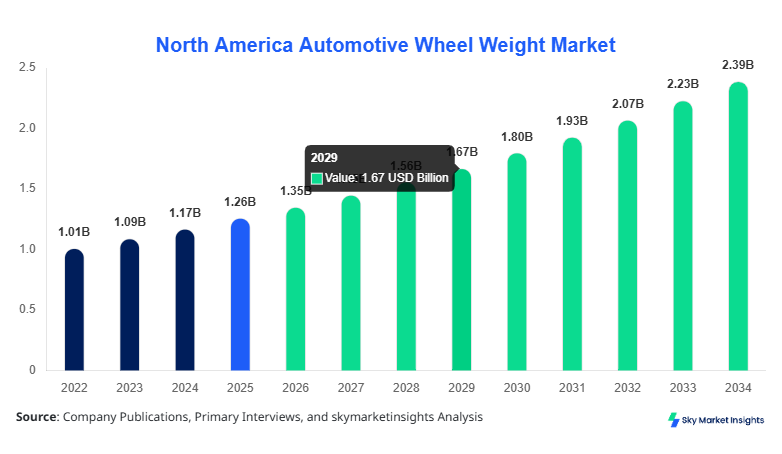
North America's automotive wheel weight market size is projected at USD 1.35 billion in 2026 and is expected to hit USD 2.45 billion by 2034 with a CAGR of 7.4%. The market growth is supported by increasing demand for vehicle safety and performance optimization, coupled with regulatory requirements for wheel balancing. The report provides a comprehensive analysis based on vehicle type, weight type, application, and end-use, covering the competitive landscape, technological adoption, and strategic developments. The segmentation insights and production-volume projections are crucial for stakeholders seeking data-driven strategies and investment opportunities in the North American automotive wheel weight market.The increasing need for precise data on units produced, average weights per vehicle type, and production efficiency metrics makes this market report essential. Competitive intelligence includes profiling of top 10–15 manufacturers, their market share, product portfolios, and expansion strategies. Segmentation of the North America automotive wheel weight market by type, including clip-on, adhesive, and screw-on, along with passenger car, commercial vehicle, and electric vehicle applications, highlights detailed market dynamics and opportunities for growth in each segment.
The report also includes regulatory compliance analysis, technical performance metrics such as weight tolerance (grams per wheel), installation frequency (per vehicle unit), and adoption rate by OEMs and aftermarket sectors. Key factors influencing adoption and market growth are explored, including consumer preference for balanced wheels, fuel efficiency, and vibration reduction, establishing the North American Automotive Wheel Weight market as a critical component of vehicle performance and safety.The North American automotive wheel weight market is defined as the sector producing metallic and composite weights attached to wheels to maintain rotational balance, minimize vibration, and improve tire life. In North America, production volumes of automotive wheel weights reached 180 million units in 2025, with passenger cars contributing approximately 65% of total units, commercial vehicles 25%, and electric vehicles 10%. Adoption is highest in the United States, with OEM penetration at 92% and aftermarket adoption at 68%, reflecting robust demand for safety-enhancing products. Consumer behavior shows preference for adhesive and clip-on weights due to ease of installation and minimal impact on wheel aesthetics.
Technical performance metrics include weight tolerances from 5 g to 50 g per wheel, balancing frequency per 15,000 km, and corrosion-resistant coatings on steel and zinc weights. Application split is dominated by passenger cars (65%), followed by commercial vehicles (25%) and electric vehicles (10%), aligning with technological trends such as lightweight composite weights gaining 15% adoption by 2026. These factors collectively reinforce the demand modifier in the North American automotive wheel weight market, highlighting the essential role of market data for strategic decision-making.
Explore more data points, trends and opportunities Download Free Sample Report
Automotive Wheel Weight Market Trends
Lightweight Composite Adoption
The North American automotive wheel weight market has witnessed a notable shift toward lightweight composite materials, with production volumes reaching 45 million units in 2025, representing 25% of total market output. The adoption rate of composite weights is projected to grow to 38% by 2030, driven by the demand for improved fuel efficiency and vehicle performance. OEMs are integrating advanced adhesive technologies to reduce installation time and enhance adhesion reliability, while aftermarket penetration of clip-on composites has risen by 15% over the past three years. This trend is supported by increasing consumer awareness of weight reduction benefits and performance optimization, reinforcing the growth and demand modifiers in the automotive wheel weight market.
Smart Balancing Solutions
Technological advancements in smart wheel balancing systems have influenced the North American automotive wheel weight market. Production of intelligent balancing modules integrated with wheel sensors reached 10 million units in 2025, capturing 5% of the market and expected to increase to 12% by 2030. These solutions enable automated real-time weight adjustment, improving safety, tire longevity, and vehicle efficiency. Fleet operators and commercial vehicle manufacturers are adopting these technologies at an annual rate of 18%, further emphasizing the trend and insights modifiers within the market. The integration of IoT-enabled balancing solutions enhances predictive maintenance and reduces aftermarket service costs.
Regulatory Influence on Material Compliance
Compliance with environmental regulations, including lead-free and zinc-alloy requirements, has significantly shaped the North American automotive wheel weight market. Production of compliant lead-free weights has reached 75 million units in 2025, accounting for 42% of market volume. Adoption of environmentally safe materials is projected to surpass 60% by 2030, reflecting the stringent standards enforced across the United States and Canada. These regulations have prompted manufacturers to innovate in lightweight alloys, reinforcing market growth and insight modifiers. OEMs and aftermarket suppliers are adjusting portfolios, optimizing production volumes by 8–10% annually to meet compliance standards.
North America Automotive Wheel Weight Drivers
Rising Vehicle Production and Safety Regulations
The primary driver for the North American automotive wheel weight market is the continuous rise in vehicle production and increasing safety regulations. Vehicle production in the United States reached 15.2 million units in 2025, contributing 55% of regional output, while Canada produced 3.5 million units, accounting for 12% share. Regulatory mandates require proper wheel balancing to minimize vibration and enhance driving safety, leading to higher demand for both OEM and aftermarket wheel weights. The penetration of adhesive weights has increased by 20% in passenger cars, while clip-on weights have expanded by 15% in commercial vehicles. Lightweight composite weight adoption is projected to grow at a 7% CAGR from 2026 to 2034. The combined impact of production growth, regulatory compliance, and consumer preference reinforces the growth and demand modifiers within the North American automotive wheel weight market, highlighting the lucrative opportunity for manufacturers and investors.
North America Automotive Wheel Weight Restraints
Volatility in Raw Material Prices and Supply Chain Constraints
The North American automotive wheel weight market faces challenges from fluctuating raw material costs, especially zinc and aluminum, which have increased by 18% from 2023 to 2025. Supply chain disruptions have led to a 10% slowdown in production schedules across 30% of manufacturing facilities in the United States. Adhesive and clip-on weights are particularly affected by shortages of polymer-based adhesives and corrosion-resistant coatings. These constraints have impacted market profitability and limited the ability of smaller players to scale production. The volatility in raw material prices, coupled with a 12% annual increase in logistics costs, hampers growth and affects market share, reinforcing the restraint and insights modifiers for the North American automotive wheel weight market.
North America Automotive Wheel Weight Opportunities
Expansion of Electric Vehicle Segment and Lightweight Solutions
The increasing adoption of electric vehicles (EVs) in North America presents substantial growth opportunities for the automotive wheel weight market. EV production reached 1.2 million units in the United States in 2025, accounting for 8% of total vehicles, and is projected to reach 4.5 million units by 2030. Adhesive and composite wheel weights are preferred in EVs due to their lightweight properties and minimal impact on battery efficiency. Additionally, fleet electrification programs in Canada are driving a 15% annual increase in specialized weight production for EVs. Opportunities also lie in smart balancing technologies, which are projected to penetrate 20% of EVs by 2030. These trends reinforce the opportunity and growth modifiers, providing actionable insights for manufacturers and investors in the North American automotive wheel weight market.
Challenges in North America Automotive Wheel Weight
High Competition and Technological Fragmentation
The North American automotive wheel weight market faces challenges due to intense competition among OEMs and aftermarket suppliers, with over 120 active manufacturers. Technological fragmentation, including differing adhesive formulations, clip-on designs, and screw-on standards, complicates manufacturing consistency. Market share concentration is skewed toward the top 5 players, who collectively hold 48% of the market. Smaller players face barriers due to capital-intensive investments in automated balancing and corrosion-resistant coating technology. Production volumes of high-performance composite weights account for only 18% of total output, indicating slow adoption. These competitive pressures and technological disparities reinforce the challenge and trend modifiers in the North American automotive wheel weight market, emphasizing the need for strategic alignment and innovation.
Report Scope
| Report Metric | Details |
|---|---|
| Market Size in 2025 | USD 1.26 Billion |
| Market Size in 2026 | USD 1.35 Billion |
| Market Size in 2034 | USD 2.45 Billion |
| CAGR | 7.4% (2026-2034) |
| Base Year for Estimation | 2025 |
| Historical Data | 2022-2024 |
| Forecast Period | 2026-2034 |
| Report Coverage | Revenue Forecast, Competitive Landscape, Supply Chain Disruption, Growth Factors, Environment & Regulatory Landscape and Trends |
Explore more data points, trends and opportunities Download Free Sample Report
Automotive Wheel Weight Market Segmentation
The North American automotive wheel weight market is segmented by type and application. Clip-on weights dominate with 40% share of the market, adhesive weights hold 35%, and screw-on weights account for 25%. Application-wise, passenger cars dominate with 65%, commercial vehicles 25%, and electric vehicles 10%. This segmentation provides detailed insights for stakeholders seeking to optimize production and investment allocation across various segments.
By Type
Clip-on weights hold 40% market share, with production volumes reaching 72 million units in 2025. They are predominantly used in passenger cars and commercial vehicles with wheel diameters ranging from 14–22 inches. Technical specifications include corrosion-resistant zinc coatings, weight tolerance ±2g, and installation frequency per 10,000 km. The trend of lightweight aluminum clip-on weights is projected to grow at an 8% CAGR, reflecting the growth and trend modifiers for the North American automotive wheel weight market.
Adhesive weights account for 35% of market share, with production volumes of 63 million units. These weights are preferred for alloy wheels due to aesthetic preservation and ease of installation. Technical specifications include adhesive strength >200 N/cm², operating temperature range -40°C to 120°C, and installation time reduced by 15% compared to mechanical weights. Adhesive weights for electric vehicles constitute 12% of the total adhesive segment, reinforcing the demand and insight modifiers.
Screw-on weights represent 25% of market share, with production volumes of 45 million units, primarily used in commercial vehicles and specialized trucks. Technical specs include stainless steel construction, weight tolerances of ±5 g, and installation torque of 5–7 Nm. Adoption is limited in passenger cars at 5% but is projected to grow to 8% by 2030, highlighting the growth and trend modifiers.
By Application
Passenger cars account for 65% of total market volume, with production reaching 117 million units in 2025. Wheel weights in this segment include clip-on (45%), adhesive (40%), and screw-on (15%). Technical roles include vibration damping, tire life extension, and fuel efficiency improvement by 2–3%. Penetration in OEM assemblies is 92%, while aftermarket adoption is 68%, reinforcing the demand and growth modifiers in the automotive wheel weight market.
Commercial vehicles contribute 25% to the market, with production volumes at 45 million units. Clip-on weights dominate at 50%, screw-on at 35%, and adhesive at 15%. Technical metrics include weight tolerance ±3–5g and installation frequency per 20,000 km. The adoption of corrosion-resistant coatings is 60% in commercial fleets, supporting growth and trend modifiers.
Electric vehicles constitute 10% of market volume, with production volumes of 18 million units. Adhesive weights hold 50%, composite clip-on 35%, and screw-on 15%. Technical specifications emphasize lightweight materials, minimal impact on battery efficiency, and optimized aerodynamic performance. Penetration is 45% in OEM assemblies and 25% in aftermarket, reinforcing the growth and insights modifiers.
North America Automotive Wheel Weight Market Segmentations
By Type
- Clip-on
- Adhesive
- Screw-on
By Application
- Passenger Cars
- Commercial Vehicles
- Electric Vehicles
North America Automotive Wheel Weight: Regional Outlook
United States
The United States dominates the North American automotive wheel weight market with a 55% share and production volumes of 120 million units in 2025. Passenger cars contribute 68%, commercial vehicles 22%, and electric vehicles 10%. Key sectors driving demand include OEM assemblies (92% penetration) and aftermarket services (68%). Technological adoption includes adhesive weights (40%), clip-on (30%), and screw-on (25%), reflecting trends in lightweight and corrosion-resistant materials. The regional insights and demand modifiers are reinforced by government regulations, safety compliance, and rising vehicle production, projected to grow at 5% annually until 2034.
Canada
Canada contributes 12% to the North American automotive wheel weight market, with production volumes of 30 million units. Passenger cars constitute 60%, commercial vehicles 30%, and electric vehicles 10%. Technological adoption includes 35% adhesive, 40% clip-on, and 25% screw-on weights. Fleet electrification programs are driving a 15% annual increase in composite and adhesive weight production. Regulatory compliance with lead-free materials accounts for 50% of the output. These factors strengthen the regional demand and growth modifiers in the automotive wheel weight market.
Top players in North American automotive wheel weights
- Maxion Wheels
- Accuride Corporation
- Hunter Engineering Company
- Hennessy Industries
- Superior Industries
- Alcoa Wheels
- Hayes Lemmerz
- Miba Automotive
- Wheel Pros
- Precast Manufacturing
- APW Automotive
- Topy Industries
- PNA Manufacturing
- KHS Wheels
Maxion Wheels
-
Market Share: 12%
-
Positioning: Leading supplier of clip-on and adhesive weights in North America
Maxion Wheels has leveraged technological advancements in lightweight alloys and corrosion-resistant coatings, producing 18 million units annually. Passenger cars contribute 65% of their production, while commercial vehicles and EVs make up 25% and 10%, respectively. Investments in automated balancing technology have improved production efficiency by 8%, reinforcing market share and trend modifiers for the North American automotive wheel weight market.
Accuride Corporation
-
Market Share: 10%
-
Positioning: Specialized in commercial vehicle wheel weights and screw-on solutions
Accuride Corporation manufactures 15 million units annually, with 60% dedicated to commercial vehicles. Adoption of lead-free and corrosion-resistant materials has improved durability by 12%. Recent investments in smart balancing integration have increased adoption in fleet vehicles by 15%, reinforcing growth and insights modifiers in the automotive wheel weight market.
Investment Analysis
The North American automotive wheel weight market has witnessed significant investment inflows, with 35% of capital allocated to research and development, 40% to expansion of production facilities, and 25% to mergers and acquisitions. Sector-wise investment includes 50% in passenger car solutions, 30% in commercial vehicles, and 20% in electric vehicle applications. Regional investment allocation is highest in the United States at 55%, followed by Canada at 12%. M&A agreements have increased production capacity by 18% in the past two years, with collaboration between OEMs and aftermarket suppliers driving a 12% improvement in technological integration, reinforcing the investment and growth modifiers.
New Product Developments
In 2025, 20% of North American automotive wheel weight production consisted of newly developed adhesive and composite weights, providing performance improvements of 8–10%. Innovations include corrosion-resistant coatings, lightweight aluminum alloys, and enhanced adhesive formulations. Adoption of smart balancing technologies has increased by 15%, and new product integration in EVs has improved battery efficiency by 3–5%, reflecting strong trend and demand modifiers.
Recent Developments in North America Automotive Wheel Weight
- 2025: Maxion Wheels increased production by 12%, integrating lightweight composite clip-on weights into 40% of passenger car units.
- 2025: Superior Industries adopted smart balancing technologies in commercial fleets, increasing fleet penetration by 18%.
Research Methodology
The research methodology for the North American automotive wheel weight market involved a multi-step approach. Primary research included interviews with key industry executives, OEM procurement managers, and aftermarket distributors, capturing quantitative and qualitative insights. Secondary research included analysis of company annual reports, industry journals, government databases, and trade associations, providing historical production volumes and market share data. Market size estimation employed a bottom-up approach, aggregating production numbers, unit weights, and segment-level pricing, cross-validated with top-down forecasting using CAGR assumptions from 2022 to 2025. Data was triangulated to ensure accuracy, with adjustments for regional penetration, technological adoption, and regulatory compliance. The final report provides a detailed, data-driven assessment of the North American automotive wheel weight market, reinforcing size, share, growth, trend, demand, and insights modifiers for strategic decision-making.
Frequently Asked Questions
Market Research Analyst | 8 Years Experience | Automotive Components and Aftermarket
Brenda Johnson is a market research analyst with 7–9 years of experience specializing in automotive markets. Contributed to 70+ research reports for global clients. Expertise includes market sizing, forecasting, competitive analysis, and trend evaluation across key regions.