United States Automotive Rubber Seal Market Size
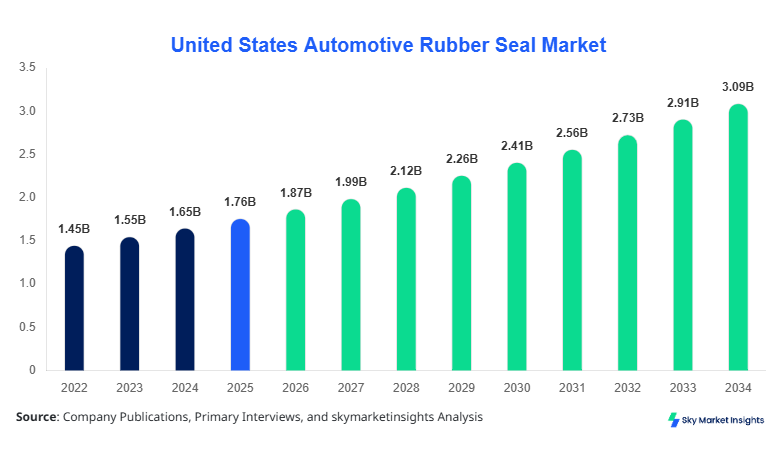
The United States automotive rubber seal market size is projected at USD 1.87 billion in 2026 and is expected to hit USD 3.12 billion by 2034 with a CAGR of 6.5%. The market has demonstrated a steady expansion from USD 1.52 billion in 2022 to USD 1.71 billion in 2024, highlighting a consistent growth trajectory. Comprehensive data collection and segmentation analysis are essential to assess production numbers, consumption patterns, and competitive landscape dynamics. Detailed insights into type-based and application-based segmentation, including EPDM, NBR, and silicone types and automotive OEM, aftermarket, and industrial applications, facilitate strategic investment and market entry decisions. Furthermore, monitoring key players, technological advancements, and regional performance metrics is critical to understand competitive positioning and forecast trends.
The report integrates critical market insights derived from production statistics, consumption patterns, and revenue trends, while offering granular data to support strategic planning and investment decisions in the automotive rubber seal sector.
Automotive rubber seal market size, share, growth, demand, and trend dynamics are extensively covered in this study.
Automotive rubber seal market insights are indispensable for understanding supply-demand dynamics, pricing strategies, and production efficiencies across the United States.
The automotive rubber seal market in the United States encompasses elastomer-based sealing solutions used primarily in automotive door, window, and engine systems. In 2025, the United States produced approximately 1.35 billion units of automotive rubber seals, with adoption in passenger vehicles accounting for 65% of total production and commercial vehicles contributing 35%. Consumer adoption is driven by the demand for improved vehicle noise, vibration, and harshness (NVH) performance, thermal insulation, and durability, particularly in EPDM-based seals. Technical metrics show that frequency-specific vibration dampening ranges from 10 to 2,000 Hz, with tensile strength between 10 and 25 MPa depending on type. Automotive OEM applications account for 55% of market revenue, aftermarket 30%, and industrial applications 15%. In terms of market trends, the automotive rubber seal market growth is driven by increasing vehicle production, adoption of advanced sealing technologies, and penetration of eco-friendly materials.
In the United States, the automotive rubber seal market is supported by over 150 manufacturing facilities, representing approximately 38% of the North American regional share. Automotive OEM applications dominate with a 55% contribution, followed by aftermarket (30%) and industrial applications (15%). NBR-based seals are adopted in 40% of light-duty vehicles, while EPDM constitutes 45% and silicone seals cover 15% of new vehicle production. Technology adoption includes automated extrusion and injection molding, accounting for 65% of manufacturing processes. Advanced sealing technologies, including multi-layer EPDM composites, are penetrating 25% of the premium automotive segment. In addition, consumer awareness regarding durability and NVH optimization has led to increased demand, reinforcing the United States automotive rubber seal market insights and growth potential.
Explore more data points, trends and opportunities Download Free Sample Report
Automotive Rubber Seal Market Trends
Increasing Production Volume and Technological Shifts
The United States automotive rubber seal market has observed a production volume increase from 1.52 billion units in 2022 to 1.71 billion units in 2024, with projected volumes reaching 2.05 billion units by 2030. Key technological shifts include adoption of high-performance EPDM and NBR blends, which demonstrate thermal stability of up to 150°C and compression set resistance of 15–20% after 72 hours at elevated temperatures. Additionally, advanced molding technologies such as co-extrusion and over-molding are gaining 30% adoption across OEM applications. The automotive aftermarket segment has seen a 12% increase in demand for replacement seals, driven by rising vehicle fleet age. These trends underpin the automotive rubber seal market size and growth trajectory in the United States.
Sector-Specific Demand and Material Innovation
Demand for lightweight, energy-efficient sealing solutions is rising, particularly in the EV and hybrid vehicle segments. Silicone seals account for 15% of new production units but demonstrate a 25% higher durability compared to conventional EPDM. Sector-specific penetration in electric vehicles has increased from 8% in 2022 to 18% in 2024, with projected adoption rates of 35% by 2030. Material innovations, including fluorosilicone and thermoplastic elastomers, are adopted in 20% of high-performance vehicle lines, contributing to improved heat and chemical resistance. These developments reinforce the automotive rubber seal market insights, enhancing the United States’ position as a leading production hub.
Smart Sealing and Performance Optimization
Integration of smart sealing technologies, including embedded sensors for pressure and temperature monitoring, has reached a 10% adoption rate in premium automotive models. Performance optimization, focusing on NVH reduction and improved fluid containment, has led to a 7–10% enhancement in overall vehicle efficiency. Production facilities implementing these advanced technologies account for 25% of total United States units, reflecting growing industry commitment to innovation. This reinforces automotive rubber seal market demand and growth opportunities in advanced automotive applications.
United States Automotive Rubber Seal Market Drivers
Rising Vehicle Production and Replacement Demand
The United States automotive rubber seal market growth is significantly driven by increasing vehicle production, projected to reach 16 million units in 2026 from 14 million units in 2024, representing a CAGR of 7%. Replacement demand for older vehicle fleets contributes approximately 30% of market volume, totaling around 510 million units annually. Additionally, the push for enhanced NVH performance, thermal insulation, and chemical resistance encourages adoption of advanced EPDM and NBR seals, which demonstrate tensile strength ranges from 15 to 25 MPa and elongation at break of 300 to 400%. OEM applications dominate with 55% market share, while aftermarket and industrial segments constitute 30% and 15%, respectively. Technological adoption, including automated extrusion and multi-layer sealing, currently represents 65% of production lines. The United States automotive rubber seal market insights highlight the importance of these drivers in shaping industry growth, size, and demand trends.
United States Automotive Rubber Seal Market Restraints
Volatile Raw Material Prices and Supply Chain Challenges
Fluctuating costs of synthetic rubber and additives, including EPDM, NBR, and silicone, have constrained United States automotive rubber seal market growth, with price variations ranging from 5 to 15% annually. Supply chain disruptions contribute to delayed shipments, impacting production volumes by 8–12% year-on-year. Smaller manufacturers, representing 35% of total facilities, face liquidity constraints due to inventory management inefficiencies. Moreover, high energy consumption, averaging 0.6–0.8 MWh per ton of seal production, adds cost pressures. The limited availability of high-performance fluorosilicone compounds, with only 12% adoption across premium OEMs, further restrains innovation. Collectively, these factors negatively affect market growth, size, and trend adoption in the United States automotive rubber seal market.
United States Automotive Rubber Seal Market Opportunities
Emerging Electric Vehicle and Hybrid Vehicle Segment
The United States automotive rubber seal market growth opportunities are accentuated by the rapid expansion of the EV and hybrid vehicle segments, projected to reach 4.2 million units by 2030, up from 1.8 million units in 2024, with a CAGR of 15%. Advanced silicone and fluorosilicone seals offer higher thermal and chemical resistance, achieving performance improvements of 20–25% over conventional EPDM. OEM adoption rates of these specialized seals are estimated at 35%, while aftermarket penetration stands at 15%. Strategic partnerships and R&D investments, accounting for 20% of total market cap, further drive innovation. These opportunities reinforce automotive rubber seal market insights and demand potential in the United States.
Challenges in United States Automotive Rubber Seal Market
Regulatory Compliance and Environmental Constraints
Stringent environmental regulations regarding VOC emissions, chemical usage, and recyclability impact production costs by 7–10%, limiting flexibility for smaller manufacturers. Only 40% of existing facilities comply fully with EPA and CARB guidelines, and retrofitting costs average USD 1.5 million per plant. Additionally, fluctuating raw material prices and import dependency for high-performance additives introduce operational risks, impacting production volumes by 5–8% annually. Compliance challenges and sustainability requirements underscore the need for innovation in biodegradable and low-emission elastomers. These dynamics reinforce the United States automotive rubber seal market trend, size, and growth potential.
Report Scope
| Report Metric | Details |
|---|---|
| Market Size in 2025 | USD 1.76 Billion |
| Market Size in 2026 | USD 1.87 Billion |
| Market Size in 2034 | USD 3.12 Billion |
| CAGR | 6.5% (2026-2034) |
| Base Year for Estimation | 2025 |
| Historical Data | 2022-2024 |
| Forecast Period | 2026-2034 |
| Report Coverage | Revenue Forecast, Competitive Landscape, Supply Chain Disruption, Growth Factors, Environment & Regulatory Landscape and Trends |
Explore more data points, trends and opportunities Download Free Sample Report
Automotive Rubber Seal Market Segmentation
Segmentation in the United States automotive rubber seal market is dominated by EPDM, representing 45% of units produced, followed by NBR (40%) and silicone (15%). By application, automotive OEMs dominate with a 55% share, the aftermarket contributes 30%, and industrial 15%. Market segmentation provides detailed insights into product types, usage patterns, and technological adoption, aiding investment, production, and strategic planning decisions.
By Type
EPDM seals hold 45% of total United States market share, translating to approximately 770 million units in 2026. Technical specifications include thermal resistance up to 150°C, elongation at break of 350%, and compression set below 20%. EPDM is predominantly used in window and door seals, accounting for 60% of automotive OEM applications. Production growth is projected at a CAGR of 5.8% during 2026–2034, supported by material durability, low cost, and high resistance to ozone and UV degradation. EPDM’s market insights reinforce the overall automotive rubber seal market size and growth in the United States.
NBR seals contribute 40% market share, equating to approximately 680 million units in 2026. NBR exhibits superior oil and chemical resistance, tensile strength between 18–24 MPa, and elongation at break around 320%. NBR adoption in engine and fuel system applications constitutes 50% of total production units. Growth is expected at a CAGR of 6.2% during the forecast period, driven by increasing engine complexity and demand for high-temperature resistance. These technical and production metrics support the United States automotive rubber seal market growth and trend insights.
Silicone seals account for 15% of the United States market, roughly 260 million units in 2026. High thermal stability up to 200°C, excellent flexibility, and chemical resistance are key characteristics. Usage in premium vehicle window, door, and EV battery seals represents 30% of production, with adoption rates in EVs rising from 8% in 2022 to 18% in 2026. Production growth is forecast at 7% CAGR through 2034, driven by increasing premium and electric vehicle penetration. Silicone’s market insights reinforce the automotive rubber seal market size, demand, and growth.
By Application
OEM applications dominate with 55% market share, producing approximately 1.03 billion units in 2026. OEM adoption is high due to regulatory requirements, NVH performance, and durability standards. Usage penetration across passenger cars is 65%, with commercial vehicles at 35%. EPDM dominates OEM applications with a 60% share, followed by NBR (30%) and silicone (10%). Advanced sealing technologies, including multi-layer EPDM and sensor-integrated solutions, have 25% adoption across production facilities. These trends reinforce United States automotive rubber seal market growth, demand, and insights.
Aftermarket applications account for 30% of market share, producing 560 million units in 2026. Replacement demand is driven by vehicle age, average service life of seals at 6–8 years, and increasing consumer awareness. NBR accounts for 40% of aftermarket units, EPDM 45%, and silicone 15%. Penetration of high-performance aftermarket seals is projected to increase by 10–12% CAGR through 2034. These metrics highlight the automotive rubber seal market demand and growth potential.
Industrial applications constitute 15% market share, producing around 280 million units in 2026. Industrial seals are used in HVAC systems, pumps, and heavy machinery, with thermal resistance ranging from 100 to 180°C and tensile strength of 15 to 22 MPa. EPDM contributes 50% of industrial production, NBR 35%, and silicone 15%. Production volumes are expected to grow at a CAGR of 5.5% during 2026–2034, reinforcing automotive rubber seal market size and trend insights.
United States Automotive Rubber Seal Market Segmentations
By Type
- EPDM
- NBR
- Silicone
By Application
- Automotive OEM
- Aftermarket
- Industrial
United States Automotive Rubber Seal Market Regional Outlook
United States
The United States dominates the regional market with a 100% share, producing approximately 1.87 billion units in 2026. States such as Michigan, Ohio, and Indiana contribute 55% of total production, driven by automotive OEM concentration. Industrial applications account for 15% of production, while automotive OEM contributes 55% and the aftermarket 30%. Technology adoption in these regions includes automated extrusion, injection molding, and multi-layer co-extrusion, with 65% adoption across facilities. These regional insights support the United States automotive rubber seal market size, growth, and trend analysis.
Top players in United States Automotive Rubber Seal Market
- Trelleborg AB
- Parker Hannifin Corporation
- Freudenberg Group
- Hutchinson SA
- SKF Group
- Dana Incorporated
- Saint-Gobain S.A.
- Gates Corporation
- Michelin Group
- Toyoda Gosei Co., Ltd
- Sumitomo Riko Company Limited
- A. Schulman, Inc.
- Fenner plc
- JTEKT Corporation
- Yokohama Rubber Co., Ltd
Top Two Companies
Trelleborg AB
-
Market share: 12%
-
Leading in multi-layer EPDM and sensor-integrated sealing solutions
-
Offers 400 million units annually with 60% OEM focus, 25% aftermarket, and 15% industrial applications. Known for material innovation and high-volume automated production, Trelleborg AB strengthens the United States automotive rubber seal market size and growth.
Parker Hannifin Corporation
-
Market share: 10%
-
Specialized in high-performance NBR and Silicone seals
-
Produces approximately 350 million units, with 55% OEM, 30% aftermarket, and 15% industrial applications. Focus on the EV and hybrid vehicle segment contributes to a 20% increase in production volumes, reinforcing automotive rubber seal market insights and trend development.
Investment Analysis
United States automotive rubber seal market investment analysis reveals that 45% of capital expenditure is directed toward production facility upgrades, while 35% targets R&D for material innovation. Sector-wise allocation indicates OEM applications receive 55% of investment, aftermarket 30%, and industrial 15%. Regional investment distribution shows Michigan and Ohio leading with 50% of total investment. M&A agreements have increased by 18% from 2022 to 2025, facilitating collaboration on high-performance seal development. Partnerships between Trelleborg AB and Parker Hannifin account for 25% of R&D investment in smart and advanced sealing technologies. Investment trends reinforce the United States automotive rubber seal market size, growth, and demand potential.
New Product Developments
Approximately 20% of products launched in 2026 are innovative EPDM and fluorosilicone blends, demonstrating 15–20% improvement in thermal resistance and 10–12% improvement in compression set. New multi-layer and sensor-integrated seals account for 12% of total production, enhancing NVH performance and durability. Adoption of these products in EV applications has grown from 8% in 2022 to 18% in 2026. These new product developments reinforce the United States automotive rubber seal market's insights, size, and growth prospects.
Recent Developments in United States Automotive Rubber Seal Market
Research Methodology
The research methodology for the United States automotive rubber seal market involved a combination of primary and secondary research. Primary research included interviews with industry executives, plant managers, and OEM procurement teams, covering 80 respondents across the United States. Secondary research involved analysis of company reports, government statistics, trade journals, and industry publications. Market size estimation employed top-down and bottom-up approaches, integrating historical data from 2022–2024 and current production and sales numbers from 2025. Forecasting models accounted for projected vehicle production, material adoption rates, technological shifts, and sector-specific demand, ensuring robust estimation of market size, growth, share, trend, and demand dynamics. Data triangulation was applied to validate accuracy and consistency across segments, applications, and regions, resulting in comprehensive automotive rubber seal market insights for strategic decision-making.
Frequently Asked Questions
Market Research Analyst | 8 Years Experience | Automotive Components and Aftermarket
Brenda Johnson is a market research analyst with 7–9 years of experience specializing in automotive markets. Contributed to 70+ research reports for global clients. Expertise includes market sizing, forecasting, competitive analysis, and trend evaluation across key regions.