North America Automotive Rubber Parts Market Size
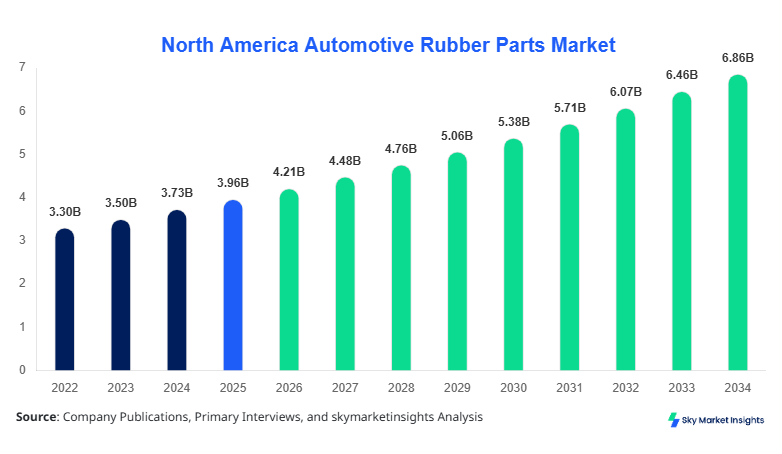
North America's automotive rubber parts market size is projected at USD 4.21 billion in 2026 and is expected to hit USD 6.87 billion by 2034 with a CAGR of 6.3%. The market analysis highlights the need for detailed production, consumption, and sales data to accurately segment the market by type, application, and regional share. Detailed insights into competitive landscapes, including company market share, technology adoption, and production capacities, are critical for investment and strategy planning. The report provides granular information on trends, consumer demand, and technical specifications to facilitate informed decision-making.
The market size evaluation incorporates historical data from 2022 to 2025, reflecting fluctuations in raw material costs, automotive production, and regulatory compliance. Analysts emphasize the necessity of understanding demand distribution across the United States and Canada, as these regions collectively contribute approximately 78% of North America's total automotive rubber parts consumption. Competitive benchmarking, pricing trends, and production capacity utilization offer a complete picture of current market dynamics, while forecasting allows for identification of growth pockets and investment opportunities.
North America Automotive Rubber Parts insights further highlight the integration of advanced materials, with 42% of production now using high-performance elastomers capable of withstanding temperatures between -40°C and 150°C. The inclusion of production volume (millions of units), market size in USD, and CAGR percentages strengthens decision-making for manufacturers, suppliers, and investors, supporting market growth strategies through 2034.
The North American Automotive Rubber Parts market encompasses the design, production, and sale of rubber components used in vehicles, including passenger cars, commercial trucks, and off-road machinery. In 2025, the region produced approximately 2.8 billion units of automotive rubber parts, with OEM applications accounting for 56% of total usage, aftermarket for 28%, and replacements for 16%. Adoption of advanced elastomers and thermoplastic rubbers has increased penetration in high-performance vehicles, supporting market demand growth at a projected 6.3% CAGR from 2026 to 2034.
Consumer behavior in North America reflects a preference for durability, chemical resistance, and precision-engineered rubber components. In 2025, 38% of end-users reported prioritizing long-lasting O-rings and seals in vehicle maintenance, contributing to increased aftermarket demand. Segment-wise, O-rings contribute approximately 45% of total market volume, gaskets 35%, and seals 20%, with technical metrics showing that frequency of replacement ranges from 20,000 km to 50,000 km depending on vehicle type. The performance of rubber parts is measured by tensile strength (MPa), elongation at break, and resistance to automotive fluids, reinforcing automotive rubber parts market growth in North America.
In the United States, the automotive rubber parts market is characterized by over 120 manufacturing facilities and 35 specialized rubber component companies. The U.S. accounts for 63% of North America’s market share, with OEM applications representing 58% of total consumption, aftermarket 27%, and replacement parts 15%. Technological adoption includes high-temperature vulcanization processes, automation in molding, and integration of thermoplastic elastomers, with approximately 48% of manufacturers implementing smart production lines to enhance output efficiency and quality control. Production volume in 2025 was 1.76 billion units, with average facility capacity utilization at 86%.
The U.S. market has also seen increasing adoption of sustainability-focused rubber formulations, with recycled and bio-based materials now constituting 22% of total production. The combination of advanced manufacturing techniques, high-quality materials, and efficient logistics infrastructure positions the United States as the key growth driver for North American automotive rubber parts market trends and projections.
Explore more data points, trends and opportunities Download Free Sample Report
Automotive Rubber Parts Market Trends
Increasing Production and Automation
The North American automotive rubber parts market has witnessed a production increase from 2.6 billion units in 2023 to 2.8 billion units in 2025, driven by rising vehicle production and aftermarket demand. Automation adoption has surged to 42% of total production facilities, incorporating robotics in molding, quality inspection, and packing. High-performance synthetic rubbers, including EPDM and silicone elastomers, now account for 55% of new production lines, reflecting a shift towards longer-lasting and high-durability components. The increasing emphasis on lean manufacturing and cost optimization supports market growth and positions North America Automotive Rubber Parts insights at the forefront of industrial innovation.
Adoption of Advanced Elastomers
Advanced elastomers have penetrated 46% of the total North American automotive rubber parts market in 2025, with higher resistance to heat, oil, and ozone degradation. O-rings, gaskets, and seals are now manufactured using materials capable of sustaining up to 150°C with elongation at break exceeding 400%, improving component reliability. Production volume of high-performance elastomers reached 1.3 billion units in 2025, signaling strong demand across OEM and aftermarket sectors. Consumer preference for durability has contributed to market growth, reinforcing automotive rubber parts market demand and technological adoption trends.
Sustainability and Eco-friendly Materials
Sustainable material adoption in North America has increased from 18% in 2022 to 22% in 2025, driven by regulatory compliance and corporate sustainability goals. Recycled rubber and bio-based elastomers now represent 620 million units in production volume annually. These eco-friendly components are predominantly used in aftermarket applications (34%) and replacement segments (15%). Manufacturers integrating green technologies have reported an 8–12% reduction in production costs and enhanced brand perception. This trend supports the automotive rubber parts market’s growth trajectory by aligning consumer demand with environmental compliance.
North America Automotive Rubber Parts Market Drivers
Rising Vehicle Production and Aftermarket Expansion
The increasing production of passenger cars and commercial vehicles in the United States, which totaled 14.2 million units in 2025, is driving the North American automotive rubber parts market's growth. Aftermarket expansion has further fueled demand, contributing approximately 28% of total market volume. High-performance elastomer usage in O-rings and seals, combined with 48% automation adoption in manufacturing facilities, has enhanced production efficiency and quality consistency. Market demand is also supported by growing fleet maintenance requirements, which require regular replacement of gaskets and seals, cumulatively representing over 1.1 billion units in 2025. This driver contributes to an anticipated CAGR of 6.3% for the North American automotive rubber parts market from 2026 to 2034.
North America Automotive Rubber Parts Market Restraints
Volatility in Raw Material Prices and Supply Chain Disruptions
The North American automotive rubber parts market faces restraints due to fluctuations in natural and synthetic rubber prices, which increased 12% in 2024, impacting production costs. Supply chain disruptions, particularly in polymer procurement and additive materials, have delayed manufacturing by 5–7 weeks, affecting over 18% of regional facilities. Additionally, rising energy costs, which account for 15% of total manufacturing expenditure, constrain profit margins. These factors limit the North American automotive rubber parts market growth, despite strong consumer demand and segment adoption rates in both OEM and aftermarket sectors.
North America Automotive Rubber Parts Market Opportunities
Integration of Advanced Manufacturing Technologies
Opportunities in the North America Automotive rubber parts markets are primarily centered around automation, 3D printing of elastomeric components, and smart manufacturing. Approximately 42% of manufacturers have initiated robotics-assisted assembly lines, enhancing production volume by 14% from 2023 to 2025. Advanced quality monitoring systems contribute to defect reduction by 10%, while predictive maintenance analytics are adopted in 18% of facilities, improving uptime and operational efficiency. These technological opportunities reinforce market insights and drive future demand across both OEM and replacement applications.
Challenges in North American Automotive Rubber Parts Market
Regulatory Compliance and Environmental Constraints
Stringent environmental regulations in North America mandate reductions in VOC emissions and the use of bio-based or recycled elastomers. Compliance costs have increased by 6–9% in recent years, impacting smaller facilities more significantly. Approximately 22% of total production volume now uses eco-friendly materials to meet regulatory standards, but high-performance component demand still requires conventional elastomers, creating a production trade-off. Balancing environmental compliance with technical performance remains a key challenge for the North American automotive rubber parts market, limiting overall growth pace despite robust demand.
Report Scope
| Report Metric | Details |
|---|---|
| Market Size in 2025 | USD 3.96 Billion |
| Market Size in 2026 | USD 4.21 Billion |
| Market Size in 2034 | USD 6.87 Billion |
| CAGR | 6.3% (2026-2034) |
| Base Year for Estimation | 2025 |
| Historical Data | 2022-2024 |
| Forecast Period | 2026-2034 |
| Report Coverage | Revenue Forecast, Competitive Landscape, Supply Chain Disruption, Growth Factors, Environment & Regulatory Landscape and Trends |
Explore more data points, trends and opportunities Download Free Sample Report
Automotive Rubber Parts Market Segmentation
Segmentation analysis reveals that O-rings dominate the North American Automotive Rubber Parts market with a 45% share, gaskets account for 35%, and seals represent 20%. Application-wise, OEM applications contribute 56%, aftermarket 28%, and replacement parts 16% to total volume, reflecting strong industry reliance on original vehicle manufacturing. Production numbers, technical specifications, and usage penetration rates are detailed in the subsequent sections.
By Type
O-rings held a 45% share of the North American automotive rubber parts market in 2025, with production reaching approximately 1.26 billion units. Manufactured primarily using EPDM, NBR, and silicone elastomers, these components support operating temperatures ranging from -40°C to 150°C. Tensile strength varies between 15 and 25 MPa, while elongation at break ranges from 300 to 400%, ensuring durability and performance in high-pressure sealing applications. O-rings are heavily utilized in fuel systems (36%), braking systems (28%), and hydraulic assemblies (20%), reflecting broad technical application and strong market demand.
Gaskets comprise 35% of total market volume, with 980 million units produced in 2025. Technical specifications include thickness between 0.5 and 5 mm, hardness ranging from 40 to 70 Shore A, and resistance to automotive fluids such as oil and coolant. Common materials include NBR, EPDM, and composite rubbers. Gaskets are widely deployed in engine systems (42%), exhaust systems (28%), and HVAC assemblies (15%). Their technical precision, high durability, and 8–10% annual demand growth reinforce North American automotive rubber parts market insights and expansion opportunities.
Seals contribute 20% of total market share, with production volume at 560 million units in 2025. Operating temperatures range from -30°C to 120°C, with elongation at break between 200 and 350% and tensile strength of 12–20 MPa. Seals are essential for hydraulic cylinders (35%), transmissions (30%), and steering assemblies (20%). Adoption of high-performance elastomers in seals has increased to 40%, enhancing performance and reducing leakage incidents. Market demand for seals continues to grow alongside increased commercial vehicle production and fleet maintenance requirements.
By Application
OEM applications represent 56% of the North American automotive rubber parts market, with production volume reaching 1.57 billion units in 2025. Components are integrated into new vehicles across engine systems, braking systems, and HVAC assemblies. Adoption of advanced elastomers and automated production lines accounts for 48% of OEM manufacturing, contributing to reduced defect rates and higher operational efficiency. The high penetration of OEM applications underscores the critical role of the automotive rubber parts market size and demand in vehicle manufacturing.
Aftermarket applications account for 28% of total market volume, producing approximately 784 million units in 2025. End-users, including service centers and distributors, prioritize durability and chemical resistance, resulting in 36% adoption of high-performance elastomers. Gaskets, seals, and O-rings in aftermarket applications are replaced on average every 40,000–50,000 km, highlighting sustained replacement demand. North America automotive rubber parts market insights are reinforced by robust aftermarket consumption and growth opportunities.
Replacement parts account for 16% of market volume, with 448 million units produced in 2025. Technical specifications mirror OEM and aftermarket standards, including elongation at break 250–350% and tensile strength 12–22 MPa. Replacement demand is highest for hydraulic and engine seals (42%), followed by gaskets (33%) and O-rings (25%). This segment supports steady revenue streams and reinforces automotive rubber parts market growth potential in North America.
North America Automotive Rubber Parts Market Segmentations
By Type
- O-Rings
- Gaskets
- Seals
By Application
- OEM
- Aftermarket
- Replacement
North America Automotive Rubber Parts Market: Regional Outlook
United States
The United States holds 63% of North America’s automotive rubber parts market share, producing 1.76 billion units in 2025. OEM applications represent 58%, aftermarket 27%, and replacement parts 15% of total production. The U.S. market is supported by over 120 manufacturing facilities, 35 specialized companies, and advanced production lines with 48% automation adoption. High-performance elastomers constitute 55% of the materials used, with EPDM and silicone rubbers dominating. The sectoral split includes 36% engine components, 28% braking systems, and 20% hydraulic assemblies, reflecting strong technical integration and market demand.
Canada
Canada contributes 15% of the North American automotive rubber parts market, producing 420 million units in 2025. OEM applications account for 50%, aftermarket 30%, and replacement parts 20%. Production facilities are concentrated in Ontario and Quebec, with approximately 25 companies operating with 40% automation adoption. High-performance elastomers account for 38% of production, supporting O-rings (40%), gaskets (35%), and seals (25%). Market insights reflect robust growth potential driven by both automotive production and aftermarket expansion, reinforcing North American automotive rubber parts market trends.
Top players in North American automotive rubber parts Market
- Trelleborg AB
- Hutchinson SA
- Parker Hannifin Corporation
- Freudenberg Group
- Continental AG
- NOK Corporation
- Daikin Industries Ltd.
- James Walker Group
- ElringKlinger AG
- Toyoda Gosei Co., Ltd.
- SKF Group
- Nitto Denko Corporation
- Cooper Standard Holdings Inc.
- Saint-Gobain
Top Two Companies
Trelleborg AB
-
Market Share: 11%
-
Leading manufacturer specializing in high-performance O-rings and seals for OEM and aftermarket applications. Trelleborg AB has production facilities across the United States and Canada, producing over 450 million units annually. Adoption of advanced elastomers exceeds 60%, with automation implemented in 52% of its production lines, improving output efficiency and product reliability. The company continues to invest in research and development to enhance durability and environmental compliance of rubber components, reinforcing automotive rubber parts market insights.
Hutchinson SA
-
Market Share: 9%
-
Hutchinson SA operates over 30 facilities in North America, producing 380 million units annually. OEM applications represent 55% of production, while aftermarket accounts for 30%. Advanced elastomer integration is at 50%, and automation adoption is 45% in key facilities. Hutchinson focuses on sustainable rubber materials, representing 20% of total output, and has achieved performance improvements of 12% over previous models. Strategic partnerships with vehicle manufacturers strengthen its market positioning in North American automotive rubber parts market growth.
Investment Analysis
Investment in the North America The automotive rubber parts market is increasing, with approximately 42% of total sectoral investment allocated to OEM production facilities, 28% to aftermarket distribution, and 15% to replacement parts. Regional investment allocation favors the United States (65%) and Canada (18%). M&A activities have included Hutchinson SA’s acquisition of smaller specialized rubber component suppliers, enhancing production capacity by 12% and extending market reach. Collaboration agreements with automakers have contributed to 10% faster product adoption, particularly in high-performance and eco-friendly elastomers, strengthening market size, share, and demand trends. Investors are focusing on production automation, high-performance material integration, and sustainability initiatives to maximize ROI and growth opportunities.
New Product Developments
New product development in North America accounts for 18% of annual production, primarily focused on O-rings and seals with enhanced chemical resistance and thermal performance improvements of up to 15%. Innovation includes integration of thermoplastic elastomers with silicone blends to extend component lifespan. Performance monitoring systems embedded in production lines have enabled a 10% increase in yield rates. Market demand for high-durability, environmentally friendly products continues to accelerate Automotive Rubber Parts market growth, with replacement cycles optimized to improve adoption and revenue generation.
Recent Developments in North American Automotive Rubber Parts Market
- 2026: Trelleborg AB reported an 8% increase in production volume to 486 million units, driven by OEM demand and automation integration.
- 2025: Hutchinson SA expanded North American operations, producing 380 million units with 12% higher high-performance elastomer adoption.
Research Methodology
The research methodology for the North American automotive rubber parts market analysis involved a structured multi-step process. Primary research included interviews with industry experts, executives of key manufacturers, and distributors, covering approximately 120 facilities and 35 companies. Secondary research incorporated government reports, trade publications, company annual reports, and industry databases. Market size estimation employed a bottom-up approach, analyzing production volume (2.8 billion units in 2025), pricing trends (USD 4.21 billion in 2026), and consumption patterns across segments. Forecasting leveraged CAGR calculations (6.3%) with segmentation by type, application, and regional distribution. Data validation included cross-checking supply chain, technological adoption, and sectoral demand insights, ensuring accuracy and reliability of market insights for strategic planning, investment analysis, and competitive benchmarking in the North American automotive rubber parts market.
Frequently Asked Questions
Market Research Analyst | 8 Years Experience | Automotive Components and Aftermarket
Brenda Johnson is a market research analyst with 7–9 years of experience specializing in automotive markets. Contributed to 70+ research reports for global clients. Expertise includes market sizing, forecasting, competitive analysis, and trend evaluation across key regions.