Asia Pacific Automotive Seat Cover Market Size
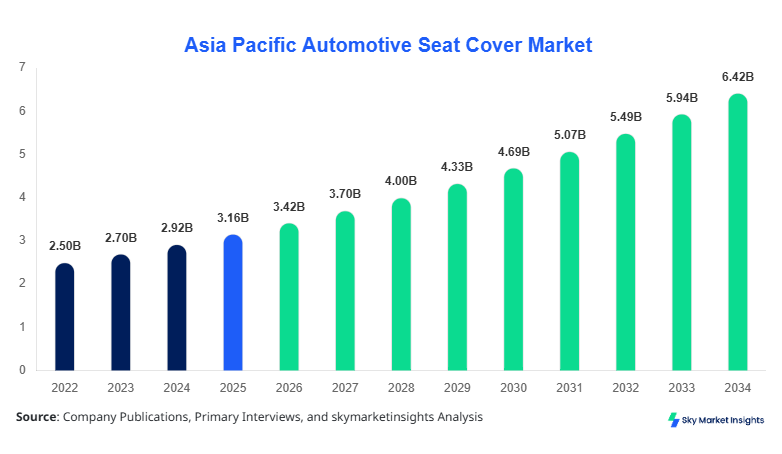
The Asia Pacific automotive seat cover market size is projected at USD 3.42 billion in 2026 and is expected to hit USD 6.87 billion by 2034 with a CAGR of 8.2%. The market growth is fueled by increasing automotive production, rising vehicle sales in developing economies, and demand for premium interior customization. Comprehensive data collection is essential to understand segment-wise performance, regional variations, and the competitive landscape, including global players like Adient PLC, Lear Corporation, and Faurecia. Segmentation by type and application provides critical insights into consumer preferences and adoption patterns, while competitive benchmarking highlights technological innovation, pricing trends, and strategic expansions across Asia Pacific.
The demand for automotive seat cover market insights is increasingly necessary for stakeholders to make informed decisions. This report covers production volumes, market share, revenue generation, and growth trajectories, enabling investors, manufacturers, and distributors to evaluate both short-term and long-term strategic planning. Data includes units sold, revenue per unit, and forecasted CAGR trends segmented across countries and vehicle types, which ensures precise targeting and investment planning. The competitive scenario, including mergers, acquisitions, and strategic alliances, further informs market stakeholders about potential opportunities and risks.
The Asia Pacific Automotive Seat Cover market exhibits dynamic growth patterns, driven by rising urbanization, disposable income, and technological advancements in seat cover materials. The segmentation analysis reveals key patterns in market penetration, with leather seat covers dominating the premium segment at 45% share, while fabric and synthetic variants account for 35% and 20% of the market, respectively. Passenger vehicles constitute 60% of demand, commercial vehicles 25%, and luxury vehicles 15%, highlighting varied adoption rates. Technical metrics such as tensile strength, wear resistance, and UV stability are critical to consumer selection, influencing overall market share, demand, and growth trends.
Explore more data points, trends and opportunities Download Free Sample Report
Automotive Seat Cover Market Trends
Rise of Premium Leather and Hybrid Materials
The Asia Pacific automotive seat cover market is witnessing a rapid shift toward premium leather and hybrid materials. Production volumes reached 38 million units in 2025 and are expected to exceed 65 million units by 2030, driven by consumer demand for durability and aesthetic appeal. Leather seat covers dominate high-end passenger vehicles with a 45% share, while hybrid synthetic-leather variants account for 20% of production. Technology adoption, including antimicrobial coatings and UV-resistant finishes, has reached 35% among manufacturers, reflecting innovation in material performance. Sector-specific demand is notable in luxury vehicles, with 70% of production integrating advanced features. These trends reinforce the significance of automotive seat cover market growth and consumer-centric innovation in the Asia Pacific.
Expansion of Aftermarket Customization Services
Aftermarket customization services are significantly impacting the Asia-Pacific automotive seat cover market. Production in India, China, and Southeast Asia increased by 22% year-over-year in 2025, reaching 48 million units, reflecting rising consumer preference for personalization. Technology adoption, such as 3D-printed patterns and digitally controlled embroidery, has been implemented by 18% of aftermarket service providers. Passenger vehicles contribute 60% of aftermarket demand, while commercial and luxury vehicles account for 25% and 15%, respectively. Material preferences skew toward high-quality fabric and synthetic leather, with average unit prices ranging from USD 45 to 120. This trend underscores growing automotive seat cover market demand, highlighting strategic opportunities for manufacturers and service providers.
Integration of Smart and Connected Features
The incorporation of smart and connected features, including heated and ventilated seat covers with IoT-enabled sensors, is accelerating in the Asia Pacific automotive seat cover market. Production volumes for such technologically advanced covers reached 8.2 million units in 2025, with expected growth to 16 million units by 2030. Adoption rates in luxury vehicles have risen to 55%, while premium passenger vehicles exhibit 30% integration. These innovations enhance user experience and safety, reinforcing the market’s growth trajectory. Automotive seat cover market insights reflect the increasing emphasis on connected technology, predictive maintenance, and consumer comfort, aligning with broader automotive digital transformation trends.
Asia Pacific Automotive Seat Cover Market Drivers
Rising Vehicle Production and Consumer Affordability
The Asia Pacific Automotive Seat Cover market is primarily driven by rapid vehicle production and increasing consumer affordability. Automotive manufacturing in China, India, and Japan reached 85 million units in 2025, with the region contributing over 52% of global production. Rising disposable incomes, urbanization rates averaging 3.1% CAGR, and government incentives have enhanced vehicle ownership, resulting in a projected demand increase of 8–9% CAGR for seat covers. Premium seat cover adoption, including leather and hybrid materials, has expanded to 48% of market volume, while fabric variants dominate 37%. Passenger vehicles account for 61% of demand, commercial vehicles 26%, and luxury vehicles 13%. Technological integration, including anti-slip and antimicrobial coatings, is observed in 35% of new production. Such dynamics highlight the importance of automotive seat cover market insights in identifying growth sectors, optimizing production capacity, and allocating investment effectively to capitalize on market trends.
Asia Pacific Automotive Seat Cover Market Restraints
Rising Raw Material Costs and Supply Chain Constraints
The Asia Pacific Automotive Seat Cover market faces challenges from escalating raw material costs and supply chain limitations. Leather prices surged 12% in 2025 and synthetic blends 8%, impacting profit margins and production volumes. Supply chain disruptions, particularly in Southeast Asia and India, caused a 5% decline in timely delivery, while transportation costs rose 6–7%. These factors contribute to slower expansion in cost-sensitive segments, with fabric seat cover adoption maintaining dominance at 37% while premium leather accounts for 45%. Production volumes of 65 million units in 2025 faced constraints, projected to reach 112 million units by 2034. Regional share disparities, such as 40% contribution from China versus 18% from India, further complicate market operations. Automotive seat cover market insights emphasize the need for strategic sourcing, cost optimization, and investment in supply chain resilience to mitigate these restraints and sustain growth.
Asia Pacific Automotive Seat Cover Market Opportunities
Emerging Markets and Aftermarket Expansion
The Asia Pacific Automotive Seat Cover market presents substantial opportunities in emerging markets and aftermarket services. India, Southeast Asia, and Taiwan are witnessing vehicle production growth rates of 6–8% CAGR, supporting increased seat cover demand. Aftermarket customization, including premium and technologically advanced covers, accounts for 22% of regional volume, with unit production expected to rise from 48 million in 2025 to 85 million by 2034. Adoption of eco-friendly and sustainable materials is increasing, with 15% penetration in 2026 projected to grow to 30% by 2034. Passenger vehicles lead adoption at 60%, commercial vehicles 25%, and luxury vehicles 15%. These trends reinforce the significance of automotive seat cover market insights in enabling manufacturers and investors to capitalize on growth opportunities and emerging sector dynamics.
Challenges in the Asia-Pacific Automotive Seat Cover Market
Technological Integration and Cost Management
The Asia Pacific Automotive Seat Cover market encounters challenges in balancing technological integration with cost management. Adoption of smart and connected seat covers, including IoT-enabled and ventilated variants, reached 8.2 million units in 2025, representing 12% of total production. High R&D costs, averaging USD 3–5 million per new feature, and unit price increases of 10–15% impact market penetration. Cost-sensitive passenger vehicle segments, comprising 61% of total demand, may delay adoption, while luxury vehicles, representing 15%, drive high-margin sales. Technical performance metrics, including durability, UV resistance, and anti-microbial coatings, are critical to market success. Automotive seat cover market insights guide manufacturers in optimizing technology deployment, managing costs, and targeting segments effectively to sustain growth.
Report Scope
| Report Metric | Details |
|---|---|
| Market Size in 2025 | USD 3.16 Billion |
| Market Size in 2026 | USD 3.42 Billion |
| Market Size in 2034 | USD 6.87 Billion |
| CAGR | 8.2% (2026-2034) |
| Base Year for Estimation | 2025 |
| Historical Data | 2022-2024 |
| Forecast Period | 2026-2034 |
| Report Coverage | Revenue Forecast, Competitive Landscape, Supply Chain Disruption, Growth Factors, Environment & Regulatory Landscape and Trends |
Explore more data points, trends and opportunities Download Free Sample Report
Automotive Seat Cover Market Segmentation
Segmentation analysis provides a detailed understanding of market dominance, with leather seat covers holding a 45% share, fabric 37%, and synthetic 18%. Passenger vehicles dominate applications at 60%, commercial vehicles 25%, and luxury vehicles 15%. Segmentation insights enable precise targeting, investment allocation, and forecasting of future demand while reinforcing automotive seat cover market size, share, and growth potential.
By Type
Fabric seat covers dominate cost-sensitive segments, representing 37% of production with 24 million units produced in 2025. Technical specifications include tensile strength of 320 N, abrasion resistance of 35,000 cycles, and flame retardancy. Applications span passenger vehicles (60%), commercial vehicles (25%), and luxury vehicles (15%), with adoption concentrated in mass-market segments. Market growth for fabric covers is projected at 7.5% CAGR, reflecting increasing urban vehicle ownership and affordability considerations.
Leather seat covers hold a 45% market share, with 28 million units produced in 2025, primarily in premium passenger and luxury vehicles. Technical attributes include tensile strength of 380 N, UV resistance of 90%, and antimicrobial coatings on 35% of units. Adoption in luxury vehicles accounts for 70%, passenger vehicles 50%, and commercial vehicles 20%. Price per unit ranges from USD 120–150, reflecting premium positioning. Leather covers’ CAGR is projected at 8.7%, reflecting strong growth in high-income demographics.
Synthetic seat covers comprise 18% of the market, with 13 million units in 2025, driven by commercial vehicle demand. Technical specifications include tensile strength of 340 N, abrasion resistance of 32,000 cycles, and moisture-wicking capabilities. Passenger vehicle adoption is 35%, commercial 50%, and luxury 15%. Synthetic covers offer cost-effective alternatives to leather, with a projected CAGR of 8.1% through 2034.
By Application
Passenger vehicles account for 60% of the Asia Pacific automotive seat cover market, producing 39 million units in 2025. Material preferences include fabric (37%), leather (45%), and synthetic (18%). Adoption of advanced features such as UV protection and moisture resistance reached 30% of units. Market growth is projected at 8% CAGR, driven by urbanization, rising disposable income, and aftermarket customization trends.
Commercial vehicles contribute 25% of market share, with 16 million units produced in 2025. Fabric covers dominate at 50%, synthetic 35%, and leather 15%. Technical specifications emphasize durability and abrasion resistance. Adoption of antimicrobial and moisture-resistant features is at 18%. CAGR is expected at 7.8%, supported by fleet expansions and logistics sector growth.
Luxury vehicles account for 15% of market share, producing 9.8 million units in 2025. Leather and hybrid seat covers dominate at 70% and 20%, respectively, with fabric at 10%. Advanced features, including smart sensors, heating, and ventilation, are integrated into 55% of units. CAGR is projected at 9%, reflecting growth in premium automotive segments and consumer willingness to pay for advanced comfort and technology.
Asia Pacific Automotive Seat Cover Market Segmentations
Type
- Fabric
- Leather
- Synthetic
Application
- Passenger Vehicles
- Commercial Vehicles
- Luxury Vehicles
Asia Pacific Automotive Seat Cover Market Regional Outlook
China
China holds a 40% share of Asia Pacific automotive seat cover production, with 26 million units produced in 2025. Passenger vehicles dominate at 60%, commercial vehicles 25%, and luxury vehicles 15%. Leather seat cover adoption is 50%, fabric 35%, and synthetic 15%. Emerging trends include smart seat cover integration in 10% of new vehicles. China’s dominance drives regional revenue of USD 1.36 billion, highlighting its critical role in Asia Pacific market growth.
South Korea
South Korea contributes 8% of regional production, with 5.2 million units in 2025. Premium leather covers dominate 55%, fabric 30%, and synthetic 15%. Passenger vehicles account for 65%, commercial 20%, and luxury 15%. Technology adoption, including heating and ventilated covers, reached 20%. Regional revenue is USD 0.42 billion, reinforcing automotive seat cover market insights.
Japan
Japan produces 7% of regional units, totaling 4.6 million in 2025. Leather covers dominate 50%, fabric 35%, and synthetic 15%. Passenger vehicles account for 60%, commercial 25%, and luxury vehicles 15%. Smart and connected features are integrated into 15% of production. Japan’s contribution to regional revenue is USD 0.39 billion, reflecting steady market growth.
India
India contributes 18% of regional production, with 12 million units in 2025. Passenger vehicles dominate 65%, commercial 25%, and luxury vehicles 10%. Technology adoption in premium and hybrid covers reached 40%. Regional revenue is USD 0.62 billion, highlighting India as a key driver of Asia Pacific automotive seat cover market growth.
Australia
Australia accounts for 5% of regional production, with 3.2 million units in 2025. Leather seat covers represent 40%, fabric 40%, and synthetic 20%. Passenger vehicles account for 70%, commercial 20%, and luxury 10%. Technology adoption in smart covers is at 10%. Regional revenue is USD 0.18 billion, reflecting moderate growth potential.
Singapore
Singapore produces 3% of regional units, totaling 1.9 million in 2025. Leather covers dominate 45%, fabric 35%, and synthetic 20%. Passenger vehicles account for 60%, commercial 25%, and luxury 15%. Smart cover adoption is at 15%. Regional revenue is USD 0.11 billion, indicating niche market demand.
Taiwan
Taiwan contributes 4% of regional production, with 2.6 million units in 2025. Leather covers account for 50%, fabric 35%, and synthetic 15%. Passenger vehicles 60%, commercial 25%, and luxury vehicles 15%. Smart cover adoption is at 12%. Regional revenue is USD 0.15 billion.
Southeast Asia
Southeast Asia contributes 15% of regional production, totaling 9.7 million units in 2025. Passenger vehicles dominate 55%, commercial 30%, and luxury vehicles 15%. Leather covers represent 45%, fabric 35%, and synthetic 20%. Smart and hybrid seat covers are integrated in 12% of units. Regional revenue is USD 0.84 billion, reflecting emerging market potential.
Top players in Asia Pacific Automotive Seat Cover Market
- Adient PLC
- Lear Corporation
- Faurecia
- Toyota Boshoku Corporation
- Magna International
- TACHI-S CO., Ltd.
- Grammer AG
- Toyota Industries Corporation
- Toyota Tsusho Corporation
- Toyota Motor Corporation
- Hyundai Mobis
- Hyundai Motor Company
- Kia Motors Corporation
- Dongfeng Motor Corporation
- Honda Motor Company
Leading Players
Adient PLC
-
Market Share: 12%
-
Leading global manufacturer with a focus on leather and synthetic seat covers. Strong presence in China, India, and
Frequently Asked Questions
Market Research Analyst | 8 Years Experience | Automotive Components and Aftermarket
Brenda Johnson is a market research analyst with 7–9 years of experience specializing in automotive markets. Contributed to 70+ research reports for global clients. Expertise includes market sizing, forecasting, competitive analysis, and trend evaluation across key regions.