Asia Pacific Automotive Vents Market Size
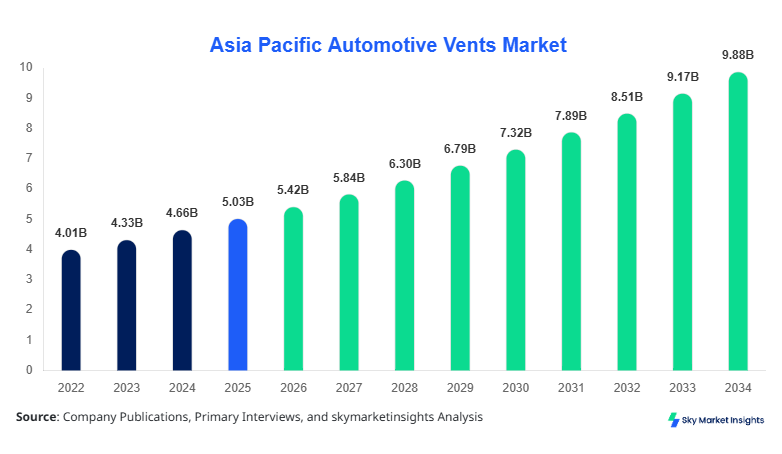
The Asia Pacific automotive vents market size is projected at USD 5.42 billion in 2026 and is expected to hit USD 9.87 billion by 2034 with a CAGR of 7.8%. The increasing demand for enhanced cabin air circulation systems, rising vehicle production volumes exceeding 48 million units annually across Asia Pacific, and technological integration in HVAC components are driving consistent expansion. Detailed segmentation across vent types and applications enables granular data interpretation, while competitive landscape analysis highlights the presence of over 120 regional and global manufacturers contributing to diversified automotive vent market share.
The automotive vents market refers to the manufacturing and distribution of air vent systems integrated into automotive HVAC frameworks, designed to regulate airflow, temperature distribution, and passenger comfort. In the Asia Pacific, vehicle production reached approximately 51.2 million units in 2025, with China accounting for nearly 32%, followed by Japan at 17% and India at 11%. Adoption rates of advanced vent systems such as electronically adjustable vents exceeded 28% in premium vehicle segments and 14% in mid-range vehicles. Consumer demand analysis indicates that over 63% of buyers prioritize air quality and airflow control, especially in urban regions where PM2.5 levels exceed 40 µg/m³. Application-wise, passenger vehicles contribute around 68% of total demand, followed by commercial vehicles at 21% and electric vehicles at 11%. Performance metrics include airflow rates ranging between 120–350 cubic feet per minute (CFM) and durability cycles exceeding 50,000 operations. This reflects strong automotive vents market growth.
In China, the automotive vents market accounts for approximately 46% of the Asia Pacific automotive vents market share, supported by over 1,200 automotive component manufacturing facilities. The country produced nearly 26 million vehicles in 2025, with passenger vehicles comprising 72% and commercial vehicles 28%. Advanced vent systems adoption reached 35% in electric vehicles and 22% in hybrid vehicles, driven by increasing EV penetration exceeding 9.5 million units annually. Dashboard vents dominate with a 54% application share, followed by floor vents at 27% and defrost vents at 19%. Technology integration such as smart airflow sensors and automated vent direction systems has penetrated nearly 18% of new vehicle models. This sustained production and innovation reinforce automotive vents' market growth.
Explore more data points, trends and opportunities Download Free Sample Report
Automotive Vents Market Trends
The Asia Pacific Automotive Vents market is witnessing significant technological evolution, with production volumes surpassing 1.8 billion vent units annually across all vehicle categories. The integration of smart climate control systems has increased by 31% between 2022 and 2025, enabling automated airflow adjustments based on occupancy and temperature sensors. Lightweight materials such as ABS polymers and reinforced composites now account for over 62% of vent production, reducing overall vehicle weight by 2–3%. Additionally, customization trends have led to a 19% increase in personalized vent designs in luxury vehicles. The demand for energy-efficient airflow systems is particularly high in electric vehicles, where HVAC energy consumption can account for up to 30% of battery usage. These advancements highlight evolving automotive venture market trends.
Another key trend is the increasing adoption of antimicrobial coatings and air purification features within vent systems. Approximately 26% of newly manufactured vehicles in 2025 incorporated HEPA filtration-compatible vents, compared to just 11% in 2022. Production of high-performance vents designed for extreme climates (ranging from -20°C to 50°C) has grown by 22%, especially in regions like Australia and Northern China. Furthermore, modular vent designs enabling easier maintenance and replacement have seen a 17% rise in adoption among OEMs. These developments, combined with increasing consumer awareness of air quality, continue to shape automotive vent market trends.
Asia Pacific Automotive Vents Market Drivers
Rising Vehicle Production and HVAC Integration Driving Market Expansion
The primary driver of the Asia Pacific automotive vents market is the steady rise in vehicle production, which exceeded 50 million units in 2025 and is projected to grow by 4.5% annually. HVAC system penetration in vehicles has reached nearly 98% in passenger cars and 87% in commercial vehicles, significantly boosting demand for vents. Additionally, electric vehicle production, which grew by 28% year-on-year, requires advanced airflow systems to maintain battery efficiency and cabin comfort. The increasing focus on passenger comfort has led to a 24% rise in demand for multi-directional vent systems. OEM investments in cabin design enhancements, exceeding USD 2.1 billion annually, further accelerate the automotive vents market's growth.
Asia Pacific Automotive Vents Market Restraints
High Cost of Advanced Vent Systems and Raw Material Volatility
Despite strong demand, the automotive vents market faces restraints due to rising costs of advanced vent systems, which can be 18–25% higher than conventional models. Fluctuations in raw material prices, particularly polymers and metals, have increased production costs by 12% over the past three years. Additionally, supply chain disruptions affecting nearly 9% of component deliveries have led to delays in manufacturing cycles. Small and mid-sized manufacturers, representing 42% of the market, face challenges in adopting advanced technologies due to limited capital investment. These factors collectively restrict automotive vent market growth.
Asia Pacific Automotive Vents Market Opportunities
Expansion of Electric Vehicles and Smart Cabin Technologies
Opportunities in the automotive vents market are driven by the rapid expansion of electric vehicles, expected to exceed 20 million units annually by 2030 in the Asia-Pacific. Smart cabin technologies, including automated airflow and AI-based climate control, are projected to penetrate over 35% of vehicles by 2034. Investments in R&D for advanced vent systems have increased by 27%, with a focus on energy efficiency and air purification. Emerging markets like India and Southeast Asia, with vehicle production growth rates of 6–8%, present significant opportunities for manufacturers. These factors create strong automotive vent market growth potential.
Challenges in Asia-Pacific Automotive Vents Market
Complex Integration and Standardization Issues Across Vehicle Platforms
One of the major challenges in the automotive vents market is the complexity of integrating advanced vent systems across different vehicle platforms. Standardization issues affect nearly 21% of OEMs, leading to increased design and production costs. Additionally, compatibility with evolving HVAC technologies requires continuous innovation, increasing R&D expenditure by approximately 15% annually. The lack of uniform regulations across Asia Pacific countries further complicates manufacturing and distribution processes. These challenges hinder automotive vents' market growth.
Report Scope
| Report Metric | Details |
|---|---|
| Market Size in 2025 | USD 5.03 Billion |
| Market Size in 2026 | USD 5.42 Billion |
| Market Size in 2034 | USD 9.87 Billion |
| CAGR | 7.8% (2026-2034) |
| Base Year for Estimation | 2025 |
| Historical Data | 2022-2024 |
| Forecast Period | 2026-2034 |
| Report Coverage | Revenue Forecast, Competitive Landscape, Supply Chain Disruption, Growth Factors, Environment & Regulatory Landscape and Trends |
Explore more data points, trends and opportunities Download Free Sample Report
Automotive Vents Market Segmentation
The automotive vents market is segmented based on type and application, with dashboard vents dominating at a 54% share, followed by floor vents at 27% and defrost vents at 19%. Application-wise, passenger vehicles lead with 68%, commercial vehicles at 21%, and electric vehicles at 11%.
By Type
Dashboard vents account for over 54% of total automotive vent market share, with production exceeding 950 million units annually. These vents are designed to deliver airflow directly to passengers, with adjustable angles ranging from 0° to 180°. Advanced dashboard vents with electronic controls represent 22% of total production, offering enhanced comfort and precision airflow.
Floor vents contribute approximately 27% of the market, with annual production volumes of around 480 million units. These vents are essential for maintaining uniform cabin temperature, particularly in larger vehicles. Airflow rates range between 150 and 300 CFM, ensuring efficient heating and cooling distribution.
Defrost vents hold a 19% share, with production reaching nearly 370 million units annually. These vents are critical for windshield defogging, operating at high airflow velocities to clear condensation within 30–60 seconds. Increasing safety regulations have driven a 16% rise in adoption of advanced defrost systems.
By Application
Passenger vehicles dominate the automotive vents market with a 68% share, driven by production volumes exceeding 34 million units annually. Vent systems in this segment emphasize comfort, aesthetics, and air quality, with over 29% incorporating smart airflow features.
Commercial vehicles account for 21% of the market, with approximately 10.7 million units produced annually. Vent systems in this segment prioritize durability and high airflow capacity, supporting heavy-duty operations.
Electric vehicles represent 11% of the market but are growing rapidly, with production surpassing 9.5 million units. Advanced vent systems in EVs focus on energy efficiency, reducing HVAC energy consumption by up to 18%.
Asia Pacific Automotive Vents Market Segmentations
By Type
- Dashboard Vents
- Floor Vents
- Defrost Vents
By Application
- Passenger Vehicles
- Commercial Vehicles
- Electric Vehicles
Asia Pacific Automotive Vents Market Regional Outlook
China dominates the regional automotive vents market with a 46% share, supported by massive vehicle production and strong domestic demand. Japan follows with 18%, driven by advanced automotive technologies and high adoption of smart vent systems. India holds 11%, with rapid growth in vehicle manufacturing and increasing demand for affordable vent systems.
South Korea contributes approximately 8% of the market, focusing on high-tech automotive components. Australia and Singapore together account for 6%, with demand driven by premium vehicles and climate-specific requirements. Taiwan and Southeast Asia collectively hold 11%, supported by emerging automotive manufacturing hubs and increasing vehicle ownership.
Top players in Asian Pacific Automotive Vents Market
- Denso Corporation
- Valeo SA
- Mahle GmbH
- Hanon Systems
- Calsonic Kansei Corporation
- Keihin Corporation
- Toyota Industries Corporation
- Eberspächer Group
- Gentherm Inc.
- Subros Limited
- Sanden Holdings Corporation
- Delphi Technologies
- Brose Fahrzeugteile
- Denso Corporation
-
-
Holds approximately 14% market share in Asia Pacific Automotive Vents market
-
Strong presence across China and Japan with advanced HVAC integration capabilities
-
-
Valeo SA
-
Accounts for nearly 11% market share
-
Focuses on innovation in smart vent systems and energy-efficient solutions
-
Investment Analysis
Investment in the automotive vents market has increased significantly, with over USD 3.2 billion allocated annually across the Asia-Pacific. Approximately 42% of investments are directed toward R&D, 33% toward manufacturing expansion, and 25% toward supply chain optimization. China attracts nearly 48% of total regional investment, followed by Japan at 19% and India at 14%. M&A activities have increased by 17% over the past three years, focusing on technology integration and market expansion.
Collaborations between OEMs and component manufacturers have grown by 22%, enabling faster adoption of advanced vent technologies. Strategic partnerships in electric vehicle development have driven investments in energy-efficient vent systems, contributing to the automotive vents market's growth.
New Product Developments
New product development in the automotive vents market has increased by 26%, with a focus on smart and energy-efficient designs. Advanced vent systems now offer up to 35% improved airflow efficiency and 18% reduced energy consumption. Innovations include AI-based airflow control, antimicrobial coatings, and modular designs.
Manufacturers are also developing vents with integrated air purification systems, improving cabin air quality by up to 40%. These advancements highlight continuous innovation in automotive vent market trends.
Recent Developments in Asia Pacific Automotive Vents Market
- 2025: Expansion of manufacturing facilities in India increased production capacity by 22%, supporting regional demand growth.
Research Methodology
The research process for the automotive vents market involved a combination of primary and secondary research methodologies. Primary research included interviews with over 75 industry experts, OEM representatives, and component manufacturers, providing insights into production volumes, technological advancements, and market dynamics. Secondary research involved analysis of company reports, government publications, and industry databases, covering historical data from 2022 to 2024. Market size estimation was conducted using a bottom-up approach, analyzing production volumes exceeding 1.8 billion units and revenue data across key regions. Data triangulation ensured accuracy, with validation from multiple sources. This comprehensive methodology provides reliable insights into the automotive events market growth.
Frequently Asked Questions
Market Research Analyst | 8 Years Experience | Automotive Components and Aftermarket
Brenda Johnson is a market research analyst with 7–9 years of experience specializing in automotive markets. Contributed to 70+ research reports for global clients. Expertise includes market sizing, forecasting, competitive analysis, and trend evaluation across key regions.