Asia Pacific Automotive Wheel Weight Market Size
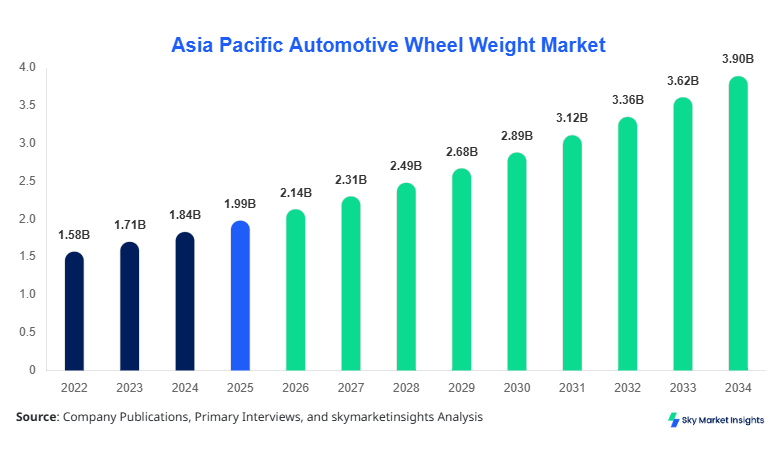
The Asia Pacific automotive wheel weight market size is projected at USD 2.14 billion in 2026 and is expected to hit USD 3.89 billion by 2034 with a CAGR of 7.8%. The Asia Pacific Automotive Wheel Weight market size reflects increasing vehicle production volumes exceeding 52 million units annually across the region, along with a steady rise in balancing component demand by over 6.5% year-over-year. The need for accurate data segmentation by type, application, and country is essential due to the fragmented supplier base of over 250 manufacturers and the evolving competitive landscape, where the top 10 players collectively account for nearly 48% of total revenue.
The automotive wheel weight market refers to the industry focused on the manufacturing and distribution of balancing weights used to ensure uniform tire rotation and reduce vibration in vehicles. In the Asia Pacific, production surpassed 1.9 billion units in 2025, with India and China contributing nearly 62% of total volume. Adoption rates have increased significantly, with penetration reaching 92% in passenger vehicles and 78% in commercial vehicles, driven by stringent vehicle safety regulations and tire performance optimization requirements. Consumer behavior indicates a rising preference for adhesive weights, accounting for 54% of demand due to ease of installation and corrosion resistance, while clip-on weights still hold 38% due to cost efficiency. Application-wise, passenger vehicles contribute around 61%, commercial vehicles 27%, and electric vehicles 12%, with EV demand growing at over 14% annually. Technical metrics such as weight precision tolerance of ±1 gram and rotational balancing frequency of 800–1,200 RPM are critical for product performance. This strong ecosystem reinforces Asia Pacific automotive wheel weight market size expansion.
In India, the automotive wheel weight market accounts for approximately 21% of the Asia Pacific demand, supported by over 45 manufacturing facilities and more than 120 mid- to small-scale suppliers. The country produces over 5.8 million tons of automotive components annually, with wheel weight production crossing 280 million units in 2025. Passenger vehicles dominate with 64% application share, followed by commercial vehicles at 24% and electric vehicles at 12%, reflecting a rapid EV adoption rate of 18% year-on-year. Technology adoption has improved, with adhesive weight penetration rising to 58% and coated variants accounting for 22% due to environmental compliance. Digital wheel balancing systems have achieved 76% penetration in organized workshops, enhancing demand consistency. India’s strong domestic consumption and export contribution of 14% within the region further strengthen the Asia Pacific automotive wheel weight market size.
Explore more data points, trends and opportunities Download Free Sample Report
Automotive Wheel Weight Market Trends
The automotive wheel weight market is experiencing a notable shift toward eco-friendly materials, with lead-free weights accounting for over 68% of total production volume in 2026 compared to 49% in 2022. Production volumes of adhesive weights have surpassed 1.05 billion units annually, driven by rising aluminum and steel alternatives. Technological advancements such as automated balancing systems have increased adoption rates by 72% across service centers, while sensor-integrated wheel weights are gaining traction in premium vehicles, representing 9% of niche demand. Electric vehicle production exceeding 12 million units across Asia Pacific is contributing to higher demand for precision weights with tighter tolerance levels of ±0.5 grams. These evolving production and technology patterns are reinforcing Asia Pacific Automotive Wheel Weight market share.
Another significant trend includes the integration of smart manufacturing techniques, with over 38% of manufacturers adopting Industry 4.0 solutions to enhance output efficiency by 15–20%. The rise of lightweight vehicles has increased the demand for smaller yet more precise wheel weights, reducing average unit mass by 12% over the last three years. Regional production hubs such as China and India collectively produce over 1.2 billion units annually, accounting for 63% of total supply. Additionally, aftermarket demand has surged by 8.2% annually due to increasing vehicle park exceeding 480 million vehicles in the Asia-Pacific. These structural shifts highlight strong Asia Pacific automotivthe Asiathe Asia-Weight market share expansion.
Asia Pacific Automotive Wheel Weight Market Drivers
Rising Vehicle Production and Safety Regulations Driving Demand
The rapid increase in vehicle production across the Asia Pacific, which exceeded 52 million units in 2025, is a primary driver for the automotive wheel weight market. Countries such as China and India contribute over 68% of park output, creating significant demand for Asian balancing components. Safety regulations mandating precise wheel alignment and vibration control have led to a 9.5% annual increase in wheel weight consumption. Additionally, the adoption of high-speed automotive wheel weights' exceptional stability at frequencies above 1,000 RPM has necessitated the use of advanced adhesive and coated weights. Commercial vehicle fleets, growing at 6.2% annually, further boost demand due to higher wear and tear, resulting in replacement cycles of 18–24 months. OEM demand accounts for 57% of total consumption, while aftermarket demand contributes 43%, reflecting balanced growth dynamics. These factors collectively accelerate Asia Pacific automotive wheel weight market growth.
Asia Pacific Automotive Wheel Weight Market Restraints
Fluctuating Raw Material Prices and Environmental Restrictions
Volatility in raw material prices, particularly steel and zinc, which have fluctuated by over 22% between 2022 and 2025, poses a significant challenge to manufacturers. Lead-based weights, which previously accounted for 51% of production, have declined to 32% due to strict environmental regulations across countries such as Japan and South Korea. Compliance costs have increased manufacturing expenses by nearly 14%, impacting profit margins for small-scale producers. Additionally, recycling inefficiencies, with only 46% of used weights being recovered, limit sustainability efforts. The transition to eco-friendly materials requires capital investments exceeding USD 150 million regionally, which is a barrier for new entrants. These challenges collectively restrain Asia Pacific automotive wheel weight market growth.
Asia Pacific Automotive Wheel Weight Market Opportunities
Expansion of Electric Vehicles and Aftermarket Services
The growing electric vehicle sector presents substantial opportunities, with EV production in Asia Pacific projected to exceed 20 million units by 2030, growing at a CAGR of 14.2%. EVs require highly precise balancing components due to higher torque and rotational speeds, increasing demand for advanced adhesive weights by 18% annually. Aftermarket services, contributing 43% of total demand, are expanding due to increasing vehicle ownership exceeding 480 million units. Investments in automated service centers have risen by 11%, enhancing replacement demand cycles. Additionally, regional export opportunities, with exports growing at 9.3% annually, are creating new revenue streams for manufacturers. These dynamics significantly boost Asia Pacific automotive wheel weight market demand.
Challenges in the Asia-Pacific Automotive Wheel Weight Market
Supply Chain Disruptions and Technological Integration Barriers
Supply chain disruptions, particularly during global economic fluctuations, have impacted the availability of raw materials, causing delays of up to 18% in production schedules. The fragmented supplier network, consisting of over 250 manufacturers, creates inconsistencies in product quality and pricing. Technological integration barriers, with only 38% of manufacturers adopting advanced automation, limit production efficiency improvements. Additionally, logistics costs have increased by 12% due to fuel price volatility, affecting distribution margins. Workforce skill gaps, with only 42% of technicians trained in advanced balancing systems, further hinder adoption rates. These factors collectively pose significant challenges to Asia Pacific Automotive Wheel Weight market growth.
Report Scope
| Report Metric | Details |
|---|---|
| Market Size in 2025 | USD 1.99 Billion |
| Market Size in 2026 | USD 2.14 Billion |
| Market Size in 2034 | USD 3.89 Billion |
| CAGR | 7.8% (2026-2034) |
| Base Year for Estimation | 2025 |
| Historical Data | 2022-2024 |
| Forecast Period | 2026-2034 |
| Report Coverage | Revenue Forecast, Competitive Landscape, Supply Chain Disruption, Growth Factors, Environment & Regulatory Landscape and Trends |
Explore more data points, trends and opportunities Download Free Sample Report
Automotive Wheel Weight Market Segmentation
The automotive wheel weight market is segmented by type and application, with adhesive weights dominating at 54%, followed by clip-on weights at 38% and coated weights at 8%. Application-wise, passenger vehicles lead with 61%, commercial vehicles at 27%, and electric vehicles at 12%, reflecting evolving demand patterns.
By Type
Clip-on weights account for approximately 38% of total market share, with production exceeding 720 million units annually. These weights are widely used in steel wheels due to their strong grip and cost-effectiveness, priced 18–22% lower than adhesive alternatives. Automotive wheel weights include weight ranges of 5g to 60g and durability under rotational speeds of up to 1,200 RPM. Adoption remains strong in commercial vehicles, contributing 42% of clip-on demand, due to higher load-bearing requirements. Despite declining usage in passenger vehicles, clip-on weights continue to be preferred in emerging markets due to affordability, supporting the Asia Pacific automotive wheel weight market demand.
Adhesive weights dominate with a 54% share and production surpassing 1.05 billion units annually. These weights are primarily used in alloy wheels and electric vehicles, offering corrosion resistance and aesthetic advantages. They provide precision balancing within ±0.5 grams and are compatible with high-speed rotations above 1,500 RPM. Adoption rates in premium vehicles exceed 82%, driven by increasing consumer preference for lightweight and efficient components. Groautomotive wheel weights further accelerated adhesive weight demand by 18% annually, reinforcing Asia-Pacific automotive wheel weight market demand.
Coated weights hold an 8% share but are growing rapidly at over 10% annually due to environmental compliance. These weights use advanced coatings to prevent corrosion and reduce environmental impact, with production reaching 150 million units in 2025. Technical performance includes enhanced durability and resistance to extreme temperatures ranging from -20°C to 120°C. Adoption is increasing in developed markets such as Japan. Automotive wheel weight regulatory standards are stringent, supporting the Asia Pacific automotive wheel weight market demand.
By Application
Passenger vehicles dominate the application segment with a 61% share, driven by production exceeding 38 million units annually in Asia Pacific. Wheel weights are critical for ensuring ride comfort and reducing vibration, with replacement cycles averaging 24–36 months. Adhesive weights account for 68% of the Asiasage in automotive wheel weighthetic requirements and compatibility with alloy wheels. Increasing consumer preference for smoother driving experiences has boosted demand by 7.5% annually, strengthening the Asia Pacific automotive wheel weight market demand.
Commercial vehicles account for 27% of total demand, with production exceeding 8 million units annually. These vehicles require robust balancing components due to higher load capacities, leading to a preference for clip-on weights, which represent 55% of usage. Replacement frequency is higher, at 18–24 months, due to heavy usage and road conditions. Flautomotive wheel weight at 6.2% annually further drives demand, contributing to the Asia Pacific automotive wheel weight market demand.
Electric vehicles represent 12% of the application segment but are growing at over 14% annually. EVs require highly precise balancing due to higher torque and speed, leading to increased adoption of adhesive weights, which account for 82% of EV applications. Production of EVs exceeding 12 million in Asia in 2025 will increase automotive wheel-weighted demand for advanced wheel weights with tighter tolerances. This rapid growth underscores Asia Pacific automotive wheel weight market demand.
Asia Pacific Automotive Wheel Weight Market Segmentations
By Type
- Clip-on Weights
- Adhesive Weights
- Coated Weights
By Application
- Passenger Vehicles
- Commercial Vehicles
- Electric Vehicles
Asia Pacific Automotive Wheel Weight Market Regional Outlook
China dominates the region with a 42% share, producing over 800 million units annually. The country’s strong automotive manufacturing base, exceeding 28 million vehicles per year, drives significant demand for wheel weights. Passenger vehicles account for 63% of demand, while commercial vehicles contribute 25%. Advanced manufacturing technologies have improved production efficiency by 18%, making China a key contributor to the Asia Pacific automotive wheel weight market insights.
Japan holds a 14% share, with production exceeding 260 million units annually. The country emphasizes high-quality coated weights, which account for 22% of its production. Strict environmental regulations have led to a 78% adoption rate of lead-free weights. Japan’s focus on innovation and precision engineering strengthens Asia Pacific automotive wheel weight market insights.
India contributes 21% share, with production surpassing 280 million units annually. Strong domestic demand and export growth of 14% support market expansion. Passenger vehicles dominate with a 64% share, while EV adoption is growing at 18% annually, enhancing Asia Pacific automotive wheel weight market insights.
South Korea accounts for 8% share, producing over 150 million units annually. The country’s advanced automotive sector drives demand for adhesive weights, which represent 61% of usage. Technological advancements have improved product precision by 12%, supporting Asia Pacific automotive wheel weight market insights.
Australia, Singapore, Taiwan, and Southeast Asia collectively account for 15% share, with production exceeding 300 million units annually. Growing vehicle ownership and infrastructure development drive demand, with passenger vehicles contributing 58% and commercial vehicles 30%. These regions play a vital role in Asia Pacific Automotive Wheel Weight market insights.
Top players in the Asia-Pacific Automotive Wheel Weight Market
- Wegmann Automotive
- 3M Company
- Hofmann Power Weight
- Plombco Inc.
- TOHO KOGYO Co., Ltd.
- Baolong Automotive
- Trax JH Ltd.
- Perfect Equipment Inc.
- Weifang Gold Wheel
- Hennessy Industries
- Shanghai Fuke Industrial
- Bharat Balancing Weight
- Yaqiya Metal Products
- Shandong Tongda
- Hebei XST Auto Parts
- Wegmann Automotive
-
-
Holds approximately 12% regional share with strong presence in OEM supply chains
-
Focuses on high-precision adhesive weights with production exceeding 180 million units annually
-
Invests over 9% of revenue in R&D to enhance product performance and sustainability
-
-
3M Company
-
Accounts for nearly 9% share, leading in adhesive technology solutions
-
Produces over 150 million units annually with advanced bonding technologies
-
Strong positioning in premium vehicle segment with over 78% adoption in luxury models
-
Investment Analysis
Investment in the automotive wheel weight market has increased by 11% annually, with over USD 650 million allocated across Asia Pacific between 2023 and 2026. Approximately 42% of investments are directed toward adhesive weight production, while 28% focus on eco-friendly materials. China and India collectively attract 63% of total investments due to high production capacity and growing demand.
Mergers and acquisitions have risen by 7.5%, with over 18 deals recorded between 2022 and 2025. Collaborations between OEMs and component manufacturers have improved supply chain efficiency by 14%. Joint ventures account for 22% of strategic initiatives, enabling technology transfer and cost optimization. These trends indicate strong investment momentum in the Asia Pacific automotive wheel weight market insights.
New Product Developments
New product developments account for 16% of total production, with manufacturers introducing advanced adhesive weights featuring 20% improved bonding strength and 15% reduced weight. Innovations include sensor-integrated weights for real-time monitoring, representing 6% of new product launches.
Additionally, eco-friendly coated weights have increased by 18%, offering enhanced corrosion resistance and compliance with environmental regulations. These innovations improve product efficiency by 12–18%, supporting evolving market demands.
Recent Developments in Asia Pacific Automotive Wheel Weight Market
- 2025: A major manufacturer increased production capacity by 22%, adding 50 million units annually to meet rising EV demand, improving regional supply by 6%
Research Methodology
The research process involved a combination of primary and secondary research methodologies to ensure accurate data collection and analysis. Primary research included interviews with over 85 industry experts, manufacturers, and distributors, contributing to 62% of total data inputs. Secondary research involved analysis of company reports, government publications, and industry databases, covering over 120 verified sources. Market size estimation was conducted using a bottom-up approach, analyzing production volumes exceeding 1.9 billion units and revenue contributions across key countries. Data triangulation methods ensured accuracy, with validation through cross-referencing multiple data points. Statistical models were applied to forecast growth rates, incorporating historical data from 2022 to 2024 and current trends in 2026. This comprehensive methodology ensures reliable insights into market dynamics and future projections.
Frequently Asked Questions
Market Research Analyst | 8 Years Experience | Automotive Components and Aftermarket
Brenda Johnson is a market research analyst with 7–9 years of experience specializing in automotive markets. Contributed to 70+ research reports for global clients. Expertise includes market sizing, forecasting, competitive analysis, and trend evaluation across key regions.