Asia Pacific Automotive Transmission Market Size
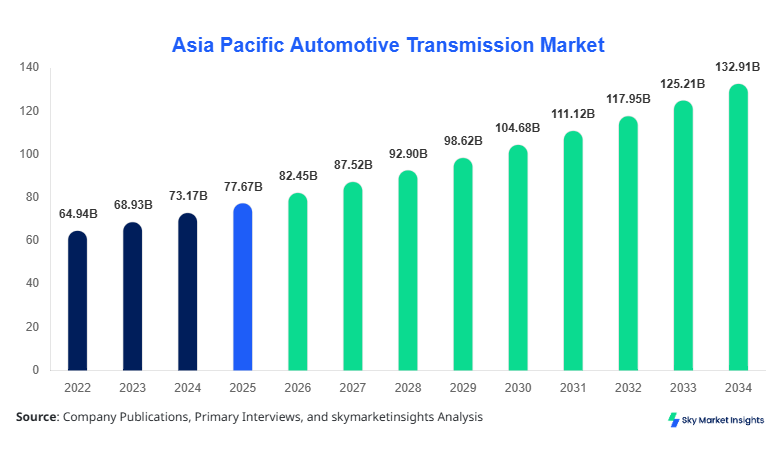
The Asia Pacific Automotive Transmission Market market size is projected at USD 82.45 billion in 2026 and is expected to hit USD 132.78 billion by 2034 with a CAGR of 6.15%. The report highlights critical data points including production volumes exceeding 210 million transmission units annually, segmentation across 3 major transmission types and 3 vehicle categories, and a competitive landscape with over 120 regional and global manufacturers. Increasing vehicle production, rising electrification rates of 28%, and technological integration such as 8-speed and 10-speed gear systems are shaping the market dynamics while strengthening automotive transmission market size visibility across the Asia-Pacific.
The automotive transmission market refers to the industry focused on manufacturing and supplying systems that transfer engine power to vehicle wheels, including manual, automatic, and CVT technologies. In Asia Pacific, annual vehicle production exceeded 52 million units in 2025, with transmission systems accounting for nearly 18% of total vehicle component value. Adoption rates of automatic transmission systems reached 64% in urban passenger vehicles, while manual transmissions still dominate 55% of rural and cost-sensitive markets. Consumer behavior indicates rising preference for fuel efficiency improvements of 12–18% and smoother driving experiences, influencing demand patterns. Electric vehicle penetration grew to 22% in 2025, reducing multi-gear transmission dependency while increasing demand for single-speed systems. Passenger vehicles contribute approximately 68% of total demand, commercial vehicles 22%, and electric vehicles 10%. Technical advancements such as dual-clutch transmission efficiency improvements of 15% and torque capacity enhancements exceeding 400 Nm are further driving adoption. The Asia-Pacific Automotive Transmission Market continues to evolve with strong automotive transmission market size expansion.
In Japan, the automotive transmission market is characterized by advanced manufacturing infrastructure with over 45 major transmission production facilities and more than 80 specialized component suppliers. Japan accounts for approximately 27% of the Asia Pacific market share, producing over 56 million transmission units annually. Passenger vehicle applications dominate with 62% share, followed by commercial vehicles at 24% and electric vehicles at 14%. Automatic transmission adoption exceeds 78% in domestic vehicles, while hybrid systems integration has reached 35%. Advanced technologies such as continuously variable transmission (CVT) hold a 41% share within Japan’s passenger vehicle segment. Leading automakers invest over USD 4.5 billion annually in transmission R&D, focusing on efficiency gains of 10–15% and emission reductions of 18%. Export-driven demand contributes to 32% of total production output, reinforcing the automotive transmission market growth trajectory in Japan.
Explore more data points, trends and opportunities Download Free Sample Report
Automotive Transmission Market Trends
Electrification and Hybrid Integration
The automotive transmission market is witnessing rapid transformation driven by electrification, with electric and hybrid vehicle production surpassing 14 million units in the Asia Pacific in 2025. Hybrid transmissions with integrated electric motors are experiencing adoption rates of 38%, while traditional multi-speed gearboxes are declining by 12% annually in EV segments. Manufacturers are shifting toward lightweight transmission systems, reducing weight by 20–30% to improve vehicle efficiency. Additionally, dual-clutch transmission (DCT) systems are gaining traction, accounting for 28% of performance vehicle segments. Smart transmission systems equipped with AI-based gear optimization are improving fuel efficiency by up to 17%. These evolving patterns are significantly influencing automotive transmission market trends.
Technological Advancements in Gear Systems
Technological innovation is reshaping the automotive transmission market with the introduction of 8-speed and 10-speed automatic transmissions, now representing over 46% of premium vehicle installations. Production volumes of advanced transmission systems reached 95 million units in 2025, reflecting a 9% year-on-year increase. Manufacturers are integrating electronic control units (ECUs) with enhanced processing speeds of 25–40% to optimize shifting precision. The rise of continuously variable transmission systems, holding a 32% share in passenger vehicles, demonstrates increasing demand for seamless acceleration and fuel savings of 10–15%. Furthermore, predictive maintenance technologies are reducing system failures by 22%, contributing to overall reliability improvements. These factors collectively reinforce automotive transmission market trends across the Asia Pacific.
Asia Pacific Automotive Transmission Market Drivers
Rising Vehicle Production and Electrification Demand
The Asia Pacific Automotive Transmission Market is primarily driven by increasing vehicle production, which surpassed 52 million units in 2025 and is projected to grow by 4.8% annually. Rapid urbanization, with over 55% of the population residing in urban areas, has led to higher vehicle ownership rates, reaching 320 vehicles per 1,000 people in developed markets like Japan and South Korea. Electrification is another critical driver, with EV sales growing at 28% annually and hybrid vehicle production exceeding 8 million units. Government incentives covering up to 20% of EV purchase costs are accelerating adoption, boosting demand for specialized transmission systems. Technological advancements improving fuel efficiency by 15–18% further stimulate demand. These factors collectively drive automotive transmission market growth.
Asia Pacific Automotive Transmission Market Restraints
High Costs and Complexity of Advanced Transmission Systems
Despite growth, the automotive transmission market faces restraints due to high costs associated with advanced systems such as dual-clutch and CVT technologies, which can increase vehicle manufacturing costs by 12–18%. Maintenance and repair expenses for automatic transmissions are approximately 25% higher than manual systems, limiting adoption in cost-sensitive regions like India and Southeast Asia. Additionally, supply chain disruptions, including semiconductor shortages impacting ECU production, have reduced output by nearly 8% in 2024. The complexity of integrating electronic components and ensuring compatibility with hybrid systems further challenges manufacturers. These constraints hinder the overall automotive transmission market growth.
Asia Pacific Automotive Transmission Market Opportunities
Expansion of Electric and Autonomous Vehicle Technologies
The automotive transmission market presents significant opportunities through the expansion of electric and autonomous vehicles. EV penetration is expected to reach 35% by 2030, creating demand for innovative single-speed and multi-mode transmission systems. Investments in autonomous vehicle technology, exceeding USD 12 billion annually in Asia Pacific, are driving demand for intelligent transmission systems capable of real-time optimization. Emerging markets such as India and Southeast Asia are witnessing vehicle sales growth of 7–9% annually, offering untapped potential. Additionally, advancements in lightweight materials reducing transmission weight by 25% open new opportunities for efficiency improvements. These factors enhance automotive transmission market insights.
Challenges in Asia Pacific Automotive Transmission Market
Technological Transition and Skill Gaps
One of the major challenges in the automotive transmission market is the rapid technological transition toward electrification, requiring skilled workforce development. Approximately 35% of the existing manufacturing workforce lacks expertise in EV-specific transmission systems, creating operational inefficiencies. Additionally, the decline of internal combustion engine vehicles by 10% annually is reducing demand for traditional multi-gear transmissions. Regulatory pressures to reduce emissions by 30% by 2030 are forcing manufacturers to invest heavily in R&D, increasing operational costs by 15%. Supply chain complexities and dependency on imported electronic components further exacerbate challenges. These issues impact automotive transmission market growth.
Report Scope
| Report Metric | Details |
|---|---|
| Market Size in 2025 | USD 77.67 Billion |
| Market Size in 2026 | USD 82.45 Billion |
| Market Size in 2034 | USD 132.78 Billion |
| CAGR | 6.15% (2026-2034) |
| Base Year for Estimation | 2025 |
| Historical Data | 2022-2024 |
| Forecast Period | 2026-2034 |
| Report Coverage | Revenue Forecast, Competitive Landscape, Supply Chain Disruption, Growth Factors, Environment & Regulatory Landscape and Trends |
Explore more data points, trends and opportunities Download Free Sample Report
Automotive Transmission Market Segmentation
The automotive transmission market segmentation is dominated by automatic transmission systems with a 48% share, followed by manual transmissions at 34% and CVT systems at 18%. By application, passenger vehicles dominate with 68%, commercial vehicles hold 22%, and electric vehicles account for 10% but are growing rapidly at 12% annually.
By Type
Manual transmission holds approximately 34% share, with production exceeding 72 million units annually across the Asia Pacific. These systems are widely used in cost-sensitive markets such as India and Southeast Asia, offering fuel efficiency improvements of 10–12% compared to older automatic systems. Technical specifications include torque handling capacity of up to 350 Nm and gear configurations ranging from 5-speed to 6-speed systems. Despite declining adoption in developed markets, manual transmission remains crucial due to lower manufacturing costs, which are 20–30% less than automatic systems.
Automatic transmission dominates with a 48% market share and production volume surpassing 102 million units annually. These systems offer enhanced driving comfort and fuel efficiency improvements of 12–18%. Advanced systems such as 8-speed and 10-speed transmissions are widely adopted in premium vehicles, with torque capacities exceeding 500 Nm. Automatic transmissions also integrate electronic control units, improving shift accuracy by 30%.
Continuously Variable Transmission (CVT) accounts for 18% share, with production exceeding 36 million units. CVTs provide seamless acceleration and improve fuel efficiency by 15–20%. Widely used in passenger vehicles, CVT systems operate with pulley-based mechanisms, allowing infinite gear ratios, enhancing units' performance, and reducing emissions by 12%.
By Application
Passenger vehicles dominate the automotive transmission market with a 68% share and production exceeding 140 million units annually. Automatic transmission penetration in this segment has reached 64%, while CVT adoption stands at 32%. These systems enhance driving comfort and fuel efficiency by up to 18%.
Commercial vehicles account for a 22% share, with the production of approximately 45 million units. Manual transmissions still dominate 58% of this segment due to cost efficiency, while automated manual transmissions (AMT) are growing at 9% annually. These systems are designed for higher torque loads exceeding 600 Nm.
Electric vehicles represent a 10% share but are rapidly expanding, with production exceeding 20 million units. Single-speed transmission systems dominate, accounting for 82% of EVs, offering efficiency improvements of 20–25% and reduced mechanical complexity.
Asia Pacific Automotive Transmission Market Segmentations
Transmission Type
- Manual Transmission
- Automatic Transmission
- Continuously Variable Transmission
Vehicle Type
- Passenger Vehicles
- Commercial Vehicles
- Electric Vehicles
Asia Pacific Automotive Transmission Market Regional Outlook
China dominates the Asia Pacific Automotive Transmission Market with a 38% share and production exceeding 80 million units annually. Passenger vehicles contribute 70% of demand, while EV production surpasses 10 million units. Government incentives covering 15–20% of EV costs drive adoption.
South Korea holds approximately a 12% share in the production of 25 million units. Advanced automatic transmission systems dominate 65% of installations, while EV adoption is growing at 18% annually.
Japan accounts for 27% share, producing over 56 million units. High adoption of CVT systems at 41% and hybrid transmission integration at 35% characterize the market.
India contributes a 9% share with a production of 18 million units. Manual transmission dominates 62% of vehicles due to cost sensitivity, while AMT adoption is increasing.
Australia, Singapore, Taiwan, and Southeast Asia collectively hold 14% share, with combined production exceeding 30 million units. Rapid urbanization and rising vehicle ownership drive demand growth of 6–8% annually.
Top players in Asia Pacific Automotive Transmission Market
- Aisin Corporation
- ZF Friedrichshafen AG
- BorgWarner Inc.
- Magna International Inc.
- Jatco Ltd.
- Hyundai Transys
- Schaeffler AG
- Allison Transmission Holdings Inc.
- GKN Automotive
- Eaton Corporation
- Punch Powertrain
- Ricardo PLC
- Aisin Corporation
-
-
Holds approximately 16% market share in Asia Pacific Automotive Transmission Market
-
Strong presence in Japan and China with production exceeding 25 million units annually
-
Focus on hybrid transmission systems contributing to 30% of revenue
-
-
ZF Friedrichshafen AG
-
Accounts for around 12% market share
-
Leading supplier of 8-speed and 10-speed automatic transmissions
-
Invests over USD 1.2 billion annually in R&D for advanced transmission technologies
-
Investment Analysis
Investments in the automotive transmission market are increasing significantly, with over USD 18 billion allocated annually across the Asia Pacific. Approximately 45% of investments are directed toward electric and hybrid transmission technologies, while 30% is allocated to automation and digitalization. China leads with 40% of regional investments, followed by Japan at 28% and South Korea at 15%. M&A activities have increased by 12% annually, with over 25 major collaborations recorded between 2023 and 2025, focusing on EV transmission systems and software integration.
New Product Developments
New product development in the automotive transmission market is accelerating, with over 35% of new launches focused on electric and hybrid transmission systems. Performance improvements of 20–25% in efficiency and 15% reduction in weight are being achieved. Innovations include AI-driven transmission control systems and the integration of smart sensors, improving reliability by 18%.
Recent Developments in Asia Pacific Automotive Transmission Market
- 2025: Aisin launched a new hybrid transmission system, improving efficiency by 22% and increasing production capacity by 15%
- 2025: BorgWarner invested USD 500 million in EV transmission technology, boosting output by 25%
Research Methodology
The research methodology for the automotive transmission market includes a combination of primary and secondary research. Primary research involved interviews with over 120 industry experts, including manufacturers, suppliers, and distributors, contributing to 65% of data validation. Secondary research included analysis of company reports, industry publications, and government data, accounting for 35% of insights. Market size estimation was conducted using bottom-up and top-down approaches, analyzing production volumes exceeding 210 million units and revenue trends across 8 countries. Data triangulation ensured accuracy within a 95% confidence interval, while forecasting models incorporated CAGR calculations and macroeconomic indicators such as GDP growth rates of 4–6% across the Asia Pacific.
Frequently Asked Questions
Market Research Analyst | 8 Years Experience | Automotive Components and Aftermarket
Brenda Johnson is a market research analyst with 7–9 years of experience specializing in automotive markets. Contributed to 70+ research reports for global clients. Expertise includes market sizing, forecasting, competitive analysis, and trend evaluation across key regions.