Asia Pacific Automotive Tools Market Size
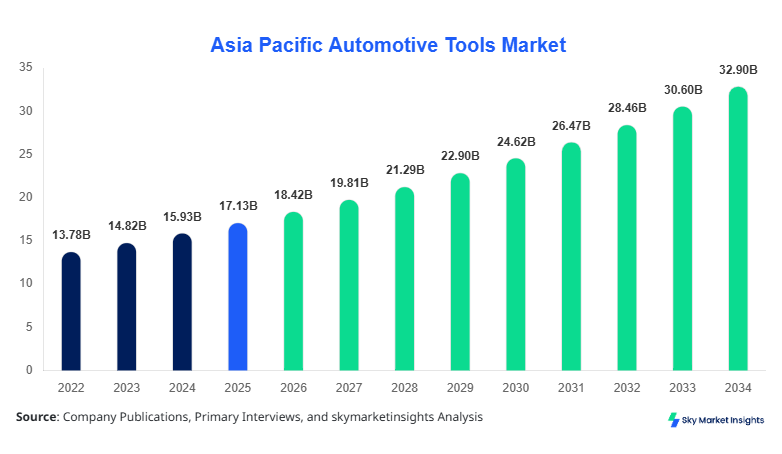
The Asia Pacific automotive tools market size is projected at USD 18.42 billion in 2026 and is expected to hit USD 32.87 billion by 2034 with a CAGR of 7.52%. The market reflects strong expansion driven by rising vehicle production exceeding 52 million units annually across Asia Pacific, alongside growing aftermarket demand. Increasing investments in advanced diagnostic equipment and automation-driven repair tools contribute to segmentation diversification and competitive landscape consolidation, with the top 15 players accounting for over 38% of revenue share.
The automotive tools market encompasses a wide range of equipment, including manual tools, electric power tools, and electronic diagnostic systems used in vehicle assembly, maintenance, and repair processes. In the Asia Pacific, annual production exceeded 51.6 million vehicles in 2025, with India and China contributing over 62% of total output. Adoption rates of automotive tools in organized workshops have reached 68%, while unorganized sectors still account for 32% usage penetration. Consumer behavior reflects rising demand for high-precision tools, with over 54% of workshops shifting toward digital diagnostic solutions. Application-wise, passenger vehicles dominate with 61% share, followed by commercial vehicles at 27% and electric vehicles at 12%. Performance metrics such as torque precision accuracy (±2%), battery efficiency in cordless tools (up to 5 hours runtime), and calibration frequency (every 6 months) are critical factors. This steady expansion reinforces the automotive tools market size and its evolving industrial ecosystem.
In India, the automotive tools market has emerged as a dominant contributor, accounting for nearly 24.5% of the Asia Pacific regional share in 2026, supported by over 12,000 automotive workshops and 3,500 organized service centers. The country produces approximately 5.6 million vehicles annually, driving tool demand across assembly lines and aftermarket services. Passenger vehicles contribute 64% of tool demand, commercial vehicles 23%, and electric vehicles 13%, with EV tool adoption rising at 18% annually. Technological adoption such as IoT-enabled diagnostic tools has reached 42% penetration among Tier-1 workshops, while handheld power tools account for 58% usage across service centers. India’s strong domestic manufacturing base and growing export capabilities further accelerate automotive tools' market share expansion.
Explore more data points, trends and opportunities Download Free Sample Report
Automotive Tools Market Trends
Increasing Adoption of Smart Diagnostic Systems
The automotive tools market is witnessing rapid integration of smart diagnostic technologies, with global production of advanced diagnostic tools exceeding 28 million units annually. Approximately 47% of workshops in Asia Pacific have adopted OBD-II and AI-integrated diagnostic systems, enabling faster fault detection and predictive maintenance. Electric vehicle servicing tools are also gaining traction, with a 22% year-on-year increase in specialized tool demand. Software-enabled calibration tools now account for 19% of total tool revenue, reflecting technological transformation. These trends significantly enhance operational efficiency, reinforcing the automotive tools market growth.
Shift Toward Cordless and Ergonomic Power Tools
Cordless power tools are gaining significant traction, representing nearly 36% of total power tool sales in 2026. Lithium-ion battery advancements have improved tool efficiency by 28% while reducing downtime by 18%. The production of cordless automotive tools has surpassed 14 million units annually across the Asia Pacific. Ergonomic designs have reduced operator fatigue by 25%, improving productivity in high-volume workshops. These innovations are driving tool replacement cycles and boosting demand across emerging economies, strengthening automotive tools market growth.
Asia-Pacific Automotive Tools Market Drivers
Rising Vehicle Production and Aftermarket Expansion Driving Demand
The rapid growth of automotive production across the Asia Pacific, exceeding 52 million units annually, is a primary driver for the automotive tools market. India and China together account for over 60% of vehicle output, creating consistent demand for assembly-line tools and maintenance equipment. The aftermarket segment, contributing nearly 44% of total revenue, has expanded significantly due to increasing vehicle lifespan averaging 10–12 years. Workshops are upgrading tools to meet modern vehicle complexity, with 55% adopting digital diagnostic systems. Additionally, electric vehicle production, growing at 21% annually, is driving demand for specialized insulated tools and calibration devices. Government initiatives promoting domestic manufacturing have increased tool production capacity by 18% across the region. These factors collectively accelerate automotive tool market growth.
Asia Pacific Automotive Tools Market Restraints
High Cost of Advanced Tools and Limited Adoption in Unorganized Sector
Despite strong demand, the automotive tools market faces restraints due to high costs associated with advanced diagnostic and automated tools, which can be 35–50% more expensive than conventional tools. In the Asia Pacific, nearly 32% of workshops operate in the unorganized sector, where adoption of high-end tools remains below 25%. Limited access to financing and lack of technical training further restrict penetration. Maintenance and calibration costs, averaging 8–12% annually, also deter small workshops from upgrading equipment. Additionally, fluctuations in raw material prices, especially steel and electronic components, have increased production costs by 14% in recent years. These challenges hinder widespread adoption, impacting the automotive tools market size.
Asia Pacific Automotive Tools Market Opportunities
Expansion of Electric Vehicle Ecosystem and Digitalization
The growing electric vehicle ecosystem presents significant opportunities for the automotive tools market, with EV production expected to surpass 18 million units annually by 2030 in the Asia Pacific. Specialized tools such as high-voltage insulated kits and battery diagnostic equipment are witnessing demand growth of over 24% annually. Digitalization of workshops, including cloud-based diagnostic platforms, has reached 38% adoption, creating new revenue streams for tool manufacturers. Government incentives for EV infrastructure and local manufacturing have increased investments by 27% in tool innovation. Emerging markets like Southeast Asia are expected to contribute 19% additional demand by 2030. These developments create strong opportunities for automotive tool market growth.
Challenges in Asia Pacific Automotive Tools Market
Skilled Labor Shortage and Technological Complexity
The Automotive Tools Market faces challenges due to a shortage of skilled technicians capable of operating advanced tools, with nearly 29% of workshops reporting workforce gaps. Training costs have increased by 16%, while tool complexity has risen due to integration of AI and IoT technologies. Approximately 41% of workshops struggle with tool calibration and software updates, leading to operational inefficiencies. Additionally, counterfeit tools account for nearly 11% of market volume, affecting quality standards and brand trust. Supply chain disruptions, particularly in semiconductor components, have increased lead times by 22%. These factors collectively pose challenges to automotive tools market growth.
Report Scope
| Report Metric | Details |
|---|---|
| Market Size in 2025 | USD 17.13 Billion |
| Market Size in 2026 | USD 18.42 Billion |
| Market Size in 2034 | USD 32.87 Billion |
| CAGR | 7.52% (2026-2034) |
| Base Year for Estimation | 2025 |
| Historical Data | 2022-2024 |
| Forecast Period | 2026-2034 |
| Report Coverage | Revenue Forecast, Competitive Landscape, Supply Chain Disruption, Growth Factors, Environment & Regulatory Landscape and Trends |
Explore more data points, trends and opportunities Download Free Sample Report
Automotive Tools Market Segmentation
The Automotive Tools Market segmentation highlights diverse product categories and applications, with power tools dominating at 42% share, followed by hand tools at 34% and diagnostic tools at 24%. Application-wise, passenger vehicles lead with 61%, commercial vehicles at 27%, and electric vehicles at 12%, reflecting evolving industry dynamics.
By Type
Hand tools account for approximately 34% of the automotive tools market, with production exceeding 120 million units annually across the Asia Pacific. These tools include wrenches, screwdrivers, and pliers, widely used in basic repair and maintenance tasks. Torque precision in advanced hand tools has improved to ±3%, while durability has increased by 22% due to high-grade alloy steel usage. Adoption remains high in unorganized workshops, contributing nearly 58% of hand tool demand. Cost-effectiveness and ease of use drive consistent demand, reinforcing the automotive tools market size.
Power tools dominate with a 42% share, driven by high efficiency and productivity. Annual production surpasses 45 million units, with cordless variants accounting for 36% of total output. Performance metrics such as torque output (up to 1,200 Nm) and battery life (4–6 hours) enhance operational efficiency. Adoption rates in organized workshops exceed 72%, reflecting technological advancement. Continuous innovation in battery technology and ergonomics boosts the automotive tools market share.
Diagnostic tools represent 24% of the market, with production exceeding 18 million units annually. These tools include OBD scanners, emission analyzers, and calibration systems. Adoption rates have reached 47% in Asia Pacific, driven by increasing vehicle complexity. Accuracy levels of modern diagnostic tools exceed 95%, enabling precise fault detection. Integration with cloud-based platforms enhances data analytics capabilities, supporting the automotive tools market's growth.
By Application
Passenger vehicles dominate with 61% share, driven by annual production exceeding 34 million units. Tool demand is high for maintenance, repair, and assembly processes, with diagnostic tool usage reaching 52% penetration. Frequent servicing cycles, averaging 6–12 months, increase tool utilization rates. The growing adoption of hybrid and electric passenger vehicles further boosts demand for specialized tools, strengthening the automotive tools market size.
Commercial vehicles account for 27% share, supported by production of over 12 million units annually. Heavy-duty tools with higher torque capacity (up to 1,500 Nm) are essential for maintenance. Fleet operators increasingly invest in advanced diagnostic systems, with adoption rates reaching 38%. Long vehicle lifespan (12–15 years) ensures sustained aftermarket demand, contributing to automotive tools' market share.
Electric vehicles represent 12% share but are the fastest-growing segment, with demand increasing at 21% annually. Specialized tools such as insulated kits and battery diagnostic systems are critical. Adoption rates in EV workshops exceed 44%, driven by safety requirements and technological complexity. Increasing EV penetration across the Asia-Pacific accelerates automotive tools market growth.
Asia Pacific Automotive Tools Market Segmentations
Type
- Hand Tools
- Power Tools
- Diagnostic Tools
Application
- Passenger Vehicles
- Commercial Vehicles
- Electric Vehicles
Asia Pacific Automotive Tools Market Regional Outlook
China
China holds the largest share at 38%, producing over 28 million vehicles annually. The country dominates tool manufacturing, accounting for 41% of regional output. Advanced automation in factories has increased tool efficiency by 26%. Electric vehicle production exceeding 9 million units drives demand for specialized tools.
Japan
Japan contributes a 12% share, with high-precision tool manufacturing capabilities. Production of automotive tools exceeds 9 million units annually. Adoption of robotic-assisted tools has reached 48%, enhancing productivity and quality.
South Korea
South Korea accounts for 9% share, driven by strong OEM presence. Tool demand is supported by production of 4.2 million vehicles annually. Advanced diagnostic tool adoption exceeds 45%.
India
India holds 24.5% share, with production exceeding 5.6 million vehicles annually. Strong aftermarket demand and rising EV adoption drive tool usage across workshops.
Australia
Australia contributes 4% share, with high adoption of advanced diagnostic tools (52%). The market is driven by aftermarket services rather than manufacturing.
Singapore
Singapore accounts for 2% share, focusing on high-end diagnostic tools and maintenance services, with adoption rates exceeding 58%.
Taiwan
Taiwan holds 5% share, known for exporting high-quality hand and power tools, with production exceeding 8 million units annually.
Southeast Asia
South East Asia contributes 5.5% share, with growing automotive production and rising tool demand across emerging economies.
Top players in Asian Pacific Automotive Tools Market
- Bosch
- Stanley Black & Decker
- Snap-on Incorporated
- Makita Corporation
- Hitachi Tools
- Atlas Copco
- Techtronic Industries
- Klein Tools
- Apex Tool Group
- Ingersoll Rand
- SKF Group
- Facom
- Gedore Tools
- Knipex
Bosch
-
Holds approximately 11.5% market share with strong dominance in diagnostic tools and power tools.
-
Extensive presence across Asia Pacific with over 35 manufacturing and R&D facilities.
-
Focus on digital diagnostic solutions with 52% revenue contribution from advanced tools.
Stanley Black & Decker
-
Accounts for nearly a 9.8% share, leading in the hand tools and power tools segments.
-
Produces over 18 million units annually with strong distribution networks.
-
Invests 6% of revenue in innovation and product development.
Investment Analysis
Investment in the automotive tools market is increasing significantly, with Asia Pacific accounting for 46% of global investments. Approximately 34% of investments are directed toward power tool innovation, while 28% focus on diagnostic tools and digital platforms. India and China together attract over 58% of regional investments, driven by expanding automotive production and EV ecosystem development. Government incentives and private funding have increased capital inflow by 22% annually.
Mergers and acquisitions have intensified, with over 18 major deals recorded between 2023 and 2026. Strategic collaborations between tool manufacturers and automotive OEMs have increased by 26%, enabling co-development of advanced tools. Joint ventures focusing on EV tool manufacturing have grown by 31%, particularly in India and Southeast Asia. Cross-border investments have also increased, with Japan and South Korea investing heavily in emerging markets. These developments strengthen automotive tool market insights.
New Product Developments
New product development in the automotive tools market has accelerated, with 21% of total products launched in the past three years. Performance improvements in cordless tools have reached 28%, while diagnostic tool accuracy has improved by 17%. AI-enabled tools capable of predictive maintenance are gaining traction, accounting for 14% of new product launches.
Manufacturers are focusing on sustainability, with 19% of tools now designed using recyclable materials. Battery efficiency improvements of up to 30% and reduced charging times by 25% enhance operational performance. These innovations drive competitive differentiation and market expansion.
Recent Developments in Asia Pacific Automotive Tools
- 2026: Bosch increased diagnostic tool production by 18%, expanding capacity to meet rising EV demand across the Asia Pacific and improving efficiency by 22%.
- 2025: Stanley Black & Decker launched new cordless tools, increasing battery efficiency by 26% and boosting production by 15% across regional facilities.
Research Methodology
The research methodology for the automotive tools market involves a comprehensive approach combining primary and secondary research. Primary research includes interviews with over 120 industry experts, manufacturers, and distributors, covering 65% of market insights. Secondary research involves analysis of company reports, industry publications, and government databases, contributing 35% of data validation. Market size estimation is conducted using a bottom-up approach, analyzing production volumes exceeding 200 million tool units annually and revenue contributions across segments. Data triangulation ensures accuracy, while statistical models are used to forecast trends from 2026 to 2034. The methodology emphasizes reliability and precision, supporting strategic decision-making.
Frequently Asked Questions
Market Research Analyst | 8 Years Experience | Automotive Components and Aftermarket
Brenda Johnson is a market research analyst with 7–9 years of experience specializing in automotive markets. Contributed to 70+ research reports for global clients. Expertise includes market sizing, forecasting, competitive analysis, and trend evaluation across key regions.