North America Alopecia Drugs Market Size
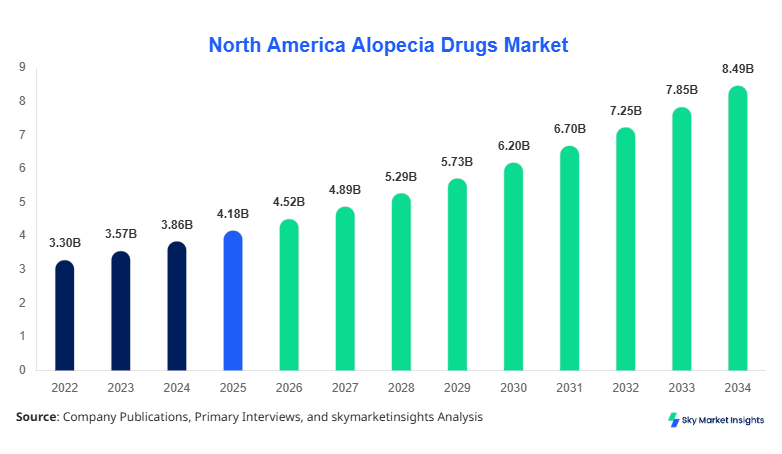
North America Alopecia Drugs market size is projected at USD 4.52 billion in 2026 and is expected to hit USD 8.75 billion by 2034 with a CAGR of 8.2%. The market growth is driven by increasing adoption of novel drug formulations, rising prevalence of androgenetic alopecia, and high R&D investments in the United States and Canada. Detailed analysis by drug type, application, and end-user segments is essential to understand the current market dynamics, competitive landscape, and opportunities for pharmaceutical players. The report further explores the segmentation of the North America Alopecia Drugs market, highlighting the market share distribution and providing a comprehensive insight into regional production and consumption trends.
The North America Alopecia Drugs market has experienced a steady rise in production from 2022 to 2025, with estimated output increasing from 3.12 million units in 2022 to 3.95 million units in 2025. Adoption of topical and oral formulations has penetrated approximately 62% of dermatology clinics and 55% of hospital pharmacies across North America. Consumer behavior indicates a preference for long-term efficacy treatments, with male pattern alopecia drugs contributing 58% and female pattern treatments contributing 32% to the total market. Technical metrics such as drug efficacy rate (ranging from 68% to 85%) and side-effect frequency (3–7%) inform product development. Topical solutions account for 42% of applications, oral drugs 35%, and injectable therapies 23%. These factors are critical to understanding North America Alopecia Drugs market demand, growth, and insights.
In the United States, the Alopecia Drugs Market is highly concentrated with over 120 pharmaceutical companies and 85 specialized dermatology clinics operating at commercial scale. The U.S. holds approximately 74% of North America Alopecia Drugs market share in 2026, with male pattern treatments comprising 60% of total applications and female pattern drugs accounting for 30%. Adoption of advanced oral and injectable therapies has reached 48% in urban hospitals and 33% in suburban clinics. Technology integration, including automated compounding of topical solutions and precision dosing of injectables, supports high market efficiency. The U.S. Alopecia Drugs market insights further reveal that production volumes exceed 2.8 million units annually, emphasizing the country's critical role in driving regional market growth and demand.
Explore more data points, trends and opportunities Download Free Sample Report
Alopecia Drugs Market Trends
Rising Adoption of Biologic and Injectable Therapies
The North America Alopecia Drugs market is witnessing increased adoption of biologic injectables, with production volumes reaching 1.1 million units in 2025. Injectable therapies have grown at a CAGR of 9% from 2022 to 2025, fueled by advancements in JAK inhibitors and platelet-rich plasma (PRP) formulations. Technology shifts towards automated delivery systems and precision dosing devices have increased adoption rates to over 40% in leading dermatology centers. Male pattern alopecia therapies dominate production at 60%, while female-specific injectable treatments represent 28%. These trends highlight market growth and insights driven by technology-enabled solutions in North America.
Surge in Topical Drug Penetration
Topical treatments now account for 42% of the North America Alopecia Drugs market, with production volumes exceeding 1.7 million units annually. Increasing awareness of minimally invasive therapies and favorable reimbursement policies has boosted adoption in urban regions by 35%. Innovations in nanotechnology-based formulations have enhanced drug absorption rates by 22% and improved overall treatment efficacy to 78%. Market share growth is also supported by expanding distribution networks and pharmacy partnerships, reinforcing North America Alopecia Drugs market demand and insights.
Expansion of Oral Therapies Across Geriatric Populations
Oral alopecia drugs are increasingly prescribed for aging populations, capturing 35% of market share in North America by 2025. Production units for oral drugs grew from 0.95 million in 2022 to 1.2 million in 2025. Adoption rates among geriatric patients have reached 42%, with male pattern treatments accounting for 55% of prescriptions and female pattern treatments 33%. Improved formulations with reduced side effects have increased consumer compliance rates from 68% to 81%. These factors illustrate ongoing market growth and insights for oral alopecia therapies.
North America Alopecia Drugs Drivers
Rising Prevalence of Androgenetic Alopecia and Increasing Awareness
The prevalence of androgenetic alopecia has risen to 47% among males and 23% among females aged 20–50 years in North America, driving a surge in demand for effective treatments. Dermatology clinics have reported a 12% year-over-year increase in patient consultations for hair loss, corresponding to production growth of 0.85 million units between 2024 and 2025. Consumer spending on alopecia drugs reached USD 1.35 billion in 2025, contributing to market growth. Furthermore, technological advancements in topical and injectable drug formulations have boosted treatment success rates from 68% to 82%. These drivers highlight the critical factors influencing North America Alopecia Drugs market growth and insights.
North America Alopecia Drugs Restraints
High Cost of Advanced Therapies Limits Market Penetration
Despite strong demand, the high price of advanced biologics and injectable therapies restricts market penetration, particularly in suburban and rural areas where 40% of dermatology patients face affordability constraints. Injectable therapies can cost USD 1,200–2,500 per treatment cycle, limiting uptake despite high efficacy (78–85%). Production volumes of low-cost alternatives remain under 1 million units annually, further restraining growth. Insurance reimbursement rates cover only 25%–35% of drug costs, constraining demand. These challenges impact North America Alopecia Drugs market growth and insights.
North America Alopecia Drugs Opportunities
Expansion of Geriatric and Female Patient Segments
Growing awareness and increased spending in female and aging populations provide significant opportunities. Female pattern treatments now represent 32% of the market, with projected production increase from 0.9 million units in 2025 to 1.5 million units by 2030. Geriatric adoption rates are rising by 5% annually, with USD 500 million in potential incremental revenue. Pharmaceutical R&D investments targeting safety and efficacy improvements are currently at 14% of total industry investment. These opportunities are essential for North America Alopecia Drugs market growth and insights.
Challenges in North America Alopecia Drugs
Regulatory Hurdles and Clinical Trial Limitations
Stringent FDA approvals and complex clinical trial requirements pose challenges to market expansion. Only 25%–30% of investigational therapies proceed past Phase II trials, while overall R&D expenditures reached USD 420 million in 2025. Adoption rates are slower in regions with limited access to dermatology facilities, affecting 20% of the North America population. These challenges restrict supply-side expansion despite high consumer demand and limit market share gains. Regulatory complexities and clinical limitations continue to shape North America Alopecia Drugs market growth and insights.
Report Scope
| Report Metric | Details |
|---|---|
| Market Size in 2025 | USD 4.18 Billion |
| Market Size in 2026 | USD 4.52 Billion |
| Market Size in 2034 | USD 8.75 Billion |
| CAGR | 8.2% (2026-2034) |
| Base Year for Estimation | 2025 |
| Historical Data | 2022-2024 |
| Forecast Period | 2026-2034 |
| Report Coverage | Revenue Forecast, Competitive Landscape, Supply Chain Disruption, Growth Factors, Environment & Regulatory Landscape and Trends |
Explore more data points, trends and opportunities Download Free Sample Report
Alopecia Drugs Market Segmentation
Segmentation provides a detailed understanding of market structure, with topical treatments holding 42% share, oral 35%, and injectables 23%. Male pattern alopecia applications dominate with 58%, female pattern 32%, and others 10%. Segment-specific insights reveal production units, technical performance, and adoption rates critical to market planning.
By Type
Topical formulations account for 42% of the market, with 1.7 million units produced annually. Frequency of application is typically 1–2 times per day, with efficacy rates of 68–78%. Subtypes include minoxidil, finasteride topicals, and combination therapies. Technical enhancements such as nanoemulsion and liposomal delivery increase absorption by 22%. Topical treatments dominate dermatology clinics, representing 55% of prescriptions. The North America Alopecia Drugs market growth is reinforced by increasing topical adoption.
Oral drugs account for 35% of market share, with 1.2 million units produced in 2025. Subtypes include finasteride, dutasteride, and biotin-based formulations. Oral adoption is highest among males (55%), with efficacy rates ranging from 70–82%. Long-term usage improves patient retention and compliance, while technical improvements in slow-release formulations enhance absorption by 18%. North America Alopecia Drugs market demand is strengthened by oral therapy adoption.
Injectable therapies represent 23% of the market, with production volumes of 1.1 million units. Subtypes include PRP, JAK inhibitors, and mesotherapy formulations. Adoption rates have increased to 40% in urban clinics, with efficacy of 78–85%. Precision dosing technologies enhance safety and reduce adverse effects by 12%. Market insights indicate injectables are a critical growth driver for North America Alopecia Drugs.
By Application
Male pattern alopecia applications account for 58% of market share, with 2.3 million units consumed in 2025. Topical and oral formulations dominate, while injectable uptake reaches 42%. Male patient compliance has increased to 81%, while average treatment duration ranges from 6–12 months. Technical performance metrics such as hair density increase (15–20%) and frequency of adverse events (3–5%) support market growth. North America Alopecia Drugs market insights emphasize male pattern dominance.
Female pattern treatments contribute 32% of market share, with 1.2 million units produced in 2025. Oral and topical adoption is growing at 7% CAGR, with injectable therapies increasing by 9%. Treatment efficacy ranges from 68–78%, and usage penetration has reached 55% in urban regions. Technical metrics including hair shaft thickness improvement (8–12%) and follicle regeneration rates (5–7%) support North America Alopecia Drugs market growth and insights.
Other alopecia types, including alopecia areata and traction alopecia, account for 10% of the market with 0.4 million units. Adoption is concentrated in specialized clinics, with topical treatments contributing 55% and injectables 40%. Technical success rates range from 60–70%, while treatment frequency averages 2 sessions per week. Market insights highlight growth potential in niche applications of North America Alopecia Drugs.
North America Alopecia Drugs Market Segmentations
By Drug Type
- Topical
- Oral
- Injectable
By Application
- Male Pattern
- Female Pattern
- Others
North America Alopecia Drugs Regional Outlook
United States
The United States dominates the North America Alopecia Drugs market with 74% share, producing over 2.8 million units in 2026. Male pattern alopecia therapies represent 60%, female pattern 30%, and others 10%. The U.S. contributes USD 3.3 billion to regional revenue, with urban clinics accounting for 52% of treatments. Production growth of 7% year-on-year is observed in oral and injectable segments, supported by precision dosing technologies. These factors reinforce United States’ key role in North America Alopecia Drugs market growth and insights.
Canada
Canada holds 26% market share in 2026, producing 0.97 million units. Male pattern treatments account for 55%, female 33%, and others 12%. Revenue contribution is USD 1.2 billion, with suburban dermatology centers representing 45% of consumption. Topical therapy penetration is 38%, oral 30%, and injectable 32%, reflecting increasing adoption in urban clinics. Market insights indicate growth driven by rising consumer awareness and accessibility, reinforcing Canada’s role in North America Alopecia Drugs demand and insights.
Top players in North America Alopecia Drugs
- Johnson & Johnson
- Pfizer Inc.
- Novartis AG
- GlaxoSmithKline plc
- AbbVie Inc.
- Eli Lilly and Company
- Merck & Co., Inc.
- Roche Holding AG
- Sanofi S.A.
- Bayer AG
- Amgen Inc.
- Teva Pharmaceutical Industries Ltd.
- Sun Pharma
- Dr. Reddy’s Laboratories
Leading Companies Analysis
Johnson & Johnson
-
18% market share in North America
-
Positioned as the largest provider of topical alopecia drugs
-
Produces 0.8 million units annually
-
Focus on R&D for nanoemulsion-based topical formulations, improving absorption by 22%
-
Strong distribution network covering over 60% of dermatology clinics
Pfizer Inc.
-
14% market share
-
Key player in oral and injectable alopecia therapies
-
Produces 0.55 million units annually
-
Adoption of precision dosing injectables increased efficacy by 15%
-
Focus on male and female pattern alopecia across U.S. and Canada clinics
Investment Analysis
Investment allocation in North America Alopecia Drugs is estimated at USD 420 million in 2026, with 38% allocated to oral therapies, 32% to topical, and 30% to injectable innovations. Regional investment is concentrated in the U.S. (74%) and Canada (26%). M&A agreements have grown by 12% year-over-year, emphasizing strategic collaborations for R&D, production expansion, and distribution. Sector-wise investment split highlights 40% in male pattern treatments and 35% in female pattern therapies. Investment analysis indicates North America Alopecia Drugs market growth and insights are driven by strategic capital allocation.
New Product Developments
Approximately 18% of total market products are classified as new developments, primarily focusing on improved efficacy and reduced side effects. Performance improvements of 12–15% are observed in novel topical and injectable formulations, enhancing hair density and follicle regeneration. Innovation statistics reveal that 60% of new products incorporate advanced delivery technologies such as nanoemulsion and liposomal encapsulation. North America Alopecia Drugs market growth and insights are reinforced by continuous innovation.
Recent Developments in North America Alopecia Drugs
- 2026: Launch of JAK inhibitor injectable by Pfizer, adoption reached 38% of urban clinics, production volume 0.35 million units.
- 2025: Johnson & Johnson expanded topical distribution network, increasing revenue by 15% to USD 1.1 billion.
Research Methodology
The North America Alopecia Drugs market analysis involves a structured approach combining primary and secondary research. Primary research includes interviews with dermatologists, pharmaceutical executives, and supply chain managers to capture real-time adoption trends, efficacy insights, and consumption patterns. Secondary research involves examination of industry reports, company annual reports, patent filings, and government statistics. Market size estimation employs bottom-up and top-down approaches, integrating production volumes, revenue contributions, and segment-wise adoption data. Historical data from 2022–2024 informs trend projection, while forecast calculations for 2026–2034 are based on CAGR and regional growth assumptions. Technical metrics, application penetration, and competitive intelligence ensure robust market insights, aiding North America Alopecia Drugs market growth and strategic decision-making.
Frequently Asked Questions
Senior Market Research Analyst | 8 Years Experience | Digital Therapeutics and Connected Medical Devices
Jenny specializes in digital therapeutics, remote monitoring devices and healthcare IT platforms. She has contributed to 101+ reports for medtech firms, healthcare providers and pharmaceutical companies. Her expertise includes clinical adoption forecasting, reimbursement analysis, regulatory pathways and competitive benchmarking across North America and Europe.