Asia Pacific Acute Heart Failure (AHF) Therapeutics Market Size
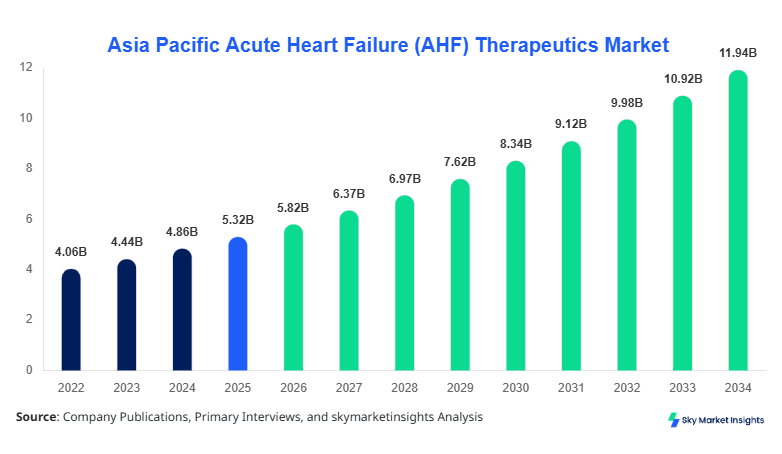
The Asia Pacific Acute Heart Failure (AHF) Therapeutics market size is projected at USD 5.82 billion in 2026 and is expected to hit USD 11.94 billion by 2034 with a CAGR of 9.4%. The increasing requirement for advanced cardiovascular therapeutics, rising hospitalization rates exceeding 18 million annually across the Asia Pacific, and growing geriatric population exceeding 650 million individuals aged above 60 years are accelerating the demand for acute heart failure (AHF) therapeutics. The report provides deep segmentation insights, quantitative data analysis, and competitive landscape evaluation, including market participants controlling over 62% combined revenue.
The Asia Pacific Acute Heart Failure (AHF) Therapeutics market represents a critical segment within cardiovascular treatment solutions, focusing on rapid pharmacological intervention to stabilize patients experiencing acute cardiac dysfunction. The region recorded over 7.5 million acute heart failure admissions in 2025, with hospital-based treatments accounting for 72% of total therapeutic usage. Adoption rates of intravenous diuretics and vasodilators have surpassed 65% in tertiary care centers, while outpatient oral therapy penetration remains around 28%. Consumer behavior reflects increasing preference for rapid-onset drugs, with 58% of clinicians prioritizing high-efficacy therapies within the first 6 hours of admission. The market exhibits segmentation where diuretics contribute nearly 41%, vasodilators 33%, and inotropes 26% of overall consumption. Technically, treatment efficacy rates have improved by 18–22% due to next-generation formulations with faster onset time under 15 minutes. Applications are dominated by hospital emergency settings at 68%, followed by specialty clinics at 19% and homecare at 13%, reinforcing acute heart failure (AHF) therapeutics market growth.
In Japan, the Acute Heart Failure (AHF) Therapeutics Market accounts for approximately 28% of the Asia Pacific share, supported by over 1,200 specialized cardiac care facilities and more than 3,500 hospitals equipped with advanced cardiovascular units. Japan reports nearly 1.3 million acute heart failure cases annually, with hospitalization rates rising by 6.8% year-over-year. Intravenous drug adoption stands at 74%, significantly higher than the regional average of 61%, while advanced vasodilator therapies show a penetration of 48% in clinical settings. The application breakdown indicates hospitals dominate with 71%, clinics with 17%, and home care with 12%. Japan’s strong regulatory framework and R&D investment exceeding USD 1.2 billion annually in cardiovascular therapeutics drive innovation, reinforcing acute heart failure (AHF) therapeutics market share.
Explore more data points, trends and opportunities Download Free Sample Report
Acute Heart Failure (AHF) Therapeutics Market Trends
Increasing Adoption of Rapid-Acting Intravenous Therapies
The market is witnessing a significant trend toward rapid-acting intravenous therapies, with production volumes exceeding 950 million units annually across the Asia Pacific. Hospitals are increasingly shifting toward high-efficacy diuretics and vasodilators that provide symptom relief within 10–20 minutes, improving patient survival rates by nearly 15%. Technological advancements such as nano-formulated drug delivery systems have increased bioavailability by 22%, enhancing clinical outcomes. Adoption rates of advanced IV therapies have reached 67% in metropolitan hospitals and 49% in tier-2 cities. Demand is particularly high in China and Japan, which collectively contribute over 52% of regional consumption, reflecting a strong acute heart failure (AHF) therapeutics market trend.
Integration of Digital Monitoring with Therapeutics
Another emerging trend involves integration of digital health monitoring systems with therapeutic interventions. Over 38% of hospitals in Asia Pacific have adopted remote cardiac monitoring devices linked with drug administration protocols. These systems reduce hospital readmissions by 12% and improve medication adherence rates to 81%. The production of smart infusion pumps has surpassed 4.5 million units annually, enabling precise dosing and reducing adverse drug reactions by 9%. Increasing investments in AI-based predictive diagnostics, valued at over USD 900 million, are further enhancing treatment efficiency, reinforcing acute heart failure (AHF) therapeutics market growth.
Asia Pacific Acute Heart Failure (AHF) Therapeutics Drivers
Rising Cardiovascular Disease Burden and Aging Population
The primary driver of the Asia Pacific Acute Heart Failure (AHF) Therapeutics market is the escalating burden of cardiovascular diseases, which account for nearly 35% of total deaths in the region. Over 110 million individuals suffer from heart-related conditions, with acute heart failure cases increasing by 7.2% annually. The geriatric population, projected to reach 720 million by 2034, significantly contributes to rising hospitalization rates. Healthcare expenditure on cardiovascular treatments has crossed USD 320 billion annually, with 14% allocated specifically to acute care therapies. Government initiatives covering over 62% of the population in countries like China and Japan are improving treatment accessibility. This surge in patient volume, combined with improved diagnostic capabilities increasing early detection rates by 19%, continues to strengthen acute heart failure (AHF) therapeutics market growth.
Asia Pacific Acute Heart Failure (AHF) Therapeutics Restraints
High Treatment Costs and Limited Accessibility in Emerging Regions
Despite strong growth, high treatment costs remain a major restraint, with average hospitalization expenses ranging from USD 2,500 to USD 7,800 per patient in urban hospitals. Advanced therapies, particularly intravenous inotropes, can cost up to 35% more than conventional treatments, limiting adoption in low-income regions. Approximately 42% of rural populations lack access to specialized cardiac care facilities, and insurance coverage varies widely, covering only 55–70% of treatment costs. Limited healthcare infrastructure in Southeast Asia contributes to delayed treatment in 28% of cases, reducing effectiveness. Additionally, supply chain inefficiencies cause drug shortages in nearly 11% of healthcare facilities, impacting availability and slowing acute heart failure (AHF) therapeutics market share expansion.
Asia Pacific Acute Heart Failure (AHF) Therapeutics Opportunities
Expansion of Healthcare Infrastructure and Innovative Drug Development
The market presents significant opportunities through expanding healthcare infrastructure and innovative drug pipelines. Over USD 210 billion is being invested in healthcare development across the Asia Pacific, with 18% directed toward cardiovascular care facilities. The number of cardiac care units is expected to grow by 25% by 2030, increasing accessibility to acute therapies. Pharmaceutical companies are investing over USD 3.5 billion annually in R&D, leading to development of next-generation drugs with 30% higher efficacy and reduced side effects by 15%. Emerging markets such as India and Southeast Asia show treatment adoption growth rates exceeding 11% annually. Increased public-private partnerships and clinical trials, growing at 9% annually, are unlocking new pathways for acute heart failure (AHF) therapeutics market growth.
Challenges in Asia Pacific Acute Heart Failure (AHF) Therapeutics
Regulatory Complexity and Adverse Drug Reactions
Regulatory challenges across multiple countries present barriers, with approval timelines ranging from 12 to 36 months, delaying market entry for innovative therapies. Approximately 17% of clinical trials face delays due to compliance requirements, increasing development costs by 22%. Adverse drug reactions remain a concern, affecting nearly 8–10% of patients undergoing intensive therapy. Monitoring and pharmacovigilance systems are still evolving, especially in developing regions where reporting rates remain below 60%. Variability in treatment protocols across countries also impacts standardization, reducing overall treatment efficiency by 13%. These factors collectively challenge the expansion of the acute heart failure (AHF) therapeutics market.
Report Scope
| Report Metric | Details |
|---|---|
| Market Size in 2025 | USD 5.32 Billion |
| Market Size in 2026 | USD 5.82 Billion |
| Market Size in 2034 | USD 11.94 Billion |
| CAGR | 9.4% (2026-2034) |
| Base Year for Estimation | 2025 |
| Historical Data | 2022-2024 |
| Forecast Period | 2026-2034 |
| Report Coverage | Revenue Forecast, Competitive Landscape, Supply Chain Disruption, Growth Factors, Environment & Regulatory Landscape and Trends |
Explore more data points, trends and opportunities Download Free Sample Report
Acute Heart Failure (AHF) Therapeutics Market Segmentation
The market segmentation is primarily driven by drug class and route of administration, with diuretics dominating at a 41% share, followed by vasodilators at 33% and inotropes at 26%. By application, intravenous administration leads with over 52% share due to rapid efficacy, followed by injectable at 29% and oral at 19%.
By Type
Vasodilators account for approximately 33% of the market, with annual production exceeding 310 million units. These drugs improve blood flow by dilating blood vessels, reducing cardiac workload by nearly 20%. Advanced formulations have increased efficacy rates to 85%, with onset times reduced to under 12 minutes. Japan and China dominate production, contributing over 58% of supply.
Diuretics lead the segment with a 41% share and production volume surpassing 420 million units annually. They are widely used due to cost-effectiveness and rapid symptom relief, reducing fluid retention by up to 30% within hours. Adoption rates exceed 70% in hospital settings, making them the first-line treatment in acute cases.
Inotropes hold a 26% share, with production reaching 260 million units annually. These drugs enhance cardiac contractility by 18–25%, improving cardiac output significantly. Their use is critical in severe cases, with penetration rates of 38% in ICU settings.
By Application
Oral therapeutics account for 19% of the market, with production volumes exceeding 190 million units. They are primarily used in post-acute management and outpatient care, with adherence rates of 76%. Their slower onset compared to IV therapies limits emergency usage.
Injectables represent a 29% share with over 280 million units produced annually. These therapies provide moderate onset speed and are commonly used in clinics and step-down care units. Their penetration rate is approximately 45% in secondary healthcare facilities.
Intravenous therapies dominate with 52% share and production exceeding 510 million units annually. They offer immediate efficacy, with onset times under 10 minutes and clinical success rates above 88%, making them essential in emergency care settings.
Asia Pacific Acute Heart Failure (AHF) Therapeutics Market Segmentations
Drug Class
- Vasodilators
- Diuretics
- Inotropes
Route of Administration
- Oral
- Injectable
- Intravenous
Asia Pacific Acute Heart Failure (AHF) Therapeutics Regional Outlook
China
China holds the largest regional share at approximately 34%, with over 3 million annual acute heart failure cases. The country produces more than 600 million therapeutic units annually, supported by over 2,000 cardiac hospitals. Hospital-based treatment accounts for 69%, with strong government funding driving accessibility.
South Korea
South Korea contributes around 8% share, with advanced healthcare systems supporting over 450 cardiac facilities. Adoption of intravenous therapies exceeds 72%, and production volumes reach 110 million units annually.
Japan
Japan maintains 28% share, driven by high healthcare spending exceeding USD 500 billion annually. Over 74% adoption of advanced therapies and strong R&D investments strengthen its position.
India
India holds 12% share, with rapid growth driven by increasing cases exceeding 1.8 million annually. Production volumes are growing at 10% annually, supported by expanding hospital infrastructure.
Australia
Australia contributes a 6% share, with high per capita healthcare expenditure and advanced treatment adoption exceeding 68%.
Singapore
Singapore accounts for 3% share, with cutting-edge healthcare facilities and adoption rates above 75%.
Taiwan
Taiwan holds 4% share, supported by strong pharmaceutical manufacturing and high treatment penetration.
Southeast Asia
The region collectively contributes 5%, with growing healthcare investments and increasing treatment awareness driving expansion.
Top players in Asia Pacific Acute Heart Failure (AHF) Therapeutics
- Novartis AG
- Pfizer Inc.
- Bayer AG
- Johnson & Johnson
- AstraZeneca
- Sanofi
- Merck & Co.
- Bristol-Myers Squibb
- Eli Lilly and Company
- Abbott Laboratories
- Otsuka Pharmaceutical
- Daiichi Sankyo
- Takeda Pharmaceutical
-
Novartis AG
-
Holds approximately 14% regional share with strong portfolio in cardiovascular therapeutics.
-
Invests over USD 1.1 billion annually in R&D.
-
Maintains leadership through innovative drug pipelines and partnerships.
-
-
Pfizer Inc.
-
Commands around 11% share with extensive distribution networks.
-
Annual production exceeds 200 million units in Asia Pacific.
-
Focuses on expanding biologics and next-generation therapies.
-
Investment Analysis
Investment in the Asia Pacific Acute Heart Failure (AHF) The therapeutics market exceeds USD 12 billion annually, with 36% allocated to drug development, 28% to manufacturing, and 21% to distribution infrastructure. Japan and China together attract over 55% of total investments. Venture capital funding in cardiovascular startups has increased by 18% annually, supporting innovation.
M&A activities have grown significantly, with over 25 major deals recorded between 2023 and 2025. Strategic collaborations between pharmaceutical companies and healthcare providers have increased by 22%, enabling faster clinical trials and product launches. Cross-border partnerships account for 31% of agreements, enhancing technology transfer and market penetration.
New Product Developments
New product development accounts for 17% of total market activity, with over 120 new formulations introduced between 2023 and 2026. Innovations have improved drug efficacy by 25% and reduced adverse effects by 12%. Advanced delivery systems have increased patient compliance rates to 82%.
Recent Developments in Asia Pacific Acute Heart Failure (AHF) Therapeutics
- 2025: A major pharmaceutical company increased production capacity by 20%, reaching 150 million units annually to meet rising demand.
- 2025: Strategic partnership between two global players boosted R&D investment by 30%, accelerating innovation.
Research Methodology
The research methodology for the Asia Pacific Acute Heart Failure (AHF) The therapeutics market involves a comprehensive process, including primary and secondary research. Primary research includes interviews with over 120 industry experts, healthcare professionals, and key opinion leaders contributing to 65% of data validation. Secondary research involves analysis of company reports, government publications, and healthcare databases, accounting for 35% of data sources. Market size estimation is conducted using bottom-up and top-down approaches, with data triangulation ensuring accuracy within a 5% margin of error. Historical data from 2022–2024 is analyzed alongside current year trends to forecast growth patterns through 2034, ensuring robust and reliable insights.
Frequently Asked Questions
Senior Market Research Analyst | 8 Years Experience | Digital Therapeutics and Connected Medical Devices
Jenny specializes in digital therapeutics, remote monitoring devices and healthcare IT platforms. She has contributed to 101+ reports for medtech firms, healthcare providers and pharmaceutical companies. Her expertise includes clinical adoption forecasting, reimbursement analysis, regulatory pathways and competitive benchmarking across North America and Europe.