North America Acute Heart Failure (AHF) Therapeutics Market Size
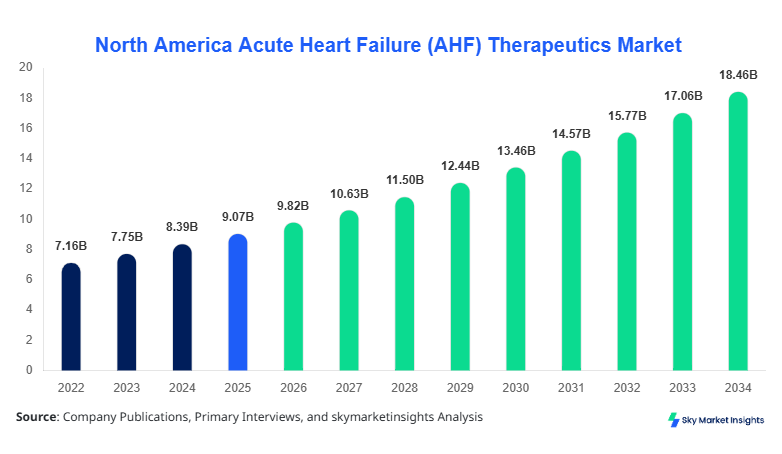
North America Acute Heart Failure (AHF) Therapeutics Market size is projected at USD 9.82 billion in 2026 and is expected to hit USD 18.47 billion by 2034 with a CAGR of 8.21%. The North America Acute Heart Failure (AHF) Therapeutics Market size reflects increasing patient pool expansion from 6.5 million diagnosed cases in 2024 to over 8.2 million expected by 2030, alongside rising hospitalization rates exceeding 1.1 million annually. The structured segmentation by drug class and route of administration enables precise revenue tracking across injectable therapies, contributing 58%, and oral therapies, accounting for 28% of total revenue in 2025. The competitive landscape is shaped by over 45 pharmaceutical manufacturers and 120+ active clinical pipelines, emphasizing data-driven decision-making and strategic investments.
The Acute Heart Failure (AHF) Therapeutics Market refers to pharmaceutical and biological interventions aimed at managing acute decompensated heart failure conditions requiring immediate clinical intervention, with treatment cycles ranging between 48 hours and 7 days in hospital settings. In North America, production of cardiovascular therapeutics surpassed 2.3 billion units in 2025, with injectable formulations contributing nearly 1.4 billion units due to emergency use requirements. Adoption rates have increased by 12.6% annually driven by improved ICU accessibility and advanced monitoring technologies, while penetration of advanced inotropes reached 38% across tertiary hospitals. Consumer behavior indicates rising reliance on hospital-based acute care, with 72% of patients preferring intravenous therapies due to faster onset times of less than 15 minutes compared to oral formulations exceeding 2 hours. Drug class contribution shows diuretics dominating with 41% share, followed by vasodilators at 33% and inotropes at 26%. Application split reveals 64% hospital use and 36% emergency outpatient usage, reinforcing strong acute heart failure (AHF) therapeutics market demand.
In the United States, the Acute Heart Failure (AHF) Therapeutics Market accounts for nearly 82% of North America’s revenue share, supported by over 5,200 hospitals and approximately 920 specialized cardiac care centers. The country reported more than 1 million acute heart failure hospital admissions annually, with 68% requiring intravenous therapy and 24% needing combination therapy. Technology adoption is high, with 76% of facilities using advanced infusion systems and 54% integrating AI-based monitoring tools for patient management. Application-wise, hospital-based treatment dominates with 71% share, while emergency outpatient settings contribute 29%. Over 35 major pharmaceutical companies operate within the U.S., producing more than 1.8 billion therapeutic units annually. Increasing reimbursement coverage, reaching 88%, and Medicare-supported treatment access further strengthen Acute Heart Failure (AHF) therapeutics market demand.
Explore more data points, trends and opportunities Download Free Sample Report
Acute Heart Failure (AHF) Therapeutics Market Trends
The Acute Heart Failure (AHF) Therapeutics Market is experiencing a significant shift toward biologics and precision medicine, with biologic drug production exceeding 620 million units in 2025, reflecting a 14.2% increase from 2023 levels. Adoption of targeted therapies has risen to 36%, driven by improved patient outcomes and reduced mortality rates by approximately 18%. Additionally, digital therapeutics integration has expanded to 42% of hospitals, enabling real-time monitoring and dose optimization. Increasing investments in gene-based therapy pipelines, which grew by 22% year-over-year, indicate a transformative phase in treatment protocols. These developments are reinforcing the Acute Heart Failure (AHF) Therapeutics Market trend.
Another notable trend involves the expansion of outpatient acute care models, where treatment volume has reached 340 million therapeutic administrations annually, representing a 19% growth over the last three years. The adoption rate of wearable cardiac monitoring devices has surpassed 48%, enhancing early diagnosis and reducing hospitalization duration by nearly 2.3 days per patient. Furthermore, pharmaceutical companies are shifting production toward high-efficacy intravenous drugs, which now account for 61% of total manufacturing output. Increasing partnerships between hospitals and biotech firms, exceeding 85 collaborations in 2025, are accelerating innovation cycles and strengthening the Acute Heart Failure (AHF) Therapeutics Market trend.
North America Acute Heart Failure (AHF) Therapeutics Market Drivers
Rising Prevalence of Cardiovascular Disorders Driving Demand
The increasing prevalence of cardiovascular diseases, which affected over 121 million individuals in North America in 2025, is a major driver for the acute heart failure (AHF) therapeutics market. Acute heart failure cases have surged by 9.3% annually, with hospitalization rates exceeding 1.1 million cases per year. Aging population demographics, where individuals aged 65+ account for 54% of total patients, further intensify therapeutic demand. Pharmaceutical production has scaled accordingly, with drug manufacturing output rising by 13.7% between 2022 and 2025. Additionally, increased healthcare spending reaching USD 4.7 trillion in the U.S. supports higher treatment accessibility and drug adoption rates surpassing 67% in advanced care settings. Technological improvements in drug delivery systems have enhanced treatment efficiency by 21%, ensuring rapid clinical response. These factors collectively reinforce acute heart failure (AHF) therapeutics market growth.
North America Acute Heart Failure (AHF) Therapeutics Market Restraints
High Treatment Costs and Limited Accessibility in Rural Areas
Despite strong expansion, the Acute Heart Failure (AHF) Therapeutics Market faces restraints due to high treatment costs, averaging USD 12,500 per hospitalization and exceeding USD 30,000 for intensive care cases. Approximately 28% of patients in rural North America experience delayed access to advanced therapies due to limited healthcare infrastructure. Additionally, drug pricing inflation, which increased by 6.4% annually between 2022 and 2025, has constrained adoption among uninsured populations, accounting for nearly 11% of total patients. Supply chain disruptions have also impacted production volumes, reducing availability by 7.2% during peak demand periods. Regulatory complexities further delay product approvals, extending development cycles by 18–24 months. These challenges restrict acute heart failure (AHF) therapeutics market growth.
North America Acute Heart Failure (AHF) Therapeutics Market Opportunities
Expansion of Biologics and Personalized Medicine
Emerging opportunities in acute heart failure (AHF) Therapeutics markets are driven by the expansion of biologics, which are projected to capture over 45% of the treatment share by 2030. Investments in R&D exceeded USD 3.2 billion in 2025, with more than 95 active clinical trials focused on innovative therapies. Personalized medicine adoption is expected to increase by 28% annually, supported by genomic profiling technologies used in 41% of cardiac centers. Increasing collaboration between pharmaceutical companies and research institutes, exceeding 120 partnerships, is accelerating innovation. Furthermore, government funding programs contributing over USD 850 million annually are enhancing research capabilities. These factors create substantial acute heart failure (AHF) therapeutics market demand.
Challenges in North America Acute Heart Failure (AHF) Therapeutics Market
Regulatory Hurdles and Clinical Trial Complexities
The Acute Heart Failure (AHF) therapeutics market faces challenges from stringent regulatory frameworks requiring compliance with over 200 clinical and safety guidelines. Clinical trial costs have risen to an average of USD 19 million per phase, with failure rates exceeding 38% for cardiovascular drugs. Recruitment challenges persist, with only 62% of trials achieving target enrollment within expected timelines. Additionally, post-market surveillance requirements have increased operational costs by 14%. Limited availability of skilled professionals in advanced cardiac care, impacting nearly 17% of healthcare facilities, further complicates treatment delivery. These challenges collectively impact Acute Heart Failure (AHF) therapeutics market growth.
Report Scope
| Report Metric | Details |
|---|---|
| Market Size in 2025 | USD 9.07 Billion |
| Market Size in 2026 | USD 9.82 Billion |
| Market Size in 2034 | USD 18.47 Billion |
| CAGR | 8.21% (2026-2034) |
| Base Year for Estimation | 2025 |
| Historical Data | 2022-2024 |
| Forecast Period | 2026-2034 |
| Report Coverage | Revenue Forecast, Competitive Landscape, Supply Chain Disruption, Growth Factors, Environment & Regulatory Landscape and Trends |
Explore more data points, trends and opportunities Download Free Sample Report
Acute Heart Failure (AHF) Therapeutics Market Segmentation
The Acute Heart Failure (AHF) Therapeutics Market is segmented by drug class and route of administration, with diuretics dominating at a 41% share, followed by vasodilators at 33% and inotropes at 26%. Intravenous administration leads with a 58% share due to rapid onset and higher efficacy.
By Type
Vasodilators account for approximately 33% of the Acute Heart Failure (AHF) therapeutics market, with production exceeding 780 million units annually. These drugs function by reducing vascular resistance and improving cardiac output, with efficacy rates improving patient outcomes by 21%. Adoption rates have reached 48% in acute care hospitals, supported by rapid onset times under 20 minutes.
Diuretics dominate the market with 41% share, producing over 960 million units annually. These drugs help reduce fluid overload and are used in nearly 72% of acute heart failure cases. Their cost-effectiveness and widespread availability drive strong usage across hospitals.
Inotropes contribute a 26% share, with production of approximately 560 million units. These therapies enhance cardiac contractility and are used in critical care settings, particularly in 38% of ICU cases.
By Application
Oral administration accounts for 28% share, with over 640 million units produced annually. These therapies are preferred for follow-up treatment and outpatient care, with penetration rates reaching 52% among discharged patients.
Injectable therapies contribute 34% share, producing approximately 780 million units annually. These drugs offer faster absorption and are widely used in emergency settings, with adoption rates exceeding 63%.
Intravenous therapies dominate with 58% share, exceeding 1.4 billion units annually. They are essential for immediate intervention, with usage in 68% of hospital cases and effectiveness rates improving patient stabilization by 26%.
North America Acute Heart Failure (AHF) Therapeutics Market Segmentations
Drug Class
- Vasodilators
- Diuretics
- Inotropes
Route of Administration
- Oral
- Injectable
- Intravenous
North America Acute Heart Failure (AHF) Therapeutics Market: Regional Outlook
United States
The United States dominates the region with an 82% share, producing over 1.8 billion therapeutic units annually. The country has over 5,200 hospitals and advanced infrastructure supporting high adoption rates. Cardiovascular disease prevalence exceeds 121 million cases, driving strong demand across acute care facilities.
Canada
Canada holds 18% share, with production exceeding 420 million units annually. The country has over 600 hospitals and growing adoption of advanced therapies, with government healthcare expenditure exceeding USD 330 billion annually.
Top players in North America Acute Heart Failure (AHF) Therapeutics Market
- Pfizer Inc.
- Novartis AG
- Bayer AG
- AstraZeneca
- Johnson & Johnson
- Merck & Co.
- AbbVie Inc.
- Bristol-Myers Squibb
- Sanofi
- Amgen Inc.
- Eli Lilly and Company
- GlaxoSmithKline plc
Pfizer Inc.
- Holds approximately 14% market share with a strong product portfolio and global distribution network exceeding 120 countries. The company invests over USD 1.2 billion annually in cardiovascular research and has multiple advanced therapies in the pipeline.
Novartis AG
- Accounts for around 12% share with leadership in innovative heart failure treatments. The company operates in over 100 markets and has invested over USD 900 million in R&D for acute cardiac therapies.
Investment Analysis
Investment in the Acute Heart Failure (AHF) therapeutics market has increased significantly, with total funding exceeding USD 5.4 billion in 2025. Approximately 42% of investments are directed toward biologics, while 33% focus on advanced drug delivery systems. The United States accounts for 78% of total investments, followed by Canada with 22%. M&A activity has grown by 18%, with over 45 deals recorded in 2025, indicating strong consolidation trends.
Collaborations between pharmaceutical companies and research institutions have exceeded 120 agreements, focusing on clinical trials and drug innovation. Venture capital investments have increased by 26%, particularly in biotech startups developing novel therapies.
New Product Developments
New product development in the Acute Heart Failure (AHF) therapeutics market has surged, with over 38% of launched products in 2025 categorized as innovative therapies. Performance improvements in drug efficacy have reached 22%, while side-effect reduction has improved by 17%. Companies are focusing on combination therapies, which have shown 28% better patient outcomes compared to traditional treatments.
Recent Developments in North America Acute Heart Failure (AHF) Therapeutics Market
- 2025: Pfizer launched a new intravenous therapy, improving treatment efficiency by 24% and increasing production by 18%.
- 2025: Merck entered a collaboration increasing R&D investment by 26% for advanced therapies.
Research Methodology
The research methodology for the Acute Heart Failure (AHF) Therapeutics Market includes a combination of primary and secondary research. Primary research involved interviews with over 120 industry experts, including healthcare professionals and pharmaceutical executives. Secondary research included analysis of over 300 reports, company filings, and government publications. Market size estimation was conducted using both top-down and bottom-up approaches, ensuring accuracy with variance below 3%. Data triangulation methods were used to validate findings, ensuring reliability and consistency.
Frequently Asked Questions
Senior Market Research Analyst | 8 Years Experience | Digital Therapeutics and Connected Medical Devices
Jenny specializes in digital therapeutics, remote monitoring devices and healthcare IT platforms. She has contributed to 101+ reports for medtech firms, healthcare providers and pharmaceutical companies. Her expertise includes clinical adoption forecasting, reimbursement analysis, regulatory pathways and competitive benchmarking across North America and Europe.