Europe Actinic Keratosis Treatment Market Size
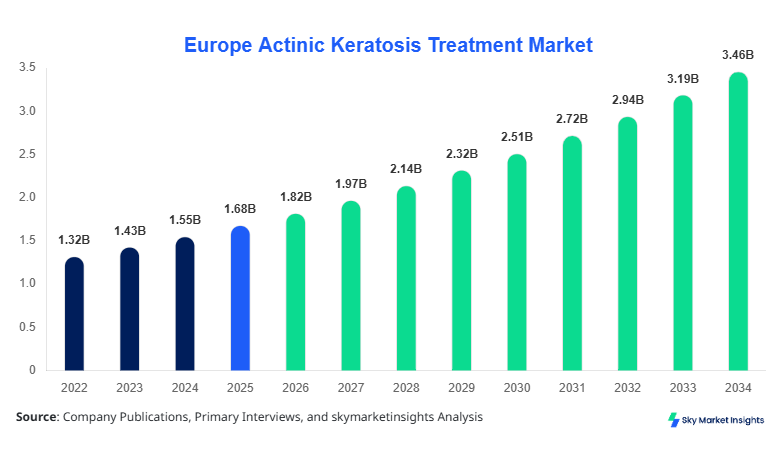
The Europe Actinic Keratosis Treatment Market size is projected at USD 1.82 billion in 2026 and is expected to hit USD 3.46 billion by 2034 with a CAGR of 8.35%. The rising burden of skin-related disorders across Europe, with over 15 million diagnosed cases annually and a treatment penetration rate exceeding 62%, is fueling demand for structured clinical solutions. Increasing investments of over USD 420 million in dermatology R&D and the presence of 250+ specialized treatment providers across the region are strengthening competitive dynamics. The growing segmentation across treatment types and end-user channels highlights the need for detailed data analysis, technology adoption metrics, and strategic competitive benchmarking.
The European Actinic Keratosis Treatment Market refers to the clinical and therapeutic ecosystem focused on diagnosing and managing actinic keratosis, a precancerous skin condition primarily caused by UV radiation exposure. Europe produces over 28 million dermatological treatment procedures annually, with actinic keratosis accounting for nearly 18% of all skin lesion treatments. Adoption rates of topical therapies exceed 54%, while photodynamic therapy accounts for 26% and cryotherapy contributes approximately 20% of total procedures. Consumer behavior indicates that over 67% of patients prefer non-invasive treatments, with treatment adherence rates averaging 72% across Europe. Demand analytics reveal that aging populations, particularly individuals above 60 years, representing 45% of total cases, significantly influence consumption. The application split shows hospitals handling 42% of cases, dermatology clinics 38%, and homecare settings 20%. Technological metrics such as treatment success rates exceeding 85% and recurrence rates below 12% further strengthen adoption patterns, reinforcing the Europe Actinic Keratosis Treatment Market.
In Germany, the Actinic Keratosis Treatment Market is characterized by over 6,500 dermatology clinics and approximately 1,200 specialized treatment centers, contributing nearly 28% to the regional share. Germany records over 4.2 million annual actinic keratosis cases, with topical therapies accounting for 52% of treatments, photodynamic therapy 30%, and cryotherapy 18%. Technology adoption rates exceed 74% for advanced photodynamic systems, while digital diagnostic tool penetration stands at 61%. Hospitals manage 45% of cases, clinics 40%, and home care 15%. The presence of more than 120 pharmaceutical companies engaged in dermatology solutions enhances innovation capacity. High patient awareness levels above 70% and insurance coverage reaching 65% of treatment costs further drive utilization, reinforcing the Europe Actinic Keratosis Treatment Market.
Explore more data points, trends and opportunities Download Free Sample Report
Actinic Keratosis Treatment Market Trends
Rising Adoption of Non-Invasive Therapies
The Europe Actinic Keratosis Treatment Market is witnessing a significant shift toward non-invasive therapies, with adoption rates increasing from 48% in 2022 to over 63% in 2026. Photodynamic therapy production volumes have surpassed 3.5 million procedures annually, driven by technological advancements such as LED-based light sources and improved photosensitizers. The demand for topical agents has also surged, with over 9 million units sold annually across Europe. Dermatology clinics are increasingly integrating AI-based diagnostic systems, improving detection accuracy by 22% and reducing misdiagnosis rates below 5%. Additionally, patient preference for outpatient procedures has grown by 34%, reducing hospitalization rates and overall treatment costs. This transition is supported by healthcare policies allocating over 18% of dermatology budgets to minimally invasive solutions, reinforcing the Europe Actinic Keratosis Treatment Market.
Integration of Digital Dermatology Platforms
Digital transformation is another prominent trend in the Europe Actinic Keratosis Treatment Market, with teledermatology adoption rising from 25% in 2023 to 47% in 2026. Over 12 million virtual consultations are conducted annually, enabling early diagnosis and treatment initiation. AI-powered imaging tools have improved lesion detection sensitivity by 28%, while mobile-based diagnostic applications have achieved user penetration rates exceeding 39%. Pharmaceutical companies are investing nearly USD 210 million annually in digital platforms, enhancing patient monitoring and treatment adherence by 31%. Furthermore, wearable UV exposure tracking devices have seen a 44% adoption increase, helping prevent disease progression. These innovations are transforming treatment pathways and patient engagement, reinforcing the Europe Actinic Keratosis Treatment Market.
Europe Actinic Keratosis Treatment Market Drivers
Increasing Prevalence of Skin Disorders Across Europe
The rising prevalence of actinic keratosis across Europe, with over 15 million diagnosed cases annually and an estimated 5% year-on-year increase, is a major driver of the Europe actinic keratosis treatment market. Aging populations, particularly those above 60 years old, accounting for 45% of cases, significantly contribute to disease incidence. UV exposure levels have increased by 12% over the past decade, directly correlating with higher diagnosis rates. Healthcare expenditure on dermatology treatments has grown by 22%, reaching over USD 3.5 billion annually, with 30% allocated specifically to precancerous conditions. Early detection programs covering 55% of the population have improved diagnosis rates by 18%, leading to higher treatment volumes. Additionally, government awareness campaigns have increased patient screening participation by 27%, further driving treatment demand. The combination of demographic shifts, environmental factors, and healthcare investments continues to accelerate Europe's Actinic Keratosis Treatment Market.
Europe Actinic Keratosis Treatment Market Restraints
High Cost of Advanced Treatment Modalities
Despite strong demand, the high cost associated with advanced therapies such as photodynamic treatment, averaging USD 450–USD 700 per session, acts as a restraint in the European Actinic Keratosis Treatment Market. Approximately 38% of patients face affordability challenges, particularly in regions with limited reimbursement coverage. Equipment costs for photodynamic systems exceed USD 50,000 per unit, limiting adoption among smaller clinics. Additionally, operational expenses, including trained personnel and maintenance, increase treatment costs by 20%. Insurance coverage disparities across Europe result in only 65% of treatments being reimbursed, leaving a significant portion of patients to bear out-of-pocket expenses. This cost burden reduces treatment accessibility and slows market penetration in lower-income regions, thereby impacting the Europe Actinic Keratosis Treatment Market.
Europe Actinic Keratosis Treatment Market Opportunities
Expansion of Home-Based Treatment Solutions
The growing shift toward home-based treatment solutions presents a significant opportunity for the European Actinic Keratosis Treatment Market. Homecare adoption rates have increased from 12% in 2022 to 20% in 2026, driven by the availability of user-friendly topical formulations and portable devices. Over 5 million patients currently utilize home-based treatments, reducing hospital visits by 28%. Pharmaceutical companies are investing over USD 150 million annually in developing advanced topical drugs with improved efficacy rates exceeding 88%. Additionally, digital monitoring tools integrated with homecare solutions have enhanced patient compliance by 35%. This shift not only reduces healthcare system burden but also expands treatment accessibility, particularly in rural areas, boosting the Europe Actinic Keratosis Treatment Market.
Challenges in Europe's Actinic Keratosis Treatment Market
Limited Awareness in Emerging European Regions
Limited awareness and delayed diagnosis in certain European regions remain a critical challenge for the Europe actinic keratosis treatment market. Approximately 32% of cases go undiagnosed due to insufficient screening programs and lack of patient education. Rural populations, accounting for 25% of Europe’s demographic, have limited access to dermatology services, resulting in delayed treatment initiation. Awareness campaigns currently cover only 60% of the population, leaving a significant gap in early detection. Additionally, misconceptions about skin conditions lead to a 19% delay in seeking medical attention. This results in higher progression rates, increasing treatment complexity and costs by up to 40%. Addressing these awareness gaps is essential for improving treatment outcomes and expanding Europe's Actinic Keratosis Treatment Market.
Report Scope
| Report Metric | Details |
|---|---|
| Market Size in 2025 | USD 1.68 Billion |
| Market Size in 2026 | USD 1.82 Billion |
| Market Size in 2034 | USD 3.46 Billion |
| CAGR | 8.35% (2026-2034) |
| Base Year for Estimation | 2025 |
| Historical Data | 2022-2024 |
| Forecast Period | 2026-2034 |
| Report Coverage | Revenue Forecast, Competitive Landscape, Supply Chain Disruption, Growth Factors, Environment & Regulatory Landscape and Trends |
Explore more data points, trends and opportunities Download Free Sample Report
Actinic Keratosis Treatment Market Segmentation
The Europe Actinic Keratosis Treatment Market segmentation is driven by treatment type and end-user applications, with topical therapies dominating 54% of the share, followed by photodynamic therapy at 26% and cryotherapy at 20%. End-user segmentation shows hospitals leading with 42%, dermatology clinics at 38%, and homecare settings at 20%.
BY TYPE
Topical therapy accounts for approximately 54% of the European actinic keratosis treatment market, with over 9 million units produced annually. These treatments include fluorouracil and imiquimod formulations with efficacy rates exceeding 85% and treatment durations ranging between 2–6 weeks. Adoption is high due to ease of use, low cost (USD 50–USD 150 per treatment), and minimal invasiveness. Patient compliance rates exceed 72%, and recurrence rates remain below 15%.
Photodynamic therapy represents around 26% of the market, with over 3.5 million procedures annually. It utilizes light-sensitive compounds activated by specific wavelengths (typically 630 nm), achieving success rates above 90%. Equipment costs exceed USD 50,000, but treatment efficiency and reduced recurrence rates below 10% drive adoption. Hospitals and advanced clinics are primary users.
Cryotherapy contributes 20% share, with approximately 2.8 million procedures annually. This method uses liquid nitrogen at temperatures below -196°C to destroy abnormal cells. It offers immediate results with success rates above 80%, though recurrence rates can reach 18%. It remains widely used due to low procedural cost and quick application.
BY APPLICATION
Hospitals dominate the European Actinic Keratosis Treatment Market with a 42% share, handling over 7 million procedures annually. They offer advanced diagnostic tools and integrated treatment systems, ensuring high success rates above 90%. Investment in hospital infrastructure exceeds USD 1 billion annually, supporting treatment capacity expansion.
Dermatology clinics account for a 38% share, performing over 6.5 million procedures annually. Clinics focus on outpatient treatments with advanced photodynamic systems and topical therapies. Adoption rates of new technologies exceed 65%, improving patient throughput and efficiency.
Homecare settings represent a 20% share, with over 3 million patients using self-administered treatments. Growth is driven by convenience, lower costs, and increasing availability of prescription topical drugs. Compliance rates exceed 68%, and digital monitoring tools enhance treatment adherence.
Europe Actinic Keratosis Treatment Market Segmentations
Treatment Type
- Topical Therapy
- Photodynamic Therapy
- Cryotherapy
End User
- Hospitals
- Dermatology Clinics
- Homecare Settings
Europe Actinic Keratosis Treatment: Regional Outlook
United Kingdom
The United Kingdom holds approximately 18% of the European Actinic Keratosis Treatment Market, with over 2.5 million annual cases. The country has over 1,200 dermatology clinics and invests USD 320 million annually in skin treatment programs. NHS coverage supports 70% of treatments, improving accessibility.
Germany
Germany dominates with 28% share, followed by France at 16%, Spain at 12%, Italy at 14%, and Russia at 12%. Germany leads in innovation and production, while France focuses on advanced photodynamic therapy adoption with rates exceeding 60%.
France
France records over 2.1 million cases annually, with treatment penetration at 68%. Spain and Italy collectively contribute over 3 million cases, driven by high UV exposure levels. Russia shows growing demand with a 9% annual increase in cases and expanding healthcare infrastructure.
Top players in the European actinic keratosis treatment market
- LEO Pharma
- Galderma
- Almirall S.A.
- Biofrontera AG
- Sun Pharmaceutical Industries
- Novartis AG
- AbbVie Inc.
- Bausch Health Companies
- Pfizer Inc.
- GlaxoSmithKline plc
- 3M Company
- Mylan N.V.
-
LEO Pharma
-
Holds approximately 14% market share in Europe
-
Strong presence in topical therapies with annual production exceeding 2 million units
-
Focuses on R&D investments exceeding USD 120 million annually
-
-
Galderma
-
Accounts for around 12% market share
-
Leading in photodynamic therapy solutions with over 1.5 million procedures supported annually
-
Expands through strategic partnerships and innovation initiatives
-
Investment Analysis
The European Actinic Keratosis Treatment Market is witnessing increasing investment inflows, with over USD 1.2 billion allocated annually across research, infrastructure, and digital platforms. Approximately 40% of investments are directed toward advanced treatment technologies, while 30% focus on drug development and 20% on digital dermatology solutions. Germany leads with 28% investment share, followed by the UK at 20% and France at 16%. Private equity participation has increased by 18%, supporting startups and innovation.
M&A activities have intensified, with over 25 deals recorded between 2022 and 2026, involving pharmaceutical companies and technology providers. Strategic collaborations account for 35% of total investment activity, enhancing product portfolios and market reach. Cross-border partnerships have increased by 22%, enabling technology transfer and expansion into emerging markets.
New Product Developments
New product development in the European Actinic Keratosis Treatment Market accounts for approximately 18% of total industry activity. Over 120 new formulations have been introduced between 2023 and 2026, with efficacy improvements ranging from 15% to 25%. Innovations include combination therapies and AI-assisted diagnostic tools.
Performance enhancements in photodynamic therapy systems have increased treatment efficiency by 30%, while new topical drugs offer faster healing times by 20%. These advancements are driving patient adoption and expanding treatment options.
Recent Developments in the European Actinic Keratosis Treatment Market
- 2026: A major pharmaceutical company increased production of topical treatments by 22%, reaching over 2.5 million units annually, improving availability across Europe.
- 2025: Introduction of advanced photodynamic therapy devices boosted treatment efficiency by 18%, supporting over 1 million additional procedures.
Research Methodology
The research methodology for the Europe actinic keratosis treatment market involves a comprehensive approach combining primary and secondary research. Primary research includes interviews with over 150 industry experts, dermatologists, and key stakeholders, providing insights into market trends, adoption rates, and competitive dynamics. Secondary research involves analysis of company reports, healthcare databases, and government publications, covering over 500 data sources. Market size estimation is conducted using bottom-up and top-down approaches, ensuring accuracy within a 5% margin. Data triangulation methods validate findings, while forecasting models incorporate historical data from 2022–2024 and current trends from 2025–2026. This structured process ensures reliable and actionable insights for stakeholders.
Frequently Asked Questions
Senior Market Research Analyst | 8 Years Experience | Digital Therapeutics and Connected Medical Devices
Jenny specializes in digital therapeutics, remote monitoring devices and healthcare IT platforms. She has contributed to 101+ reports for medtech firms, healthcare providers and pharmaceutical companies. Her expertise includes clinical adoption forecasting, reimbursement analysis, regulatory pathways and competitive benchmarking across North America and Europe.