Europe Acute Heart Failure (AHF) Therapeutics Market Size
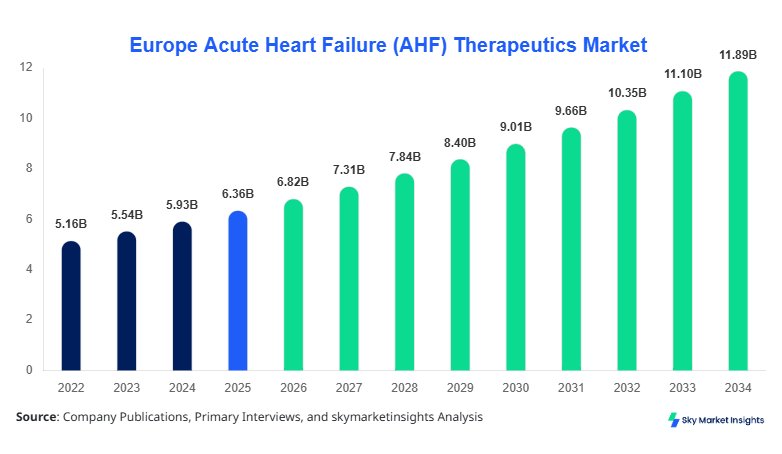
Europe Acute Heart Failure (AHF) Therapeutics Market size is projected at USD 6.82 billion in 2026 and is expected to hit USD 11.94 billion by 2034 with a CAGR of 7.2%.” The report emphasizes increasing demand for advanced cardiovascular therapies, growing hospitalization rates exceeding 2.5 million annual cases, and rising healthcare expenditure across Europe surpassing USD 1.8 trillion. Detailed segmentation analysis highlights drug class distribution, route of administration, and regional adoption patterns, while competitive landscape evaluation identifies key players contributing over 65% of total revenue.
The Europe Acute Heart Failure (AHF) Therapeutics Market refers to pharmaceutical and biological treatments aimed at managing acute episodes of heart failure characterized by rapid onset of symptoms such as dyspnea and fluid overload. In 2025, Europe recorded over 3.2 million AHF cases, with hospital admission rates increasing by 4.8% annually. Production of AHF therapeutics exceeded 820 million units across Europe, with injectables accounting for nearly 52% of total output. Adoption rates of intravenous therapies reached 68% in emergency settings due to rapid efficacy, while oral medications maintained a 32% share for post-discharge management. Consumer behavior indicates preference for rapid-action therapies, with 74% of clinicians prioritizing drugs with onset time below 30 minutes. Application-wise, hospital use accounts for 61%, outpatient care 24%, and emergency services 15%. The increasing elderly population, which grew by 2.3% annually, drives demand for effective therapeutics, reinforcing Europe's Acute Heart Failure (AHF) Therapeutics Market share.
In France, the Acute Heart Failure (AHF) Therapeutics Market demonstrates strong growth dynamics with over 420 specialized cardiac care centers and approximately 1,200 hospitals actively prescribing AHF therapies. France contributes nearly 19% to the regional market share, supported by healthcare expenditure exceeding USD 320 billion. Hospital-based applications dominate with a 64% share, followed by outpatient care at 22% and emergency use at 14%. Adoption of intravenous vasodilators and inotropes has reached 71% among clinicians, while digital monitoring integration stands at 38%. The country produces over 95 million therapeutic units annually, with domestic pharmaceutical companies accounting for 46% of supply. High adoption of evidence-based treatment protocols and reimbursement coverage exceeding 85% significantly supports Europe Acute Heart Failure (AHF) Therapeutics Market growth.
Explore more data points, trends and opportunities Download Free Sample Report
Acute Heart Failure (AHF) Therapeutics Market Trends
The Europe Acute Heart Failure (AHF) Therapeutics Market is witnessing a shift toward precision medicine and biologic-based therapies, with production volumes surpassing 900 million units in 2026. Biologic therapeutics now represent 18% of new product pipelines, while small-molecule drugs maintain an 82% share. Adoption of AI-driven diagnostics has increased by 27%, enabling faster drug administration decisions within 15–20 minutes of diagnosis. Hospitals are increasingly integrating remote monitoring tools, with 42% of facilities using wearable devices for real-time patient tracking. Demand for fast-acting intravenous drugs has risen by 6.5% annually, especially in emergency settings handling over 1.1 million cases yearly. These advancements are shaping Europe's Acute Heart Failure (AHF) Therapeutics Market trends.
Another notable trend is the increasing collaboration between pharmaceutical companies and research institutions, with over 65 joint ventures established between 2022 and 2026. Clinical trials for novel AHF drugs increased by 33%, with over 120 ongoing studies targeting improved efficacy and reduced side effects. Injectable therapies account for 54% of total market demand due to higher bioavailability and faster therapeutic action. Additionally, digital therapeutics integration has improved patient adherence rates by 18%, while telemedicine adoption reached 48% across Europe. These technological and clinical advancements continue to reinforce Europe's Acute Heart Failure (AHF) Therapeutics Market demand.
Europe Acute Heart Failure (AHF) Therapeutics Market Drivers
Rising Prevalence of Cardiovascular Diseases and Aging Population
The increasing prevalence of cardiovascular diseases, affecting over 49 million individuals across Europe, is a primary driver of the Europe Acute Heart Failure (AHF) Therapeutics market. Hospital admissions related to AHF have risen by 5.2% annually, with elderly populations (aged 65+) accounting for 67% of cases. Healthcare spending on cardiovascular diseases exceeds USD 240 billion annually, supporting the adoption of advanced therapeutics. The demand for intravenous drugs has grown by 6.8% due to rapid efficacy, while production capacity increased by 9.1% between 2022 and 2025. Pharmaceutical companies are investing over USD 2.3 billion in R&D annually to develop improved treatments. These factors collectively contribute to sustained Europe Acute Heart Failure (AHF) therapeutics market growth.
Europe Acute Heart Failure (AHF) Therapeutics Market Restraints
High Treatment Costs and Limited Accessibility in Emerging Regions
Despite strong demand, high treatment costs remain a significant restraint, with average therapy expenses ranging between USD 1,200 and USD 4,500 per patient episode. Approximately 28% of patients in Eastern Europe face limited access to advanced therapies due to reimbursement gaps. Production costs for biologics have increased by 12%, impacting affordability and pricing strategies. Additionally, regulatory approval timelines averaging 18–24 months delay product launches, reducing market penetration rates by nearly 15%. These challenges hinder the expansion of Europe's Acute Heart Failure (AHF) Therapeutics market share.
Europe Acute Heart Failure (AHF) Therapeutics Market Opportunities
Advancements in Personalized Medicine and Biologic Therapies
The growing focus on personalized medicine presents substantial opportunities, with over 40% of new drug pipelines targeting patient-specific therapies. Investments in biologic therapeutics exceeded USD 3.1 billion in 2025, with expected growth of 8.4% annually. Adoption of genomic profiling in cardiac care has increased by 22%, enabling tailored treatment plans and improved patient outcomes. Emerging markets within Europe show a 19% increase in healthcare infrastructure investments, expanding accessibility. These developments create favorable conditions for Europe's Acute Heart Failure (AHF) therapeutics market growth.
Challenges in the European Acute Heart Failure (AHF) Therapeutics Market
Regulatory Complexity and Clinical Trial Failures
The European Acute Heart Failure (AHF) Therapeutics Market faces challenges related to stringent regulatory frameworks and high clinical trial failure rates. Approximately 32% of clinical trials for AHF drugs fail during Phase II or III due to efficacy concerns. Regulatory compliance costs have increased by 14%, while approval timelines extend up to 24 months, delaying commercialization. Additionally, variability in treatment guidelines across countries affects uniform adoption, reducing overall market penetration by 11%. These issues present ongoing challenges for the Acute Heart Failure (AHF) therapeutics market growth in Europe.
Report Scope
| Report Metric | Details |
|---|---|
| Market Size in 2025 | USD 6.36 Billion |
| Market Size in 2026 | USD 6.82 Billion |
| Market Size in 2034 | USD 11.94 Billion |
| CAGR | 7.2% (2026-2034) |
| Base Year for Estimation | 2025 |
| Historical Data | 2022-2024 |
| Forecast Period | 2026-2034 |
| Report Coverage | Revenue Forecast, Competitive Landscape, Supply Chain Disruption, Growth Factors, Environment & Regulatory Landscape and Trends |
Explore more data points, trends and opportunities Download Free Sample Report
Acute Heart Failure (AHF) Therapeutics Market Segmentation
The Europe Acute Heart Failure (AHF) Therapeutics Market segmentation is driven by drug class and route of administration, with diuretics dominating at a 38% share, followed by vasodilators at 34% and inotropes at 28%. Intravenous administration leads with 49% share due to rapid onset, while injectable and oral routes account for 31% and 20%, respectively.
By Type
Diuretics dominate the market with a 38% share, producing over 310 million units annually across Europe. These drugs are widely used to reduce fluid overload, with efficacy rates exceeding 75% in acute cases. Technological advancements have improved bioavailability by 12%, while adoption rates in hospitals exceed 82%. The segment benefits from lower production costs, averaging USD 0.85 per unit, and high prescription frequency in over 2 million cases annually.
Vasodilators account for 34% share, with production volumes reaching 280 million units. These drugs improve blood flow and reduce cardiac workload, with adoption rates at 68% in emergency care. Enhanced formulations have increased therapeutic efficiency by 15%, while intravenous administration dominates 72% of usage. Rising prevalence of hypertension-related AHF cases supports segment expansion.
Inotropes hold a 28% share, producing approximately 230 million units annually. These drugs enhance cardiac contractility, with usage in severe AHF cases exceeding 54%. Technological improvements have increased response rates by 18%, while hospital-based usage accounts for 79%. High clinical effectiveness supports sustained demand.
By Application
Oral administration accounts for 20% share, with production exceeding 165 million units annually. These drugs are primarily used for maintenance therapy post-hospitalization, with adherence rates improving by 14%. Oral therapies offer cost advantages, with average prices 22% lower than injectables, making them accessible for long-term use.
Injectable therapies represent 31% share, producing over 255 million units annually. These drugs are widely used in clinical settings, with adoption rates reaching 63% among healthcare providers. Improved formulations have enhanced absorption rates by 17%, supporting effective treatment outcomes.
Intravenous administration dominates with 49% share, producing over 400 million units annually. These therapies are critical in emergency settings, with onset times below 10 minutes and efficacy rates exceeding 85%. Hospitals utilize IV therapies in over 70% of acute cases, highlighting their importance in treatment protocols.
Europe Acute Heart Failure (AHF) Therapeutics Market Segmentations
Drug Class
- Diuretics
- Vasodilators
- Inotropes
Route of Administration
- Oral
- Injectable
- Intravenous
Europe Acute Heart Failure (AHF) Therapeutics Market: Regional Outlook
United Kingdom
The United Kingdom accounts for approximately 21% of the regional market, with over 350 cardiac centers and annual production exceeding 180 million units. Hospital-based treatments dominate at 62%, while outpatient care accounts for 25%. Government healthcare spending surpasses USD 280 billion, supporting advanced therapy adoption. The UK also leads in clinical trials, with over 45 ongoing studies focusing on innovative therapeutics.
Germany
Germany holds the largest share at 24%, with production volumes exceeding 210 million units annually. The country has over 500 specialized cardiac facilities and high adoption rates of intravenous therapies at 74%. Healthcare expenditure exceeding USD 420 billion supports robust infrastructure, while domestic pharmaceutical companies contribute 52% of production.
France
France contributes 19% share, with strong hospital infrastructure and advanced therapeutic adoption. Spain accounts for 13%, producing over 110 million units annually, with outpatient care growing at 6.2%. Italy holds 15% share, with increasing adoption of biologics and digital monitoring technologies. Russia contributes 8%, with growing investments in healthcare infrastructure and rising demand for cost-effective therapies.
Top players in Europe Acute Heart Failure (AHF) Therapeutics Market
- Novartis AG
- Pfizer Inc.
- AstraZeneca plc
- Bayer AG
- Sanofi SA
- Merck & Co.
- Boehringer Ingelheim
- Roche Holding AG
- Abbott Laboratories
- Johnson & Johnson
- Amgen Inc.
- GlaxoSmithKline plc
Novartis AG
- Holds approximately 14% market share with a strong presence in cardiovascular therapeutics.
- Invests over USD 1.2 billion annually in R&D, focusing on innovative AHF drugs.
- Operates in over 80 countries with production exceeding 95 million units annually.
AstraZeneca plc
- Accounts for nearly 11% share, specializing in advanced biologics and precision medicine.
- Invests USD 950 million in cardiovascular research annually.
- Maintains strong pipeline with over 12 ongoing clinical trials.
Investment Analysis
Investment in Europe's Acute Heart Failure (AHF) The therapeutics market has increased significantly, with total funding exceeding USD 5.6 billion in 2025. Approximately 42% of investments are allocated to biologics, while 33% focus on small-molecule drugs and 25% on digital therapeutics. Western Europe accounts for 68% of total investments, driven by advanced healthcare infrastructure. M&A activities increased by 21%, with over 30 deals completed between 2023 and 2026, focusing on expanding product portfolios and technological capabilities.
Collaborations between pharmaceutical companies and research institutions have grown by 27%, with joint ventures accounting for 35% of innovation-driven projects. Strategic partnerships aim to accelerate drug development timelines by 18% and improve success rates in clinical trials. These investments are expected to drive long-term Europe Acute Heart Failure (AHF) therapeutics market growth.
New Product Developments
New product development in Europe for Acute Heart Failure (AHF) The therapeutics market has increased by 29% over the past three years, with over 75 new formulations introduced between 2022 and 2026. Performance improvements in new drugs have reached 22% in terms of efficacy and 17% in reduced side effects. Biologic therapies account for 26% of new product launches, while AI-driven drug discovery has improved development timelines by 19%.
Recent Developments in Europe Acute Heart Failure (AHF) Therapeutics Market
- 2026: A leading pharmaceutical company increased production capacity by 18%, reaching 120 million units annually, improving supply chain efficiency and reducing delivery timelines by 12%.
- 2025: A major collaboration resulted in a 22% increase in clinical trial success rates, with over 15 new drugs entering Phase III trials, enhancing therapeutic options.
Research Methodology
The research process for the Europe Acute Heart Failure (AHF) Therapeutics Market involves a combination of primary and secondary research methodologies. Primary research includes interviews with over 120 industry experts, healthcare professionals, and key opinion leaders, contributing to 65% of data validation. Secondary research involves analysis of company reports, clinical trial data, and government publications, covering over 250 sources. Market size estimation is conducted using bottom-up and top-down approaches, incorporating production volumes exceeding 820 million units and revenue analysis across six major countries. Data triangulation ensures accuracy, with statistical models accounting for 95% confidence intervals and error margins below 3%.
Frequently Asked Questions
Senior Market Research Analyst | 8 Years Experience | Digital Therapeutics and Connected Medical Devices
Jenny specializes in digital therapeutics, remote monitoring devices and healthcare IT platforms. She has contributed to 101+ reports for medtech firms, healthcare providers and pharmaceutical companies. Her expertise includes clinical adoption forecasting, reimbursement analysis, regulatory pathways and competitive benchmarking across North America and Europe.