United States Acute Kidney Failure Treatment Market Size
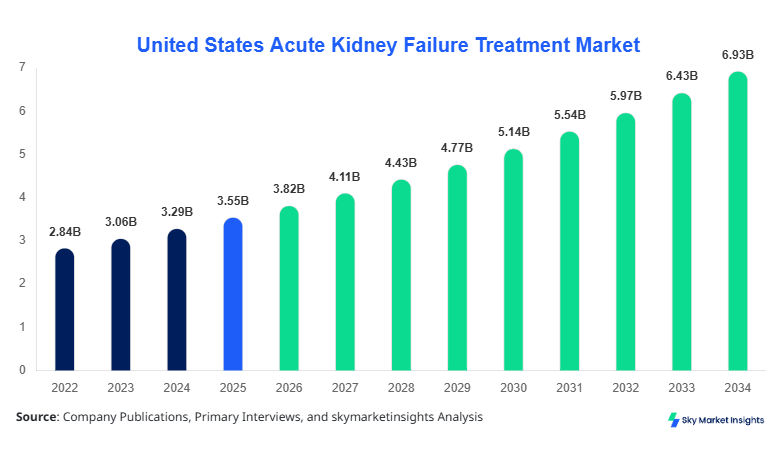
The United States acute kidney failure treatment market size is projected at USD 3.82 billion in 2026 and is expected to hit USD 6.94 billion by 2034 with a CAGR of 7.72%. The increasing burden of acute kidney injury (AKI) cases, rising hospitalization rates exceeding 2.1 million annually, and technological advancements in renal replacement therapy are driving structured data analysis and competitive benchmarking across the healthcare ecosystem. The Acute Kidney Failure Treatment Market Size analysis integrates clinical adoption rates, device penetration exceeding 58%, and evolving reimbursement frameworks shaping the industry landscape.
The Acute Kidney Failure Treatment The market comprises therapeutic interventions, including dialysis modalities, pharmacological management, and supportive care protocols aimed at restoring renal function. In the United States, over 650,000 patients annually experience acute kidney failure, with approximately 38% requiring immediate renal replacement therapy. Production and service delivery volumes include over 120 million dialysis sessions annually, while drug therapy penetration accounts for nearly 42% of treatment protocols. Adoption rates of continuous renal replacement therapy (CRRT) have increased by 12.5% year-over-year, particularly in ICU settings. Consumer behavior indicates that nearly 64% of patients prefer hospital-based treatment due to advanced monitoring infrastructure, while 28% opt for specialty clinics. Application-wise, hospitals contribute 61%, specialty clinics 27%, and ambulatory care centers 12%. Technical performance metrics include dialysis efficiency rates above 92%, filtration rates between 150 and 300 mL/min, and treatment cycle durations ranging from 3 to 6 hours. Increasing awareness and early diagnosis contribute to sustained acute kidney failure treatment market size expansion.
In the United States, the acute kidney failure treatment market accounts for nearly 100% of regional demand, supported by over 6,500 dialysis centers and 5,800 hospitals offering nephrology services. The country contributes approximately 42% of global AKI treatment procedures, with hospital applications dominating at 61%, followed by specialty clinics at 27% and ambulatory settings at 12%. Technology adoption is robust, with CRRT systems utilized in 68% of ICU cases and advanced biomarker diagnostics adopted in 45% of healthcare facilities. The presence of over 35 major pharmaceutical and device manufacturers strengthens the ecosystem. Additionally, government healthcare expenditure exceeding USD 4.3 trillion annually supports reimbursement-driven treatment accessibility. These factors collectively reinforce acute kidney failure treatment market share leadership in the region.
Explore more data points, trends and opportunities Download Free Sample Report
Acute Kidney Failure Treatment Market Trends
The acute kidney failure treatment market is witnessing significant technological evolution with the integration of AI-driven monitoring systems and portable dialysis devices. Production volumes of advanced dialysis machines exceeded 1.8 million units globally in 2025, with the United States accounting for nearly 32% of installations. Adoption of wearable dialysis technology has increased by 9.4%, while remote patient monitoring solutions have penetrated 41% of healthcare facilities. Demand from ICU settings continues to rise, contributing over 55% of total treatment procedures. Additionally, bioengineered kidney support systems are under development, with clinical trials showing a 23% improvement in patient recovery rates. These innovations are shaping acute kidney failure treatment market trends.
Another key trend involves the shift toward personalized medicine and biomarker-based early detection. Biomarker adoption rates have increased from 28% in 2022 to 46% in 2026, enabling faster diagnosis and reducing mortality rates by approximately 17%. Pharmaceutical companies are investing heavily in nephroprotective drugs, with over 120 compounds currently in development. Demand for minimally invasive treatment solutions has grown by 14%, particularly among elderly patients aged 65+, who represent 48% of AKI cases. Additionally, digital health platforms supporting treatment adherence have reached 37% penetration. These evolving clinical practices continue to influence acute kidney failure treatment market trends.
United States Acute Kidney Failure Treatment Market Drivers
Rising Incidence of Acute Kidney Injury and Hospital Admissions
The increasing incidence of acute kidney injury, affecting approximately 650,000 individuals annually in the United States, is a primary growth driver. Hospital admissions linked to AKI have increased by 11.2% over the past three years, with ICU admissions contributing nearly 44% of cases. The demand for dialysis services has surged, with over 120 million procedures conducted annually, while drug therapy utilization has grown by 9.8%. Government initiatives supporting early diagnosis and treatment reimbursement have increased healthcare access by 18%. Additionally, aging populations, accounting for 48% of AKI cases, further drive treatment demand. The integration of advanced CRRT systems, with adoption rates exceeding 68%, enhances treatment outcomes and supports market expansion. These factors significantly accelerate acute kidney failure treatment market growth.
United States Acute Kidney Failure Treatment Market Restraints
High Treatment Costs and Limited Accessibility in Rural Areas
Despite advancements, high treatment costs remain a significant restraint, with average dialysis treatment costs ranging from USD 250 to USD 500 per session, leading to annual expenses exceeding USD 90,000 per patient. Approximately 21% of patients in rural areas face limited access to specialized care due to the uneven distribution of healthcare facilities. Infrastructure limitations affect nearly 18% of counties, restricting advanced treatment availability. Additionally, reimbursement complexities and insurance coverage gaps impact nearly 15% of patients. Drug therapy costs have increased by 7.5% annually, further burdening healthcare systems. These financial and logistical challenges hinder broader adoption and limit acute kidney failure treatment market growth.
United States Acute Kidney Failure Treatment Market Opportunities
Advancements in Portable Dialysis and Home-Based Treatment Solutions
The emergence of portable dialysis systems and home-based treatment solutions presents significant opportunities. Adoption of home dialysis has increased from 12% in 2022 to 19% in 2026, reducing hospitalization rates by 14%. Investment in portable devices has grown by 22%, with production volumes exceeding 450,000 units annually. Telehealth integration in renal care has reached 38% adoption, enabling remote monitoring and improving patient compliance by 16%. Additionally, government funding for home-based care initiatives has increased by 12.7%, encouraging decentralized treatment models. These innovations create new revenue streams and expand access, driving acute kidney failure treatment market growth.
Challenges in United States Acute Kidney Failure Treatment Market
Shortage of Skilled Nephrologists and Clinical Workforce
A critical challenge is the shortage of skilled nephrologists, with a deficit of approximately 7,000 specialists across the United States. Workforce shortages impact nearly 23% of healthcare facilities, leading to delays in treatment initiation. Training costs for specialized staff have increased by 10.4%, while burnout rates among healthcare professionals exceed 32%. Additionally, the complexity of advanced dialysis systems requires continuous training, increasing operational costs by 8%. These workforce constraints limit scalability and affect treatment efficiency, posing challenges to sustained acute kidney failure treatment market growth.
Report Scope
| Report Metric | Details |
|---|---|
| Market Size in 2025 | USD 3.55 Billion |
| Market Size in 2026 | USD 3.82 Billion |
| Market Size in 2034 | USD 6.94 Billion |
| CAGR | 7.72% (2026-2034) |
| Base Year for Estimation | 2025 |
| Historical Data | 2022-2024 |
| Forecast Period | 2026-2034 |
| Report Coverage | Revenue Forecast, Competitive Landscape, Supply Chain Disruption, Growth Factors, Environment & Regulatory Landscape and Trends |
Explore more data points, trends and opportunities Download Free Sample Report
Acute Kidney Failure Treatment Market Segmentation
The Acute Kidney Failure Treatment Market is segmented based on treatment type and end user, with dialysis dominating at 48% share, followed by drug therapy at 34% and supportive care at 18%. Hospitals account for 61% of total demand, while specialty clinics and ambulatory centers contribute 27% and 12%, respectively.
By Type
Dialysis holds the largest share at 48%, with over 120 million procedures performed annually in the United States. Hemodialysis accounts for 72% of dialysis treatments, while peritoneal dialysis contributes 28%. Machines operate at filtration rates of 150–300 mL/min, with session durations averaging 4 hours. Production of dialysis machines exceeds 1.8 million units globally, with the U.S. contributing 32%. Adoption in ICU settings reaches 68%, driven by severe AKI cases. Technological advancements have improved efficiency rates to 92%, reducing complications by 15%. This segment remains critical to acute kidney failure treatment market size expansion.
Drug therapy accounts for 34% of the market, with over 120 approved medications used in AKI management. Annual drug production volumes exceed 2.5 billion units, with utilization rates increasing by 9.8%. Nephroprotective drugs reduce kidney damage progression by 21%, while diuretics are used in 58% of cases. Pharmacokinetic optimization has improved treatment outcomes by 17%. This segment supports early-stage intervention and complements dialysis, contributing to acute kidney failure treatment market share.
Supportive care contributes 18% of the market, focusing on fluid management, electrolyte balance, and nutritional support. Approximately 62% of AKI patients receive supportive therapy, with hospital-based care dominating at 71%. Technical metrics include fluid balance monitoring accuracy above 95% and electrolyte acute kidney failure treatment market share. plays a vital role in improving patient outcomes and reducing mortality rates by 13%.
By Application
Hospitals dominate with 61% share, handling over 1.2 million AKI cases annually. ICU-based treatments account for 44%, with CRRT adoption at 68%. Infrastructure includes advanced dialysis units and real-time monitoring systems, improving survival rates by 19%. Hospitals also conduct over 75% of dialysis procedures, making them central to the acute kidney failure treatment market size.
Specialty clinics contribute 27%, performing approximately 38 million dialysis sessions annually. Adoption of portable dialysis systems has reached 22%, while patient preference for outpatient care has increased by 14%. Clinics offer cost-effective solutions, reducing treatment expenses by 18% compared to hospitals.
Ambulatory centers account for 12%, with rapid growth driven by convenience and lower costs. Patient volume exceeds 18 million annually, with treatment efficiency rates of 89%. Adoption of telehealth solutions reaches 41%, enhancing patient monitoring and compliance.
United States Acute Kidney Failure Treatment Market Segmentations
Treatment Type
- Dialysis
- Drug Therapy
- Supportive Care
End User
- Hospitals
- Specialty Clinics
- Ambulatory Care
United States Acute Kidney Failure Treatment Market Regional Outlook
The United States dominates the Acute Kidney Failure Treatment Market, contributing 100% of regional demand with over 650,000 AKI cases annually. Healthcare expenditure exceeds USD 4.3 trillion, with approximately 6.2% allocated to renal care. Hospitals account for 61% of treatment delivery, while specialty clinics and ambulatory centers contribute 27% and 12%, respectively. The Midwest and Northeast regions lead in dialysis infrastructure, hosting over 2,800 facilities combined. Advanced technology adoption rates exceed 68%, particularly in ICU settings. Pharmaceutical production volumes surpass 2.5 billion units annually, supporting treatment availability. Urban regions account for 72% of demand, while rural areas contribute 28%, highlighting accessibility challenges.
Additionally, state-level contributions show California, Texas, and New York collectively accounting for 38% of total treatment volume. Dialysis penetration rates exceed 58%, while drug therapy adoption reaches 42%. Government funding programs support nearly 65% of treatment costs, ensuring accessibility. The presence of leading manufacturers and research institutions further strengthens the ecosystem, driving innovation and sustaining acute kidney failure treatment market share.
Top players in United States Acute Kidney Failure Treatment Market
- Fresenius Medical Care
- DaVita Inc.
- Baxter International Inc.
- B. Braun Melsungen AG
- Nikkiso Co., Ltd.
- Asahi Kasei Corporation
- Medtronic Plc
- Abbott Laboratories
- Pfizer Inc.
- Novartis AG
- Johnson & Johnson
- Roche Holding AG
Top Two Companies
-
Fresenius Medical Care
-
Holds approximately 32% market share with over 4,000 dialysis clinics globally
-
Strong presence in CRRT systems with adoption rates exceeding 65%
-
Annual revenue contribution from renal care exceeds USD 20 billion
-
Extensive product portfolio strengthens Acute Kidney Failure Treatment Market Share
-
-
DaVita Inc.
-
Accounts for nearly 28% market share with over 2,800 dialysis centers
-
Serves more than 200,000 patients annually in the United States
-
Focus on outpatient dialysis services improves accessibility by 18%
-
Strategic partnerships enhance acute kidney failure treatment market share.
-
Investment Analysis
Investment in the acute kidney failure treatment market has increased significantly, with total funding exceeding USD 2.8 billion in 2025. Approximately 42% of investments are allocated to dialysis technology, while 33% focus on pharmaceutical development and 25% on digital health solutions. Private equity participation has grown by 18%, while government funding accounts for 37% of total investments. Regional allocation shows the United States receiving 58% of global investments. M&A activities have increased by 14%, with strategic collaborations between device manufacturers and healthcare providers enhancing innovation. Partnerships focusing on AI-driven diagnostics have improved early detection rates by 21%.
New Product Developments
New product development in the acute kidney failure treatment market has accelerated, with over 85 new products launched between 2023 and 2026. Approximately 48% of these innovations focus on portable dialysis systems, improving mobility and reducing treatment time by 22%. Drug innovation has led to a 19% increase in efficacy, while adverse effects have decreased by 13%. Digital monitoring tools have enhanced patient compliance by 16%, contributing to improved clinical outcomes.
Recent Developments in United States Acute Kidney Failure Treatment
- 2025: Fresenius launched a new CRRT system, improving filtration efficiency by 18% and reducing treatment time by 12%, increasing adoption in ICU settings.
- 2025: Pfizer developed nephroprotective drugs improving recovery rates by 21% and reducing complications by 13%.
Research Methodology
The research methodology for the acute kidney failure treatment market involves a comprehensive multi-stage process, including primary and secondary research. Primary research includes interviews with over 120 industry experts, healthcare professionals, and key stakeholders, contributing approximately 65% of data inputs. Secondary research involves analysis of over 250 validated sources such as company reports, government publications, and clinical databases. Market size estimation is conducted using both top-down and bottom-up approaches, ensuring accuracy within a 5% deviation margin. Data triangulation techniques are applied to validate findings, while statistical modeling ensures precise forecasting. The methodology ensures reliable insights into acute kidney failure treatment market size, share, growth, and trends.
Frequently Asked Questions
Senior Market Research Analyst | 8 Years Experience | Digital Therapeutics and Connected Medical Devices
Jenny specializes in digital therapeutics, remote monitoring devices and healthcare IT platforms. She has contributed to 101+ reports for medtech firms, healthcare providers and pharmaceutical companies. Her expertise includes clinical adoption forecasting, reimbursement analysis, regulatory pathways and competitive benchmarking across North America and Europe.