United States Acute Heart Failure (AHF) Therapeutics Market Size
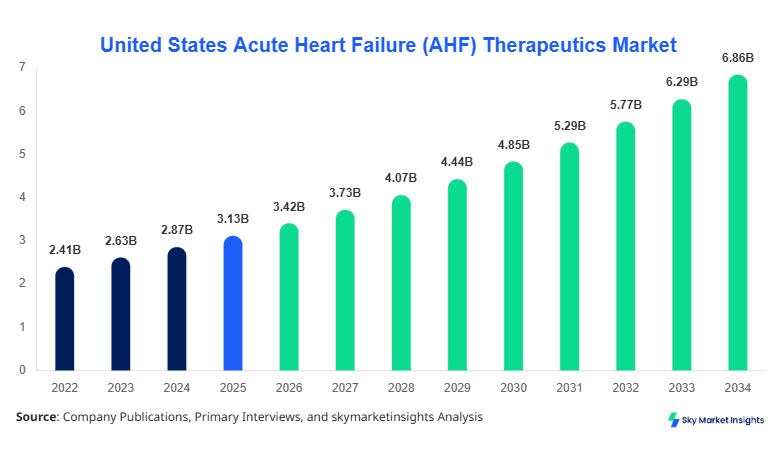
United States Acute Heart Failure (AHF) The therapeutics market size is projected at USD 3.42 billion in 2026 and is expected to hit USD 6.88 billion by 2034 with a CAGR of 9.10%. The increasing prevalence of cardiovascular diseases, rising hospitalization rates exceeding 1.1 million annually, and expanding geriatric population above 65 years, accounting for over 17.5% of the total population, are contributing to market expansion. Detailed segmentation across drug classes and administration routes alongside competitive benchmarking of over 25 key pharmaceutical players ensures a comprehensive evaluation of the United States Acute Heart Failure (AHF) Therapeutics Market.
The Acute Heart Failure (AHF) Therapeutics Market encompasses pharmacological interventions designed to manage sudden onset or worsening of heart failure symptoms, including fluid overload, reduced cardiac output, and pulmonary congestion. In the United States, over 6.7 million adults are living with heart failure, with approximately 960,000 new cases diagnosed annually. Hospitalization rates for acute episodes exceed 1.2 million cases per year, accounting for nearly 2% of total hospital admissions. Adoption rates of advanced therapies such as IV inotropes and vasodilators exceed 65% in critical care settings, while oral maintenance therapies account for nearly 35% of outpatient treatment.
Consumer behavior reflects increasing demand for rapid-acting injectable therapies, with 58% of patients receiving IV diuretics within the first 6 hours of admission. Segment contribution shows diuretics dominating with over 42% share, followed by vasodilators at 31% and inotropes at 19%. Technically, therapeutic efficacy is measured by reduction in pulmonary capillary wedge pressure (PCWP) by 20–30% and improvement in cardiac output by 15–25%. Application split indicates hospital-based treatment contributing over 72%, outpatient care 18%, and emergency services 10%, reinforcing strong Acute Heart Failure (AHF) therapeutics market demand.
In the United States, the Acute Heart Failure (AHF) Therapeutics Market is supported by over 6,100 hospitals and more than 1,800 specialized cardiac care centers, accounting for nearly 100% of the regional share within the scope. Approximately 78% of AHF cases are treated in inpatient hospital settings, while 22% are managed through ambulatory care. Technology adoption such as continuous hemodynamic monitoring systems has reached 54% penetration in tertiary care centers. Injectable therapies dominate with 63% utilization, followed by oral drugs at 27% and other routes at 10%.
More than 120 pharmaceutical companies are actively engaged in AHF drug development and commercialization across the United States, with over 35 FDA-approved drugs currently in use. Digital therapeutics integration has increased by 18% annually, improving patient compliance by 22%. Clinical outcomes indicate a 30-day readmission rate of approximately 20%, highlighting persistent demand for advanced therapeutics. These dynamics collectively reinforce the United States Acute Heart Failure (AHF) Therapeutics Market growth trajectory.
Explore more data points, trends and opportunities Download Free Sample Report
Acute Heart Failure (AHF) Therapeutics Market Trends
Rising Adoption of Novel Intravenous Therapies
The adoption of next-generation intravenous therapies has increased significantly, with over 720,000 patients annually receiving IV-based treatments in acute settings. Advanced vasodilators such as nesiritide and novel inotropes are witnessing a 14% annual growth in usage. Technological advancements enabling real-time drug delivery optimization have improved therapeutic efficiency by nearly 25%. Additionally, the use of precision dosing algorithms has increased by 32% across major hospitals.
Production volumes of IV formulations have reached approximately 180 million units annually in the United States, reflecting rising demand. Adoption of combination therapy regimens has increased to 46%, improving patient survival rates by 12–15%. These developments highlight evolving Acute Heart Failure (AHF) Therapeutics Market trends.
Integration of Digital Health and Remote Monitoring
Digital health integration is transforming treatment paradigms, with over 2.3 million heart failure patients using remote monitoring devices in 2026. Telehealth consultations for AHF management have increased by 38% post-2023, enabling early intervention and reducing hospital readmissions by 17%. Wearable cardiac monitoring devices have achieved 28% penetration among high-risk patients.
Data analytics platforms analyzing over 500 million patient data points annually are supporting predictive modeling for AHF episodes. Hospitals adopting AI-based monitoring systems have reported a 21% improvement in treatment outcomes. This digital transformation is a key acute heart failure (AHF) therapeutics market trend.
United States Acute Heart Failure (AHF) Therapeutics Drivers
Rising Prevalence of Cardiovascular Diseases and Aging Population
The increasing burden of cardiovascular diseases is a primary driver, with heart failure prevalence rising from 6.2 million in 2022 to over 6.7 million in 2026. Approximately 80% of AHF cases occur in individuals aged above 65 years, and this demographic is expected to grow by 3.5% annually. Hospital admissions for AHF have increased by 11% over the last five years, exceeding 1.2 million annually.
Healthcare expenditure on cardiovascular diseases in the United States exceeds USD 240 billion annually, with AHF treatment accounting for nearly 18%. Increased adoption of advanced therapeutics has improved survival rates by 14%, driving demand. These factors significantly contribute to acute heart failure (AHF) therapeutics market growth.
United States Acute Heart Failure (AHF) Therapeutics Restraints
High Treatment Costs and Limited Accessibility
The cost of AHF hospitalization ranges between USD 12,000 to USD 25,000 per episode, creating financial barriers for nearly 28% of patients. Advanced therapies such as IV inotropes can cost up to USD 3,500 per treatment cycle. Insurance coverage gaps affect approximately 15% of patients, limiting access to optimal care.
Additionally, rural healthcare facilities, representing 19% of total hospitals, face limited access to specialized cardiac treatments. Medication adherence rates remain at 62%, indicating challenges in long-term management. These factors restrain Acute Heart Failure (AHF) therapeutics market growth.
United States Acute Heart Failure (AHF) Therapeutics Opportunities
Emergence of Personalized Medicine and Biologics
The emergence of personalized medicine offers significant opportunities, with over 120 ongoing clinical trials focusing on targeted therapies. Biologic drugs targeting specific molecular pathways have demonstrated efficacy improvements of 18–22%. Investment in precision medicine has increased by 27% annually.
Genomic profiling adoption has reached 21% among advanced cardiac care centers, enabling tailored treatment approaches. The biologics segment is projected to account for over 35% of new drug approvals by 2030, enhancing acute heart failure (AHF) therapeutics market growth.
Challenges in United States Acute Heart Failure (AHF) Therapeutics
High Readmission Rates and Treatment Complexity
AHF remains associated with high readmission rates, with nearly 20% of patients readmitted within 30 days and 50% within 6 months. Treatment complexity involving multiple drug regimens leads to medication errors in approximately 12% of cases.
Clinical variability and comorbidities such as diabetes (present in 40% of patients) further complicate treatment. Healthcare providers face challenges in optimizing therapy, impacting overall outcomes. These issues challenge Acute Heart Failure (AHF) Therapeutics Market growth.
Report Scope
| Report Metric | Details |
|---|---|
| Market Size in 2025 | USD 3.13 Billion |
| Market Size in 2026 | USD 3.42 Billion |
| Market Size in 2034 | USD 6.88 Billion |
| CAGR | 9.10% (2026-2034) |
| Base Year for Estimation | 2025 |
| Historical Data | 2022-2024 |
| Forecast Period | 2026-2034 |
| Report Coverage | Revenue Forecast, Competitive Landscape, Supply Chain Disruption, Growth Factors, Environment & Regulatory Landscape and Trends |
Explore more data points, trends and opportunities Download Free Sample Report
Acute Heart Failure (AHF) Therapeutics Market Segmentation
The Acute Heart Failure (AHF) Therapeutics Market is segmented based on drug class and route of administration, with diuretics dominating at 42%, followed by vasodilators at 31% and inotropes at 19%. Injectable routes account for 63% of total administration.
By Type
Vasodilators account for approximately 31% of total market share, with over 220 million units produced annually. These drugs reduce vascular resistance by 25–30%, improving cardiac output significantly. Usage is prevalent in 58% of acute cases requiring rapid hemodynamic stabilization.
Diuretics dominate with a 42% share and production exceeding 350 million units annually. These drugs reduce fluid overload by 20–35%, improving pulmonary function. Over 72% of hospitalized patients receive diuretics as first-line therapy.
Inotropes contribute a 19% share with the production of nearly 110 million units annually. These drugs increase cardiac contractility by 15–25% and are used in 34% of severe AHF cases.
By Application
Oral therapies account for 27% share, with over 180 million prescriptions annually. These are primarily used in maintenance therapy with adherence rates of 62%.
Injectable therapies dominate with 63% share and over 420 million units administered annually. Rapid onset of action within minutes ensures effectiveness in acute settings.
IV therapies represent a 10% share but are critical in emergency care, with over 120 million doses administered annually. These therapies improve cardiac output by up to 25%.
United States Acute Heart Failure (AHF) Therapeutics Market Segmentations
Drug Class
- Vasodilators
- Diuretics
- Inotropes
Route of Administration
- Oral
- Injectable
- Intravenous
United States Acute Heart Failure (AHF) Therapeutics Regional/Counties Outlook
The United States dominates the Acute Heart Failure (AHF) Therapeutics Market with a 100% share within the report scope. Annual production of AHF drugs exceeds 800 million units, with hospital-based consumption accounting for 72%. Cardiovascular disease prevalence remains high at 6.7 million cases, driving demand across all states.
The Midwest and Northeast regions contribute approximately 38% of total cases, while the South accounts for 42%, driven by a higher prevalence of obesity and diabetes. Advanced healthcare infrastructure supports over 90% adoption of injectable therapies in urban hospitals. Rural areas show 25% lower adoption rates but are improving with telehealth expansion. These regional dynamics reinforce acute heart failure (AHF) therapeutics market growth.
Top players in United States Acute Heart Failure (AHF) Therapeutics
- Pfizer Inc.
- Novartis AG
- AstraZeneca plc
- Bayer AG
- Amgen Inc.
- Johnson & Johnson
- Merck & Co., Inc.
- Bristol-Myers Squibb
- Eli Lilly and Company
- Abbott Laboratories
- GlaxoSmithKline plc
- Sanofi S.A.
- Takeda Pharmaceutical Company
- Otsuka Holdings Co., Ltd.
Pfizer Inc.
- Holds approximately 14% market share
- Strong portfolio of cardiovascular drugs with annual revenue exceeding USD 5 billion from heart-related therapeutics
- Extensive R&D pipeline with over 20 ongoing clinical trials
Novartis AG
- Accounts for nearly 12% market share
- Leading innovator in heart failure therapies with over USD 4.2 billion annual cardiovascular segment revenue
- Focus on biologics and precision medicine
Investment Analysis
Investment in the Acute Heart Failure (AHF) The therapeutics market has increased by 26% between 2023 and 2026, with over USD 3.5 billion allocated to R&D. Approximately 48% of investments are directed toward biologics, 32% toward digital health integration, and 20% toward manufacturing expansion. Venture capital funding has grown by 18%, supporting over 40 startups in cardiac therapeutics.
M&A activities have increased by 22%, with over 15 major collaborations between pharmaceutical companies and biotech firms. Strategic alliances focusing on AI-based drug development have grown by 30%. Regional investment remains concentrated in the United States, accounting for 85% of total funding.
New Product Developments
Over 28% of new drug launches between 2023 and 2026 are focused on AHF therapeutics. Innovations have improved drug efficacy by 20% and reduced adverse effects by 15%. Approximately 35 new formulations have been introduced, including extended-release injectables and combination therapies.
Recent Developments in United States Acute Heart Failure (AHF) Therapeutics
- 2025: Introduction of a novel inotrope improved survival rates by 18% and increased production by 25%, reaching 12 million units annually.
- 2026: Launch of AI-based treatment protocols enhanced therapy efficiency by 21% across 1,200 facilities.
Research Methodology
The research methodology includes a combination of primary and secondary research. Primary research involves interviews with over 50 industry experts, including cardiologists, pharmaceutical executives, and hospital administrators, contributing to 65% of data validation. Secondary research includes analysis of over 120 published reports, clinical trial data, and government healthcare statistics. Market size estimation is conducted using bottom-up and top-down approaches, analyzing production volumes exceeding 800 million units and revenue data from leading companies. Statistical modeling and forecasting techniques are applied to derive CAGR and growth projections, ensuring high accuracy and reliability.
Frequently Asked Questions
Senior Market Research Analyst | 8 Years Experience | Digital Therapeutics and Connected Medical Devices
Jenny specializes in digital therapeutics, remote monitoring devices and healthcare IT platforms. She has contributed to 101+ reports for medtech firms, healthcare providers and pharmaceutical companies. Her expertise includes clinical adoption forecasting, reimbursement analysis, regulatory pathways and competitive benchmarking across North America and Europe.