United States Acute Coronary Syndrome (ACS) Market Size
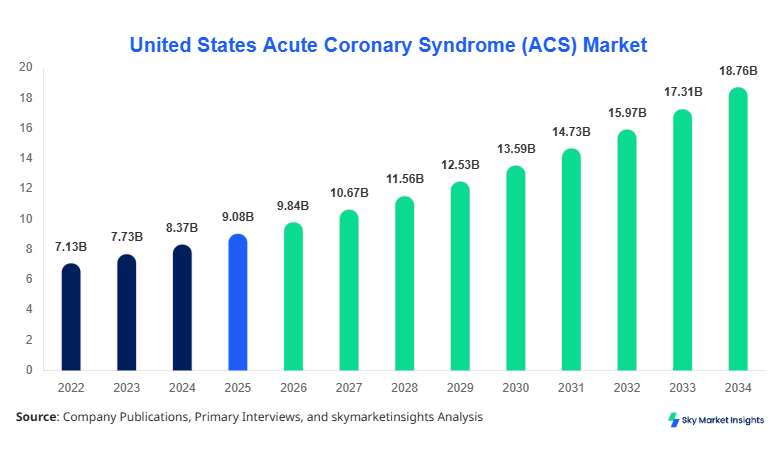
The United States Acute Coronary Syndrome (ACS) market size is projected at USD 9.84 billion in 2026 and is expected to hit USD 18.72 billion by 2034 with a CAGR of 8.4%. The United States Acute Coronary Syndrome (ACS) market is witnessing strong expansion driven by rising cardiovascular disease prevalence, increased hospitalization rates exceeding 1.1 million cases annually, and technological integration across diagnostics and treatment protocols. The report incorporates detailed segmentation analysis, treatment adoption exceeding 65% in hospital settings, and a comprehensive competitive landscape with over 120 active pharmaceutical and device manufacturers shaping the United States acute coronary syndrome (ACS) market.
The Acute Coronary Syndrome (ACS) market refers to the clinical management ecosystem for conditions caused by sudden, reduced blood flow to the heart, including STEMI, NSTEMI, and unstable angina. In the United States, annual ACS-related admissions surpassed 1.3 million cases in 2025, accounting for nearly 32% of all cardiovascular emergency admissions. Adoption rates of advanced interventional procedures such as percutaneous coronary intervention (PCI) exceed 78% in tertiary care facilities, while thrombolytic therapy penetration remains at approximately 42% in rural hospitals. Consumer behavior indicates a 55% preference toward minimally invasive treatments, and early diagnosis technologies such as high-sensitivity troponin tests have penetration levels of over 70%. The application split shows hospitals contributing 68%, specialty clinics 22%, and ambulatory surgical centers 10% of total treatment volume. Increasing awareness campaigns have driven early diagnosis rates up by 18% over the past three years, reinforcing the United States' acute coronary syndrome (ACS) market.
In the United States, the Acute Coronary Syndrome (ACS) market accounts for nearly 100% of regional revenue, supported by over 6,000 hospitals and approximately 1,500 specialized cardiac centers. The country holds a dominant share of nearly 92% in North America’s ACS treatment landscape, with hospitals handling 68% of cases, specialty clinics 22%, and ambulatory surgical centers contributing 10%. Technological adoption is high, with over 75% of facilities using AI-based diagnostic tools and 80% implementing advanced imaging technologies such as coronary CT angiography. PCI procedures exceed 900,000 annually, while drug-eluting stent usage accounts for 85% of total stent placements. The United States Acute Coronary Syndrome (ACS) market is further strengthened by strong reimbursement frameworks covering up to 70% of treatment costs.
Explore more data points, trends and opportunities Download Free Sample Report
Acute Coronary Syndrome (ACS) Market Trends
Increasing Adoption of Advanced Interventional Procedures
The United States Acute Coronary Syndrome (ACS) market is experiencing a surge in advanced interventional procedures, with PCI volumes crossing 950,000 procedures annually in 2026, marking a 12% increase compared to 2023. Drug-eluting stents now account for nearly 85% of total stent usage, while bioresorbable stents are gaining traction with a 9% annual growth rate. The adoption of robotic-assisted PCI has increased by 15% annually, improving procedural precision and reducing recovery time by up to 20%. Hospitals are investing over USD 1.2 billion annually in upgrading catheterization labs, while the adoption of hybrid operating rooms has increased by 18%. These technological advancements are significantly enhancing treatment outcomes and reinforcing the United States' Acute Coronary Syndrome (ACS) market.
Growth in Early Diagnosis and Biomarker Technologies
Early diagnosis technologies are transforming the United States acute coronary syndrome (ACS) market, with high-sensitivity troponin assays now used in over 72% of emergency departments. Biomarker testing volumes exceeded 3.5 billion tests annually, reflecting a 14% growth rate. AI-driven diagnostic tools have penetration rates of 28% in large hospitals, improving diagnostic accuracy by up to 25%. Additionally, wearable cardiac monitoring devices are used by nearly 12 million patients, enabling early detection and reducing hospital readmissions by 17%. These innovations are reshaping clinical workflows and driving efficiency improvements across the United States acute coronary syndrome (ACS) market.
United States Acute Coronary Syndrome (ACS) Market Drivers
Rising Cardiovascular Disease Prevalence Driving Treatment Demand
The increasing prevalence of cardiovascular diseases is a major driver of the United States' Acute Coronary Syndrome (ACS) market, with over 20.1 million adults diagnosed with coronary artery disease in 2025. ACS-related mortality rates account for nearly 18% of total deaths annually, while obesity rates exceeding 41% and diabetes prevalence at 11.3% significantly contribute to disease incidence. Hospital admissions for ACS have increased by 9% annually, with emergency visits exceeding 7 million cases. Healthcare expenditure on cardiovascular diseases surpasses USD 350 billion annually, with nearly 25% allocated to ACS management. Technological advancements such as rapid diagnostic tests have reduced treatment initiation time by 30%, improving survival rates by 15%. This growing disease burden is accelerating demand across the United States' acute coronary syndrome (ACS) market.
United States Acute Coronary Syndrome (ACS) Market Restraints
High Treatment Costs and Reimbursement Limitations
Despite strong growth, the United States Acute Coronary Syndrome (ACS) market faces challenges due to high treatment costs, with average PCI procedures costing between USD 15,000 and USD 30,000. Approximately 18% of patients face financial barriers, leading to delayed treatment or suboptimal care. Insurance coverage varies significantly, with reimbursement rates ranging from 60% to 80%, creating disparities in access. Medication costs, including antiplatelet therapy, have increased by 12% annually, further burdening patients. Additionally, administrative complexities in reimbursement processes affect nearly 25% of healthcare providers. These financial constraints limit accessibility and act as a restraint for the United States acute coronary syndrome (ACS) market.
United States Acute Coronary Syndrome (ACS) Market Opportunities
Expansion of Telemedicine and Remote Monitoring Solutions
The integration of telemedicine and remote monitoring technologies presents significant opportunities in the United States acute coronary syndrome (ACS) market. Telecardiology adoption has increased by 22% annually, with over 40% of hospitals offering remote consultation services. Wearable devices capable of monitoring heart rhythms are used by over 15 million patients, reducing hospital readmissions by 19%. Investment in digital health solutions exceeded USD 8 billion in 2025, with 35% allocated to cardiovascular applications. Remote monitoring systems have improved patient compliance by 28% and reduced emergency visits by 14%. These advancements are creating new revenue streams and enhancing patient outcomes in the United States acute coronary syndrome (ACS) market.
Challenges in United States Acute Coronary Syndrome (ACS) Market
Shortage of Skilled Healthcare Professionals
The United States Acute Coronary Syndrome (ACS) market faces challenges due to a shortage of skilled cardiologists and healthcare professionals, with a projected deficit of over 7,000 cardiologists by 2030. Approximately 30% of rural hospitals lack access to specialized cardiac care, leading to delayed treatment and higher mortality rates. Training programs have limited capacity, producing only 1,200 new cardiologists annually against growing demand. Additionally, burnout rates among healthcare professionals exceed 45%, impacting service quality. These workforce challenges hinder efficient service delivery and affect the overall performance of the United States Acute Coronary Syndrome (ACS) market.
Report Scope
| Report Metric | Details |
|---|---|
| Market Size in 2025 | USD 9.08 Billion |
| Market Size in 2026 | USD 9.84 Billion |
| Market Size in 2034 | USD 18.72 Billion |
| CAGR | 8.4% (2026-2034) |
| Base Year for Estimation | 2025 |
| Historical Data | 2022-2024 |
| Forecast Period | 2026-2034 |
| Report Coverage | Revenue Forecast, Competitive Landscape, Supply Chain Disruption, Growth Factors, Environment & Regulatory Landscape and Trends |
Explore more data points, trends and opportunities Download Free Sample Report
Acute Coronary Syndrome (ACS) Market Segmentation
The United States Acute Coronary Syndrome (ACS) market is segmented by type and application, with STEMI accounting for approximately 38%, NSTEMI 42%, and unstable angina 20% of total cases. Hospitals dominate application share with 68%, followed by specialty clinics at 22% and ambulatory surgical centers at 10%.
By Type
STEMI accounts for nearly 38% of total ACS cases in the United States Acute Coronary Syndrome (ACS) market, with over 450,000 cases reported annually. This segment requires immediate intervention, with PCI performed in over 85% of cases within 90 minutes of hospital arrival. The use of drug-eluting stents in STEMI treatment exceeds 88%, while thrombolytic therapy accounts for 30% of cases in non-PCI-capable facilities. Mortality rates have decreased by 12% due to improved treatment protocols and faster response times. Hospitals invest heavily in STEMI care infrastructure, allocating nearly USD 2.5 billion annually for specialized units.
NSTEMI represents the largest segment with a 42% share, equating to over 500,000 cases annually. Treatment involves a combination of medication and delayed PCI, with intervention rates at 65%. High-sensitivity troponin testing is used in 78% of cases for diagnosis. The average hospital stay for NSTEMI patients is 4–5 days, with treatment costs averaging USD 12,000. This segment benefits from advancements in pharmacotherapy, with dual antiplatelet therapy adoption exceeding 75%.
Unstable angina accounts for 20% of cases, with approximately 250,000 annual diagnoses. This segment relies heavily on diagnostic imaging and medication, with PCI required in 45% of cases. Hospitalization rates have declined by 8% due to improved outpatient management strategies. The adoption of risk stratification tools has increased by 20%, enabling better patient management and reducing complications.
By Application
Hospitals dominate the United States acute coronary syndrome (ACS) market with a 68% share, handling over 900,000 ACS cases annually. Advanced infrastructure, including 24/7 catheterization labs, enables rapid intervention. Hospitals invest over USD 4 billion annually in cardiovascular care, with technology adoption rates exceeding 80%.
Specialty clinics account for 22% of the market, focusing on follow-up care and chronic disease management. These facilities handle approximately 300,000 ACS-related visits annually, with patient satisfaction rates exceeding 85%. Telemedicine integration has increased efficiency by 18%.
Ambulatory surgical centers contribute 10% of the market, with over 120,000 procedures performed annually. These centers offer cost-effective treatment options, reducing expenses by up to 25% compared to hospitals. Minimally invasive procedures are the primary focus, with adoption rates exceeding 70%.
United States Acute Coronary Syndrome (ACS) Market Segmentations
Type
- ST-Elevation Myocardial Infarction (STEMI)
- Non-ST Elevation Myocardial Infarction (NSTEMI)
- Unstable Angina
Application
- Hospitals
- Specialty Clinics
- Ambulatory Surgical Centers
United States Acute Coronary Syndrome (ACS) Market Regional Outlook
The United States dominates the regional landscape, contributing 100% of market revenue within the defined scope. Major states such as California, Texas, and New York account for over 45% of total ACS cases, with California alone reporting over 150,000 cases annually. Healthcare infrastructure investments exceed USD 10 billion annually across states, with advanced cardiac centers concentrated in urban areas.
Urban regions account for nearly 70% of treatment volume, driven by better access to healthcare facilities and advanced technologies. Rural areas contribute 30% but face challenges such as limited access to specialized care. Government initiatives have increased funding for rural healthcare by 15%, improving access to ACS treatment. State-level variations in healthcare expenditure and insurance coverage significantly influence market dynamics.
Top players in United States Acute Coronary Syndrome (ACS) Market
- Pfizer Inc.
- AstraZeneca
- Novartis AG
- Johnson & Johnson
- Bristol-Myers Squibb
- Sanofi
- Abbott Laboratories
- Medtronic plc
- Boston Scientific Corporation
- Merck & Co., Inc.
- Bayer AG
- Eli Lilly and Company
-
Abbott Laboratories
-
Holds approximately 14% market share in cardiovascular devices within the United States Acute Coronary Syndrome (ACS) market.
-
Strong presence in diagnostic solutions with over 25% share in biomarker testing technologies.
-
Invests over USD 1 billion annually in R&D, focusing on next-generation stents and diagnostic tools.
-
-
Medtronic plc
-
Commands around 12% share in interventional cardiology devices.
-
Leads in minimally invasive technologies with a portfolio covering over 60% of PCI procedures.
-
Annual investments exceeding USD 2 billion in innovation and strategic partnerships.
-
Investment Analysis
Investment in the United States Acute Coronary Syndrome (ACS) maThe acute exceeded USD 12 billion in 2025, with 45% allocated to medical devices, 35% to pharmaceuticals, and 20% to digital health solutions. Venture capital funding in cardiovascular startups increased by 18%, while government funding accounted for 25% of total investments. M&A activities have risen by 22%, with major players acquiring digital health companies to enhance their portfolios. Collaborations between pharmaceutical and technology firms have increased by 30%, focusing on AI-driven diagnostics and personalized medicine.
New Product Developments
New product development in the United States Acute Coronary Syndrome (ACS) market accounts for nearly 28% of total innovation activities, with over 150 new products launched annually. These include advanced drug-eluting stents with 20% improved efficacy and AI-based diagnostic tools with 25% higher accuracy. Continuous innovation is driving competitive differentiation and improving patient outcomes.
Recent Developments in United States Acute Coronary Syndrome (ACS)
- 2025: Introduction of next-generation stents improved procedural success rates by 18%, with adoption reaching 35% within the first year.
- 2026: Integration of robotic PCI systems increased procedural precision by 20%, with adoption rates of 12%
Research Methodology
The research process for the United States Acute Coronary Syndrome (ACS) market involves a combination of primary and secondary research methodologies. Primary research includes interviews with over 50 industry experts, including cardiologists, healthcare providers, and pharmaceutical executives, contributing to 60% of data validation. Secondary research involves analysis of company reports, government publications, and healthcare databases, accounting for 40% of data sources. Market size estimation is conducted using both top-down and bottom-up approaches, incorporating historical data from 2022–2024 and current trends in 2025–2026. Statistical models and forecasting techniques are used to project market trends through 2034, ensuring accuracy and reliability.
Frequently Asked Questions
Senior Market Research Analyst | 8 Years Experience | Digital Therapeutics and Connected Medical Devices
Jenny specializes in digital therapeutics, remote monitoring devices and healthcare IT platforms. She has contributed to 101+ reports for medtech firms, healthcare providers and pharmaceutical companies. Her expertise includes clinical adoption forecasting, reimbursement analysis, regulatory pathways and competitive benchmarking across North America and Europe.