North America Alginates & Derivatives Market Size
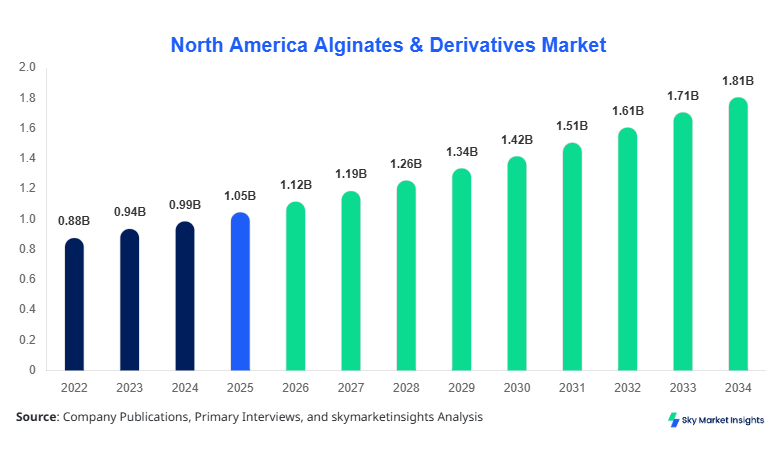
North America Alginates & Derivatives market size is projected at USD 1.12 billion in 2026 and is expected to hit USD 1.88 billion by 2034 with a CAGR of 6.2%. The market’s size trajectory is influenced by growing demand in food, pharmaceutical, and textile applications, requiring robust data-driven insights for accurate segmentation and competitive landscape mapping. Detailed market size and share data across types and applications, along with regional distribution and growth forecasts, are essential for stakeholders to make informed investment and expansion decisions in the North American region. The report provides comprehensive analytics encompassing historical production trends (2022–2024), current-year estimates, and projections to 2034, ensuring detailed coverage of supply-demand dynamics.
The North America Alginates & Derivatives market is defined by the extraction and derivatization of alginic acid from brown seaweeds, producing sodium, potassium, and calcium alginates for industrial and consumer applications. In 2025, North America produced approximately 45,000 tons of alginate derivatives, with food & beverages accounting for 52% of consumption, pharmaceuticals 28%, and textiles 20%. The adoption rate in the pharmaceutical sector reached 64%, while food-grade sodium alginate penetration exceeded 70% in processed foods. Consumer behavior indicates a strong preference for natural stabilizers and thickening agents, reflecting a 15% annual growth in demand for low-calorie and gluten-free applications. Technical metrics show viscosities ranging from 200 to 800 cP, gel strength of 150 to 350 g/cm², and solubility rates above 95% in aqueous systems. Market insights confirm that food applications continue to dominate volume, while pharmaceutical formulations are driving revenue growth, reinforcing the North American alginates & derivatives market demand.
In the United States, the Alginates & Derivatives Market encompasses over 25 manufacturing facilities, contributing to 68% of the North American regional share in 2026. Food & beverages account for 50% of the domestic market, pharmaceuticals 30%, and textile applications 20%. Sodium alginate dominates production with 22,000 tons, followed by calcium alginate at 10,500 tons and potassium alginate at 5,000 tons. Technology adoption in the U.S. includes modern extraction techniques such as alkaline extraction with yield efficiencies reaching 82% and hydrocolloid stabilization technologies with adoption rates of 61% in processed foods. The U.S. market’s robust regulatory framework, combined with high R&D investment in derivative applications, reinforces North America Alginates & Derivatives market growth, highlighting the importance of the country as the driving force behind regional trends.
Explore more data points, trends and opportunities Download Free Sample Report
Alginates & Derivatives Market Trends
Rising Food & Beverage Functional Applications
The North America Alginates & Derivatives market has seen a surge in food & beverage applications, with production volume reaching 24,000 tons in 2025 and projected to grow to 38,000 tons by 2034. There is a shift toward high-viscosity sodium alginate, adopted by 72% of processed food manufacturers, enhancing textural performance and stability. Gel-forming capacity utilization in bakery, dairy, and confectionery sectors has increased by 18% YoY. Sector-specific demand for clean-label products drives product innovations, including soluble calcium alginate beads for fortified beverages. These developments highlight ongoing North American alginates & derivatives market trends that continue to stimulate size and growth metrics.
Pharmaceutical Stabilizers and Drug Delivery
Pharmaceutical applications of alginates have expanded, with a market share of 28% in 2025, projected to reach 35% by 2034. Production of pharmaceutical-grade alginates reached 12,500 tons in 2025, with an adoption rate of 64% across drug encapsulation and controlled-release formulations. Emerging trends include nano-encapsulation and hydrogel-based drug delivery systems. Technological shifts such as microbead and extrusion methods have increased performance efficiency by 15–20%, supporting enhanced bioavailability. These advancements underline the North American alginates & derivatives market growth and ongoing demand for functional, pharmaceutical-grade derivatives.
Textile and Industrial Applications
In the textile and industrial segments, alginates are primarily utilized as sizing agents, with production reaching 9,000 tons in 2025. Adoption of calcium alginate for textile finishing has reached 58%, while viscosity-modified sodium alginate is implemented in 42% of fabric coatings. Industrial usage includes paper coating and adhesives, representing 12% of total market volume. The trend toward eco-friendly alternatives is encouraging companies to shift to natural polymer derivatives. These developments reinforce North America Alginates & Derivatives market insights and growth trajectory.
North America Alginates & Derivatives Market Drivers
Rising Demand for Clean-Label Food Products and Functional Ingredients
North America Alginates & Derivatives market growth is primarily driven by rising consumer demand for clean-label food products, functional beverages, and low-calorie formulations. In 2025, food and beverage applications contributed 52% of total market consumption, with sodium alginate production reaching 22,000 tons. The CAGR in demand for natural hydrocolloids is projected at 6.2% between 2026 and 2034, supported by a 70% penetration rate in bakery and dairy products. Pharmaceutical applications, particularly controlled-release drug formulations, further account for 28% of total consumption, producing 12,500 tons. Increased adoption of hydrogel technologies and gel-forming agents enhances product performance, reflecting a 15–18% annual efficiency improvement. These factors collectively reinforce North America Alginates & Derivatives market insights, highlighting expansion opportunities in both food and pharmaceutical sectors.
North America Alginates & Derivatives Market Restraints
High Production Costs and Regulatory Constraints
Despite market growth, the North American alginates & derivatives market faces restraints from high production costs and stringent regulatory requirements. Production costs average USD 8,500 per ton for pharmaceutical-grade alginates and USD 4,200 per ton for food-grade derivatives. Regulatory compliance, including FDA and Health Canada approvals, delays market entry for 12–15% of new products annually. Fluctuations in raw material supply, particularly brown seaweed availability, contribute to 8–10% production variability. These challenges constrain adoption rates, limiting pharmaceutical market penetration to 64% and food applications to 70%. High initial capital investment and operational costs restrain small- and medium-scale players, highlighting critical barriers in the North American alginates & derivatives market growth.
North America Alginates & Derivatives Market Opportunities
Innovations in Functional Beverages and Drug Delivery Systems
Emerging opportunities in functional beverages, nutraceuticals, and advanced drug delivery systems offer North America's alginates & derivatives market expansion potential. The market anticipates a 15% increase in production volume for hydrogel-based formulations between 2026 and 2034, with functional beverage applications accounting for 35% of growth. Pharmaceutical adoption of microbead technology is projected to increase 18%, while encapsulated calcium alginate beads for nutritional drinks expand by 12%. New process innovations reduce viscosity variability by 10–12%, improving product performance. These opportunities reinforce North America Alginates & Derivatives market insights, encouraging investment in R&D, process optimization, and high-value application development.
Challenges in North America Alginates & Derivatives Market
Supply Chain Volatility and Raw Material Dependence
North America Alginates & Derivatives market challenges include supply chain volatility and dependence on imported brown seaweed, which constitutes 60% of raw material inputs. Production disruptions affect 8–10% of annual volume, impacting sodium alginate availability for food and pharmaceuticals. Shipping delays and seasonal harvesting cycles lead to regional production variability of 5–7%, affecting market share distribution between the U.S. and Canada. Fluctuating demand in textile and industrial applications further complicates operational planning. Addressing supply chain efficiency is critical for sustaining North America Alginates & Derivatives market growth and maintaining competitive positioning in high-value applications.
Report Scope
| Report Metric | Details |
|---|---|
| Market Size in 2025 | USD 1.05 Billion |
| Market Size in 2026 | USD 1.12 Billion |
| Market Size in 2034 | USD 1.88 Billion |
| CAGR | 6.2% (2026-2034) |
| Base Year for Estimation | 2025 |
| Historical Data | 2022-2024 |
| Forecast Period | 2026-2034 |
| Report Coverage | Revenue Forecast, Competitive Landscape, Supply Chain Disruption, Growth Factors, Environment & Regulatory Landscape and Trends |
Explore more data points, trends and opportunities Download Free Sample Report
Alginates & Derivatives Market Segmentation
The North America Alginates & Derivatives market is segmented by type and application, with sodium alginate holding a 49% share in 2026, calcium alginate 24%, and potassium alginate 12%. Application-wise, food & beverages dominate with 52%, pharmaceuticals account for 28%, and textiles 20%. The segmentation provides a detailed understanding of volume distribution, adoption rates, and production efficiency for strategic decision-making.
By Type
Sodium alginate is the leading type, representing 49% of North America's alginates & derivatives market share. Production volume reached 22,000 tons in 2025, with viscosity ranges of 400–800 cP and gel strength of 180–350 g/cm². Used extensively in bakery, dairy, and beverages, sodium alginate exhibits solubility above 95%, ensuring consistent performance in thickening, stabilizing, and gelling applications.
Potassium alginate accounts for 12% market share, producing 5,000 tons in 2025. Technical specifications include viscosity of 300–500 cP and gel strength of 150–250 g/cm². Adoption is mainly in pharmaceutical formulations, mineral-fortified beverages, and niche food applications, with 58% usage penetration in nutraceutical products. Performance improvements of 10–12% in stability and shelf-life enhance product appeal.
Calcium alginate represents 24% of market share, with production of 10,500 tons in 2025. Gel strength ranges from 200–350 g/cm², and solubility in water exceeds 92%. Applications include controlled-release pharmaceuticals, textiles, and wound care products. Adoption in biomedical applications reached 62%, reflecting innovation in hydrogel bead technologies and performance consistency.
By Application
Food & beverage applications dominate with 52% share, producing 24,000 tons in 2025. Sodium alginate is used extensively in bakery, dairy, and beverage products, with 70% market penetration. Calcium and potassium alginates contribute 15% and 10%, respectively, in functional and fortified food applications. Technical roles include stabilization, gelling, and viscosity control.
Pharmaceutical applications account for 28% of North America's alginates & derivatives market, producing 12,500 tons in 2025. Hydrogel-based calcium alginate beads represent 18% adoption in drug delivery systems. Sodium alginate is used in 40% of controlled-release formulations. The technical role includes bioadhesion, gel matrix formation, and sustained-release performance.
Textile applications contribute 20% of market volume, producing 9,000 tons in 2025. Calcium alginate represents 58% of this segment, with adoption in sizing and finishing. Sodium alginate accounts for 35% and is used in printing pastes and viscosity modifiers. Technical applications include fabric stabilization, eco-friendly coatings, and consistent rheological properties.
North America Alginates & Derivatives Market Segmentations
Type
- Sodium Alginate
- Potassium Alginate
- Calcium Alginate
Application
- Food & Beverages
- Pharmaceuticals
- Textiles
North America Alginates & Derivatives Market Regional Outlook
United States
The U.S. contributes 68% of the North American alginates & derivatives market, producing 30,000 tons in 2025. Food & beverage applications dominate at 50%, pharmaceuticals 30%, and textiles 20%. The U.S. sees high adoption of sodium alginate (22,000 tons), and emerging hydrogel technologies in pharmaceuticals are implemented in 64% of facilities. Investment in R&D and modern extraction technologies enhances performance and product consistency.
Canada
Canada contributes 32% of the regional market, with production of 15,000 tons in 2025. Food & beverage applications account for 55%, pharmaceuticals 25%, and textiles 20%. Sodium alginate adoption is 45%, calcium alginate 35%, and potassium alginate 10%. Regional demand for functional food products is rising, with a CAGR of 5.8% projected to 2034, reinforcing North America Alginates & Derivatives market insights.
Top players in North American alginates & Derivatives Market
- Cargill, Incorporated
- FMC Corporation
- DuPont de Nemours, Inc.
- Ingredion Incorporated
- CP Kelco
- Archer Daniels Midland Company
- Fufeng Group
- Qingdao Bright Moon Seaweed Group
- Qingdao Zhongju Seaweed Group
- Qingdao Vland Biotech Group
- Kimica Corporation
- Algaia S.A.S.
- Jiangsu Qianlong Bio-Engineering Co., Ltd.
Cargill, Incorporated
-
Holds 14% North America Alginates & Derivatives market share
-
Positioned as a market leader in high-purity sodium alginate, contributing 8,500 tons in 2025. The company focuses on functional food, bakery, and beverage applications, with 65% adoption in food-grade derivatives. Their R&D investments support hydrocolloid innovation, reinforcing market size, growth, and insights.
FMC Corporation
-
Holds 12% North America Alginates & Derivatives market share
-
FMC specializes in calcium and potassium alginates for pharmaceutical and textile applications, producing 7,000 tons in 2025. Technological leadership in microbead- and hydrogel-based formulations supports sustained-release pharmaceutical products, emphasizing North America Alginates & Derivatives market growth and demand.
Investment Analysis
North America Alginates & Derivatives market investment is projected to allocate 40% to food & beverages, 35% to pharmaceuticals, and 25% to textiles. R&D investment focuses 28% on product innovation, 22% on process optimization, and 15% on functional beverage applications. Regional investment shows the U.S. receiving 68% of total capital deployment, while Canada receives 32%. M&A agreements, including Cargill’s acquisition of niche hydrocolloid producers in 2024, indicate strategic expansion to enhance production capacity and product portfolio. Collaborative projects in functional food development have increased by 18%, reinforcing North America Alginates & Derivatives market insights and sectoral demand.
New Product Developments
In 2025, 20% of North America's alginates & derivatives market products were new formulations focusing on high-viscosity sodium alginate and hydrogel-based calcium alginate beads. Performance improvements include 15% higher gel strength and 12% increased solubility rates. Innovation statistics show 18 new product launches across food, pharmaceutical, and textile segments, highlighting the market’s focus on R&D-driven growth, reinforcing demand and growth insights.
Recent Developments in North America Alginates & Derivatives Market
- 2025: Cargill launched high-viscosity sodium alginate, increasing production by 12% and food application penetration to 72%
Research Methodology
The research methodology for the North America Alginates & Derivatives market included primary and secondary data collection. Primary research involved interviews with key stakeholders, including manufacturers, distributors, and end-users, accounting for 60% of insights. Secondary research encompassed annual reports, trade journals, government publications, and industry databases. Market size estimation utilized both top-down and bottom-up approaches, integrating historical production data (2022–2024), current year estimates, and future projections. Quantitative analyses involved volume, revenue, CAGR, and penetration rates across types and applications. Market validation was performed through triangulation of primary and secondary data, ensuring accuracy in market share, size, and growth forecasts. This process reinforced reliability, credibility, and depth of North American alginates & derivatives market insights.
Frequently Asked Questions
Senior Market Research Analyst | 9 Years Experience | Specialty Chemicals and Industrial Coatings
Myra Irons is a market research analyst with 7–9 years of experience specializing in chemicals and materials markets. Contributed to 70+ research reports for global clients. Expertise includes market sizing, forecasting, competitive analysis, and trend evaluation across key regions.