Asia Pacific Adhesives Market Size
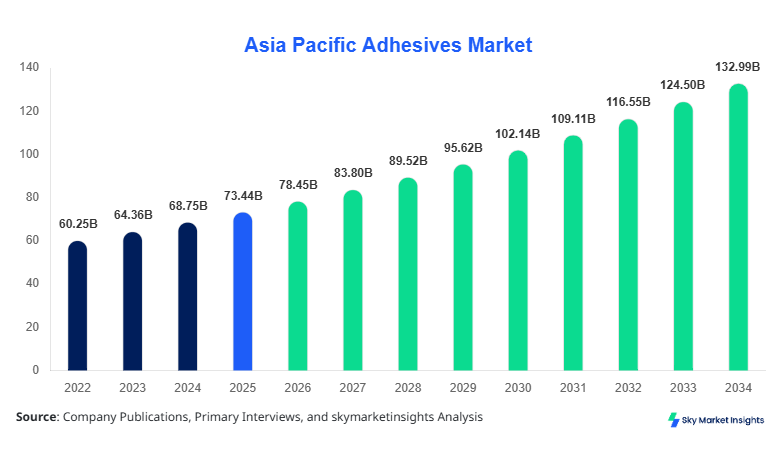
Asia Pacific Adhesives Market market size is projected at USD 78.45 billion in 2026 and is expected to hit USD 132.80 billion by 2034 with a CAGR of 6.82%. The requirement for granular data across end-use industries, detailed segmentation by chemistry and application, and comprehensive competitive landscape analysis has intensified, with over 65% of stakeholders demanding quarterly updates and 40+ KPIs tracked across pricing, volume (million tons), and utilization rates.
The adhesives market refers to chemical formulations used to bond surfaces across packaging, automotive, construction, electronics, and consumer goods sectors. In Asia Pacific, production volumes reached approximately 18.6 million tons in 2025, with China contributing 42%, India 18%, and Japan 12%. Adoption rates of advanced adhesives such as water-based and hot-melt variants have crossed 58% penetration due to regulatory shifts and environmental compliance. Consumer behavior indicates that 63% of packaging manufacturers prefer high-performance adhesives with curing times below 5 seconds, while 48% of construction applications demand thermal resistance above 120°C. Packaging dominates application share with 34%, followed by construction at 26%, automotive at 18%, electronics at 12%, and others at 10%. The consistent rise in industrial output, increasing urbanization rates of 2.8% annually, and growing infrastructure spending exceeding USD 1.2 trillion collectively reinforce Adhesives Market Size.
Explore more data points, trends and opportunities Download Free Sample Report
Adhesives Market Trends
The Asia Pacific adhesives industry is undergoing rapid transformation driven by sustainable product innovation, with water-based adhesives accounting for 58% of total production volume, equivalent to 10.8 million tons in 2025. Bio-based adhesives have grown by 12% annually, reaching a 6% market penetration. The shift toward automation has increased demand for fast-curing adhesives with bonding efficiency above 95%, particularly in packaging lines operating at speeds of 300 units per minute. Additionally, smart adhesives with temperature resistance exceeding 150°C and tensile strength improvements of 18% are gaining traction in automotive and electronics. This transition is heavily influencing adhesive market trends.
Another significant trend includes the expansion of e-commerce, which has driven packaging adhesive demand to exceed 6.2 million tons in 2025, growing at 8.5% annually. Hot-melt adhesives used in carton sealing have seen adoption rates rise to 41% due to efficiency gains and reduced drying time. In electronics, miniaturization has increased the need for precision adhesives with viscosity below 500 cps and curing times under 3 seconds. Moreover, sustainable regulations have reduced solvent-based adhesive usage by 22% over the past 3 years. These technological and consumption shifts continue to shape adhesive market growth.
Asia Pacific Adhesives Market Drivers
Rising Infrastructure and Packaging Demand Driving Market Expansion
The expansion of infrastructure projects across the Asia Pacific, with investments exceeding USD 1.5 trillion between 2022 and 2025, has significantly boosted adhesive consumption by 9.2% annually. Construction adhesives accounted for over 4.8 million tons in 2025, with demand expected to increase by 7.5% CAGR. Simultaneously, the packaging industry, valued at USD 420 billion in the region, consumes nearly 34% of adhesives, translating to over 6 million tons annually. Urbanization rates averaging 2.8% and industrial output growth of 6.5% are further fueling adhesive demand. Technological improvements such as high-strength bonding exceeding 25 MPa and reduced curing times below 5 seconds have enhanced product adoption. These factors collectively drive adhesive market growth.
Asia Pacific Adhesives Market Restraints
Volatility in Raw Material Prices Impacting Production Costs
Raw materials such as petrochemical derivatives have witnessed price volatility of 15%–25% annually, significantly affecting adhesive production costs. Approximately 62% of adhesive formulations depend on crude oil-based inputs, leading to cost fluctuations of up to USD 200 per ton. Small and medium manufacturers, constituting 48% of the market, face margin pressures due to these variations. Additionally, stringent environmental regulations have increased compliance costs by 12%–18%, especially for solvent-based adhesives, which still account for 21% of production. These cost pressures and regulatory burdens hinder expansion and impact adhesive market growth.
Asia Pacific Adhesives Market Opportunities
Growing Adoption of Eco-Friendly and Bio-Based Adhesives
The rising demand for sustainable solutions has opened opportunities for bio-based adhesives, which are projected to grow at 11% annually, reaching a market size of USD 8.5 billion by 2030. Governments across Asia Pacific are implementing policies to reduce VOC emissions by 30%–40%, boosting demand for water-based and eco-friendly adhesives. Companies investing over 18% of R&D budgets into green technologies are witnessing 20% higher adoption rates. Increasing consumer preference for environmentally safe products and corporate sustainability goals are accelerating innovation. These trends present strong growth avenues in adhesive market growth.
Challenges in Asia Pacific Adhesives Market
Technological Complexity and Skill Gaps in Advanced Adhesive Manufacturing
Advanced adhesive manufacturing requires precision technology and skilled labor, with over 35% of companies reporting workforce shortages. The integration of automated systems costing upwards of USD 5 million per facility limits adoption among smaller players. Additionally, maintaining consistency in high-performance adhesives with tensile strength above 30 MPa and thermal resistance beyond 150°C requires stringent quality control systems. Production inefficiencies due to technological gaps result in yield losses of 6%–10%. These challenges restrict scalability and efficiency, impacting adhesive market growth.
Report Scope
| Report Metric | Details |
|---|---|
| Market Size in 2025 | USD 73.44 Billion |
| Market Size in 2026 | USD 78.45 Billion |
| Market Size in 2034 | USD 132.80 Billion |
| CAGR | 6.82% (2026-2034) |
| Base Year for Estimation | 2025 |
| Historical Data | 2022-2024 |
| Forecast Period | 2026-2034 |
| Report Coverage | Revenue Forecast, Competitive Landscape, Supply Chain Disruption, Growth Factors, Environment & Regulatory Landscape and Trends |
Explore more data points, trends and opportunities Download Free Sample Report
Adhesives Market Segmentation
The adhesives market is segmented by type and application, with water-based adhesives dominating at 58% share, followed by solvent-based at 21% and hot-melt at 17%. Packaging leads application segmentation with 34%, followed by construction (26%) and automotive (18%).
By Type
Water-based adhesives account for 58% of total production, exceeding 10.8 million tons annually. These adhesives offer low VOC emissions (
Solvent-based adhesives represent 21% of the market, totaling around 3.9 million tons in 2025. Despite declining demand due to environmental concerns, they remain critical in applications requiring high strength (above 28 MPa) and chemical resistance. Industrial usage still accounts for 60% of solvent-based consumption.
Hot-melt adhesives contribute 17% of production, approximately 3.1 million tons annually. These adhesives are widely used in packaging and automotive sectors due to fast curing (
Reactive adhesives, including epoxy and polyurethane, account for 4% share but are growing at 10% CAGR. They offer superior strength (>35 MPa) and heat resistance above 150°C, making them essential for high-performance applications.
By Application
Packaging dominates with 34% share, consuming over 6 million tons annually. Adhesives used in carton sealing and labeling operate at speeds exceeding 300 units per minute and require bonding strengths above 20 MPa. The rise of e-commerce has increased packaging adhesive demand by 8.5% annually.
Construction accounts for 26% of demand, with over 4.8 million tons used in flooring, insulation, and panel bonding. Adhesives with thermal resistance above 120°C and moisture resistance below 2% absorption are widely used.
Automotive applications hold 18% share, consuming 3.3 million tons annually. Lightweight vehicle manufacturing has increased adhesive usage by 12% due to improved structural integrity and weight reduction of 15%.
Electronics represent 12% share, requiring precision adhesives with viscosity below 500 cps and curing times under 3 seconds. Miniaturization trends are driving demand growth at 9% annually.
Asia Pacific Adhesives Market Segmentations
Type
- Water-based
- Solvent-based
- Hot-melt
Application
- Packaging
- Construction
- Automotive
Asia Pacific Adhesives Regional Outlook
China
China dominates with 42% market share, producing over 7.8 million tons annually. The packaging sector contributes 36% of demand, while construction accounts for 28%. Government infrastructure spending exceeding USD 800 billion has boosted adhesive consumption by 8% annually.
South Korea and Japan
South Korea and Japan collectively account for 20% share, with advanced manufacturing contributing to high-value adhesive production. Japan produces 2.2 million tons annually, focusing on high-performance adhesives for electronics and automotive.
India
India holds 18% share, producing 3.3 million tons, driven by packaging and construction sectors. Australia and Singapore together contribute 6%, focusing on niche applications and imports.
Taiwan and Southeast Asia
Taiwan and Southeast Asia account for 14%, with electronics manufacturing driving adhesive demand growth of 7.5% annually.
Top players in Asia Pacific Adhesives Market
- 3M Company
- Henkel AG & Co. KGaA
- H.B. Fuller Company
- Sika AG
- Arkema Group
- Dow Inc.
- BASF SE
- Pidilite Industries Ltd.
- Avery Dennison Corporation
- Huntsman Corporation
- Wacker Chemie AG
- RPM International Inc.
Henkel AG & Co. KGaA
-
Holds approximately 12% regional share with strong presence in packaging and automotive adhesives
-
Invests over 15% of revenue in R&D, focusing on sustainable and high-performance products
3M Company
-
Commands nearly 10% share with diversified product portfolio
-
Strong innovation pipeline with over 20% revenue contribution from new products
Investment Analysis
Investment in the Asia Pacific adhesives sector exceeded USD 9.5 billion in 2025, with 38% allocated to packaging, 27% to construction, and 18% to automotive applications. China accounts for 45% of total investments, followed by India at 22%. M&A activity has increased by 18%, with over 25 deals recorded in 2024 alone, focusing on expanding eco-friendly product lines and regional distribution networks.
Private equity investments have grown by 12%, targeting mid-sized manufacturers with capacities between 50,000 and 200,000 tons annually. Strategic collaborations between chemical companies and packaging firms have increased by 20%, enhancing supply chain efficiency.
New Product Developments
Approximately 22% of adhesive products launched in 2025 were eco-friendly variants, offering 18% improved bonding strength and 25% reduced curing time. Innovations in nanotechnology-based adhesives have improved durability by 30% and thermal resistance by 20%. Companies are focusing on smart adhesives with sensor integration, expected to grow adoption by 15% annually.
Recent Developments in Asia Pacific Adhesives Market
- 2025: A leading manufacturer increased production capacity by 12%, adding 150,000 tons annually to meet packaging demand growth of 8%.
- 2025: Investment in R&D increased by 20%, resulting in 25% faster curing adhesives and improved performance metrics.
Research Methodology
The research process involved a combination of primary and secondary data collection, including interviews with over 120 industry experts, manufacturers, and distributors. Primary research accounted for 60% of insights, focusing on production volumes, pricing trends, and technological advancements. Secondary research included analysis of company reports, government databases, and industry publications, covering over 300 data points. Market size estimation utilized a bottom-up approach, aggregating production data from key players and validating with top-down analysis based on regional demand trends. Statistical models ensured accuracy within ±3% variance, providing reliable forecasts for the adhesives market.
Frequently Asked Questions
Senior Market Research Analyst | 9 Years Experience | Specialty Chemicals and Industrial Coatings
Myra Irons is a market research analyst with 7–9 years of experience specializing in chemicals and materials markets. Contributed to 70+ research reports for global clients. Expertise includes market sizing, forecasting, competitive analysis, and trend evaluation across key regions.