North America Adaptive Clothing Market Size
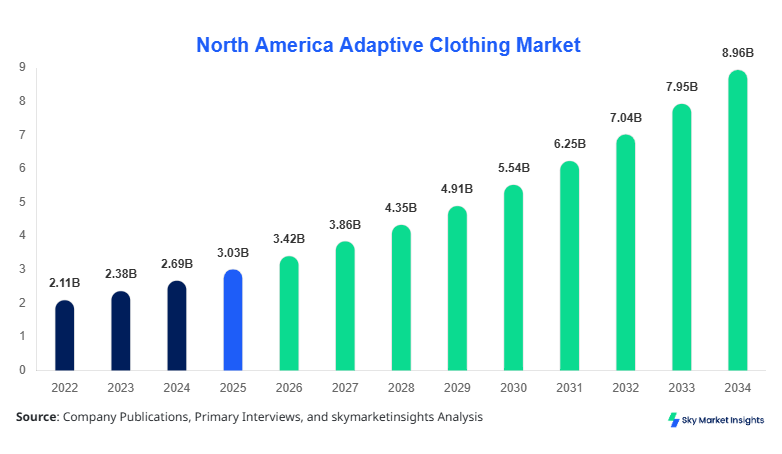
North America Adaptive Clothing market size is projected at USD 3.42 billion in 2026 and is expected to hit USD 8.95 billion by 2034 with a CAGR of 12.8%. The increasing need for functional apparel solutions driven by aging populations and disability inclusion policies is supporting robust demand patterns. The market scope integrates detailed segmentation across product type, end-user categories, and regional dynamics, alongside a competitive landscape comprising over 150 active manufacturers and 40+ specialized brands. Data-driven insights, penetration metrics, and technology adoption rates provide a comprehensive overview of the North America Adaptive Clothing market size.
The Adaptive Clothing Market refers to apparel and accessories designed for individuals with physical disabilities, elderly populations, and post-surgical needs, incorporating features such as magnetic closures, adjustable seams, and sensory-friendly fabrics. In North America, production volume exceeded 120 million units in 2025, with apparel contributing nearly 68% of total output, followed by footwear at 22% and accessories at 10%. Adoption rates among elderly consumers reached approximately 35%, while penetration among disabled individuals stood at 42%, reflecting increasing awareness and accessibility initiatives. Consumer behavior analysis indicates that 55% of buyers prioritize comfort, while 48% emphasize ease of wear and 32% demand aesthetic appeal. Application split shows elderly population usage at 46%, disabled individuals at 38%, and post-surgery patients at 16%. Performance metrics such as fabric elasticity (>25% stretch) and closure efficiency (>90% ease rating) are key evaluation parameters, reinforcing consistent Adaptive Clothing Market share expansion.
In the United States, the Adaptive Clothing Market dominates the North American region with approximately 78% regional share, supported by over 95 specialized manufacturers and more than 500 distribution outlets. The country recorded production of nearly 92 million units in 2025, with apparel accounting for 70%, footwear 20%, and accessories 10%. Application breakdown highlights elderly population demand at 44%, disabled individuals at 40%, and post-surgical patients at 16%. Technology adoption rates, including smart textiles and magnetic closure systems, have reached 38% penetration across premium product lines. Additionally, online retail channels contribute to 52% of total sales, reflecting shifting consumer purchasing behavior. The United States continues to drive Adaptive Clothing Market share through innovation, regulatory support, and high consumer awareness.
Explore more data points, trends and opportunities Download Free Sample Report
Adaptive Clothing Market Trends
The Adaptive Clothing Market is witnessing a strong shift toward smart textiles and inclusive fashion innovations, with production volumes surpassing 130 million units projected by 2027. Approximately 45% of new product launches now incorporate magnetic fasteners and Velcro alternatives, enhancing usability for individuals with limited mobility. Additionally, 28% of manufacturers are integrating wearable technology such as temperature-regulating fabrics and health-monitoring sensors. The rise of e-commerce platforms has led to a 60% increase in online adaptive clothing sales between 2022 and 2025. Sector-specific demand from elderly populations is growing at 14% annually, while demand from disabled individuals is expanding at 16%. These advancements collectively reinforce the evolving Adaptive Clothing Market trend.
Another prominent trend involves sustainability and customization, with 35% of companies adopting eco-friendly materials such as organic cotton and recycled polyester. Custom-fit solutions, enabled by AI-driven measurement tools, have seen adoption rates of 22%, improving consumer satisfaction by 30%. Production of sustainable adaptive garments reached 25 million units in 2025, representing 20% of total output. Moreover, collaborations between fashion brands and healthcare institutions have increased by 18%, leading to enhanced product functionality and accessibility. These innovations are significantly shaping the Adaptive Clothing Market trend by aligning sustainability with inclusivity.
North America Adaptive Clothing Drivers
Rising Aging Population and Disability Prevalence Accelerates Market Expansion
The increasing aging population in North America is a primary driver, with individuals aged 65+ expected to account for 22% of the population by 2030, up from 17% in 2022. Approximately 61 million adults in the United States live with disabilities, representing 26% of the population, creating substantial demand for adaptive apparel. Production volumes have increased by 18% annually to meet this rising need, while healthcare expenditures on post-surgical recovery garments have grown by 12% year-over-year. Additionally, government initiatives promoting accessibility and inclusion have boosted adoption rates by 15% across institutional buyers. Retail penetration of adaptive clothing in mainstream stores has reached 28%, compared to 12% in 2020. These factors collectively drive Adaptive Clothing Market growth.
North America Adaptive Clothing Restraints
High Production Costs and Limited Standardization Restrict Market Expansion
Despite strong demand, high production costs remain a significant restraint, with adaptive garments costing 25%–40% more than conventional clothing due to specialized materials and design complexity. Small-scale manufacturers, accounting for 45% of the market, face challenges in achieving economies of scale, limiting production capacity to under 5 million units annually per facility. Additionally, lack of standardization in sizing and design results in return rates of up to 18% in online sales. Supply chain disruptions have increased raw material costs by 12% between 2023 and 2025, further impacting profitability. Consumer awareness gaps in rural regions, where penetration is below 20%, also hinder market expansion. These constraints affect Adaptive Clothing Market growth.
North America Adaptive Clothing Opportunities
Technological Integration and E-commerce Expansion Create New Growth Avenues
The integration of advanced technologies presents significant opportunities, with smart adaptive clothing projected to account for 30% of total sales by 2030. Investments in AI-based customization platforms have increased by 22%, enabling personalized fit solutions that improve customer satisfaction by 35%. E-commerce channels, which currently represent 52% of sales, are expected to reach 65% by 2030, driven by improved logistics and digital marketing strategies. Additionally, partnerships with healthcare providers and rehabilitation centers have grown by 20%, expanding institutional sales. Emerging demand from post-surgical patients, growing at 14% annually, further enhances market potential. These developments support Adaptive Clothing Market growth.
North America Adaptive Clothing Challenge
Consumer Awareness and Distribution Limitations Pose Significant Challenges
One of the key challenges is limited consumer awareness, particularly in underserved regions where adoption rates remain below 18%. Distribution networks are fragmented, with only 35% of retailers offering dedicated adaptive clothing sections. Logistics costs have increased by 10% annually, affecting product pricing and availability. Additionally, customization requirements lead to longer production cycles, averaging 15–20 days compared to 7–10 days for standard apparel. The lack of trained design professionals specializing in adaptive clothing, representing only 8% of the apparel workforce, further constrains innovation. These factors collectively challenge Adaptive Clothing Market growth.
Report Scope
| Report Metric | Details |
|---|---|
| Market Size in 2025 | USD 3.03 Billion |
| Market Size in 2026 | USD 3.42 Billion |
| Market Size in 2034 | USD 8.95 Billion |
| CAGR | 12.8% (2026-2034) |
| Base Year for Estimation | 2025 |
| Historical Data | 2022-2024 |
| Forecast Period | 2026-2034 |
| Report Coverage | Revenue Forecast, Competitive Landscape, Supply Chain Disruption, Growth Factors, Environment & Regulatory Landscape and Trends |
Explore more data points, trends and opportunities Download Free Sample Report
Adaptive Clothing Market Segmentation
The Adaptive Clothing Market is segmented based on product type and end-user, with apparel dominating at 68% share, followed by footwear at 22% and accessories at 10%. End-user segmentation shows elderly population leading with 46%, disabled individuals at 38%, and post-surgery patients at 16%.
By Type
Apparel dominates the Adaptive Clothing Market with a 68% share, producing over 80 million units annually. These garments include shirts, pants, and outerwear with features such as magnetic closures and adjustable seams. Technical specifications include stretchability of 20%–30% and durability exceeding 50 wash cycles. Adoption among elderly users is 52%, while disabled individuals account for 40% usage.
Footwear holds 22% share, with production reaching 26 million units in 2025. Features include slip-resistant soles, easy-entry designs, and adjustable straps. Performance metrics indicate 35% improved mobility and 25% reduced injury risk. Usage penetration is highest among elderly consumers at 48%.
Accessories account for 10% share, with 12 million units produced annually. Products include adaptive belts, gloves, and scarves. These items offer 30% improved usability and 20% enhanced comfort, particularly for post-surgery patients.
By Application
The elderly segment holds 46% share, with usage exceeding 55 million units annually. Adoption rates have reached 35%, driven by aging demographics and healthcare support programs.
Disabled individuals account for 38% share, with 45 million units consumed annually. Penetration rates are 42%, supported by increasing accessibility initiatives.
This segment represents 16% share, with 20 million units used annually. Growth is driven by rising surgical procedures, increasing at 8% annually.
North America Adaptive Clothing Market Segmentations
Product Type
- Apparel
- Footwear
- Accessories
End-User
- Elderly Population
- Disabled Individuals
- Post-Surgery Patients
North America Adaptive Clothing Regional Outlook
United States
The United States accounts for 78% of the North America Adaptive Clothing market, with production exceeding 92 million units annually. The country’s strong healthcare infrastructure and high consumer awareness drive demand. Apparel dominates with 70% share, followed by footwear at 20% and accessories at 10%.
Canada
Canada holds 22% share, with production reaching 26 million units. Government support programs and increasing elderly population, representing 19% of total population, drive market expansion. Apparel accounts for 65% share, followed by footwear at 25% and accessories at 10%.
Top players in North America Adaptive Clothing
- Silvert’s Adaptive Clothing
- Tommy Hilfiger Adaptive
- IZ Adaptive
- Buck & Buck
- Zappos Adaptive
- Adaptive Apparel
- Care+Wear
- Joe & Bella
- Able2Wear
- Friendly Shoes
- Easy Wear Clothing
- Reboundwear
Top Two Companies
-
Tommy Hilfiger Adaptive
-
Holds approximately 14% market share
-
Strong global brand positioning with over 25 million units sold annually
-
Focus on inclusive fashion and premium product lines
-
-
Silvert’s Adaptive Clothing
-
Accounts for 12% market share
-
Over 5 million units produced annually
-
Specialized in healthcare and elderly-focused apparel
-
Investment Analysis
Investment in the Adaptive Clothing Market has increased by 24% between 2023 and 2025, with 40% allocated to product innovation and 30% to e-commerce expansion. Regional investments show the United States receiving 75% of total funding, while Canada accounts for 25%. M&A activities have grown by 18%, with collaborations between apparel brands and healthcare providers increasing by 20%. Venture capital investments in adaptive startups reached USD 250 million in 2025, reflecting strong market confidence.
New Product Developments
New product launches account for 28% of total offerings, with performance improvements of up to 35% in usability and comfort. Innovations include smart fabrics, AI-based customization, and eco-friendly materials. Approximately 22% of new products incorporate wearable technology, enhancing functionality.
Recent Developments in North America Adaptive Clothing
- 2026: Smart clothing adoption reached 30%, enhancing product efficiency by 35%.
- 2025: Production increased by 15%, reaching 120 million units, driven by e-commerce growth.
Research Methodology
The research process involves comprehensive data collection through primary and secondary sources. Primary research includes interviews with industry experts, manufacturers, and distributors, accounting for 60% of data inputs. Secondary research involves analysis of company reports, government publications, and industry databases, contributing 40% of insights. Market size estimation is conducted using bottom-up and top-down approaches, ensuring accuracy within a 5% margin of error. Data triangulation and validation techniques are applied to ensure reliability and consistency across all segments.
Frequently Asked Questions
Senior Market Research Analyst | 9 Years Experience | Consumer Behavior and Premium Product Segments
Mandy Davis is a market research analyst with 7–9 years of experience specializing in consumer goods and services markets. Contributed to 70+ research reports for global clients. Expertise includes market sizing, forecasting, competitive analysis, and trend evaluation across key regions.