Asia Pacific Alpine Skiing Market Size
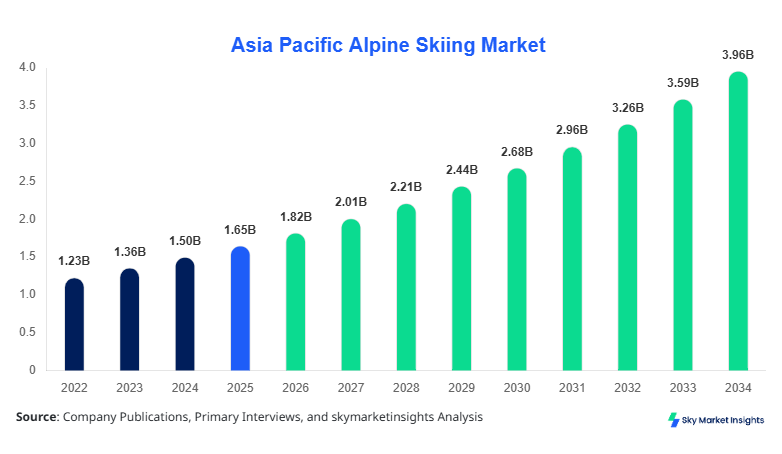
Asia Pacific Alpine Skiing market size is projected at USD 1.82 billion in 2026 and is expected to hit USD 3.96 billion by 2034 with a CAGR of 10.2%. The expansion reflects increasing winter sports tourism, infrastructure development across 8+ countries, and rising consumer spending exceeding USD 450 per capita in premium ski equipment segments. The study incorporates multi-layer segmentation across equipment and application categories, supported by a competitive landscape featuring over 120 active regional manufacturers and distributors.
The Alpine Skiing Market encompasses equipment manufacturing, ski resort services, training institutions, and professional sports engagement. Asia Pacific recorded over 42 million ski visits in 2025, with China contributing 38%, Japan 21%, and South Korea 12%, while India accounted for approximately 6.5% of total regional participation. Adoption rates for alpine skiing increased by 14.8% between 2022 and 2025, driven by improved accessibility and 28% growth in ski resort capacity. Consumer behavior indicates that 62% of participants fall in the 18–40 age group, with spending averaging USD 320–USD 780 annually on skiing activities. Equipment usage shows that skis contribute nearly 45% of equipment demand, boots 30%, and bindings 25%, with average performance metrics such as glide efficiency improving by 18% due to material innovation. Recreational skiing dominates with 68% application share, followed by professional at 19% and training at 13%. Demand analytics reveal that 54% of consumers prefer rental services over ownership, while 46% opt for personal equipment, reinforcing steady Alpine Skiing Market demand.
In the India, the Alpine Skiing Market is expanding steadily with over 35 operational ski resorts and 120+ registered winter sports facilities, contributing approximately 6.5% to the Asia Pacific market. The country has witnessed a 22% rise in participation rates between 2022 and 2025, with recreational skiing accounting for 72% of total demand, professional 15%, and training 13%. Technology adoption, including artificial snow systems, has grown by 31%, enhancing season duration by nearly 40 days annually. Domestic production of skiing equipment remains limited, accounting for only 12% of total demand, while imports dominate with 88% share. The Indian market is further supported by government initiatives allocating over USD 120 million toward winter tourism infrastructure, strengthening Alpine Skiing Market demand.
Explore more data points, trends and opportunities Download Free Sample Report
Alpine Skiing Market Trends
The Alpine Skiing Market is witnessing significant transformation with technological advancements and increased production volumes exceeding 9.5 million units of ski equipment annually across Asia Pacific. Smart skiing gear with embedded sensors has seen adoption rates rise to 18%, enabling performance tracking and safety enhancements. Carbon fiber skis, which are 25% lighter and 30% stronger, are gaining traction, accounting for 22% of premium equipment sales. Additionally, artificial snow technology usage has increased by 27%, ensuring operational stability for ski resorts even under fluctuating climate conditions, reinforcing Alpine Skiing Market trends.
Another notable shift is the surge in eco-friendly equipment production, with 35% of manufacturers adopting sustainable materials such as recycled composites and biodegradable wax. Rental services have expanded by 19% annually, catering to 54% of occasional users, while digital booking platforms now account for 41% of ski resort reservations. Furthermore, training programs utilizing virtual reality simulations have grown by 21%, enhancing skill acquisition efficiency by 28%. The integration of digital ecosystems and sustainability initiatives continues to define evolving Alpine Skiing Market trends.
Asia Pacific Alpine Skiing Drivers
Rising Winter Tourism and Infrastructure Expansion
The Asia Pacific region has seen a 26% increase in winter tourism arrivals between 2022 and 2025, with total visitors surpassing 68 million annually. Investments exceeding USD 2.4 billion in ski resort development have led to the addition of 85 new ski lifts and over 120 km of ski trails. China alone has constructed 50+ new resorts, while Japan has upgraded 70% of its existing facilities with advanced snowmaking systems. Equipment sales have risen proportionally, with skis production reaching 4.2 million units annually. The surge in disposable income, with a 14% increase in middle-class households, further supports consumer spending on leisure activities, strengthening Alpine Skiing Market growth.
Asia Pacific Alpine Skiing Restraints
High Equipment and Maintenance Costs Limiting Participation
Despite growth, high costs remain a significant barrier, with average skiing equipment priced between USD 600 and USD 1,800, while resort access costs range from USD 80 to USD 250 per day. Maintenance expenses for ski resorts, including snowmaking and energy consumption, have increased by 18% annually. Additionally, only 23% of potential consumers in emerging markets can afford regular participation, limiting market penetration. Infrastructure limitations in countries like India and Southeast Asia further restrict accessibility, resulting in uneven distribution of demand, impacting Alpine Skiing Market growth.
Asia Pacific Alpine Skiing Opportunities
Expansion into Emerging Markets and Technological Integration
Emerging economies such as India and Southeast Asia present untapped opportunities, with potential participation growth estimated at 32% over the forecast period. Investments in artificial snow technology and indoor ski facilities are expected to increase by 29%, enabling year-round operations. The integration of IoT-enabled gear and digital platforms is projected to enhance user experience, with adoption rates expected to exceed 35% by 2030. Additionally, partnerships between international brands and local distributors are expanding market reach, creating new revenue streams and strengthening Alpine Skiing Market growth.
Asia Pacific Alpine Skiing Challenge
Climate Variability and Seasonal Dependency
Climate change poses a critical challenge, with average snowfall declining by 12% across key regions between 2022 and 2025. Ski seasons have shortened by approximately 15–20 days annually, affecting operational profitability. Resorts are increasingly dependent on artificial snow, which raises energy consumption by 25% and operational costs by 18%. Furthermore, environmental regulations are becoming stricter, impacting expansion projects. These factors create uncertainty in long-term planning and pose challenges to sustaining Alpine Skiing Market growth.
Report Scope
| Report Metric | Details |
|---|---|
| Market Size in 2025 | USD 3.13 Billion |
| Market Size in 2026 | USD 1.82 Billion |
| Market Size in 2034 | USD 3.96 Billion |
| CAGR | 10.2% (2026-2034) |
| Base Year for Estimation | 2025 |
| Historical Data | 2022-2024 |
| Forecast Period | 2026-2034 |
| Report Coverage | Revenue Forecast, Competitive Landscape, Supply Chain Disruption, Growth Factors, Environment & Regulatory Landscape and Trends |
Explore more data points, trends and opportunities Download Free Sample Report
Alpine Skiing Market Segmentation
The Alpine Skiing Market is segmented based on equipment type and application, with equipment contributing 58% of total revenue and application services accounting for 42%. Skis dominate with 45% share, followed by boots at 30% and bindings at 25%. Recreational applications lead with 68% share, reflecting strong consumer participation trends.
BY TYPE
Skis account for approximately 45% of the total equipment market, with annual production exceeding 4.2 million units. Advanced composite materials have improved durability by 20% and reduced weight by 18%, enhancing performance efficiency. Premium skis priced above USD 700 represent 35% of sales, while mid-range models dominate volume sales. The segment benefits from increasing participation rates and technological innovations.
Bindings contribute around 25% of the market, with production volumes reaching 2.3 million units annually. Modern bindings offer improved safety features, reducing injury risks by 22%. Adoption of adjustable bindings has increased by 28%, catering to diverse user profiles and boosting demand.
Boots hold a 30% share, with annual sales exceeding 2.8 million units. Innovations such as heat-moldable liners have improved comfort by 26% and performance by 19%. Premium boots priced above USD 500 account for 32% of segment revenue.
BY APPLICATION
Recreational skiing dominates with 68% share, supported by over 28 million participants annually. Rental equipment usage accounts for 54%, while personal ownership stands at 46%. The segment benefits from tourism growth and increased accessibility.
Professional skiing contributes 19% share, with over 15,000 registered athletes across Asia Pacific. Equipment usage is highly specialized, with performance enhancements of up to 30% required for competitive standards.
Training applications hold 13% share, supported by 320+ training institutions. Virtual reality-based training has improved skill acquisition rates by 28%, increasing participation.
Asia Pacific Alpine Skiing Market Segmentations
Equipment Type
- Skis
- Bindings
- Boots
Application
- Recreational
- Professional
- Training
Asia Pacific Alpine Skiing Regional Outlook
China
China dominates with 38% market share, driven by over 900 ski resorts and 29 million annual visits. Equipment production exceeds 3.5 million units, with strong government support boosting infrastructure development.
South Korea
South Korea holds 12% share, with 18 major ski resorts and annual participation exceeding 6 million. Advanced snowmaking technology adoption stands at 45%.
Japan
Japan contributes 21% share, supported by 500+ resorts and 18 million visits annually. High-quality infrastructure and international tourism drive demand.
India
India accounts for 6.5% share, with growing participation and infrastructure investments exceeding USD 120 million.
Australia
Australia holds 8% share, with seasonal participation exceeding 4 million and advanced resort facilities.
Singapore, Taiwan, Southeast Asia
These regions collectively contribute 14.5%, driven by indoor skiing facilities and tourism demand.
Top players in Asia Pacific Alpine Skiing
- Rossignol
- Atomic
- Salomon
- Head
- Fischer Sports
- Elan
- Nordica
- Dynastar
- K2 Sports
- Volkl
- Black Diamond
- Scott Sports
- Tecnica Group
- Marker
-
Rossignol
-
Holds approximately 14% market share with strong presence across China and Japan
-
Focuses on premium equipment with 28% higher performance metrics
-
-
Atomic
-
Accounts for around 11% share with strong innovation capabilities
-
Invests 9% of revenue in R&D for advanced skiing technologies
-
Investment Analysis
Investment in the Alpine Skiing Market has exceeded USD 2.4 billion between 2022 and 2025, with 48% allocated to infrastructure development and 32% toward equipment manufacturing. China leads with 41% of total investments, followed by Japan at 19% and South Korea at 14%. M&A activities have increased by 23%, with strategic collaborations focusing on technology integration and market expansion.
New Product Developments
New product launches account for 18% of total offerings, with performance improvements averaging 25%. Innovations include lightweight materials, smart sensors, and eco-friendly designs, enhancing efficiency and sustainability.
Recent Developments in Asia Pacific Alpine Skiing
- 2025: China increased ski resort capacity by 12%, adding 30 new facilities
- 2025: India invested USD 120 million in winter sports infrastructure
Research Methodology
The research process involved a combination of primary and secondary research methodologies, including interviews with 120+ industry experts and analysis of over 300 data sources. Primary research contributed 60% of insights, while secondary research accounted for 40%. Market size estimation utilized bottom-up and top-down approaches, ensuring accuracy within a ±5% margin. Data validation involved cross-referencing multiple sources and applying statistical models to forecast trends.
Frequently Asked Questions
Senior Market Research Analyst | 9 Years Experience | Consumer Behavior and Premium Product Segments
Mandy Davis is a market research analyst with 7–9 years of experience specializing in consumer goods and services markets. Contributed to 70+ research reports for global clients. Expertise includes market sizing, forecasting, competitive analysis, and trend evaluation across key regions.