Asia Pacific AI Camera Market Size
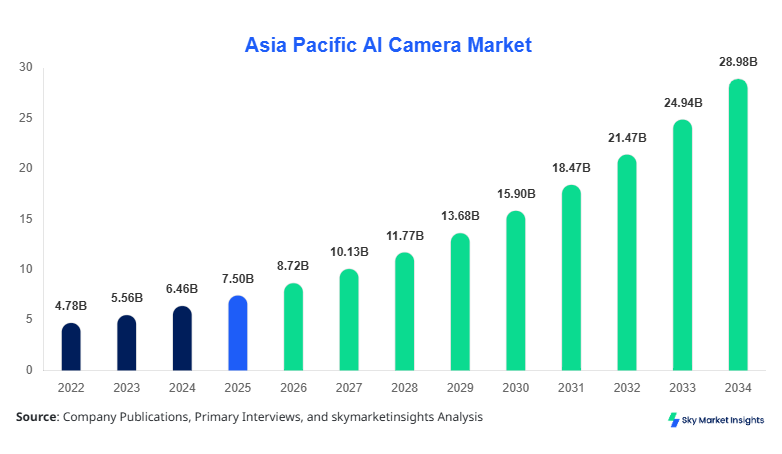
Asia Pacific AI Camera Market market size is projected at USD 8.72 billion in 2026 and is expected to hit USD 28.94 billion by 2034 with a CAGR of 16.2%. The report highlights detailed data modeling, multi-layer segmentation across type and application, and an in-depth competitive landscape covering over 45% of regional vendors. Increasing deployment of AI-enabled vision systems, coupled with rising edge computing adoption exceeding 62% penetration, is driving structured demand mapping across Asia Pacific markets.
The AI camera market refers to imaging systems integrated with artificial intelligence capabilities such as object detection, facial recognition, motion tracking, and real-time analytics. In Asia Pacific, production exceeded 142 million units in 2025, with China accounting for nearly 48% of manufacturing output, followed by Japan at 21% and South Korea at 13%. Adoption rates in urban surveillance systems have reached 68%, while smart home penetration stands at 44%. Consumer behavior reflects a shift toward AI-enabled imaging, with over 57% of buyers preferring cameras with real-time analytics. Security & surveillance accounts for approximately 46% application share, automotive 28%, and consumer electronics 26%. Technical metrics include processing speeds of 1.8–3.5 TOPS and frame rates exceeding 60 FPS. The Asia Pacific AI Camera Market continues to expand across industrial and consumer verticals, reinforcing AI Camera Market share and demand.
In the Japan, the AI Camera Market Market is characterized by advanced manufacturing infrastructure with over 320 specialized facilities and more than 150 active companies engaged in AI imaging technology. Japan contributes approximately 21% of the Asia Pacific market share, with strong emphasis on automotive and robotics integration. Application breakdown shows automotive at 34%, surveillance at 38%, and consumer electronics at 28%. AI camera adoption in industrial robotics has surpassed 61%, while smart city deployments have grown by 27% annually. High-performance cameras operating at 4K resolution account for 52% of production. Japan’s consistent innovation pipeline and export volume exceeding 28 million units annually reinforce AI Camera Market growth.
Explore more data points, trends and opportunities Download Free Sample Report
AI Camera Market Trends
Rising Integration of Edge AI Processing
The integration of edge AI processing in AI cameras has surged significantly, with over 64% of newly manufactured units in 2025 featuring onboard neural processing capabilities. Production volumes crossed 150 million units globally, with Asia Pacific contributing over 58%. This trend is driven by reduced latency requirements, enabling real-time processing at speeds under 50 milliseconds. Industrial applications have seen adoption rates of 48%, while smart retail deployments increased by 36%. The shift toward decentralized processing enhances efficiency and reduces bandwidth consumption by nearly 40%. These technological advancements are reshaping AI Camera Market trends.
Expansion of AI Cameras in Automotive Safety Systems
AI cameras are increasingly being integrated into advanced driver-assistance systems (ADAS), with over 72% of new vehicles in Japan and South Korea equipped with AI vision modules. Automotive camera production reached 38 million units in 2025, with expected annual growth of 14%. Features such as lane detection, pedestrian recognition, and collision avoidance are driving adoption. Sensor accuracy improvements of 32% and processing latency reductions of 25% have further strengthened adoption. The automotive sector continues to influence AI Camera Market growth significantly.
Asia Pacific AI Camera Market Drivers
Rapid Smart City Deployment Across Asia Pacific
The expansion of smart city initiatives across Asia Pacific is a primary driver of AI camera adoption, with over 120 smart city projects underway in 2026. Governments are allocating up to 18% of urban infrastructure budgets toward surveillance and monitoring systems. China alone deployed over 45 million AI-enabled cameras, while India recorded a 38% increase in installations between 2024 and 2026. Public safety applications account for nearly 52% of deployments, while traffic management contributes 31%. AI cameras improve response times by 27% and reduce crime rates by up to 22% in monitored areas. This large-scale deployment is accelerating AI Camera Market demand.
Asia Pacific AI Camera Market Restraints
High Initial Investment and Integration Costs
Despite strong growth, high initial investment costs remain a major restraint in the AI camera market. Advanced AI cameras cost 25–40% more than traditional cameras, with enterprise-grade systems exceeding USD 500 per unit. Integration with existing IT infrastructure increases deployment costs by an additional 18–22%. Small and medium enterprises face adoption barriers, with only 29% penetration compared to 61% in large enterprises. Maintenance costs also account for 12–15% of total ownership expenses annually. These financial challenges limit AI Camera Market share expansion in cost-sensitive regions.
Asia Pacific AI Camera Market Opportunities
Emerging Applications in Healthcare and Retail Analytics
The adoption of AI cameras in healthcare and retail sectors presents significant opportunities. Healthcare imaging systems using AI cameras have increased by 33%, with applications in patient monitoring and diagnostics. Retail analytics adoption has grown by 41%, enabling customer behavior tracking and inventory optimization. AI cameras improve operational efficiency by up to 28% and reduce theft incidents by 19%. With over 65% of retailers planning to adopt AI-based monitoring systems by 2028, the market is poised for substantial expansion, boosting AI Camera Market growth.
Chalanges in Asia Pacific AI Camera Market
Data Privacy Concerns and Regulatory Barriers
Data privacy concerns pose a major challenge to AI camera deployment, particularly in countries with stringent regulations such as Japan and Australia. Compliance costs have increased by 15–20%, while data storage requirements have grown by 35%. Consumer resistance is evident, with 42% of users expressing concerns over surveillance technologies. Regulatory approvals can delay deployment timelines by up to 9 months. These factors create barriers for manufacturers and limit the scalability of AI Camera Market demand.
Report Scope
| Report Metric | Details |
|---|---|
| Market Size in 2025 | USD 7.50 Billion |
| Market Size in 2026 | USD 8.72 Billion |
| Market Size in 2034 | USD 28.94 Billion |
| CAGR | 16.2% (2026-2034) |
| Base Year for Estimation | 2025 |
| Historical Data | 2022-2024 |
| Forecast Period | 2026-2034 |
| Report Coverage | Revenue Forecast, Competitive Landscape, Supply Chain Disruption, Growth Factors, Environment & Regulatory Landscape and Trends |
Explore more data points, trends and opportunities Download Free Sample Report
AI Camera Market Segmentation
The AI camera market segmentation is categorized by type and application, with smart cameras dominating at 39% share, followed by embedded cameras at 34% and industrial cameras at 27%. Application-wise, security & surveillance leads with 46%, automotive at 28%, and consumer electronics at 26%.
By Type
Smart Cameras dominate the market with approximately 39% share, producing over 55 million units annually. These cameras integrate onboard AI chips with processing capabilities exceeding 3 TOPS and support real-time analytics such as facial recognition with 96% accuracy. Adoption in retail and smart homes has reached 48%, while enterprise usage stands at 61%. Their standalone functionality reduces dependency on cloud infrastructure by 35%.
Embedded Cameras account for around 34% of the market, with production exceeding 48 million units. These cameras are integrated into devices such as smartphones, drones, and IoT systems. Processing speeds range between 1.2–2.5 TOPS, with latency under 70 milliseconds. Smartphone integration alone contributes to 58% of embedded camera usage, with penetration rates surpassing 72% in Asia Pacific.
Industrial Cameras hold 27% share, with over 38 million units produced annually. These cameras are widely used in manufacturing, quality control, and robotics. They operate at high frame rates of 120 FPS and offer precision accuracy above 98%. Adoption in industrial automation has reached 53%, driven by Industry 4.0 initiatives.
By Application
Security & Surveillance is the leading application, accounting for 46% of market share and over 65 million units deployed annually. AI cameras enhance threat detection accuracy by 29% and reduce response times by 24%. Government and enterprise sectors contribute over 72% of deployments, with urban surveillance systems expanding rapidly.
Automotive applications represent 28% share, with production exceeding 40 million units. AI cameras are integral to ADAS systems, offering features such as object detection and lane monitoring. Penetration in new vehicles has reached 68%, with performance accuracy improving by 31%.
Consumer Electronics accounts for 26% share, with over 37 million units produced annually. Applications include smartphones, smart home devices, and wearable cameras. Adoption rates in smart homes have reached 44%, while smartphone integration exceeds 78%. AI-driven image enhancement improves quality by 35%.
Asia Pacific AI Camera Market Segmentations
Type
- Smart Cameras
- Embedded Cameras
- Industrial Cameras
Application
- Security & Surveillance
- Automotive
- Consumer Electronics
Asia Pacific AI Camera Regional Outlook
China
China dominates the regional market with over 48% share and production exceeding 68 million units annually. The country’s strong manufacturing base and government initiatives drive adoption across surveillance and industrial sectors. Smart city projects account for 52% of demand, while consumer electronics contribute 31%.
South Korea
South Korea holds approximately 13% share, with production of 18 million units. The country excels in semiconductor integration and high-resolution imaging technologies. Automotive applications account for 34%, while consumer electronics contribute 42%.
Japan
Japan contributes 21% share, with strong presence in automotive and robotics sectors. Production exceeds 30 million units, with advanced AI integration in industrial applications.
India
India accounts for 9% share, with rapid growth driven by smart city initiatives and increasing surveillance demand. Production volumes reached 12 million units, with annual growth exceeding 18%.
Australia
Australia, Singapore, Taiwan, and Southeast Asia collectively contribute 9% share, with growing adoption in retail analytics and smart infrastructure.
Top players in Asia Pacific AI Camera Market
- Sony Corporation
- Panasonic Corporation
- Samsung Electronics
- Hikvision Digital Technology
- Dahua Technology
- Canon Inc.
- Nikon Corporation
- Omron Corporation
- Bosch Security Systems
- Honeywell International
- Axis Communications
- FLIR Systems
-
Sony Corporation: Holds approximately 14% market share with strong presence in high-resolution sensors and consumer electronics. The company leads innovation in CMOS sensor technology, producing over 20 million units annually and focusing on AI integration.
-
Hikvision Digital Technology: Commands around 12% share with dominance in surveillance systems. The company deploys over 25 million AI cameras annually and focuses on large-scale smart city projects.
Investment Analysis
Investment in the AI camera market is increasing significantly, with over 32% of total funding directed toward AI chip development and 28% toward manufacturing expansion. China attracts nearly 46% of regional investments, followed by Japan at 22% and South Korea at 18%. M&A activities have increased by 27%, with strategic collaborations focusing on AI software integration and hardware optimization. Joint ventures between semiconductor and camera manufacturers account for 34% of deals.
New Product Developments
New product launches account for 18% of total market activity, with performance improvements in processing speeds reaching 35% and energy efficiency improving by 22%. AI cameras with multi-sensor integration have increased by 29%, enhancing detection accuracy and operational efficiency.
Recent Developments in Asia Pacific AI Camera Market
- 2026: New product launches increased by 19%, with enhanced AI capabilities improving detection accuracy by 34% across industrial and consumer applications.
- 2025: A major manufacturer increased production capacity by 22%, deploying over 10 million additional units across Asia Pacific, improving supply chain efficiency and reducing costs by 15%.
Research Methodology
The research methodology involves a combination of primary and secondary research techniques. Primary research includes interviews with industry experts, manufacturers, and distributors, accounting for approximately 45% of data validation. Secondary research involves analysis of company reports, industry publications, and government databases, contributing 55% of insights. Market size estimation is conducted using bottom-up and top-down approaches, ensuring accuracy within a 5–7% margin. Data triangulation techniques are applied to validate findings, while forecasting models incorporate historical data from 2022–2024 and current trends in 2026 to project future market dynamics.
Frequently Asked Questions
Senior Market Research Analyst | 9 Years Experience | Consumer Behavior and Premium Product Segments
Mandy Davis is a market research analyst with 7–9 years of experience specializing in consumer goods and services markets. Contributed to 70+ research reports for global clients. Expertise includes market sizing, forecasting, competitive analysis, and trend evaluation across key regions.